

上海交通大学学报 ›› 2025, Vol. 59 ›› Issue (11): 1720-1731.doi: 10.16183/j.cnki.jsjtu.2023.629
韩一鸣, 贺彬, 杨博( ), 李嘉乐
收稿日期:2023-12-15
修回日期:2024-01-12
接受日期:2024-03-05
出版日期:2025-11-28
发布日期:2025-12-02
通讯作者:
杨博
E-mail:yangbo_ac@outlook.com
作者简介:韩一鸣(1993—),讲师,研究方向为人工智能在电力系统中的应用.
基金资助:
HAN Yiming, HE Bin, YANG Bo(), LI Jiale
Received:2023-12-15
Revised:2024-01-12
Accepted:2024-03-05
Online:2025-11-28
Published:2025-12-02
Contact:
YANG Bo
E-mail:yangbo_ac@outlook.com
摘要:
随着国内电动汽车保有量的不断提升,为了满足电动汽车日益增长的充电需求,电动汽车充电站(EVCS)开始大量接入配电网,给配电网的稳定性、安全性和经济性带来前所未有的挑战.为了缓解EVCS带来配电网冲击的同时保证投资者和电动汽车用户的利益,提出一种考虑电动汽车用户行为特性的EVCS联合电池储能系统(BESS)的多目标规划模型.该模型以最小化EVCS和BESS综合成本、用户等待时间和系统电压波动为目标,通过规划EVCS及BESS实现经济性与稳定性的最佳权衡;并采用非支配排序遗传算法(NSGA-III)分别在扩展的IEEE-33节点测试系统与昆明市呈贡区大学城上进行验证.仿真结果表明:在IEEE-33节点测试系统,与未配置BESS时相比,电压波动与系统网损分别下降36.73%和35.41%,有效提高了配网的稳定性与经济性.
中图分类号:
韩一鸣, 贺彬, 杨博, 李嘉乐. 考虑行驶特性的电动汽车充电站联合电储能系统最优规划[J]. 上海交通大学学报, 2025, 59(11): 1720-1731.
HAN Yiming, HE Bin, YANG Bo, LI Jiale. Optimal Planning of Electric Vehicle Charging Stations Combined with Battery Energy Storage Systems Considering Driving Characteristics[J]. Journal of Shanghai Jiao Tong University, 2025, 59(11): 1720-1731.

图1
整体研究框架


图2
日行驶里程概率分布


图3
起始行驶时刻概率分布


图4
起始SOC概率


图5
充电需求计算流程


图6
充电桩排队模型


图7
基于NSGA-III-IGTDM EVCS联合BESS选址定容模型流程图


图8
拓展的IEEE-33测试节点

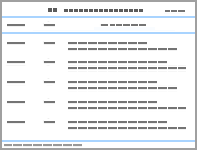
表1
拓展IEEE-33下各算法目标函数优化结果
| 优化策略 | 成本/万元 | 系统网损/ (MW·h) | 电压波动 标幺值 |
|---|---|---|---|
| 初始状态 | 0.920 | 0.330 | |
| NSGA-III(无BESSs) | 3.722 | 0.569 | |
| NSGA-III | 1115.800 | 2.404 | 0.360 |
| MOTEO | 1282.264 | 3.229 | 0.434 |
| MOMA | 1059.716 | 2.919 | 0.444 |
| MOPSO | 611.643 | 2.973 | 0.498 |

图9
拓展IEEE-33测试节点下各算法电压波动


图10
规划区域配电网图


图11
规划区域配电网拓扑结构图


图12
规划区域分区图


图13
1 d 内各时间段充电需求量

表2
各算法目标函数的优化结果
| 优化策略 | 成本/万元 | 等待时间/h | 电压波动 标幺值 |
|---|---|---|---|
| 初始状态 | 0.306 | ||
| NSGA-III(无BESSs) | 0.729 | ||
| NSGA-III | 4596.216 | 0.297 | 0.375 |
| MOTEO | 4428.101 | 0.548 | 0.538 |
| MOMA | 4620.419 | 0.498 | 0.589 |
| MOPSO | 3705.245 | 0.603 | 0.825 |

图14
各算法电压波动


图15
EVCS联合BESS规划位置图

| [1] | 王育飞, 刘德宾, 薛花, 等. 耦合氢能的光储充电站多目标优化配置策略[J]. 电力自动化设备, 2023, 43(12): 101-108. |
| WANG Yufei, LIU Debin, XUE Hua, et al. Multi-objective optimal configuration strategy of photovoltaic-energy storage charging station coupled with hydrogen energy[J]. Electric Power Automation Equipment, 2023, 43(12): 101-108. | |
| [2] |
付卓铭, 胡俊杰, 马文帅, 等. 规模化电动汽车参与电力系统二次调频研究综述[J]. 电力建设, 2023, 44(2): 1-14.
doi: 10.12204/j.issn.1000-7229.2023.02.001 |
|
FU Zhuoming, HU Junjie, MA Wenshuai, et al. Review of research on participation of numerous electric vehicles in power system secondary frequency-regulation service[J]. Electric Power Construction, 2023, 44(2): 1-14.
doi: 10.12204/j.issn.1000-7229.2023.02.001 |
|
| [3] |
李玲, 曹锦业, TOMIN Nikita, 等. 计及电动汽车接入的区域综合能源系统双层日前协调优化调度[J]. 电力建设, 2023, 44(5): 23-33.
doi: 10.12204/j.issn.1000-7229.2023.05.003 |
|
LI Ling, CAO Jinye, TOMIN Nikita, et al. Bi-level coordinated day-ahead optimal dispatch of regional integrated energy system considering the integrations of electric vehicles[J]. Electric Power Construction, 2023, 44(5): 23-33.
doi: 10.12204/j.issn.1000-7229.2023.05.003 |
|
| [4] | 杨子昊, 娄柯, 蒋卓伟. 考虑需求响应的微电网优化调度[J]. 昆明理工大学学报(自然科学版), 2023, 48(4): 74-86. |
| YANG Zihao, LOU Ke, JIANG Zhuowei. Optimal scheduling of microgrid considering demand response[J]. Journal of Kunming University of Science & Technology (Natural Sciences), 2023, 48(4): 74-86. | |
| [5] | 刘东奇, 张曦, 钱奕衡. 电动汽车集群充放电演化博弈协同策略[J]. 电力系统保护与控制, 2023, 51(16): 84-93. |
| LIU Dongqi, ZHANG Xi, QIAN Yiheng. Evolutionary game coordination strategy of electric vehicle cluster charging and discharging[J]. Power System Protection & Control, 2023, 51(16): 84-93. | |
| [6] |
YANG B, LI J L, SHU H C, et al. Recent advances of optimal sizing and location of charging stations: A critical overview[J]. International Journal of Energy Research, 2022, 46(13): 17899-17925.
doi: 10.1002/er.v46.13 URL |
| [7] | 张美霞, 张倩倩, 杨秀, 等. 基于交通-电力均衡耦合的电动汽车快充站与配电网联合规划[J]. 电力系统保护与控制, 2023, 51(11): 51-63. |
| ZHANG Meixia, ZHANG Qianqian, YANG Xiu, et al. Joint planning of electric vehicle fast charging stations and distribution network based on a traffic-electricity equilibrium coupling model[J]. Power System Protection & Control, 2023, 51(11): 51-63. | |
| [8] | 王华莹, 李勇, 朱辉, 等. 考虑配电网负荷的电动汽车充电站规划[J]. 电力系统及其自动化学报, 2022, 34(11): 134-141. |
| WANG Huaying, LI Yong, ZHU Hui, et al. Planning of electric vehicle charging stations considering distribution network load[J]. Proceedings of the CSU-EPSA, 2022, 34(11): 134-141. | |
| [9] |
ZHANG H C, MOURA S J, HU Z C, et al. PEV fast-charging station siting and sizing on coupled transportation and power networks[J]. IEEE Transactions on Smart Grid, 2018, 9(4): 2595-2605.
doi: 10.1109/TSG.2016.2614939 URL |
| [10] | 左逸凡, 李伟豪, 杨伟. 考虑充电负荷时空分布特性的EV充电站规划[J]. 电测与仪表, 2025, 62(3): 1-9. |
| ZUO Yifan, LI Weihao, YANG Wei. EV charging station planning considering space-time distribution characteristics of charging load[J]. Electrical Measurement & Instrumentation, 2025, 62(3): 1-9. | |
| [11] | 侯慧, 唐俊一, 王逸凡, 等. 城区电动汽车充电站布局规划研究[J]. 电力系统保护与控制, 2022, 50(14): 181-187. |
| HOU Hui, TANG Junyi, WANG Yifan, et al. Layout planning of electric vehicle charging stations in urban areas[J]. Power System Protection & Control, 2022, 50(14): 181-187. | |
| [12] | 景小敏, 邢洁, 郭建豪, 等. 基于多目标优化的电动汽车充电站规划研究[J]. 电气应用, 2022, 41(6): 55-62. |
| JING Xiaomin, XING Jie, GUO Jianhao, et al. Research on electric vehicle charging station planning based on multi-objective optimization[J]. Application Research, 2022, 41(6): 55-62. | |
| [13] | 张美霞, 徐立成, 杨秀, 等. 基于电动汽车充电需求时空分布特性的充电站规划研究[J]. 电网技术, 2023, 47(1): 256-265. |
| ZHANG Meixia, XU Licheng, YANG Xiu, et al. Planning of charging stations based on spatial and temporal distribution characteristics of electric vehicle charging demand[J]. Power System Technology, 2023, 47(1): 256-265. | |
| [14] |
LIU J P, ZHANG T X, ZHU J, et al. Allocation optimization of electric vehicle charging station (EVCS) considering with charging satisfaction and distributed renewables integration[J]. Energy, 2018, 164: 560-574.
doi: 10.1016/j.energy.2018.09.028 URL |
| [15] | 曹佳佳, 王淳, 霍崇辉, 等. 考虑配电网负荷波动和电压偏移的充电站优化规划[J]. 电力科学与技术学报, 2021, 36(4): 12-19. |
| CAO Jiajia, WANG Chun, HUO Chonghui, et al. Optimal planning of electric vehicle charging stations considering the load fluctuation and voltage offset of distribution network[J]. Journal of Electric Power Science & Technology, 2021, 36(4): 12-19. | |
| [16] | MOSTAPHA K H. NSGA-III:Non-dominated sorting genetic algorithm, the third version—MATLAB implementation[EB/OL].(2020-12-12)[2023-12-03]. https://yarpiz.com/456/ypea126-nsga3. |
| [17] | GUO C X, LIU D Y, GENG W, et al. Modeling and analysis of electric vehicle charging load in residential area[C]// 2019 4th International Conference on Power and Renewable Energy. Chengdu, China: IEEE, 2019: 394-402. |
| [18] | GAO Q, ZHU T, ZHOU W J, et al.Charging load forecasting of electric vehicle based on Monte Carlo and deep learning[C]//2019 IEEE Sustainable Power and Energy Conference (iSPEC). Beijing, China: IEEE, 2019: 1309-1314. |
| [19] |
YANG J, DONG J, HU L. A data-driven optimization-based approach for siting and sizing of electric taxi charging stations[J]. Transportation Research Part C: Emerging Technologies, 2017, 77: 462-477.
doi: 10.1016/j.trc.2017.02.014 URL |
| [20] |
XIAO D, AN S, CAI H, et al. An optimization model for electric vehicle charging infrastructure planning considering queuing behavior with finite queue length[J]. Journal of Energy Storage, 2020, 29: 101317.
doi: 10.1016/j.est.2020.101317 URL |
| [21] |
WANG H, ZHAO D, CAI Y T, et al. Taxi trajectory data based fast-charging facility planning for urban electric taxi systems[J]. Applied Energy, 2021, 286: 116515.
doi: 10.1016/j.apenergy.2021.116515 URL |
| [22] |
LI J L, YANG B, HUANG J X, et al. Optimal planning of electricity-hydrogen hybrid energy storage system considering demand response in active distribution network[J]. Energy, 2023, 273: 127142.
doi: 10.1016/j.energy.2023.127142 URL |
| [23] | YANG Y Q, BREMNER S, MENICTAS C, et al. Modelling and optimal energy management for battery energy storage systems in renewable energy systems: A review[J]. Renewable & Sustainable Energy Reviews, 2022, 167: 112671. |
| [24] |
CONG T N. Progress in electrical energy storage system: A critical review[J]. Progress in Natural Science, 2009, 19(3): 291-312.
doi: 10.1016/j.pnsc.2008.07.014 URL |
| [25] |
LIU J, CAO S L, CHEN X, et al. Energy planning of renewable applications in high-rise residential buildings integrating battery and hydrogen vehicle storage[J]. Applied Energy, 2021, 281: 116038.
doi: 10.1016/j.apenergy.2020.116038 URL |
| [26] |
HARVEY L D D. Clarifications of and improvements to the equations used to calculate the levelized cost of electricity (LCOE), and comments on the weighted average cost of capital (WACC)[J]. Energy, 2020, 207: 118340.
doi: 10.1016/j.energy.2020.118340 URL |
| [27] | 薛金花, 叶季蕾, 陶琼, 等. 采用全寿命周期成本模型的用户侧电池储能经济可行性研究[J]. 电网技术, 2016, 40(8): 2471-2476. |
| XUE Jinhua, YE Jilei, TAO Qiong, et al. Economic feasibility of user-side battery energy storage based on whole-life-cycle cost model[J]. Power System Technology, 2016, 40(8): 2471-2476. | |
| [28] | CUI Z H, CHANG Y, ZHANG J J, et al. Improved NSGA-III with selection-and-elimination operator[J]. Swarm & Evolutionary Computation, 2019, 49: 23-33. |
| [29] |
DEB K, JAIN H. An evolutionary many-objective optimization algorithm using reference-point-based nondominated sorting approach, part I: Solving problems with box constraints[J]. IEEE Transactions on Evolutionary Computation, 2014, 18(4): 577-601.
doi: 10.1109/TEVC.2013.2281535 URL |
| [30] | 姜惠兰, 安星, 王亚微, 等. 基于改进NSGA2算法的考虑风机接入电能质量的多目标电网规划[J]. 中国电机工程学报, 2015, 35(21): 5405-5411. |
| JIANG Huilan, AN Xing, WANG Yawei, et al. Improved NSGA2 algorithm based multi-objective planning of power grid with wind farm considering power quality[J]. Proceedings of the CSEE, 2015, 35(21): 5405-5411. | |
| [31] | 李嘉乐, 杨博, 胡袁炜骥, 等. 考虑需求侧响应的电-氢混合储能系统选址定容[J]. 电网技术, 2023, 47(9): 3698-3709. |
| LI Jiale, YANG Bo, HU Yuanweiji, et al. Location and capacity planning of electricity hydrogen hybrid energy storage system considering demand response[J]. Power System Technology, 2023, 47(9): 3698-3709. |
| [1] | 刘林, 杨丝雨, 黄夏楠, 陈延滔, 徐化帅, 王玲玲, 蒋传文. 数据-模型混合驱动的电动汽车集群行为模拟方法[J]. 上海交通大学学报, 2026, 60(1): 51-60. |
| [2] | 冯梦圆, 文书礼, 时珊珊, 王皓靖, 朱淼, 杨雯. 满足新型电力系统调峰调频需求的储能优化配置及运行研究综述[J]. 上海交通大学学报, 2026, 60(1): 1-18. |
| [3] | 刘永江, 郭杉, 贾俊青, 刘小恺, 蔡文超, 曾龙. 多种充电模式协同的规模化电动汽车分层充电方法[J]. 上海交通大学学报, 2025, 59(9): 1304-1314. |
| [4] | 胡龙, 方八零, 樊飞龙, 陈达伟, 李新喜, 曾润. 用户-基站-充电站能量互动和储能共享优化方法[J]. 上海交通大学学报, 2025, 59(7): 877-888. |
| [5] | . 基于多种影响因素的电动汽车充电负荷建模方法[J]. J Shanghai Jiaotong Univ Sci, 2025, 30(6): 1232-1241. |
| [6] | 魏茂华, 杨苓, 翁亮涛, 杨继沛, 陈泳桥. 考虑容量差异的孤岛直流微网分布式储能单元SOC均衡策略[J]. 上海交通大学学报, 2025, 59(3): 376-387. |
| [7] | 孙欣, 江海林, 谢敬东, 王思敏, 王森. 基于用户信用指数的园区电动汽车充放电调度机制[J]. 上海交通大学学报, 2025, 59(2): 200-207. |
| [8] | 杨欢红, 杨镇瑜, 黄文焘, 柴磊, 王宇轩, 叶婧元. 面向分时跨区削峰填谷的货运铁路储能牵引系统设计与优化[J]. 上海交通大学学报, 2025, 59(12): 1784-1794. |
| [9] | 潘益, 王明深, 缪惠宇, 袁晓冬, 韩华春. 车网互动技术激励机制演化分析[J]. 上海交通大学学报, 2025, 59(11): 1637-1646. |
| [10] | 李建林, 孙浩元, 赵文鼎, 梁策, 梁忠豪, 袁晓冬. 基于变分模态分解-多模糊控制的风电混储系统功率分配策略[J]. 上海交通大学学报, 2025, 59(10): 1498-1509. |
| [11] | 白文超, 班明飞, 宋梦, 夏世威, 李知艺, 宋文龙. 电动汽车-无人机联合救援系统协调调度模型[J]. 上海交通大学学报, 2024, 58(9): 1443-1453. |
| [12] | 陈晖, 何耿生, 刘昱良, 曾红梅, 张世旭, 李姚旺. 考虑热力系统等效储能特性的低碳园区储能容量优化配置[J]. 上海交通大学学报, 2024, 58(6): 863-871. |
| [13] | 邱革非, 冯泽华, 沈赋, 何超, 何虹辉, 刘铠铭. 考虑车网互动的园区电网动态双层能量管理策略[J]. 上海交通大学学报, 2024, 58(6): 916-925. |
| [14] | 孙毅, 葛明洋, 王献春, 鲍荟谕, 杨泓玥, 姚陶. 考虑补偿激励的电动汽车多区域优化调度策略[J]. 上海交通大学学报, 2024, 58(5): 636-646. |
| [15] | 张诚, 琚长江, 熊灿, 杨根科. 基于双级主动式拓扑的锂电池寿命优化[J]. 上海交通大学学报, 2024, 58(5): 719-729. |
| 阅读次数 | ||||||
|
全文 |
|
|||||
|
摘要 |
|
|||||
