

上海交通大学学报 ›› 2025, Vol. 59 ›› Issue (11): 1732-1741.doi: 10.16183/j.cnki.jsjtu.2024.009
叶骏1, 何一冰1, 李先锋1, 严国灿2, 燕磊2( )
)
收稿日期:2024-01-05
修回日期:2024-04-02
接受日期:2024-04-30
出版日期:2025-11-28
发布日期:2025-12-02
通讯作者:
燕磊
E-mail:yan_lei@zju.edu.cn
作者简介:叶 骏(1990—),工程师,从事220 kV及以下变电站二次设计研究.
YE Jun1, HE Yibing1, LI Xianfeng1, YAN Guocan2, YAN Lei2()
Received:2024-01-05
Revised:2024-04-02
Accepted:2024-04-30
Online:2025-11-28
Published:2025-12-02
Contact:
YAN Lei
E-mail:yan_lei@zju.edu.cn
摘要:
为研究城市电力系统电源结构的演化路径,分析城市电力系统各类电源装机容量的影响因素,建立城市电力系统电源结构的系统动力学模型,包括电量平衡、火电发展、分布式光伏发展、集中式风光发展和新能源承载能力模块.在建模过程中,采用符号回归方法准确地设置模型参数,并着重考虑低碳政策对各类电源的影响,以及新能源承载能力对新能源装机容量的反馈作用.通过差异化低碳政策场景仿真,得到未来城市电力系统各类电源装机容量、新能源接入比例和新能源承载能力的变化趋势.仿真结果表明:低碳政策有助于新能源发展和“双碳”目标实现,助力城市能源体系的绿色低碳转型,但过高的政策强度可能导致城市电力系统新能源承载能力不足,引发新能源消纳问题.
中图分类号:
叶骏, 何一冰, 李先锋, 严国灿, 燕磊. 城市电力系统演化路径的系统动力学建模分析[J]. 上海交通大学学报, 2025, 59(11): 1732-1741.
YE Jun, HE Yibing, LI Xianfeng, YAN Guocan, YAN Lei. System Dynamics Modeling Analysis of Urban Power System Evolution Path[J]. Journal of Shanghai Jiao Tong University, 2025, 59(11): 1732-1741.

图1
城市电力系统电源结构演化的因果回路


图2
表达式z=1.3τ0+${e}^{{\tau }_{1}}$的树状结构表示

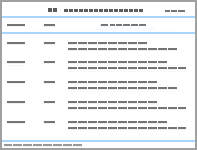
表1
总用电量表达式的符号回归结果
| 表达式 | C | L | S |
|---|---|---|---|
| y=716.3 | 1 | 1.608×10⁴ | 0.0 |
| y=x1-270.9 | 3 | 2955 | 0.8469 |
| y=0.030 61x0+353.4 | 5 | 365.9 | 1.045 |
| y=0.030 61x0+353.4 | 7 | 365.9 | 1.639×10⁻⁵ |
| y=0.032 93x0-0.075 95x1+400.9 | 9 | 353.3 | 0.01746 |
| y=0.032 90x0-0.074 72x1+400.1 | 11 | 353.3 | 6.623×10⁻⁶ |
| y=0.032 90x0-0.075 13x1+400.4 | 15 | 353.3 | 2.105×10⁻⁵ |

图3
总用电量表达式y=0.030 61x0+353.4的拟合精度


图4
系统动力学模型的电量平衡模块


图5
系统动力学模型的火电发展模块


图6
系统动力学模型的分布式光伏发展模块


图7
系统动力学模型的集中式风电发展模块


图8
系统动力学模型的集中式光伏发展模块


图9
系统动力学模型的新能源承载能力模块


图10
不同场景下火电装机容量的仿真结果


图11
不同场景下新能源装机容量的仿真结果


图12
不同场景下新能源接入比例的仿真结果


图13
不同场景下新能源承载能力的仿真结果


图14
基准场景、超低碳场景下新能源上网电量的仿真结果

| [1] | 阮前途, 梅生伟, 黄兴德, 等. 低碳城市电网韧性提升挑战与展望[J]. 中国电机工程学报, 2022, 42(8): 2819-2830. |
| RUAN Qiantu, MEI Shengwei, HUANG Xingde, et al. Challenges and research prospects of resilience enhancement of low-carbon power grid[J]. Proceedings of the CSEE, 2022, 42(8): 2819-2830. | |
| [2] | 钟永光, 贾晓菁, 钱颖, 等. 系统动力学[M]. 2版. 北京: 科学出版社, 2013. |
| ZHONG Yongguang, JIA Xiaojing, QIAN Ying. System dynamics[M]. 2nd ed. Beijing: Science Press, 2013. | |
| [3] | 赵盛楠, 王蓓蓓, 李扬, 等. 基于系统动力学的分布式可再生能源激励机制分析[J]. 电力系统自动化, 2017, 41(24): 97-104. |
| ZHAO Shengnan, WANG Beibei, LI Yang, et al. System dynamics based analysis on incentive mechanism of distributed renewable energy resources[J]. Automation of Electric Power Systems, 2017, 41(24): 97-104. | |
| [4] |
曾博, 穆宏伟, 董厚琦, 等. 考虑5G基站低碳赋能的主动配电网优化运行[J]. 上海交通大学学报, 2022, 56(3): 279-292.
doi: 10.16183/j.cnki.jsjtu.2021.367 |
| ZENG Bo, MU Hongwei, DONG Houqi, et al. Optimization of active distribution network operation considering decarbonization endowment from 5G base stations[J]. Journal of Shanghai Jiao Tong University, 2022, 56(3): 279-292. | |
| [5] |
YU X Y, DONG Z J, ZHOU D Q, et al. Integration of tradable green certificates trading and carbon emissions trading: How will Chinese power industry do?[J]. Journal of Cleaner Production, 2021, 279: 123485.
doi: 10.1016/j.jclepro.2020.123485 URL |
| [6] |
陈文溆乐, 向月, 彭光博, 等. “双碳” 目标下电力系统供给侧形态发展系统动力学建模与分析[J]. 上海交通大学学报, 2021, 55(12): 1567-1576.
doi: 10.16183/j.cnki.jsjtu.2021.294 |
| CHEN Wenxule, XIANG Yue, PENG Guangbo, et al. System dynamic modeling and analysis of power system supply side morphological development with “dual carbon” targets[J]. Journal of Shanghai Jiao Tong University, 2021, 55(12): 1567-1576. | |
| [7] |
TANG L, GUO J, ZHAO B Y, et al. Power generation mix evolution based on rolling horizon optimal approach: A system dynamics analysis[J]. Energy, 2021, 224: 120075.
doi: 10.1016/j.energy.2021.120075 URL |
| [8] | 彭光博, 向月, 陈文溆乐, 等. “双碳” 目标下电力系统风电装机与投资发展动力学推演及分析[J]. 电力自动化设备, 2022, 42(11): 70-77. |
| PENG Guangbo, XIANG Yue, CHEN Wenxule, et al. Kinetic deduction and analysis of installed capacity and investment development for wind power in power system under “dual carbon” target[J]. Electric Power Automation Equipment, 2022, 42(11): 70-77. | |
| [9] |
ZHAO X G, WANG W, WU L. A dynamic analysis of research and development incentive on China’s photovoltaic industry based on system dynamics model[J]. Energy, 2021, 233: 121141.
doi: 10.1016/j.energy.2021.121141 URL |
| [10] | 张汀荟, 谢明成, 王蓓蓓, 等. 分布式光伏的共享价值及其对配电网影响的系统动力学仿真[J]. 电力系统自动化, 2021, 45(18): 35-44. |
| ZHANG Tinghui, XIE Mingcheng, WANG Beibei, et al. System dynamics simulation of shared value of distributed photovoltaic and its impact on distribution network[J]. Automation of Electric Power Systems, 2021, 45(18): 35-44. | |
| [11] |
FU X Q, GUO Q L, SUN H B. Statistical machine learning model for stochastic optimal planning of distribution networks considering a dynamic correlation and dimension reduction[J]. IEEE Transactions on Smart Grid, 2020, 11(4): 2904-2917.
doi: 10.1109/TSG.5165411 URL |
| [12] | ORZECHOWSKI P, LA CAVA W, MOORE J H. Where are we now? A large benchmark study of recent symbolic regression methods[C]// Proceedings of the Genetic and Evolutionary Computation Conference. Kyoto, Japan: ACM, 2018: 1183-1190. |
| [13] |
周雅, 李永平, 黄国和. 深圳市可持续电力规划模型及节能减排分析[J]. 电力建设, 2014, 35(6): 75-80.
doi: 10,3969/j.issn,1000-7229,2014,06,014 |
|
ZHOU Ya, LI Yongping, HUANG Guohe. Sustainable electric power planning model and energy-saving & emission-reduction analysis in Shenzhen[J]. Electric Power Construction, 2014, 35(6): 75-80.
doi: 10,3969/j.issn,1000-7229,2014,06,014 |
|
| [14] |
黄强, 郭怿, 江建华, 等. “双碳” 目标下中国清洁电力发展路径[J]. 上海交通大学学报, 2021, 55(12): 1499-1509.
doi: 10.16183/j.cnki.jsjtu.2021.272 |
| HUANG Qiang, GUO Yi, JIANG Jianhua, et al. Development pathway of China’s clean electricity under carbon peaking and carbon neutrality goals[J]. Journal of Shanghai Jiao Tong University, 2021, 55(12): 1499-1509. | |
| [15] | 鲁宗相, 林弋莎, 乔颖, 等. 极高比例可再生能源电力系统的灵活性供需平衡[J]. 电力系统自动化, 2022, 46(16): 3-16. |
| LU Zongxiang, LIN Yisha, QIAO Ying, et al. Flexibility supply-demand balance in power system with ultra-high proportion of renewable energy[J]. Automation of Electric Power Systems, 2022, 46(16): 3-16. | |
| [16] | CRANMER M. SymbolicRegression. Interpretable machine learning for science with PySR and jl[EB/OL]. (2023-05-02) [2023-11-30]. https://arXiv.org/abs/2305.01582v3. |
| [17] | 刘志强, 赵毅, 潘荔. 中外火电节能减排效率分析与比较[J]. 热力发电, 2021, 50(3): 9-18. |
| LIU Zhiqiang, ZHAO Yi, PAN Li. Analysis and comparison of energy saving efficiency and emission reduction efficiency of thermal power between China and foreign countries[J]. Thermal Power Generation, 2021, 50(3): 9-18. | |
| [18] | IRENA. Renewable power generation costs in 2022[R]. Abu Dhabi, UAE: International Renewable Energy Agency, 2023. |
| [1] | 杜晔1, 赵一飞2, 高德毅1. 基于交通大数据的集装箱码头外集卡作业时长仿真预测[J]. J Shanghai Jiaotong Univ Sci, 2024, 29(5): 801-808. |
| [2] | 李威, 李然, 胡炎, 王曦炜, 熊康. 计及碳成本的区域间电价差与跨区电力交易量评估模型[J]. 上海交通大学学报, 2024, 58(12): 1835-1845. |
| [3] | 张晗, 韩冬, 刘坦, 黄燕. 碳中和背景下分布式光伏渗透与售电市场耦合机制分析[J]. 上海交通大学学报, 2023, 57(4): 464-472. |
| [4] | 陈文溆乐, 向月, 彭光博, 刘友波, 刘俊勇. “双碳”目标下电力系统供给侧形态发展系统动力学建模与分析[J]. 上海交通大学学报, 2021, 55(12): 1567-1576. |
| [5] | 杜晓旭,崔航. 自主水下航行器载荷侧向分离三维运动仿真分析[J]. 上海交通大学学报, 2017, 51(12): 1480-1487. |
| [6] | 杨辉, 陆建飞, 王建华, 张庆华. 黄浦江过江隧道的动力抗震分析[J]. 上海交通大学学报, 2001, 35(10): 1512-1516. |
| 阅读次数 | ||||||
|
全文 |
|
|||||
|
摘要 |
|
|||||
