

上海交通大学学报 ›› 2026, Vol. 60 ›› Issue (3): 418-426.doi: 10.16183/j.cnki.jsjtu.2024.146
李诗杰1,2,3, 刘泰序3, 刘佳仑1,4,5( ), 董智霖3, 徐诚祺3
收稿日期:2024-04-28
修回日期:2024-05-20
接受日期:2024-06-17
出版日期:2026-03-28
发布日期:2026-03-30
通讯作者:
刘佳仑,研究员,博士生导师;E-mail:作者简介:李诗杰(1988—),副教授,从事船舶智能航行运动控制研究.
基金资助:
LI Shijie1,2,3, LIU Taixu3, LIU Jialun1,4,5(), DONG Zhilin3, XU Chengqi3
Received:2024-04-28
Revised:2024-05-20
Accepted:2024-06-17
Online:2026-03-28
Published:2026-03-30
摘要:
针对双全回转尾推进拖轮轨迹跟踪控制问题,提出通过门控循环单元(GRU)神经网络构建拖轮三自由度运动数据驱动模型,并基于GRU模型构建模型预测控制(MPC)轨迹跟踪控制器,克服传统控制方法对精确系统机理模型限制.在不改变拖轮推进器转速前提下,通过调节左右舵角对拖轮速度与航向进行调控,并通过仿真实验验证所提出方案的有效性.在噪声干扰下,模型精度良好.通过对比不同预测步长下的控制性能,探讨预测步长对控制效果及求解时间的影响.当预测步长增加时,控制精度得到提升,但由于优化求解复杂度提升,求解时间增加.本研究为拖轮的精确轨迹跟踪控制提供新思路,也为类似非线性系统控制研究提供有价值的参考.
中图分类号:
李诗杰, 刘泰序, 刘佳仑, 董智霖, 徐诚祺. 基于GRU-MPC的双全回转推进拖轮轨迹跟踪控制[J]. 上海交通大学学报, 2026, 60(3): 418-426.
LI Shijie, LIU Taixu, LIU Jialun, DONG Zhilin, XU Chengqi. Trajectory Tracking Control of Azimuth Stern Drive Tugs Based on GRU-MPC[J]. Journal of Shanghai Jiao Tong University, 2026, 60(3): 418-426.

图1
三自由度船舶运动坐标系


图2
基于GRU网络结构的船舶运动姿态预测


图3
GRU-MPC拖轮轨迹跟踪控制器结构图


图4
“求新5号”拖轮模型

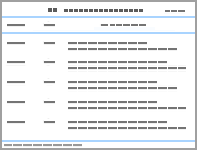
表1
“求新5号”拖轮模型参数
| 参数 | 取值 |
|---|---|
| 质量/kg | 187.6 |
| 排水, Δ/m3 | 0.187 6 |
| 型深,D/m | 0.248 5 |
| 船宽,B/m | 0.695 2 |
| 船长,L/m | 2.152 |
| m11/kg | 216.472 7 |
| m22/kg | 183.490 6 |
| m33/kg | 0.063 2 |
| d11/(kg·s-1) | 44.187 8 |
| d22/(kg·s-1) | 152.938 0 |
| d33/(kg·s-1) | 0.262 9 |

图5
双全回转推进器左右舵角激励信号


图6
训练损失趋势


图7
回转实验预测

表2
GRU模型准确度分析
| 参数 | eRMSE | R2 |
|---|---|---|
| u | 0.000 5 m/s | 0.956 0 |
| v | 0.008 2 m/s | 0.940 2 |
| r | 0.252 5 (°)/s | 0.928 4 |

图8
轨迹跟踪仿真实验1

表3
仿真实验1轨迹跟踪误差与平均求解时间
| Np | eRMSE/m | 平均求解时间/s |
|---|---|---|
| 1 | 9.49 | 0.03 |
| 3 | 3.79 | 0.32 |
| 5 | 3.51 | 1.15 |

图9
轨迹跟踪仿真实验2

| [1] |
LIU J, YANG F, LI S, et al. Testing and evaluation for intelligent navigation of ships: Current status, possible solutions, and challenges[J]. Ocean Engineering, 2024, 295: 116969.
doi: 10.1016/j.oceaneng.2024.116969 URL |
| [2] | 刘佳仑, 董智霖, 李诗杰, 等. 基于改进反步滑模控制算法的拖轮自主靠泊控制[J]. 中国舰船研究, 2024, 19(1): 119-127. |
| LIU Jialun, DONG Zhilin, LI Shijie, et al. Autonomous berthing control of tugboat based on improved backstepping sliding mode control algorithm[J]. Chinese Journal of Ship Research, 2024, 19(1): 119-127. | |
| [3] | HOW B V E, JIN Y, YIEW L J, et al. Adaptive neural tracking control for an autonomous azimuthing stern drive (ASD) tug[C]// IOP Conference Series: Materials Science and Engineering. Ulsan, ROK: IOP Publishing, 2020, 929(1): 012002. |
| [4] |
何宇, 欧阳子路, 邹璐, 等. 基于矢量场制导法和模型预测控制的船舶路径跟踪与避碰[J]. 上海交通大学学报, 2024, 58(11): 1644-1653.
doi: 10.16183/j.cnki.jsjtu.2023.121 |
| HE Yu, OUYANG Zilu, ZOU Lu, et al. Ship path following and collision avoidance based on vector field guidance law and model predictive control[J]. Journal of Shanghai Jiao Tong University, 2024, 58(11): 1644-1653. | |
| [5] | 于特, 刘佳鹏, 吴超, 等. 基于非线性干扰观测器的无人船与自主水下航行器协同运动控制策略[J]. 上海交通大学学报, 2023, 57 (Sup.1): 114-123. |
| YU Te, LIU Jiapeng, WU Chao, et al. USV and AUV cooperative control strategy based on nonlinear disturbance observer[J]. Journal of Shanghai Jiao Tong University, 2023, 57 (Sup.1): 114-123. | |
| [6] |
YAN Z, FENG W, WANG H. Adaptive surge control of variable-mass unmanned surface vehicle based on sliding mode observation[J]. Ocean Engineering, 2023, 269: 113576.
doi: 10.1016/j.oceaneng.2022.113576 URL |
| [7] | 宋俊龙, 张靖扬, 董磊, 等. 船舶操纵运动建模方法研究进展与展望[J]. 船舶工程, 2024, 46(2): 14-26. |
| SONG Junlong, ZHANG Jingyang, DONG Lei, et al. Research progress and prospects on ship maneuvering motion modeling methods[J]. Ship Engineering, 2024, 46(2): 14-26. | |
| [8] |
LOU J, WANG H, WANG J, et al. Deep learning method for 3-DOF motion prediction of unmanned surface vehicles based on real sea maneuverability test[J]. Ocean Engineering, 2022, 250: 111015.
doi: 10.1016/j.oceaneng.2022.111015 URL |
| [9] |
CARRON A, ARCARI E, WERMELINGER M, et al. Data-driven model predictive control for trajectory tracking with a robotic arm[J]. IEEE Robotics and Automation Letters, 2019, 4(4): 3758-3765.
doi: 10.1109/LSP.2016. URL |
| [10] |
XU P, QIN H, MA J, et al. Data-driven model predictive control for ships with Gaussian process[J]. Ocean Engineering, 2023, 268: 113420.
doi: 10.1016/j.oceaneng.2022.113420 URL |
| [11] | FOSSEN T I. Handbook of marine craft hydrodynamics and motion control[M]. Chichester, West Sussex, UK: John Wiley & Sons, 2011. |
| [12] |
詹可, 朱仁传. 一种CNN-LSTM船舶运动极值预报模型[J]. 上海交通大学学报, 2023, 57(8): 963-971.
doi: 10.16183/j.cnki.jsjtu.2022.089 |
| ZHAN Ke, ZHU Renchuan. A CNN-LSTM ship motion extreme value prediction model[J]. Journal of Shanghai Jiao Tong University, 2023, 57(8): 963-971. | |
| [13] |
徐长节, 李欣雨. 基于人工神经网络的深基坑支护结构侧移预测[J]. 上海交通大学学报, 2024, 58(11): 1735-1744.
doi: 10.16183/j.cnki.jsjtu.2023.109 |
| XU Changjie, LI Xinyu. Lateral deformation prediction of deep foundation retaining structures based on artificial neural network[J]. Journal of Shanghai Jiao Tong University, 2024, 58(11): 1735-1744. | |
| [14] | DEY R, SALEM F M. Gate-variants of gated recurrent unit (GRU) neural networks[C]//2017 IEEE 60th international midwest symposium on circuits and systems (MWSCAS). Boston, MA, USA:IEEE, 2017: 1597-1600. |
| [15] |
JIANG Y, HOU X R, WANG X G, et al. Identification modeling and prediction of ship maneuvering motion based on LSTM deep neural network[J]. Journal of Marine Science and Technology, 2022, 27(1): 125-137.
doi: 10.1007/s00773-021-00819-9 |
| [16] |
YUAN S, LIU Z, SUN Y, et al. An event-triggered trajectory planning and tracking scheme for automatic berthing of unmanned surface vessel[J]. Ocean Engineering, 2023, 273: 113964.
doi: 10.1016/j.oceaneng.2023.113964 URL |
| [1] | 乔文超, 聂伟民, 杜选民, 刘本奇, 叶天明, 杨天霖. 用于圆周合成孔径声呐成像的无人船圆周运动精准控制方法[J]. 上海交通大学学报, 2026, 60(1): 154-162. |
| [2] | . 基于输入映射及事件触发自适应策略的刚柔混合机械臂模型预测控制[J]. J Shanghai Jiaotong Univ Sci, 2026, 31(1): 36-47. |
| [3] | . 基于模型预测控制的欠驱动USV自主航行模型[J]. J Shanghai Jiaotong Univ Sci, 2025, 30(6): 1255-1264. |
| [4] | 崔思远, 李浩, 范翔宇, 倪磊, 侯佳航. 基于AMDE-DMPC算法的多无人机协同目标搜索方法[J]. 空天防御, 2025, 8(6): 35-44. |
| [5] | 曹永吉, 张江丰, 王天宇, 郑可轲, 吴秋伟. 基于分布式模型预测控制的自适应二次调频策略[J]. 上海交通大学学报, 2025, 59(3): 333-341. |
| [6] | . 基于数据驱动的永磁同步电机控制系统模型预测控制方法[J]. J Shanghai Jiaotong Univ Sci, 2025, 30(2): 270-279. |
| [7] | 邱革非, 冯泽华, 沈赋, 何超, 何虹辉, 刘铠铭. 考虑车网互动的园区电网动态双层能量管理策略[J]. 上海交通大学学报, 2024, 58(6): 916-925. |
| [8] | 刘月笙, 贺宁, 贺利乐, 张译文, 习坤, 张梦芮. 基于机器学习的移动机器人路径跟踪MPC控制器参数自整定[J]. J Shanghai Jiaotong Univ Sci, 2024, 29(6): 1028-1036. |
| [9] | 张啸天1,何德峰1,廖飞2. 复杂环境及约束下舰载机自动着舰迭代模型预测控制[J]. J Shanghai Jiaotong Univ Sci, 2024, 29(4): 712-724. |
| [10] | 穆建彬,杨海丽,何德峰. 基于控制屏障函数的自主移动机器人安全编队分布式模型预测控制[J]. J Shanghai Jiaotong Univ Sci, 2024, 29(4): 678-688. |
| [11] | 蔡振华, 黎灿兵, 阳同光, 魏娟, 葛睿, 李立雄. 考虑动态频率惯量特性的储能电池参与电网一次调频控制[J]. 上海交通大学学报, 2024, 58(12): 1946-1956. |
| [12] | 何宇, 欧阳子路, 邹璐, 陈伟民, 邹早建. 基于矢量场制导法和模型预测控制的船舶路径跟踪与避碰[J]. 上海交通大学学报, 2024, 58(11): 1644-1653. |
| [13] | 刘传斌, 矫文书, 吴秋伟, 陈健, 周前. 基于模型预测控制的风储联合电场参与电网二次调频策略[J]. 上海交通大学学报, 2024, 58(1): 91-101. |
| [14] | 姜恩宇, 陈宇, 施峥靖, 吴哲城, 林顺富, 李东东. 考虑碳配额引导需求响应的微电网能量管理策略[J]. 上海交通大学学报, 2023, 57(9): 1126-1136. |
| [15] | 奚鑫泽, 邢超, 覃日升, 何廷一, 和鹏, 孟贤, 程春辉. 含双馈风力发电系统的配电网短路电流特性[J]. 上海交通大学学报, 2023, 57(7): 921-927. |
| 阅读次数 | ||||||
|
全文 |
|
|||||
|
摘要 |
|
|||||
