

Journal of Shanghai Jiao Tong University ›› 2025, Vol. 59 ›› Issue (9): 1270-1280.doi: 10.16183/j.cnki.jsjtu.2023.509
• New Type Power System and the Integrated Energy • Previous Articles Next Articles
YANG Yinguo1, FENG Yinying2( ), WEI Wei2, XIE Pingping1, CHEN Yue1
Received:2023-10-10
Revised:2023-12-18
Accepted:2023-12-29
Online:2025-09-28
Published:2025-09-25
CLC Number:
YANG Yinguo, FENG Yinying, WEI Wei, XIE Pingping, CHEN Yue. Coordinated Day-Ahead Scheduling and Real-Time Dispatch of a Wind-Thermal-Storage Energy Base Considering Flexibility Interval[J]. Journal of Shanghai Jiao Tong University, 2025, 59(9): 1270-1280.
Add to citation manager EndNote|Ris|BibTeX
URL: https://xuebao.sjtu.edu.cn/EN/10.16183/j.cnki.jsjtu.2023.509
Fig.1
Wind-thermal-storage system configuration
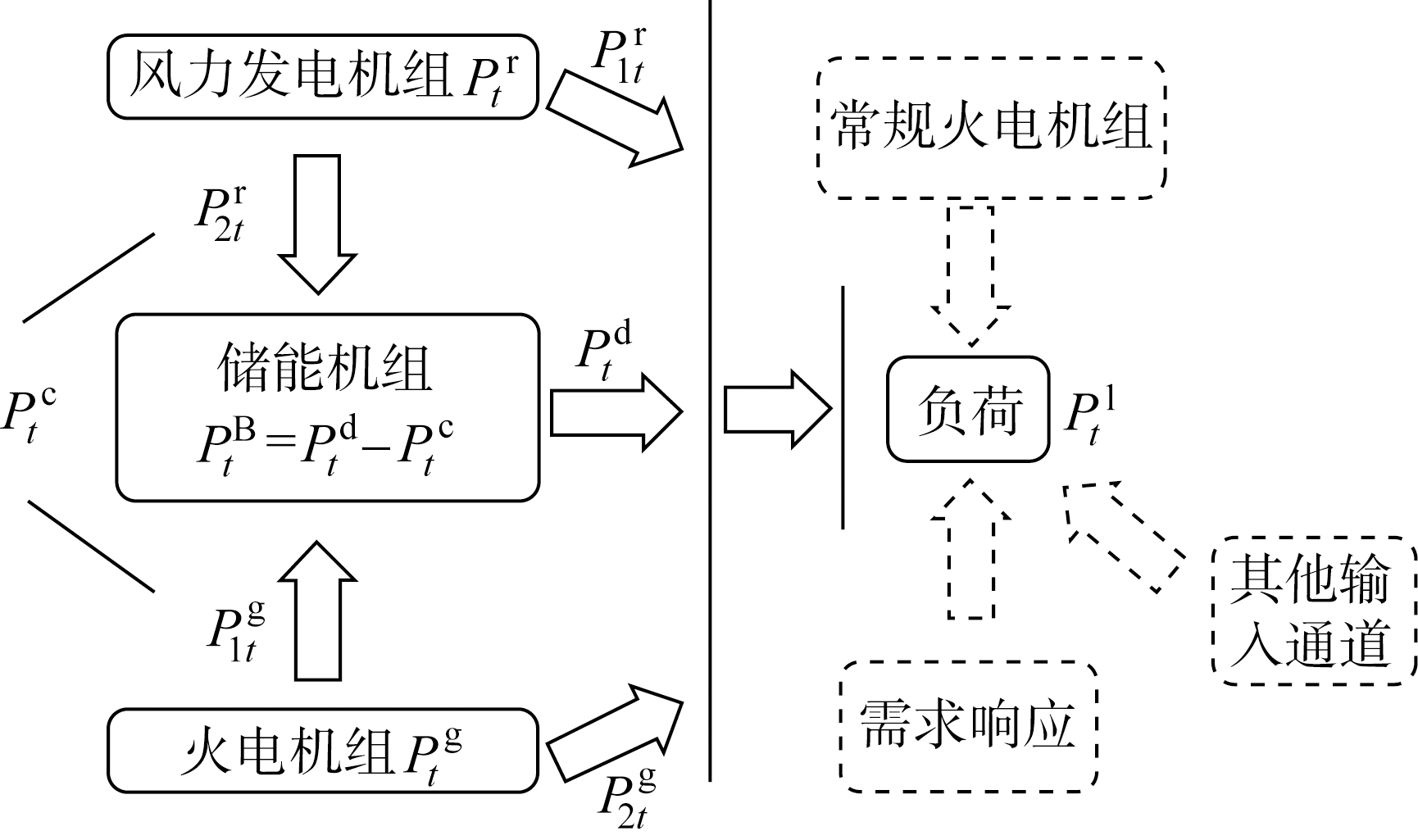
Fig.2
Framework of integrated day-ahead scheduling and real-time dispatch
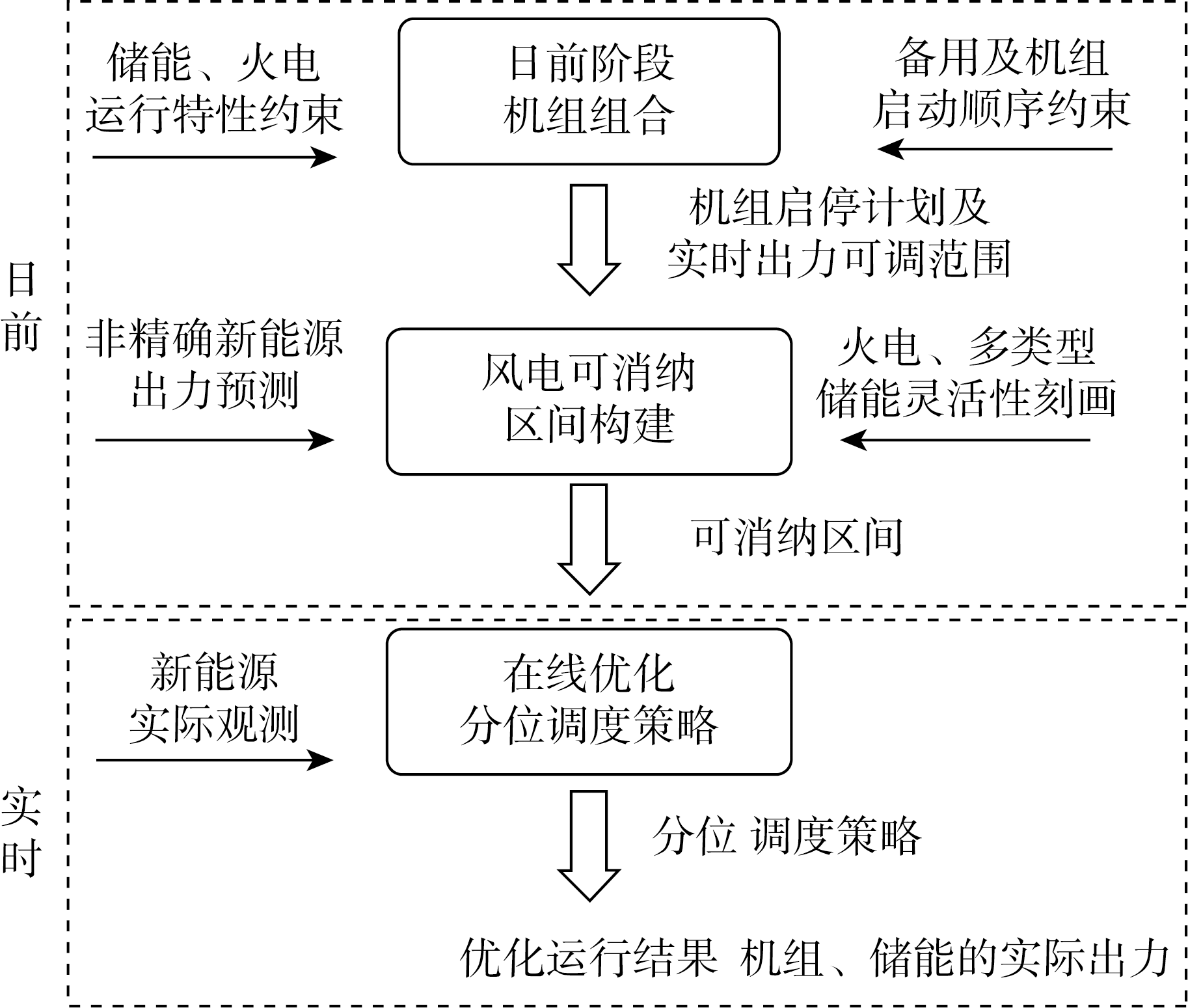
Fig.3
Boxplot of wind power generation
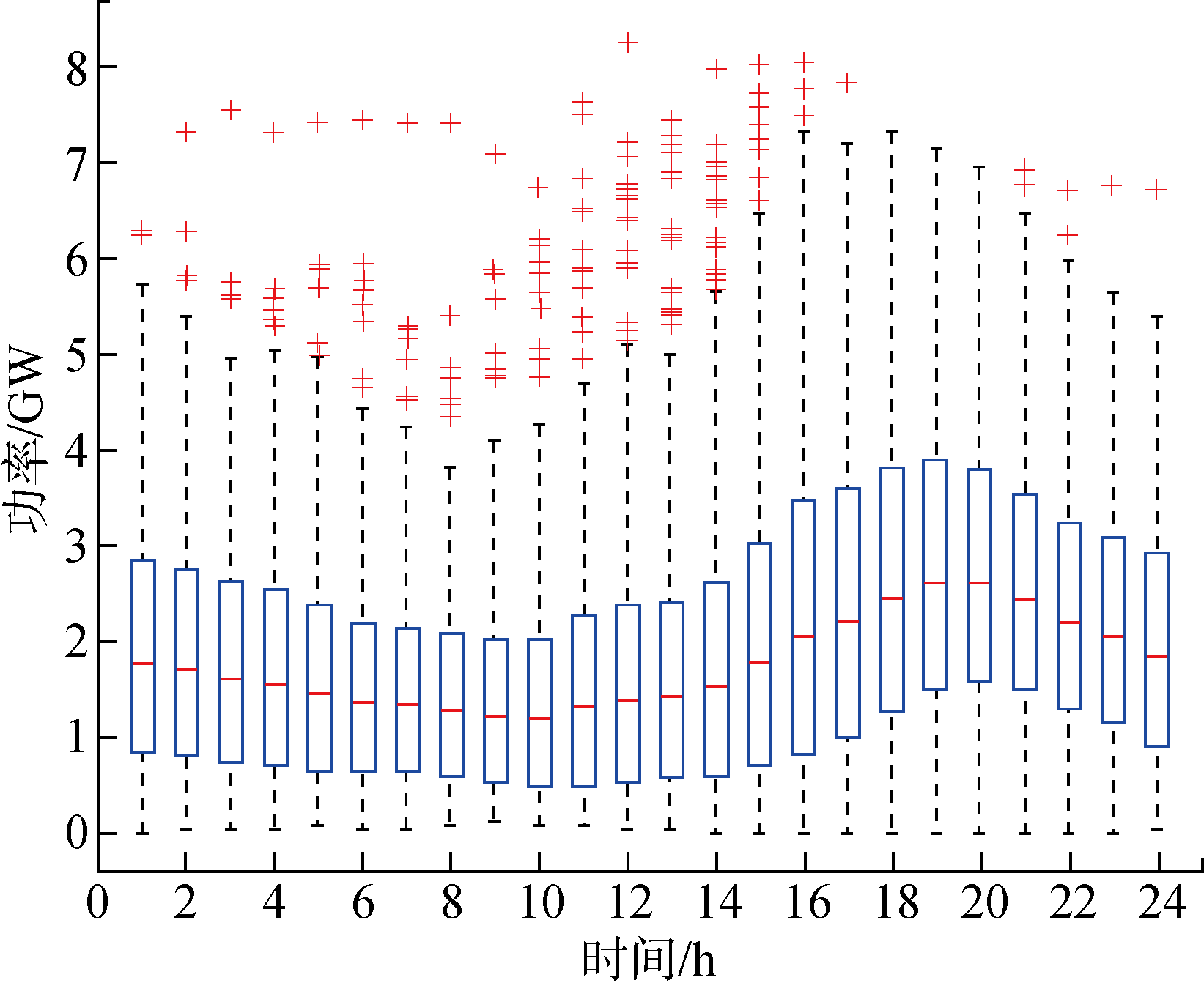
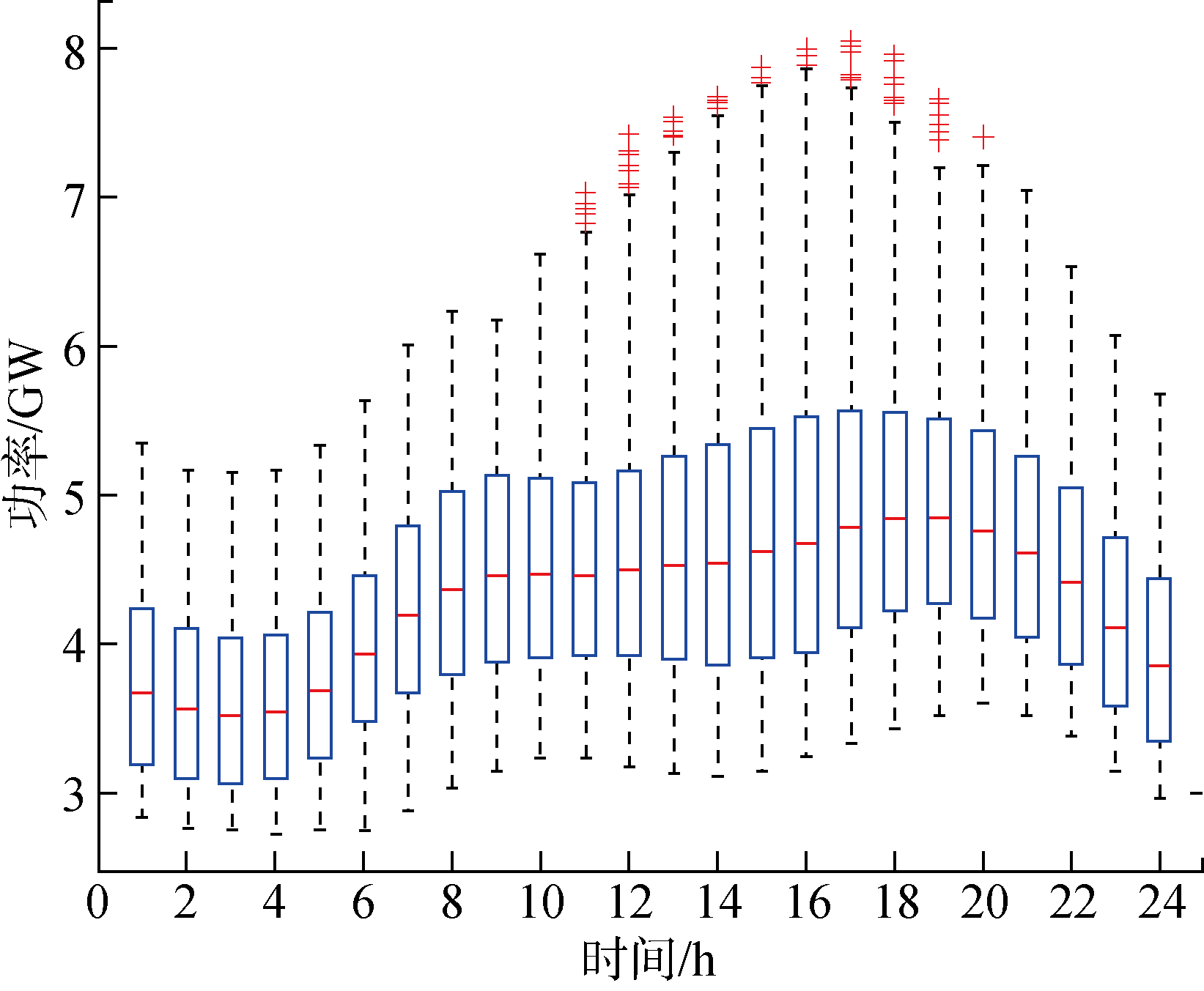
Fig.4
Boxplot of load power
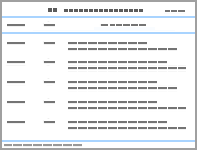
Tab.1
Parameters of case study
| 参数 | 数值 |
|---|---|
| 风电额定功率/GW | 10 |
| 负荷峰值/GW | 8 |
| N | 8 |
| 单台火电机组出力上限/MW | 500 |
| 单台火电机组出力下限/MW | 125 |
| 单台火电机组开/关机爬坡/(MW·h-1) | 250 |
| 储能SOC范围 | [0.2,0.95] |
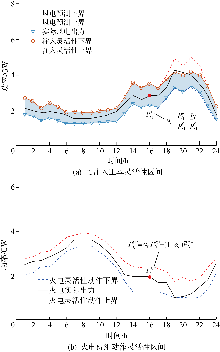
Fig.5
Dispatch based on flexibility interval
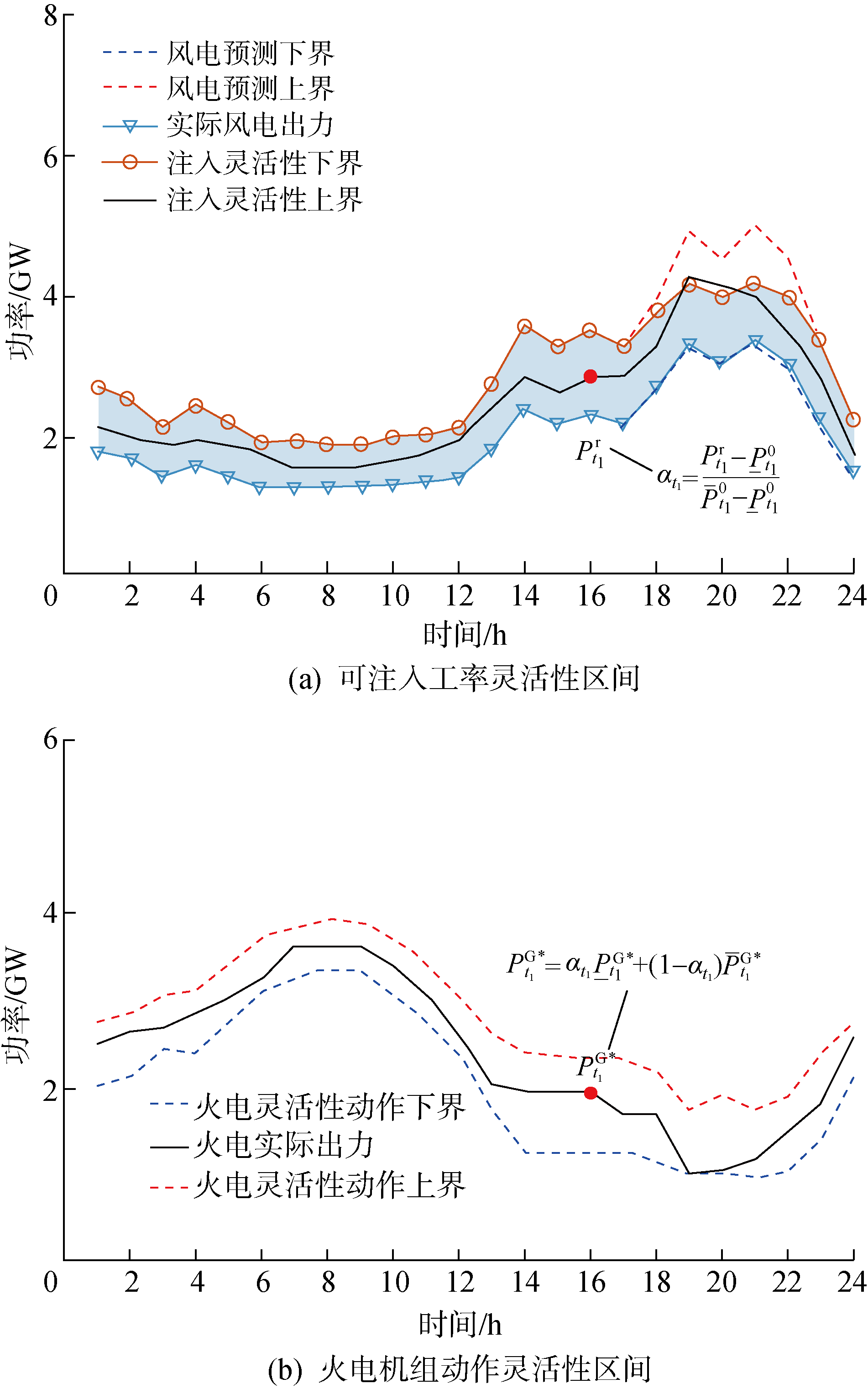
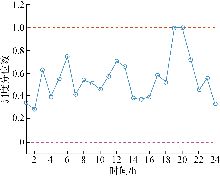
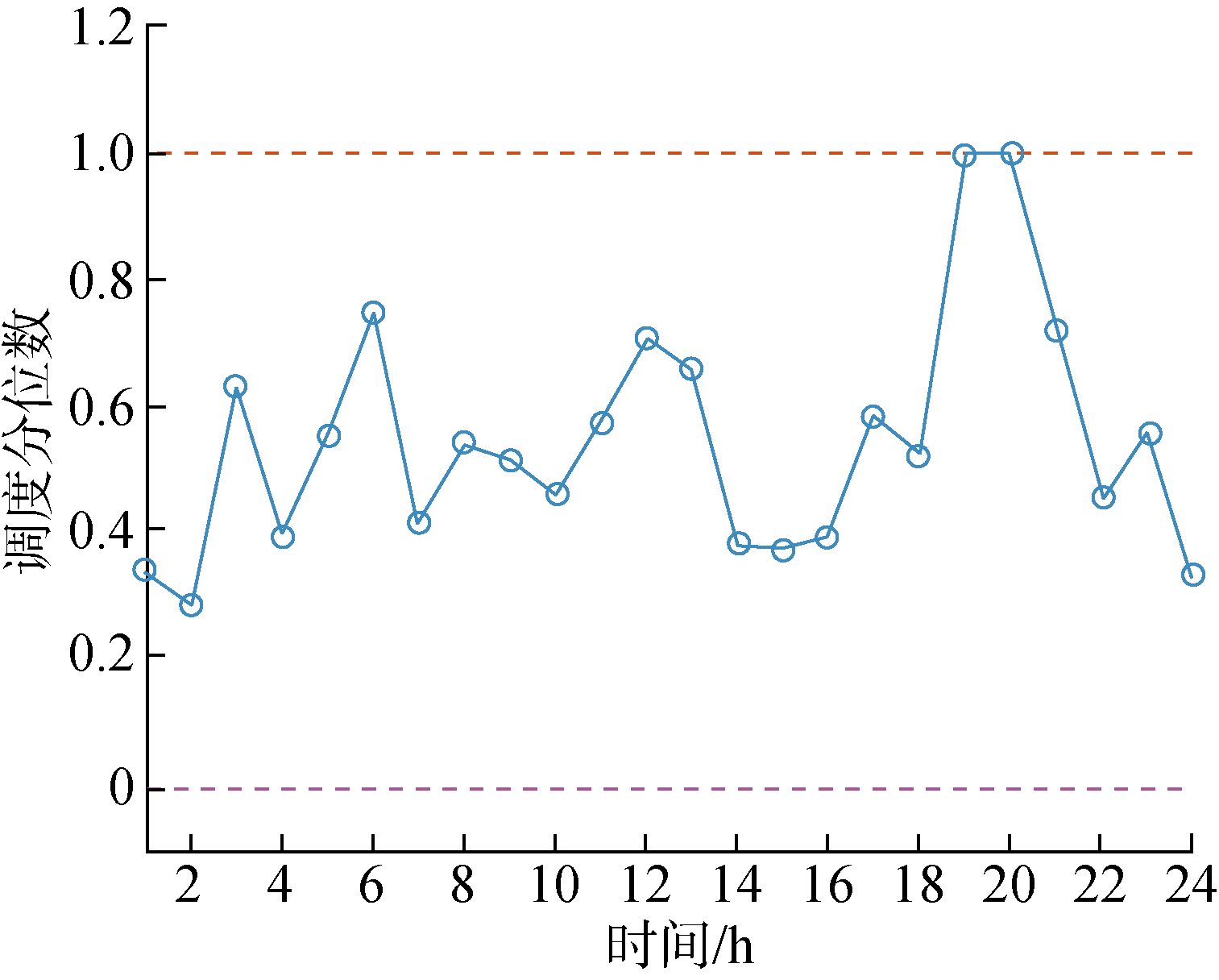
Fig.6
Dispatch quantile ratio
Tab.2
Scheduling results of different strategies
| 算法 | 总成本× 10-6/元 | 运行成本× 10-6/元 | 优化间隙/% |
|---|---|---|---|
| B1 | 2.4732 | 2.4732 | |
| B2 | 3.0222 | 2.8243 | 14.20 |
| B3(10%) | 2.9530 | 2.8538 | 15.39 |
| B3(20%) | 2.9585 | 2.8574 | 15.53 |
| 所提方法 | 2.8381 | 2.8298 | 14.42 |
Tab.3
Scheduling result with different SOC limits
| SOC范围 | 总成本× 10-6/元 | 运行成本× 10-6/元 | 优化间隙/% |
|---|---|---|---|
| [0.2,0.8] | 2.8442 | 2.8398 | 15.00 |
| [0.2,0.95] | 2.8381 | 2.8298 | 14.76 |
| [0.15,0.8] | 2.8473 | 2.8367 | 15.13 |
| [1] | 韩肖清, 李廷钧, 张东霞, 等. 双碳目标下的新型电力系统规划新问题及关键技术[J]. 高电压技术, 2021, 47(9): 3036-3046. |
| HAN Xiaoqing, LI Tingjun, ZHANG Dongxia, et al. New issues and key technologies of new power system planning under double carbon goals[J]. High Voltage Engineering, 2021, 47(9): 3036-3046. | |
| [2] |
黄强, 郭怿, 江建华, 等. “双碳” 目标下中国清洁电力发展路径[J]. 上海交通大学学报, 2021, 55(12): 1499-1509.
doi: 10.16183/j.cnki.jsjtu.2021.272 |
| HUANG Qiang, GUO Yi, JIANG Jianhua, et al. Development pathway of China’s clean electricity under carbon peaking and carbon neutrality goals[J]. Journal of Shanghai Jiao Tong University, 2021, 55(12): 1499-1509. | |
| [3] | 王骞, 张学广, 朱玲, 等. 含整体煤气化燃料电池-碳捕集电厂的风火储系统分布鲁棒调度方法[J]. 中国电机工程学报, 2024, 44(9): 3573-3588. |
| WANG Qian, ZHANG Xueguang, ZHU Ling, et al. Robust scheduling method for wind-fire-energy storage system with integrated gasification fuel cell and carbon capture power plant[J]. Proceedings of the CSEE, 2024, 44(9): 3573-3588. | |
| [4] |
黄远明, 张玉欣, 夏赞阳, 等. 考虑需求响应资源和储能容量价值的新型电力系统电源规划方法[J]. 上海交通大学学报, 2023, 57(4): 432-441.
doi: 10.16183/j.cnki.jsjtu.2021.477 |
| HUANG Yuanming, ZHANG Yuxin, XIA Zanyang, et al. Power system planning considering demand response resources and capacity value of energy storage[J]. Journal of Shanghai Jiao Tong University, 2023, 57(4): 432-441. | |
| [5] | LÓPEZ-GRAJALES A M, GONZÁLEZ-SANCHEZ J W, CARDONA-RESTREPO H A, et al. Economy, financial, and regulatory method for the integration of electrical energy storage in a power network[J]. Journal of Energy Storage, 2023, 58: 106433. |
| [6] | ABDALLA A N, NAZIR M S, TAO H, et al. Integration of energy storage system and renewable energy sources based on artificial intelligence: An overview[J]. Journal of Energy Storage, 2021, 40: 102811. |
| [7] | BAFRANI H A, SEDIGHIZADEH M, DOWLATSHAHI M, et al. Reliability and reserve in day ahead joint energy and reserve market stochastic scheduling in presence of compressed air energy storage[J]. Journal of Energy Storage, 2021, 43: 103194. |
| [8] | 汪超群, 韦化, 吴思缘. 计及风电不确定性的随机安全约束机组组合[J]. 电网技术, 2017, 41(5): 1419-1427. |
| WANG Chaoqun, WEI Hua, WU Siyuan. Stochastic-security-constrained unit commitment considering uncertainty of wind power[J]. Power System Technology, 2017, 41(5): 1419-1427. | |
| [9] | WU H Y, SHAHIDEHPOUR M, LI Z Y, et al. Chance-constrained day-ahead scheduling in stochastic power system operation[J]. IEEE Transactions on Power Systems, 2014, 29(4): 1583-1591. |
| [10] | BERTSIMAS D, LITVINOV E, SUN X A, et al. Adaptive robust optimization for the security constrained unit commitment problem[J]. IEEE Transactions on Power Systems, 2013, 28(1): 52-63. |
| [11] | ZEYNALI S, ROSTAMI N, AHMADIAN A, et al. Robust multi-objective thermal and electrical energy hub management integrating hybrid battery-compressed air energy storage systems and plug-in-electric-vehicle-based demand response[J]. Journal of Energy Storage, 2021, 35: 102265. |
| [12] |
李建林, 张则栋, 梁策, 等. 计及源-荷不确定性的综合能源系统多目标鲁棒优化调度[J]. 上海交通大学学报, 2025, 59(2): 175-185.
doi: 10.16183/j.cnki.jsjtu.2023.238 |
| LI Jianlin, ZHANG Zedong, LIANG Ce, et al. Multi-objective robust optimization dispatch for integrated energy systems considering source-load uncertainty[J]. Journal of Shanghai Jiao Tong University, 2025, 59(2): 175-185. | |
| [13] | XIONG P, JIRUTITIJAROEN P, SINGH C. A distributionally robust optimization model for unit commitment considering uncertain wind power generation[J]. IEEE Transactions on Power Systems, 2017, 32(1): 39-49. |
| [14] | ZHENG X D, QU K P, LV J Q, et al. Addressing the conditional and correlated wind power forecast errors in unit commitment by distributionally robust optimization[J]. IEEE Transactions on Sustainable Energy, 2021, 12(2): 944-954. |
| [15] | 马洪艳, 贠靖洋, 严正. 基于分布鲁棒优化的灵活爬坡备用调度方法[J]. 中国电机工程学报, 2020, 40(19): 6121-6132. |
| MA Hongyan, YUN Jingyang, YAN Zheng. Distributionally robust optimization based dispatch methodology of flexible ramping products[J]. Proceedings of the CSEE, 2020, 40(19): 6121-6132. | |
| [16] | 杨策, 孙伟卿, 韩冬, 等. 考虑风电出力不确定的分布鲁棒经济调度[J]. 电网技术, 2020, 44(10): 3649-3655. |
| YANG Ce, SUN Weiqing, HAN Dong, et al. Distributionally-robust economic dispatch considering uncertain wind power output[J]. Power System Technology, 2020, 44(10): 3649-3655. | |
| [17] | TANG Y, ZHAI Q Z, ZHAO J X. Multi-stage robust economic dispatch with virtual energy storage and renewables based on a single level model[J]. IEEE Transactions on Automation Science & Engineering, 2024, 21(4): 5490-5502. |
| [18] | LIN S J, FAN G S, JIAN G Y, et al. Stochastic economic dispatch of power system with multiple wind farms and pumped-storage hydro stations using approximate dynamic programming[J]. IET Renewable Power Generation, 2020, 14(13): 2507-2516. |
| [19] | 韦化, 龙丹丽, 黎静华. 求解大规模机组组合问题的策略迭代近似动态规划[J]. 中国电机工程学报, 2014, 34(25): 4420-4429. |
| WEI Hua, LONG Danli, LI Jinghua. Policy iteration-approximate dynamic programming for large scale unit commitment problems[J]. Proceedings of the CSEE, 2014, 34(25): 4420-4429. | |
| [20] | XIONG H B, SHI Y H, CHEN Z, et al. Multi-stage robust dynamic unit commitment based on pre-extended-fast robust dual dynamic programming[J]. IEEE Transactions on Power Systems, 2023, 38(3): 2411-2422. |
| [21] | 包宇庆, 王蓓蓓, 李扬, 等. 考虑大规模风电接入并计及多时间尺度需求响应资源协调优化的滚动调度模型[J]. 中国电机工程学报, 2016, 36(17): 4589-4600. |
| BAO Yuqing, WANG Beibei, LI Yang, et al. Rolling dispatch model considering wind penetration and multi-scale demand response resources[J]. Proceedings of the CSEE, 2016, 36(17): 4589-4600. | |
| [22] | KHALID M, SAVKIN A V. A model predictive control approach to the problem of wind power smoothing with controlled battery storage[J]. Renewable Energy, 2010, 35(7): 1520-1526. |
| [23] | DI GIORGIO A, LIBERATI F, LANNA A, et al. Model predictive control of energy storage systems for power tracking and shaving in distribution grids[J]. IEEE Transactions on Sustainable Energy, 2017, 8(2): 496-504. |
| [24] | ZHAO Z L, GUO J T, LUO X, et al. Distributed robust model predictive control-based energy management strategy for islanded multi-microgrids considering uncertainty[J]. IEEE Transactions on Smart Grid, 2022, 13(3): 2107-2120. |
| [25] | LIN M H, LIU Z H, WIERMAN A, et al. Online algorithms for geographical load balancing[C]// 2012 International Green Computing Conference. San Jose, USA: IEEE, 2012: 1-10. |
| [26] | ZHANG J, QIN D, YE Y C, et al. Multi-time scale economic scheduling method based on day-ahead robust optimization and intraday MPC rolling optimization for microgrid[J]. IEEE Access, 2021, 9: 140315-140324. |
| [1] | ZHANG Shipeng, LI Peiqiang, ZHANG Yijun, LIU Xifeng. Secondary Frequency Modulation Strategy of Composite Energy Storage Based on Variable Filter Time Constant and Fuzzy Control [J]. Journal of Shanghai Jiao Tong University, 2025, 59(9): 1370-1382. |
| [2] | FANG Jun, HE De, PEI Zhigang, PENG Zhihui, BAO Jieying, LIU Weikang, ZHOU Bin. A Multi-Grade Pricing Strategy for Distributed Energy Storage Considering Default Risks of Customized Power Services [J]. Journal of Shanghai Jiao Tong University, 2025, 59(9): 1359-1369. |
| [3] | HU Long, FANG Baling, FAN Feilong, CHEN Dawei, LI Xinxi, ZENG Run. Energy Interaction and Energy Storage Sharing Optimization Method for Users, Base Stations, and Charging Stations [J]. Journal of Shanghai Jiao Tong University, 2025, 59(7): 877-888. |
| [4] | ZHOU Xia, CHEN Wenjian, DAI Jianfeng, XIE Xiangpeng. Black-Start Coordinated Control Strategy of Optical Storage Microgrid Considering State of Charge Balance of Distributed Energy Storage [J]. Journal of Shanghai Jiao Tong University, 2025, 59(7): 938-951. |
| [5] | DENG Qianwen, LI Qi, QIU Yibin, LI Doumeng, HUO Shasha, CHEN Weirong. Optimal Allocation Method of Integrated Energy System Considering Joint Operation of Multiple Flexible Resources [J]. Journal of Shanghai Jiao Tong University, 2025, 59(7): 912-922. |
| [6] | LI Jinghao, LI Ran, HUA Hao, HUANG Wentao, GAO Fei, TAI Nengling. Reliability Allocation Method for Electric Aircraft Lightweight Propulsion System [J]. Journal of Shanghai Jiao Tong University, 2025, 59(6): 867-876. |
| [7] | WEI Maohua, YANG Ling, WENG Liangtao, YANG Jipei, CHEN Yongqiao. SOC Balancing Strategy for Distributed Energy Storage Units in Isolated DC Microgrids Considering Capacity Differences [J]. Journal of Shanghai Jiao Tong University, 2025, 59(3): 376-387. |
| [8] | ZHAO Yongxi, GAO Pengchao, FAN Hong. Power Coordination Strategy for Hybrid Energy Storage in AC/DC Microgrids Based on Virtual Impedance-Fuzzy Algorithm [J]. Journal of Shanghai Jiao Tong University, 2025, 59(3): 388-399. |
| [9] | WU Jing, LIU Xuanyu, LI Xiang, QI Xiaoyan, LI Chengjun, ZHANG Zhong. Impact Mechanism Analysis of Carbon Price Uncertainty on Power System Dispatch [J]. Journal of Shanghai Jiao Tong University, 2025, 59(3): 354-364. |
| [10] | LI Jianlin, ZHANG Zedong, LIANG Ce, ZENG Fei. Multi-Objective Robustness of Integrated Energy System Considering Source-Load Uncertainty [J]. Journal of Shanghai Jiao Tong University, 2025, 59(2): 175-185. |
| [11] | TIAN Shuxin, HAN Xue, FU Yang, SU Xiangjing, LI Zhenkun. Two-Stage Robust Expansion Planning of Transmission Network Considering Uncertainty of Offshore Wind Power [J]. Journal of Shanghai Jiao Tong University, 2024, 58(9): 1400-1409. |
| [12] | MI Yang, FU Qixin, ZHAO Haihui, MA Siyuan, WANG Yufei. Robust Optimal Scheduling of Micro Energy Grid Considering Multi-Interval Uncertainty Set of Source-Load and Integrated Demand Response [J]. Journal of Shanghai Jiao Tong University, 2024, 58(9): 1323-1333. |
| [13] | MI Yang, CHEN Yuyang, CHEN Boyang, HAN Yunhao, YUAN Minghan. Shared Energy Storage Multi-Objective Allocation Strategy Considering Integrated Energy Microgrid Access to Active Distribution Network [J]. Journal of Shanghai Jiao Tong University, 2024, 58(9): 1309-1322. |
| [14] | LIN Sen, WEN Shuli, ZHU Miao, DAI Qun, YAN Lun, ZHAO Yao, YE Huili. Optimal Allocation of Electric-Thermal Hybrid Energy Storage for Seaport Integrated Energy System Considering Carbon Trading Mechanism [J]. Journal of Shanghai Jiao Tong University, 2024, 58(9): 1344-1356. |
| [15] | YANG Sen, GUO Ning, ZHANG Shouming. Robust Optimal Scheduling of Agricultural Microgrid Combined with Irrigation System Under Uncertainty Conditions [J]. Journal of Shanghai Jiao Tong University, 2024, 58(9): 1432-1442. |
| Viewed | ||||||
|
Full text |
|
|||||
|
Abstract |
|
|||||
