

Journal of Shanghai Jiao Tong University ›› 2026, Vol. 60 ›› Issue (4): 682-694.doi: 10.16183/j.cnki.jsjtu.2024.243
• New Type Power System and the Integrated Energy • Previous Articles Next Articles
SHI Zichuan1, TAI Nengling2( ), FAN Feilong2, CHEN Xinyi3, LIU Zhong3, ZHANG Xipeng3
Received:2024-06-24
Revised:2024-08-15
Accepted:2024-09-23
Online:2026-04-28
Published:2026-04-29
Contact:
TAI Nengling
E-mail:nltai@sjtu.edu.cn
CLC Number:
SHI Zichuan, TAI Nengling, FAN Feilong, CHEN Xinyi, LIU Zhong, ZHANG Xipeng. Cross-Season Energy-Power Coordinated Dispatch Method for Hybrid Energy Storages Systems in Renewable-Rich Parks[J]. Journal of Shanghai Jiao Tong University, 2026, 60(4): 682-694.
Add to citation manager EndNote|Ris|BibTeX
URL: https://xuebao.sjtu.edu.cn/EN/10.16183/j.cnki.jsjtu.2024.243

Fig.1
Structure of wind-solar-hydrogen-gas-battery energy system in renewable-rich parks


Fig.2
Decision stage-making process

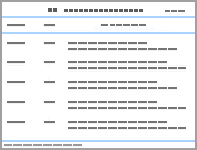
Tab.1
Key parameters of energy storages
| 参数 | 数值 |
|---|---|
| 12000 | |
| 2400 | |
| 800 | |
| 600 | |
| ηED | 0.74 |
| ηFC | 0.5 |
| 40 | |
| 160 | |
| 120 | |
| ηBS_C、ηBS_D | 0.92 |
| 6000 | |
| 0 | |
| 200 | |
| 200 | |
| ηHG | 0.75 |
| ηGT | 0.34 |
| 单位发电量的碳排放份额/[t·(MW·h)-1] | 0.7598 |
| 燃气机组供热基准值/(t·GJ-1) | 0.059 |

Fig.3
Parameters of uncertain variables of typical days


Fig.4
Annual SOC of hydrogen storage and gas storage


Fig.5
Power of energy storages


Fig.6
Daily SOC of energy storages


Fig.7
Power of wind turbine, photovoltaic, and tie line

Tab.2
RES curtailment and optimized dispatch costs of different optimization methods
| 优化方法 | 可再生能源 弃用量/(kW·h) | 总运行 成本/美元 | 碳排放量/kg |
|---|---|---|---|
| 方法1 | 1193310.02 | 152794.44 | 2088199.75 |
| 方法2 | 348008.47 | 67660.69 | 996478.59 |
| 方法3 | 213290.85 | 45207.27 | 768174.37 |
| 方法4 | 189109.96 | 42551.95 | 733362.64 |
Tab.3
Comparison of carbon trading market
| 情况 | 可再生能源弃用量/(kW·h) | 碳排放量/kg | 碳交易收益/美元 | 总运行成本/美元 |
|---|---|---|---|---|
| 不考虑碳交易市场 | 227535.88 | 779826.76 | 0 | 141578.52 |
| 考虑碳交易市场 | 189109.96 | 733362.64 | 116380.50 | 42551.95 |
| [1] | 孙鹤旭, 李争, 陈爱兵, 等. 风电制氢技术现状及发展趋势[J]. 电工技术学报, 2019, 34(19): 4071-4083. |
| SUN Hexu, LI Zheng, CHEN Aibing, et al. Current status and development trend of hydrogen production technology by wind power[J]. Transactions of China Electrotechnical Society, 2019, 34(19): 4071-4083. | |
| [2] | 江全元, 龚裕仲. 储能技术辅助风电并网控制的应用综述[J]. 电网技术, 2015, 39(12): 3360-3368. |
| JIANG Quanyuan, GONG Yuzhong. Review of wind power integration control with energy storage technology[J]. Power System Technology, 2015, 39(12): 3360-3368. | |
| [3] | 刘继春, 周春燕, 高红均, 等. 考虑氢能-天然气混合储能的电-气综合能源微网日前经济调度优化[J]. 电网技术, 2018, 42(1): 170-179. |
| LIU Jichun, ZHOU Chunyan, GAO Hongjun, et al. A day-ahead economic dispatch optimization model of integrated electricity-natural gas system considering hydrogen-gas energy storage system in microgrid[J]. Power System Technology, 2018, 42(1): 170-179. | |
| [4] | 刘春阳, 王秀丽, 吴雄. 考虑蓄电池分组优化的风储系统多层次调度策略[J]. 电网技术, 2016, 40(10): 3029-3037. |
| LIU Chunyang, WANG Xiuli, WU Xiong. A multi-layer dispatch strategy of combined wind-storage systems considering optimization of battery units[J]. Power System Technology, 2016, 40(10): 3029-3037. | |
| [5] | 李相俊, 张晶琼, 何宇婷, 等. 基于自适应动态规划的储能系统优化控制方法[J]. 电网技术, 2016, 40(5): 1355-1362. |
| LI Xiangjun, ZHANG Jingqiong, HE Yuting, et al. Optimal control method of energy storage system based on adaptive dynamic programming[J]. Power System Technology, 2016, 40(5): 1355-1362. | |
| [6] | 孙运志, 蒋德玉, 张盛林, 等. 计及电池寿命损耗的多能源微网储能优化配置[J]. 电力系统及其自动化学报, 2021, 33(5): 128-133. |
| SUN Yunzhi, JIANG Deyu, ZHANG Shenglin, et al. Optimal energy-storage configuration of multi-energy microgrid considering battery life degradation[J]. Proceedings of the CSU-EPSA, 2021, 33(5): 128-133. | |
| [7] | 赵诣, 方陈, 冯冬涵, 等. 考虑电池储能寿命损耗的风光储微网随机日前调度策略[J]. 电气工程学报, 2022, 17(3): 210-218. |
| ZHAO Yi, FANG Chen, FENG Donghan, et al. Stochastic day-ahead scheduling optimization for wind-PV-ES microgrid considering battery life loss[J]. Journal of Electrical Engineering, 2022, 17(3): 210-218. | |
| [8] | 何青, 沈轶. 风氢耦合储能系统技术发展现状[J]. 热力发电, 2021, 50(8): 9-17. |
| HE Qing, SHEN Yi. Development status of hydrogen energy storage system coupled wind power generation[J]. Thermal Power Generation, 2021, 50(8): 9-17. | |
| [9] | 段青熙, 袁铁江, 梅生伟, 等. 风电-氢储能与煤化工多能耦合系统能量协调控制策略[J]. 高电压技术, 2018, 44(1): 176-186. |
| DUAN Qingxi, YUAN Tiejiang, MEI Shengwei, et al. Energy coordination control of wind power-hydrogen energy storage and coal chemical multi-functional coupling system[J]. High Voltage Engineering, 2018, 44(1): 176-186. | |
| [10] | 李蕊睿, 李奇, 蒲雨辰, 等. 计及功率交互约束的含电—氢混合储能的多微电网系统容量优化配置[J]. 电力系统保护与控制, 2022, 50(14): 53-64. |
| LI Ruirui, LI Qi, PU Yuchen, et al. Optimal configuration of an electric-hydrogen hybrid energy storage multi-microgrid system considering power interaction constraints[J]. Power System Protection & Control, 2022, 50(14): 53-64. | |
| [11] | 尹文良, 刘琳, 张存山, 等. 含制氢储能的混合传动风电系统建模与运行特性分析[J]. 电力自动化设备, 2020, 40(10): 64-70. |
| YIN Wenliang, LIU Lin, ZHANG Cunshan, et al. Modeling and operation performance analysis of hybrid drive wind power generation system with hydrogen energy storage[J]. Electric Power Automation Equipment, 2020, 40(10): 64-70. | |
| [12] | 左冠林, 郭红霞, 林文智, 等. 考虑低碳制氢的微电网优化配置[J]. 电力自动化设备, 2023, 43(2): 9-18. |
| ZUO Guanlin, GUO Hongxia, LIN Wenzhi, et al. Optimal configuration of microgrid considering low-carbon hydrogen production[J]. Electric Power Automation Equipment, 2023, 43(2): 9-18. | |
| [13] | 刘伟佳, 文福拴, 薛禹胜, 等. 电转气技术的成本特征与运营经济性分析[J]. 电力系统自动化, 2016, 40(24): 1-11. |
| LIU Weijia, WEN Fushuan, XUE Yusheng, et al. Cost characteristics and economic analysis of power-to-gas technology[J]. Automation of Electric Power Systems, 2016, 40(24): 1-11. | |
| [14] | 卫志农, 张思德, 孙国强, 等. 计及电转气的电-气互联综合能源系统削峰填谷研究[J]. 中国电机工程学报, 2017, 37(16): 4601-4609. |
| WEI Zhinong, ZHANG Side, SUN Guoqiang, et al. Power-to-gas considered peak load shifting research for integrated electricity and natural-gas energy systems[J]. Proceedings of the CSEE, 2017, 37(16): 4601-4609. | |
| [15] | 曾红, 刘天琪, 何川, 等. 含电转气设备的气电互联综合能源系统多目标优化[J]. 电测与仪表, 2019, 56(8): 99-107. |
| ZENG Hong, LIU Tianqi, HE Chuan, et al. Multi-objective optimization for integrated natural-gas and electricity energy system considering power-to-gas[J]. Electrical Measurement & Instrumentation, 2019, 56(8): 99-107. | |
| [16] | 龚晓琴, 王进, 王珑, 等. 含电转气的电—气互联综合能源系统低碳经济运行[J]. 电力科学与技术学报, 2020, 35(2): 76-83. |
| GONG Xiaoqin, WANG Jin, WANG Long, et al. Low-carbon economic operation for integrated electricity and natural-gas energy system with power-to-gas[J]. Journal of Electric Power Science & Technology, 2020, 35(2): 76-83. | |
| [17] |
PAPAVASILIOU A, OREN S S, O’NEILL R P. Reserve requirements for wind power integration: A scenario-based stochastic programming framework[J]. IEEE Transactions on Power Systems, 2011, 26(4): 2197-2206.
doi: 10.1109/TPWRS.2011.2121095 URL |
| [18] |
KAZEMTARGHI A, MALLIK A. A two-stage stochastic programming approach for electric energy procurement of EV charging station integrated with BESS and PV[J]. Electric Power Systems Research, 2024, 232: 110411.
doi: 10.1016/j.epsr.2024.110411 URL |
| [19] |
KARIMI H, JADID S, MAKUI A. Stochastic energy scheduling of multi-microgrid systems considering independence performance index and energy storage systems[J]. Journal of Energy Storage, 2021, 33: 102083.
doi: 10.1016/j.est.2020.102083 URL |
| [20] |
马会萌, 李相俊, 吴荣宇, 等. 兼顾新能源消纳和主动支撑电网能力提升的多类型储能容量优化配置[J]. 电力建设, 2024, 45(6): 111-119.
doi: 10.12204/j.issn.1000-7229.2024.06.011 |
|
MA Huimeng, LI Xiangjun, WU Rongyu, et al. Optimal capacity configuration method for multi-type energy storage systems enhancing new energy consumption and actively supporting the grid[J]. Electric Power Construction, 2024, 45(6): 111-119.
doi: 10.12204/j.issn.1000-7229.2024.06.011 |
|
| [21] | 王扬, 路菲, 李骥, 等. 基于综合优化目标的低碳园区能源系统规划配置[J]. 中国电力, 2024, 57(4): 14-24. |
| WANG Yang, LU Fei, LI Ji, et al. Multi-energy system planning and configuration study for low-carbon parks based on comprehensive optimization objectives[J]. Electric Power, 2024, 57(4): 14-24. | |
| [22] | 王晓鹰, 徐婧, 杨兆宇, 等. 考虑碳排放的孤岛综合能源系统多目标规划优化[J]. 热力发电, 2023, 52(10): 129-137. |
| WANG Xiaoying, XU Jing, YANG Zhaoyu, et al. Research on multi-objective planning optimization of islanded integrated energy system concerning carbon emissions[J]. Thermal Power Generation, 2023, 52(10): 129-137. | |
| [23] |
SHI Z C, FAN F L, TAI N L, et al. Stochastic flexible resource operations in coordinated green-seaport energy-logistics systems using constraint generation approach[J]. IEEE Transactions on Transportation Electrification, 2024, 10(1): 1656-1667.
doi: 10.1109/TTE.2023.3288384 URL |
| [24] |
YAN Z F, HITT J L, TURNER J A, et al. Renewable electricity storage using electrolysis[J]. Proceedings of the National Academy of Sciences of the United States of America, 2020, 117(23): 12558-12563.
doi: 10.1073/pnas.1821686116 pmid: 31843917 |
| [25] | 侯健敏, 余威杰, 徐志豪, 等. 考虑柔性电/热负荷的综合能源系统分布鲁棒优化调度[J]. 电测与仪表, 2024, 61(8): 134-142. |
| HOU Jianmin, YU Weijie, XU Zhihao, et al. Distributionally robust optimal dispatching of integrated energy system with flexible electrical/thermal load[J]. Electrical Measurement & Instrumentation, 2024, 61(8): 134-142. | |
| [26] |
SHI Z C, FAN F L, TAI N L, et al. Coordinated operation of the multiple types of energy storage systems in the green-seaport energy-logistics integrated system[J]. IEEE Transactions on Industry Applications, 2024, 60(3): 4482-4493.
doi: 10.1109/TIA.2024.3359585 URL |
| [27] |
FAN F L, TAI N L, ZHENG X D, et al. Equalization strategy for multi-battery energy storage systems using maximum consistency tracking algorithm of the conditional depreciation[J]. IEEE Transactions on Energy Conversion, 2018, 33(3): 1242-1254.
doi: 10.1109/TEC.60 URL |
| [28] |
BLANCO H, NIJS W, RUF J, et al. Potential of power-to-methane in the EU energy transition to a low carbon system using cost optimization[J]. Applied Energy, 2018, 232: 323-340.
doi: 10.1016/j.apenergy.2018.08.027 URL |
| [29] |
IBRAHIM T K, BASRAWI F, AWAD O I, et al. Thermal performance of gas turbine power plant based on exergy analysis[J]. Applied Thermal Engineering, 2017, 115: 977-985.
doi: 10.1016/j.applthermaleng.2017.01.032 URL |
| [30] | 中华人民共和国生态环境部. 全国全国碳排放权交易配额总量设定与分配实施方案[S]. 中华人民共和国生态环境部, 2021. |
| General Office in Ministry of Ecology and Environment of the People’s Republic of China. Implementation plan for the setting and allocation of national carbon emission allowances[S]. Ministry of Ecology and Environment of the People’s Republic of China, 2021. | |
| [31] | 刘雨佳, 樊艳芳, 白雪岩, 等. 基于优化计算型区块链系统的虚拟电厂模型与调度策略[J]. 电工技术学报, 2023, 38(15): 4178-4191. |
| LIU Yujia, FAN Yanfang, BAI Xueyan, et al. Virtual power plant model and scheduling strategy based on optimized computing block-chain system[J]. Transactions of China Electrotechnical Society, 2023, 38(15): 4178-4191. | |
| [32] |
ZHANG Y, LIANG C J, SHI J, et al. Optimal port microgrid scheduling incorporating onshore power supply and berth allocation under uncertainty[J]. Applied Energy, 2022, 313: 118856.
doi: 10.1016/j.apenergy.2022.118856 URL |
| [1] | ZHOU Yongwang, XU Cancheng, CAI Zhengtong, ZHAO Zhuoli, NI Qiang. Optimization of Integrated Energy System with Joint Operation of Flexible Equipment Considering Reward-Penalty Carbon Trading [J]. Journal of Shanghai Jiao Tong University, 2026, 60(4): 617-627. |
| [2] | WANG Rui, BAI Xiaoqing, HUANG Shengquan. Local Control Strategy for Optimal Power Flow in Low-Voltage Distribution Network Based on Robust Stochastic Optimization [J]. Journal of Shanghai Jiao Tong University, 2026, 60(2): 235-245. |
| [3] | LI Jianlin, SUN Haoyuan, ZHAO Wending, LIANG Ce, LIANG Zhonghao, YUAN Xiaodong. Power Allocation Strategy for Wind Power Hybrid Storage Systems Based on Variational Modal Decomposition-Multifuzzy Control [J]. Journal of Shanghai Jiao Tong University, 2025, 59(10): 1498-1509. |
| [4] | LIN Sen, WEN Shuli, ZHU Miao, DAI Qun, YAN Lun, ZHAO Yao, YE Huili. Optimal Allocation of Electric-Thermal Hybrid Energy Storage for Seaport Integrated Energy System Considering Carbon Trading Mechanism [J]. Journal of Shanghai Jiao Tong University, 2024, 58(9): 1344-1356. |
| [5] | JIANG Biao, LIU Jia, ZENG Pingliang, TANG Zao, LI Yalou. Two-Stage Robust Planning for Transmission Network Considering Adaptive Decision of Carbon Trading Volume [J]. Journal of Shanghai Jiao Tong University, 2024, 58(6): 826-835. |
| [6] | QIU Gefei, FENG Zehua, SHEN Fu, HE Chao, HE Honghui, LIU Kaiming. Dynamic Double-Layer Energy Management Strategy for Park Power Grid Considering Vehicle-to-Grid [J]. Journal of Shanghai Jiao Tong University, 2024, 58(6): 916-925. |
| [7] | ZHANG Cheng, JU Changjiang, XIONG Can, YANG Genke. Optimization of Lithium Battery Lifetime Based on Dual-Stage Active Topology [J]. Journal of Shanghai Jiao Tong University, 2024, 58(5): 719-729. |
| [8] | ZHANG Xianwen, YIN Gaowen, SHEN Feifan, HUANG Sheng, WEI Juan. Bidding Strategies for Energy Storage Participation in Electricity Market Considering Uncertainty of Wind Power and Carbon Trading [J]. Journal of Shanghai Jiao Tong University, 2024, 58(12): 1868-1880. |
| [9] | PENG Sijia, XING Haijun, CHENG Mingyang. Low Carbon Economic Dispatch of Virtual Power Plants Considering Ladder-Type Carbon Trading in Multiple Uncertainties [J]. Journal of Shanghai Jiao Tong University, 2023, 57(12): 1571-1582. |
| [10] | LU Qiuyu, YU Zhen, YANG Yinguo, LI Li. Two-Stage Optimal Schedule of Offshore Wind-Power-Integrated Multi-Microgrid Considering Uncertain Power of Sources and Loads [J]. Journal of Shanghai Jiao Tong University, 2022, 56(10): 1308-1316. |
| [11] | LIU Mingtao, XIE Jun, ZHANG Qiuyan, BAO Changyu, CHANG Yifan, DUAN Jianan, SHI Xionghua, BAO Yong. Short-Term Production Simulation of Power System Containing Wind Power Under Carbon Trading Environment [J]. Journal of Shanghai Jiao Tong University, 2021, 55(12): 1598-1607. |
| [12] | LÜ Xiangmei, LIU Tianqi, LIU Xuan, HE Chuan, NAN Lu, ZENG Hong. Low-Carbon Economic Dispatch of Multi-Energy Park Considering High Proportion of Renewable Energy [J]. Journal of Shanghai Jiao Tong University, 2021, 55(12): 1586-1597. |
| [13] | Yi-tian HUANG. Development of Climate Governance in 2015 and Implications [J]. Journal of Shanghai Jiaotong University (Philosophy and Social Sciences), 2016, 24(1): 28-37. |
| [14] | LU Hong-fang1,2*(吕红芳), ZHANG Hao1,3 (张浩). Stochastic Optimization in Cooperative Relay Networks for Revenue Maximization [J]. Journal of shanghai Jiaotong University (Science), 2014, 19(3): 287-293. |
| [15] | WU Zhi-wei*(吴志伟), ZHANG Jian-long (张建龙), ZHANG Xi (张希), YIN Cheng-liang (殷承良). Peak Current Control Strategy with Extended-State Tracking Compensator for DC-DC in Hybrid Energy Storage System [J]. Journal of shanghai Jiaotong University (Science), 2013, 18(2): 166-172. |
| Viewed | ||||||
|
Full text |
|
|||||
|
Abstract |
|
|||||
