

Journal of Shanghai Jiao Tong University ›› 2026, Vol. 60 ›› Issue (4): 674-681.doi: 10.16183/j.cnki.jsjtu.2024.244
• New Type Power System and the Integrated Energy • Previous Articles Next Articles
SONG Zhaohui1, LI Xin1, LIU Min1, CHEN Zehong2, ZHANG Jingying2, WANG Feng2, CHEN She2( )
)
Received:2024-06-24
Revised:2024-09-13
Accepted:2024-10-16
Online:2026-04-28
Published:2026-04-29
Contact:
CHEN She
E-mail:chenshe@hnu.edu.cn
CLC Number:
SONG Zhaohui, LI Xin, LIU Min, CHEN Zehong, ZHANG Jingying, WANG Feng, CHEN She. Surface Charge Dissipation Characteristics of Epoxy Resin Under Different Thermal Aging Conditions[J]. Journal of Shanghai Jiao Tong University, 2026, 60(4): 674-681.
Add to citation manager EndNote|Ris|BibTeX
URL: https://xuebao.sjtu.edu.cn/EN/10.16183/j.cnki.jsjtu.2024.244

Fig.1
Schematic of surface charge measurement system


Fig.2
Surface charge dissipation of unaged sample from 0 to 20 h under -10 kV applied to needle electrode

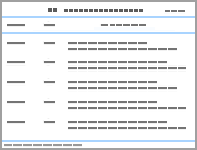
Tab.1
Total surface charge of samples with different aging conditions during 0—20 h dissipation
| 时间/h | 未老化总电荷量/μC | 120 ℃老化10天总电荷量/μC | 150 ℃老化10天总电荷量/μC | 180 ℃老化10天总电荷量/μC |
|---|---|---|---|---|
| 0 | -1.090 | -1.106 | -1.099 | -1.111 |
| 0.5 | -1.066 | -1.088 | -1.078 | -1.085 |
| 1 | -1.053 | -1.082 | -1.070 | -1.074 |
| 2 | -1.033 | -1.074 | -1.058 | -1.064 |
| 3 | -1.016 | -1.069 | -1.050 | -1.054 |
| 5 | -1.000 | -1.055 | -1.040 | -1.046 |
| 10 | -0.973 | -1.033 | -1.014 | -1.017 |
| 20 | -0.939 | -0.999 | -0.989 | -0.981 |

Fig.3
Exponential fitting of charge dissipation of four samples

Tab.2
Time constant, glass transition temperature, and volume resistivity of samples under different aging conditions
| 老化程度 | 时间 常数,t1/h | 玻璃化 转变温度/℃ | 体积电阻率/ (Ω·cm) |
|---|---|---|---|
| 未老化 | 5.3116 | 97.16 | 1.43×10¹⁶ |
| 120 ℃老化10天 | 11.0563 | 112.19 | 2.74×10¹⁶ |
| 150 ℃老化10天 | 7.8565 | 113.10 | 2.88×10¹⁶ |
| 180 ℃老化10天 | 6.7953 | 114.90 | 2.86×10¹⁶ |

Fig.4
Surface charge dissipation of unaged sample from 0 to 10 h under -20 kV applied to needle electrode

Tab.3
Remaining percentage of charge dissipation under -20 kV applied to needle electrode (0—10 h)
| 时间/h | 电荷剩余比例/% | |
|---|---|---|
| 未老化 | 180 ℃老化10天 | |
| 0 | 100 | 100 |
| 10 | 83.00 | 85.51 |

Fig.5
Surface charge dissipation of unaged sample under +10 kV applied to needle electrode (0—10 h)

Tab.4
Remaining percentage of charge dissipation at different voltage polarities (0-10 h)
| t/h | 电荷剩余比例/% | |||
|---|---|---|---|---|
| -10 kV 未老化 | +10 kV 未老化 | -10 kV 180 ℃ 10天 | +10 kV 180 ℃ 10天 | |
| 0 | 100.00 | 100.00 | 100.00 | 100.00 |
| 10 | 86.96 | 87.27 | 91.65 | 93.54 |
| [1] |
王耀港, 王哲铭, 李珂, 等. 不同主导机制下考虑表面陷阱效应的直流GIL绝缘子表面电荷积聚特性[J]. 上海交通大学学报, 2025, 59(7): 983-994.
doi: 10.16183/j.cnki.jsjtu.2023.420 |
| WANG Yaogang, WANG Zheming, LI Ke, et al. Characteristics of surface charge accumulation on DC GIL insulators under different dominant mechanisms considering surface trapping effect[J]. Journal of Shanghai Jiao Tong University, 2025, 59(7): 983-994. | |
| [2] | 黎斌. SF6高压电器设计[M]. 第5版. 北京: 机械工业出版社, 2019. |
| LI Bin. Design of SF6 high voltage electrical apparatus[M]. 5th ed. Beijing: China Machine Press, 2019. | |
| [3] |
WANG Y, BI C L, QI Z, et al. Analysis on discharge fault of busbar in 220 kV gas insulated switchgear[J]. Journal of Physics: Conference Series, 2024, 2774(1): 012060.
doi: 10.1088/1742-6596/2774/1/012060 |
| [4] | 于晓翔. 500 kV高压开关设备隔离开关绝缘拉杆故障分析[J]. 电气技术, 2021, 22(2): 54-58. |
| YU Xiaoxiang. Fault analysis of 500 kV HGIS disconnecting switch’s insulating tension pole[J]. Electrical Engineering, 2021, 22(2): 54-58. | |
| [5] | 陈静, 臧春艳, 龚禹璐, 等. 超特高压GIL三支柱绝缘子研究述评[J]. 高压电器, 2024, 60(2): 143-155. |
| CHEN Jing, ZANG Chunyan, GONG Yulu, et al. Research review on tri-post insulator for EHV/UHV GIL[J]. High Voltage Apparatus, 2024, 60(2): 143-155. | |
| [6] | WANG F, LIANG F W, CHEN S, et al. Effect of surface charges on flashover voltage-an examination considering charge decay rates[J]. IEEE Transactions on Dielectrics & Electrical Insulation, 2021, 28(3): 1053-1060. |
| [7] | CALLENDER G, GODDARD K F, LEWIN P L. Simulating surface charge dynamics[J]. IEEE Transactions on Dielectrics & Electrical Insulation, 2021, 28(1): 19-27. |
| [8] | WENDEL T, KINDERSBERGER J. Effect of surface layer on the space charge accumulation in epoxy samples under DC stress[J]. IEEE Transactions on Dielectrics & Electrical Insulation, 2020, 27(6): 1989-1997. |
| [9] | 王天宇, 李大雨, 侯易岑, 等. SiO2纳米颗粒表面接枝对环氧树脂纳米复合电介质表面电荷积聚的抑制[J]. 高电压技术, 2020, 46(12): 4129-4137. |
| WANG Tianyu, LI Dayu, HOU Yicen, et al. Suppression of surface charge accumulation of epoxy resin nanocomposites by SiO2 nanoparticle surface grafting[J]. High Voltage Engineering, 2020, 46(12): 4129-4137. | |
| [10] | MA J T, TAO F B, MA Y, et al. Quantitative analysis on the influence of surface charges on flashover of insulators in SF6[J]. IEEE Transactions on Dielectrics & Electrical Insulation, 2021, 28(1): 274-281. |
| [11] | LI G C, HU K, SUN W X, et al. The influence of thermal aging on the surface trap characteristics and surface flashover of epoxy resin[J]. Journal of Solid State Science & Technology, 2023, 12(10): 103017. |
| [12] |
PROIA A, MATTHYS S. Influence of environmental conditions on the glass transition temperature of epoxy used for strengthening applications[J]. Polymer Testing, 2019, 79: 106012.
doi: 10.1016/j.polymertesting.2019.106012 URL |
| [13] | 谢伟, 杨征, 程显, 等. 环氧树脂材料热氧老化特性研究[J]. 电工技术学报, 2020, 35(20): 4397-4404. |
| XIE Wei, YANG Zheng, CHENG Xian, et al. Study on thermo-oxygen aging characteristics of epoxy resin material[J]. Transactions of China Electrotechnical Society, 2020, 35(20): 4397-4404. | |
| [14] | 任鹏. GIS盆式绝缘子电热老化的热动力学特性与绝缘寿命预测方法[D]. 北京: 华北电力大学, 2021. |
| REN Peng. Thermodynamic characteristics and insulation life prediction method of GIS basin insulator during electrothermal aging[D]. Beijing: North China Electric Power University, 2021. | |
| [15] |
ZHANG L, LIN C J, LI C Y, et al. Gas-solid interface charge characterisation techniques for HVDC GIS/GIL insulators[J]. High Voltage, 2020, 5(2): 95-109.
doi: 10.1049/hve2.v5.2 URL |
| [16] | 毛诗壹, 潘成, 罗毅, 等. 基于混合Lanczos-Tikhonov算法的绝缘子表面电荷反演计算[J]. 电工技术学报, 2023, 38(7): 1921-1934. |
| MAO Shiyi, PAN Cheng, LUO Yi, et al. Inversion algorithm for surface charge on insulator based on hybrid Lanczos-Tikhonov algorithm[J]. Transactions of China Electrotechnical Society, 2023, 38(7): 1921-1934. | |
| [17] | WANG T Y, ZHANG G X, LI D Y, et al. MXene-doped epoxy resin to suppress surface charge accumulation on insulators in a DC gas-insulated system[J]. IEEE Transactions on Dielectrics & Electrical Insulation, 2020, 27(3): 939-946. |
| [18] |
WANG Y Q, FENG C H, FEI R Y, et al. Thermal-ageing characteristics of dry-type transformer epoxy composite insulation[J]. High Performance Polymers, 2020, 32(7): 741-752.
doi: 10.1177/0954008320906439 URL |
| [19] | CHEN S, VAN DEN BERG R G W, NIJDAM S. The effect of DC voltage polarity on ionic wind in ambient air for cooling purposes[J]. Plasma Sources Science & Technology, 2018, 27(5): 055021. |
| [20] |
GU L, TAN W, HE J, et al. Relationship between corona discharge thrust and applied voltage’s polarity[J]. Energies, 2023, 16(14): 5257.
doi: 10.3390/en16145257 URL |
| [1] | ZHANG Changhong, LI Weiguo, YANG Xu, LI Mingyang, WANG Miao, LUO Lin’gen. Digital Inference Method for Metal Particle Size Inside Gas Insulated Switchgear [J]. Journal of Shanghai Jiao Tong University, 2026, 60(4): 664-673. |
| [2] | WANG Yaogang, WANG Zheming, LI Ke, JIA Bowen, YANG Hua, YAN Wu, LU Wu. Characteristics of Surface Charge Accumulation on Direct Current GIL Insulators Under Different Dominant Mechanisms Considering Surface Trapping Effect [J]. Journal of Shanghai Jiao Tong University, 2025, 59(7): 983-994. |
| [3] | TAO Ran, SHEN Peifeng, CHEN Ting, LUO Lingen, SHENG Gehao, JIANG Xiuchen. Estimation Method of Actual Discharge Quantity Inferred from Ultra-High Frequency Signals in Digital Modeling of GIS [J]. Journal of Shanghai Jiao Tong University, 2025, 59(6): 800-811. |
| [4] | LI Jiayang, ZHAO Jiuyi, QIAN Yong, LI Guoyu, XU Zhiren, PAN Chao, SHENG Gehao. Location of Partial Discharge in GIS Based on Electromagnetic Wave Time Reversal [J]. Journal of Shanghai Jiao Tong University, 2025, 59(12): 1763-1772. |
| [5] | 1. Institute of Bio-Inspired Structure and Surface Engineering of College of Astronautics,. Fretting Wear Characteristics of Carbon Fiber Reinforced Epoxy Resin Matrix Composites in Low Temperature [J]. Journal of Shanghai Jiao Tong University, 2018, 52(5): 604-611. |
| Viewed | ||||||
|
Full text |
|
|||||
|
Abstract |
|
|||||
