

Journal of Shanghai Jiao Tong University ›› 2025, Vol. 59 ›› Issue (7): 962-970.doi: 10.16183/j.cnki.jsjtu.2023.452
• New Type Power System and the Integrated Energy • Previous Articles Next Articles
LI Xiang1, CHEN Siyuan1( ), ZHANG Jun1, KE Deping1, GAO Jiemai1, YANG Huanhuan2
Received:2023-09-07
Revised:2023-12-20
Accepted:2024-03-15
Online:2025-07-28
Published:2025-07-22
Contact:
CHEN Siyuan
E-mail:wddqcsy@whu.edu.cn
CLC Number:
LI Xiang, CHEN Siyuan, ZHANG Jun, KE Deping, GAO Jiemai, YANG Huanhuan. Physics-Informed Fast Transient Stability Assessment of Non-Fixed Length in Power Systems[J]. Journal of Shanghai Jiao Tong University, 2025, 59(7): 962-970.
Add to citation manager EndNote|Ris|BibTeX
URL: https://xuebao.sjtu.edu.cn/EN/10.16183/j.cnki.jsjtu.2023.452
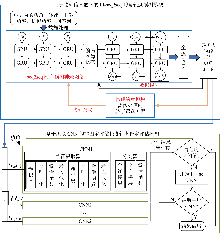
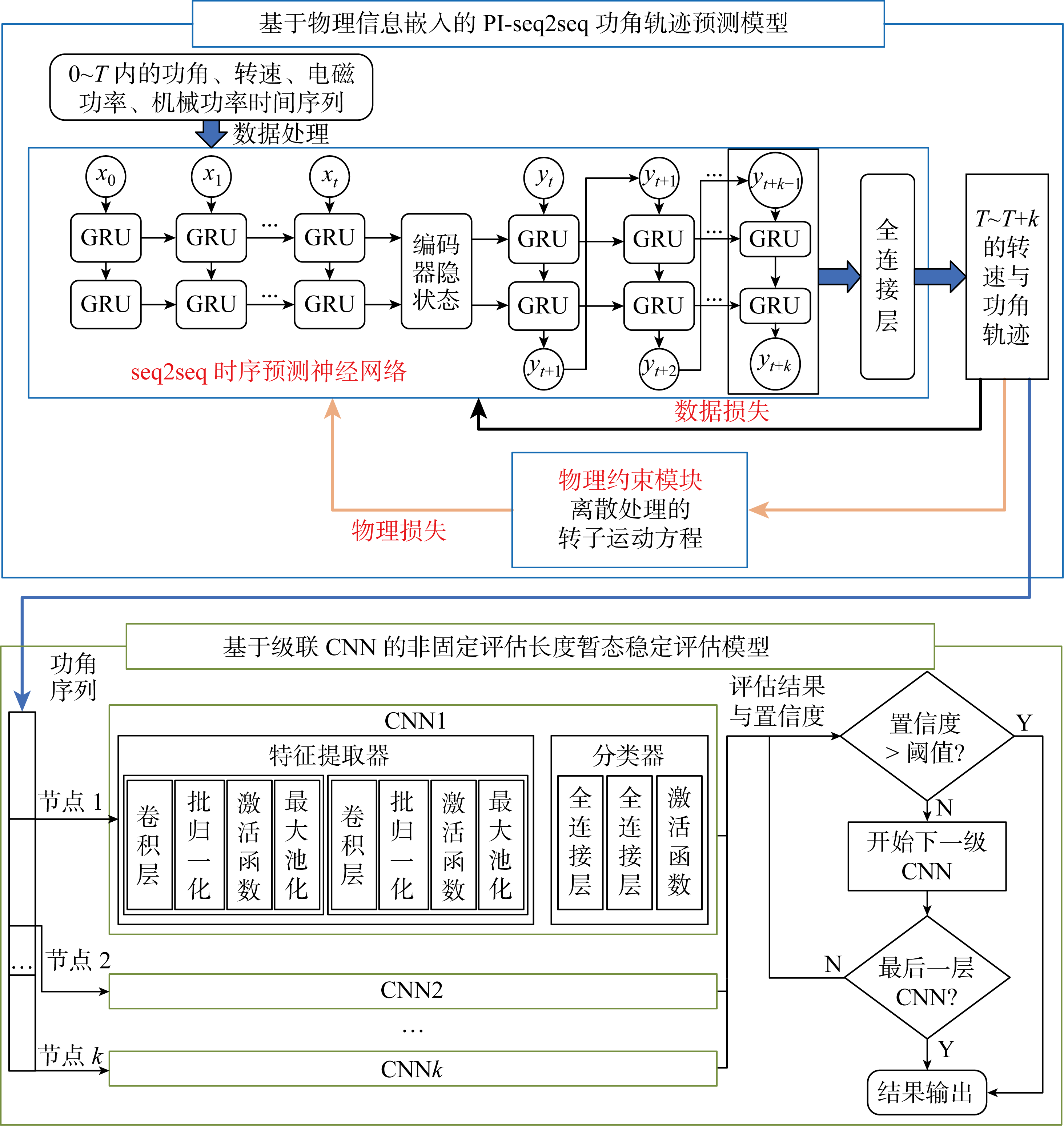
Fig.1
Framework of PI-seq2seq-CNN transient stability assessment
Tab.1
Training configuration for PI-seq2seq angle trajectory prediction model
| 参数 | 含义 | 取值 |
|---|---|---|
| Input_len | 输入长度 | 5步长 |
| Output_len | 预测长度 | 20步长 |
| Input_dim | 输入特征数量 | 20 |
| Output_dim | 输出特征数量 | 2 |
| Learning_rate | 学习率 | 3×10⁻⁴(预训练)/ 1×10⁻⁴(微调) |
| Hidden_size | 隐藏层大小 | 128 |
| Epoch | 训练轮次 | 80 |
| Batch_size | 训练批次大小 | 64 |
| Optimizer | 优化器 | Adam |
| Loss function | 损失函数 | RMSE |
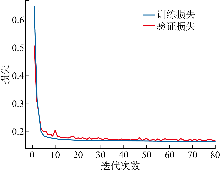
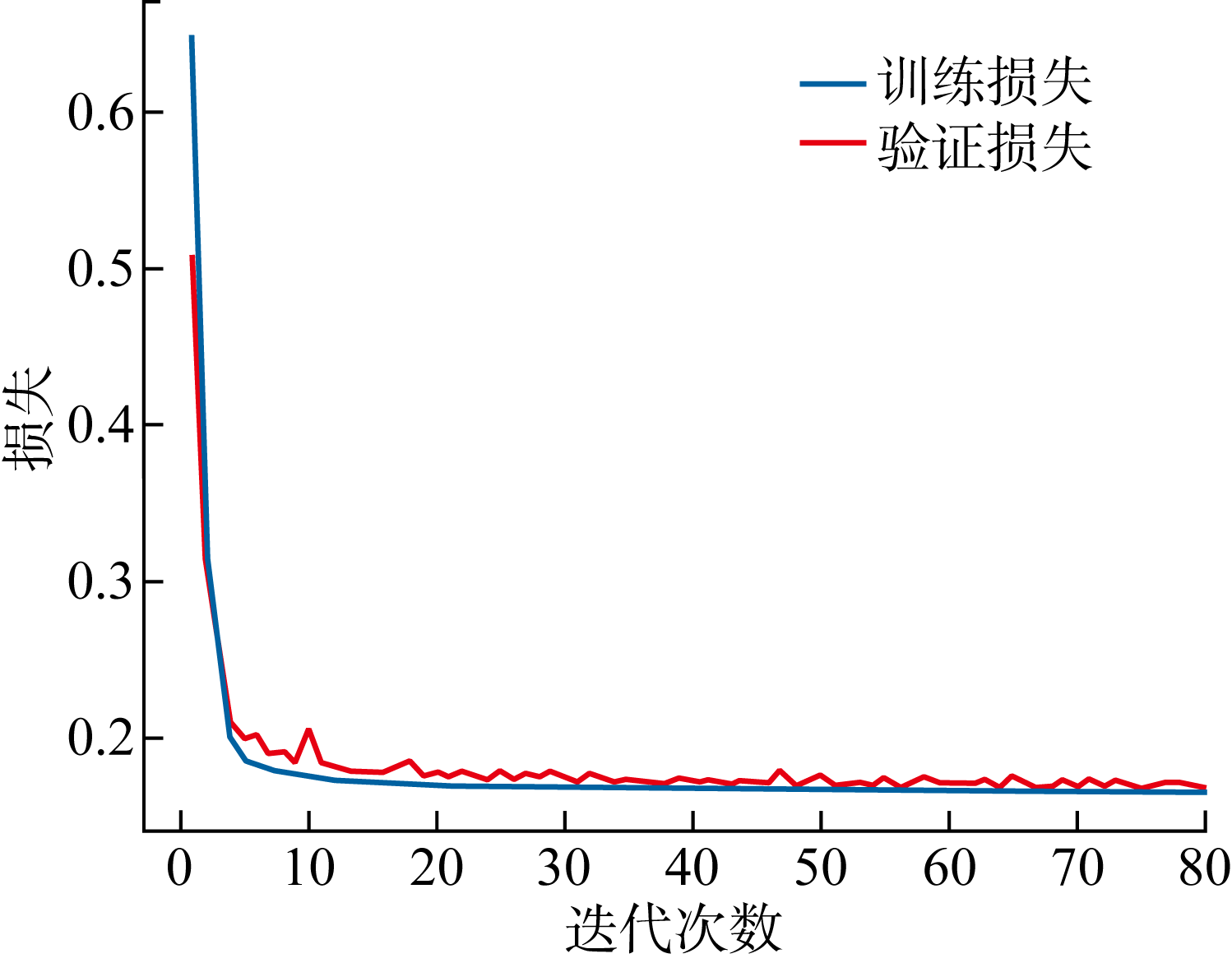
Fig.2
Loss curves of angle trajectory prediction model PI-seq2seq (RK4)
Tab.2
Test errors of different angle trajectory prediction models
| 模型 序号 | 模型 | 平均绝对误差 | 均方误差 | 平均相对 误差/% |
|---|---|---|---|---|
| 1 | seq2seq | 5.531×10⁻³ | 8.412×10⁻⁵ | 0.7226 |
| 2 | PI-seq2seq(Euler) | 5.199×10⁻³ | 8.975×10⁻⁵ | 0.4820 |
| 3 | PI-seq2seq(RK4) | 4.359×10⁻³ | 7.117×10⁻⁵ | 0.4189 |
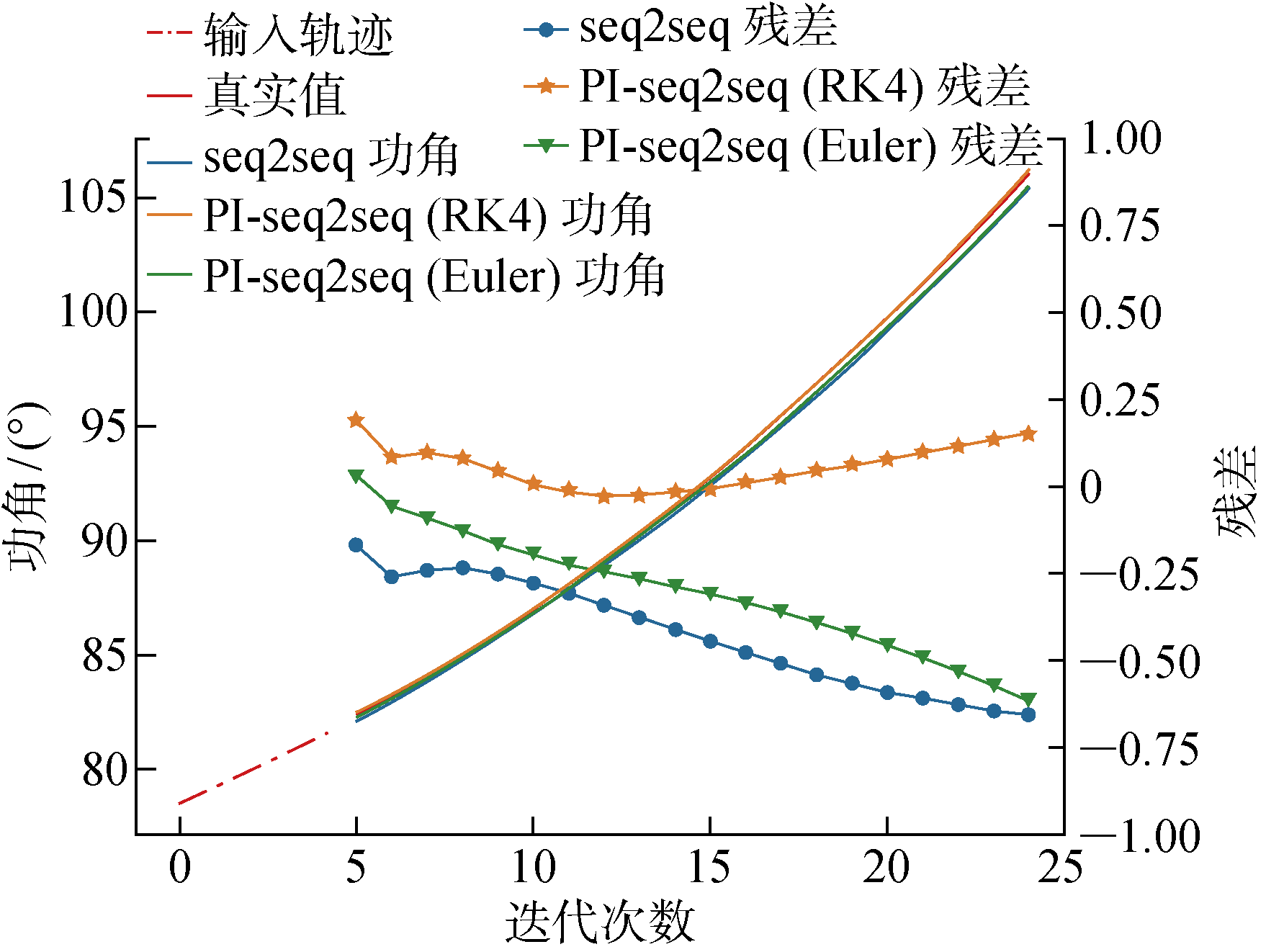
Fig.3
Prediction results of three models
Tab.3
Comparison of time consumption of time-domain simulations
| 计算长度 | Andes时域仿真 平均耗时/s | PI-seq2seq(RK4) 平均耗时/s |
|---|---|---|
| 0.3 s功角曲线 | 0.3480 | 0.0199 |
| 0.5 s功角曲线 | 0.5300 | 0.0215 |
Tab.4
Training configuration for cascade CNN transient stability assessment model
| 参数 | 含义 | 取值 |
|---|---|---|
| Kernal size | 卷积核大小 | 3×3 |
| Learning_rate | 学习率 | 3×10⁻⁴ |
| Epoch | 训练轮次 | 100 |
| Batch_size | 训练批次大小 | 64 |
| Optimizer | 优化器 | Adam |
| Loss function | 损失函数 | 交叉熵损失 |
Tab.5
Evaluation results of cascaded CNN TSA model %
| 层级 | 准确率 | 查准率 | 查全率 | F1 |
|---|---|---|---|---|
| CNN1 | 97.28 | 90.74 | 95.14 | 92.89 |
| CNN2 | 98.73 | 95.23 | 97.09 | 96.15 |
| CNN3 | 99.27 | 98.05 | 98.05 | 98.05 |
Tab.6
Results of cascade CNN assessment %
| 层级 | 满足阈值 占比 | 准确率 | 查准率 | 查全率 | F1 |
|---|---|---|---|---|---|
| CNN1 | 95.47 | 95.28 | 100 | 83.01 | 89.25 |
| CNN2 | 97.37 | 97.83 | 97.22 | 98.91 | 98.04 |
| CNN3 | 100 | 99.09 | 96.65 | 98.06 | 97.35 |
| [1] | 中华人民共和国国家能源局. 国家能源局2023年一季度新闻发布会文字实录[EB/OL]. (2023-02-13)[2023-8-28]. http://www.nea.gov.cn/2023-02/13/c_1310697149.htm. |
| National Energy Administration of the People’s Republic of China. Transcript of the National Energy Administration’s press conference for the first quarter of 2023[EB/OL]. (2023-02-13)[2023-8-28]. http://www.nea.gov.cn/2023-02/13/c_1310697149.htm. | |
| [2] | 何剑, 屠竞哲, 孙为民, 等. 美国加州“8·14” 、“8·15” 停电事件初步分析及启示[J]. 电网技术, 2020, 44(12): 4471-4478. |
| HE Jian, TU Jingzhe, SUN Weimin, et al. Preliminary analysis and lessons of California power outage events on August 14 and 15, 2020[J]. Power System Technology, 2020, 44(12): 4471-4478. | |
| [3] | 樊陈, 姚建国, 张琦兵, 等. 英国“8·9” 大停电事故振荡事件分析及思考[J]. 电力工程技术, 2020, 39(4): 34-41. |
| FAN Chen, YAO Jianguo, ZHANG Qibing, et al. Reflection and analysis for oscillation of the blackout event of 9 August 2019 in UK[J]. Electric Power Engineering Technology, 2020, 39(4): 34-41. | |
| [4] | 王伟胜, 林伟芳, 何国庆, 等. 美国得州2021年大停电事故对我国新能源发展的启示[J]. 中国电机工程学报, 2021, 41(12): 4033-4043. |
| WANG Weisheng, LIN Weifang, HE Guoqing, et al. Enlightenment of 2021 texas blackout to the renewable energy development in China[J]. Proceedings of the CSEE, 2021, 41(12): 4033-4043. | |
| [5] | 肖先勇, 郑子萱. “双碳” 目标下新能源为主体的新型电力系统:贡献、关键技术与挑战[J]. 工程科学与技术, 2022, 54(1): 47-59. |
| XIAO Xianyong, ZHENG Zixuan. New power systems dominated by renewable energy towards the goal of emission peak & carbon neutrality: Contribution, key techniques, and challenges[J]. Advanced Engineering Sciences, 2022, 54(1): 47-59. | |
| [6] |
舒印彪, 陈国平, 贺静波, 等. 构建以新能源为主体的新型电力系统框架研究[J]. 中国工程科学, 2021, 23(6): 61-69.
doi: 10.15302/J-SSCAE-2021.06.003 |
|
SHU Yinbiao, CHEN Guoping, HE Jingbo, et al. Building a new electric power system based on new energy sources[J]. Strategic Study of CAE, 2021, 23(6): 61-69.
doi: 10.15302/J-SSCAE-2021.06.003 |
|
| [7] | 杨博, 陈义军, 姚伟, 等. 基于新一代人工智能技术的电力系统稳定评估与决策综述[J]. 电力系统自动化, 2022, 46(22): 200-223. |
| YANG Bo, CHEN Yijun, YAO Wei, et al. Review on stability assessment and decision for power systems based on new-generation artificial intelligence technology[J]. Automation of Electric Power Systems, 2022, 46(22): 200-223. | |
| [8] | 赵恺, 石立宝. 基于改进一维卷积神经网络的电力系统暂态稳定评估[J]. 电网技术, 2021, 45(8): 2945-2957. |
| ZHAO Kai, SHI Libao. Transient stability assessment of power system based on improved one-dimensional convolutional neural network[J]. Power System Technology, 2021, 45(8): 2945-2957. | |
| [9] | 张亮, 安军, 周毅博. 基于时间卷积和图注意力网络的电力系统暂态稳定评估[J]. 电力系统自动化, 2023, 47(7): 114-122. |
| ZHANG Liang, AN Jun, ZHOU Yibo. Transient stability assessment of power system based on temporal convolution and graph attention network[J]. Automation of Electric Power Systems, 2023, 47(7): 114-122. | |
| [10] | 李志兵, 肖健梅, 王锡淮. 基于多粒度NRS和改进Bi-LSTM的电力系统暂态稳定评估[J]. 电气工程学报, 2023, 18(3): 232-241. |
| LI Zhibing, XIAO Jianmei, WANG Xihuai. Transient stability assessment of power system based on multi-granularity neighborhood rough set and improved bi-directional long-short-term memory network[J]. Journal of Electrical Engineering, 2023, 18(3): 232-241. | |
| [11] | ZHOU Y Z, GUO Q L, SUN H B, et al. A novel data-driven approach for transient stability prediction of power systems considering the operational variability[J]. International Journal of Electrical Power & Energy Systems, 2019, 107: 379-394. |
| [12] | RAISSI M, PERDIKARIS P, KARNIADAKIS G E. Physics-informed neural networks: A deep learning framework for solving forward and inverse problems involving nonlinear partial differential equations[J]. Journal of Computational Physics, 2019, 378: 686-707. |
| [13] | MISYRIS G S, VENZKE A, CHATZIVASILEIADIS S. Physics-informed neural networks for power systems[C]// 2020 IEEE Power & Energy Society General Meeting. Montreal, Canada: IEEE, 2020: 1-5. |
| [14] | MANSOURLAKOURAJ M, GAUTAM M, HOSSAIN R, et al. Event classification in active distribution grids using physics-informed graph neural network and PMU measurements[C]// 2022 IEEE Industry Applications Society Annual Meeting. Detroit, USA: IEEE, 2022: 1-6. |
| [15] | PLANT R, BABAZADEH D, STOCK S, et al. Real-time inertia estimation in an inverter-dominated distribution grid using a physics-informed recurrent neural network[C]// CIRED Porto Workshop 2022:E-mobility and power distribution systems. Porto, Portugal: IET, 2022: 940-944. |
| [16] | 陈颖, 高仕林, 宋炎侃, 等. 面向新型电力系统的高性能电磁暂态云仿真技术[J]. 中国电机工程学报, 2022, 42(8): 2854-2864. |
| CHEN Ying, GAO Shilin, SONG Yankan, et al. High-performance electromagnetic transient simulation for new-type power system based on cloud computing[J]. Proceedings of the CSEE, 2022, 42(8): 2854-2864. | |
| [17] | YU J J Q, HILL D J, LAM A Y S, et al. Intelligent time-adaptive transient stability assessment system[J]. IEEE Transactions on Power Systems, 2018, 33(1): 1049-1058. |
| [18] | CHEN Q F, WANG H Y. Time-adaptive transient stability assessment based on gated recurrent unit[J]. International Journal of Electrical Power & Energy Systems, 2021, 133: 107156. |
| [19] | 张若愚. 基于卷积神经网络的电力系统暂态稳定评估[D]. 北京: 北京交通大学, 2020. |
| ZHANG Ruoyu. Power system transient stability assessment based on convolutional neural networks[D]. Beijing: Beijing Jiaotong University, 2020. | |
| [20] | 李福成, 徐箭, 廖思阳, 等. 基于样本关注度和多层次特征的多阶段电力系统暂态稳定评估[J]. 中国电机工程学报, 2021, 41(22): 7596-7608. |
| LI Fucheng, XU Jian, LIAO Siyang, et al. Multi-stage power system transient stability assessment based on sample attention and hierarchical features[J]. Proceedings of the CSEE, 2021, 41(22): 7596-7608. | |
| [21] | ZHANG H B, XIANG W, LIN W X, et al. Grid forming converters in renewable energy sources dominated power grid: Control strategy, stability, application, and challenges[J]. Journal of Modern Power Systems & Clean Energy, 2021, 9(6): 1239-1256. |
| [22] | 中华人民共和国国家市场监督管理总局, 国家标准化管理委员会. 电力系统安全稳定导则: GB 38755—2019[S]. 北京: 中国标准出版社, 2019. |
| State Administration for Market Regulation, Standardization Administration of the People’s Republic of China. Code on security and stability for power system: GB 38755—2019[S]. Beijing: Standards Press of China, 2019. | |
| [23] | CUI H T, LI F X, TOMSOVIC K. Hybrid symbolic-numeric framework for power system modeling and analysis[J]. IEEE Transactions on Power Systems, 2021, 36(2): 1373-1384. |
| [1] | ZENG Jupeng, ZENG Xiangjun, BAI Hao, YU Kun, YANG Weichen, LONG Xuanlin, ZHUANG Jie. Fault Location Method for Active Distribution Networks Based on Holographic-Mapping of Time-Frequency Traveling Waves [J]. Journal of Shanghai Jiao Tong University, 2026, 60(2): 256-269. |
| [2] | SHEN Bing, CHAI Wei, WANG Kai, LI Xiaoyuan, LÜ Jing. Oscillation Suppression Method of Power Electronic Alternating Current Distribution System Based on Weak Point Location [J]. Journal of Shanghai Jiao Tong University, 2026, 60(1): 32-41. |
| [3] | ZHANG Yu, ZHANG Chen, LIU Hui, YU Siqi, WU Linlin, CAI Xu. Mechanism of Power Transfer Limit Under Multiple Electrical Constraints for Grid-Connected New Energy Units and Full-Power Operation Conditions in Weak Grids [J]. Journal of Shanghai Jiao Tong University, 2026, 60(1): 19-31. |
| [4] | BAI Feng, CHEN Wuhui, QIN Wei. Sub-Synchronous Oscillations Caused by Interaction of a PMSG-Based Wind Farm with a Four-Terminal MMC-HVDC Grid [J]. Journal of Shanghai Jiao Tong University, 2025, 59(11): 1707-1719. |
| [5] | REN Xiancheng, LI Shangzhi, LI Yingbiao, HU Jiabing, XU Taishan, BAO Yanhong, WU Feng. Transient Modeling and Characteristic Comparative Analysis of Grid-Forming VSC with and Without Current Control [J]. Journal of Shanghai Jiao Tong University, 2025, 59(7): 971-982. |
| [6] | WU Shuangxi, LI Wenbo, QIN Yingjie, YAN Binjie, LI Jiapeng, LI Yujun. Quantization and Enhancement of System Frequency Nadir in Power Step Control [J]. Journal of Shanghai Jiao Tong University, 2025, 59(6): 857-866. |
| [7] | WANG Yuyang, ZHANG Chen, ZHANG Yu, WANG Yiming, XU Po, CAI Xu. Reactive Power-Voltage Droop Gain Online Tuning Method of Photovoltaic Inverters for Improvement of Stable Output Power Capability in Weak Grids [J]. Journal of Shanghai Jiao Tong University, 2025, 59(6): 845-856. |
| [8] | SI Wenjia, CHEN Junru, ZHANG Chenglin, LIU Muyang. Influence of DC-Bus Voltage on Synchronization Stability of Grid-Following Converters [J]. Journal of Shanghai Jiao Tong University, 2025, 59(3): 313-322. |
| [9] | LI Hongxin, ZHONG Zuhao, LU Yi, WEN Yunfeng. Optimization of Frequency Control Parameters of Wind Farms Considering Inertia Security Requirement [J]. Journal of Shanghai Jiao Tong University, 2025, 59(3): 323-332. |
| [10] | ZONG Haoxiang, ZHANG Chen, BAO Yanhong, WU Feng, CAI Xu. Frequency-Domain Modeling and Synchronization Perspective Interaction Mechanism of GFL-GFM Converter System [J]. Journal of Shanghai Jiao Tong University, 2025, 59(2): 151-164. |
| [11] | ZHANG Yu, ZHANG Chen, BAO Yanhong, WU Feng, CAI Xu. Transient Frequency Interaction Between Grid-Following and Grid-Forming Sources in Windfarm Under Severe Grid Faults [J]. Journal of Shanghai Jiao Tong University, 2024, 58(12): 1903-1914. |
| [12] | ZHOU Tao, HUANG Ju, HAN Rushuai, HU Qinran, QUAN Hao. Inertial Support Capacity Analysis and Equivalent Inertia Estimation of Wind Turbines in Integrated Inertial Control [J]. Journal of Shanghai Jiao Tong University, 2024, 58(12): 1915-1924. |
| [13] | DENG Xiaoyu, LIU Muyang, CHANG Xiqiang, NAN Dongliang, MO Ruo, CHEN Junru. Online Monitoring Method for Inertial Support Capacity of Point-to-Grid in New Power Systems [J]. Journal of Shanghai Jiao Tong University, 2024, 58(9): 1390-1399. |
| [14] | LUO Min, YANG Jinfeng, YU Hui, LAI Yuchen, GUO Yangyun, ZHOU Shangli, XIANG Rui, TONG Xing, CHEN Xiao. TPE-Based Boosting Short-Term Load Forecasting Method [J]. Journal of Shanghai Jiao Tong University, 2024, 58(6): 819-825. |
| [15] | BI Zhongqin, YU Xiaowan, WANG Baonan, HUANG Wentao, ZHANG Dan, DONG Zhen. Fast Fault Location Technology for Distribution Network Based on Quantum Ant Colony Algorithm [J]. Journal of Shanghai Jiao Tong University, 2024, 58(5): 693-708. |
| Viewed | ||||||
|
Full text |
|
|||||
|
Abstract |
|
|||||
