

上海交通大学学报 ›› 2026, Vol. 60 ›› Issue (3): 486-498.doi: 10.16183/j.cnki.jsjtu.2024.280
邵润珠1, 滕金芳1( ), 樊琳2, 钟勇健3, 居振州2, 朱铭敏1
收稿日期:2024-07-12
修回日期:2024-08-07
接受日期:2024-09-04
出版日期:2026-03-28
发布日期:2026-03-30
通讯作者:
滕金芳,研究员,博士生导师,电话(Tel.):021-34206191;E-mail:作者简介:邵润珠(1994—),博士生,从事叶轮机械气动热力学研究.
基金资助:
SHAO Runzhu1, TENG Jinfang1(), FAN Lin2, ZHONG Yongjian3, JU Zhenzhou2, ZHU Mingmin1
Received:2024-07-12
Revised:2024-08-07
Accepted:2024-09-04
Online:2026-03-28
Published:2026-03-30
摘要:
压气机静叶根部内环蜂窝与轮盘篦齿形成封严容腔,腔内的间隙泄漏流对轴流压气机的气动性能产生重要影响.本文以低速大尺寸压气机前1.5级为研究对象,通过数值模拟讨论了蜂窝封严相较于光壁结构对压气机气动性能的影响以及在两种篦齿封严间隙下蜂窝封严结构的气动性能差异.性能计算结果表明:0.2 mm封严间隙下,使用蜂窝内环结构的压气机效率低于使用光壁内环的压气机,原因在于容腔泄流导致总温升高.容腔泄漏流特性对比及详细流场分析表明:蜂窝结构使得容腔泄漏流量和旋流角同时增加,容腔以及蜂窝内的气流产生强烈相互作用,从而形成更复杂的漩涡流动,使封严容腔和蜂窝内总温升高,最终导致压气机效率降低.使用蜂窝内环结构时,压气机效率会随封严间隙的减小而升高.零间隙蜂窝模型和0.2 mm间隙蜂窝模型相比,其总温比的下降导致等熵效率上升;零间隙模型泄漏流量和旋流角都大幅降低,综合导致泄漏流掺混损失基本相当;零间隙模型虽然由于间隙的减小使得泄漏流平均总温上升,但由于泄漏流量的大幅减少,压气机效率有所升高.研究结果揭示了在实际压气机中,不同间隙下静叶蜂窝与篦齿封严结构的泄漏流对性能的影响及其机理,并对蜂窝封严容腔的工程设计具有一定参考价值.
中图分类号:
邵润珠, 滕金芳, 樊琳, 钟勇健, 居振州, 朱铭敏. 低速大尺寸压气机静叶蜂窝与篦齿间隙泄漏流[J]. 上海交通大学学报, 2026, 60(3): 486-498.
SHAO Runzhu, TENG Jinfang, FAN Lin, ZHONG Yongjian, JU Zhenzhou, ZHU Mingmin. Leakage Flow in Honeycomb-Labyrinth Seal Cavity in Stator of Low-Speed Research Compressor[J]. Journal of Shanghai Jiao Tong University, 2026, 60(3): 486-498.

图1
LSRC示意图

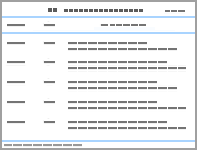
表1
LSRC前1.5级叶片的设计参数
| 结构 | 流量系数 | 叶片数 | 设计转速/(r·min-1) | 弦长(中径)/mm | 轮毂比 | 稠度(中径) | 展弦比(中径) |
|---|---|---|---|---|---|---|---|
| IGV | 0.467 | 42 | 81.3 | 0.88 | 0.77 | 1.11 | |
| R1 | 0.467 | 52 | 900 | 113.3 | 0.88 | 1.33 | 0.79 |
| S1 | 0.467 | 78 | 73.7 | 0.88 | 1.30 | 1.22 |

图2
带篦齿封严容腔的LSRC 前1.5级压气机计算域


图3
数值模拟方法对压气机总体特性预测的验证


图4
近失速工况下不同叶高的无量纲静压梯度和无量纲径向涡量分布


图5
带封严容腔的LSRC压气机静子叶片出口总压分布对比


图6
光壁模型与蜂窝模型的1.5级压气机总体特性


图7
50%叶高以下蜂窝模型和光壁模型静叶总压损失系数偏差、出口气流角偏差和熵增系数偏差径向分布


图8
有无蜂窝内环的静叶出口总压比和气流角分布


图9
有无蜂窝内环的静叶吸力面表面静压和极限流线分布


图10
蜂窝模型和光壁模型的总温比差在静子通道子午面上的云图分布


图11
蜂窝模型和光壁模型容腔出口泄漏流总温比和径向速度分布


图12
蜂窝模型和光壁模型泄漏流相对流量、旋流角和总温比特性


图13
蜂窝模型和光壁模型容腔内总温比和二维流线分布


图14
两种间隙蜂窝模型的1.5级压气机总体特性


图15
50%叶高以下0.2 mm间隙模型和零间隙模型的静叶总压损失系数偏差、出口气流角偏差和熵增系数偏差径向分布


图16
不同封严间隙的静叶出口总压比和气流角分布


图17
不同封严间隙的静叶吸力面表面静压和极限流线分布


图18
0.2 mm间隙模型和零间隙模型的静叶通道总温比差在子午面的分布


图19
不同封严间隙的容腔出口泄漏流总温比和径向速度分布


图20
不同封严间隙的泄漏流相对流量、旋流角和总温比特性


图21
不同间隙的容腔内总温比和二维流线分布

| [1] | HEIDEGGER N, HALL E, DELANEY R. Parameterized study of high-speed compressor seal cavity flow[C]// 32nd Joint Propulsion Conference & Exhibit. Lake Buena Vista, USA: AIAA, 1996: AIAA 1996-2807. |
| [2] |
WELLBORN S R, OKIISHI T H. The influence of shrouded stator cavity flows on multistage compressor performance[J]. Journal of Turbomachinery, 1999, 121(3): 486-497.
doi: 10.1115/1.2841341 URL |
| [3] | KIM J W, SONG S J, KIM T. Streamwise evolution of loss in a shrouded axial compressor cascade passage[J]. Journal of Propulsion & Power, 2011, 27(4): 884-889. |
| [4] | FARKAS B, DE WYER N V, BROUCKAERT J F. Numerical study on the effect of seal leakage flow on low pressure axial compressor performance[C]// ASME Turbo Expo 2013:Turbine Technical Conference & Exposition. San Antonio, USA: ASME, 2013: V06AT35A039. |
| [5] |
YOON S, SELMEIER R, CARGILL P, et al. Effect of the stator hub configuration and stage design parameters on aerodynamic loss in axial compressors[J]. Journal of Turbomachinery, 2015, 137(9): 091001.
doi: 10.1115/1.4029598 URL |
| [6] | DE DOMINICIS I, ROBENS S, WOLFRUM N, et al. Interacting effects in a multistage axial compressor using shrouded and cantilevered stators[J]. Journal of Propulsion & Power, 2021, 37(4): 615-624. |
| [7] | KAMDAR N, LOU F Y, KEY N L. Details of shrouded stator hub cavity flow in a multi-stage axial compressor part 1: Interactions with the primary flow[C]// ASME Turbo Expo 2021: Turbomachinery Technical Conference & Exposition. Virtual, Online:ASME, 2021: V02AT31A041. |
| [8] | KAMDAR N, LOU F Y, KEY N L. Details of shrouded stator hub cavity flow in a multistage axial compressor part 2: Leakage flow characteristics in stator wells[J]. Journal of Engineering for Gas Turbines & Power, 2022, 144: 011027. |
| [9] | KONG X Z, LIU Y X, LIU G W, et al. Attempts on the reduction of leakage flow through the stator well in an axial compressor[J]. Journal of Engineering for Gas Turbines & Power, 2019, 141(8): 082501. |
| [10] |
KONG X Z, LIU Y X, LU H W, et al. Performance analysis of inter-stage leakage flows at rotating conditions in an axial compressor[J]. Journal of Thermal Science, 2020, 29(6): 1558-1568.
doi: 10.1007/s11630-020-1378-z |
| [11] | 孔晓治, 黄天硕, 刘育心, 等. 不同来流附面层厚度下容腔泄漏流对围带式静叶性能影响[J]. 航空动力学报, 2023, 38(1): 184-196. |
| [14] | WRÓBLEWSKI W, FRĄCZEK D, MARUGI K. Leakage reduction by optimisation of the straight-through labyrinth seal with a honeycomb and alternative land configurations[J]. International Journal of Heat & Mass Transfer, 2018, 126: 725-739. |
| [15] | XU W F, WANG Z M, SUN D, et al. Numerical and experimental study on the influence of honeycomb bushing wear on the leakage flow characteristics of labyrinth seal[J]. Journal of Engineering for Gas Turbines & Power, 2024, 146(8): 081021. |
| [16] | 陈远翔. 不同转速下蜂窝篦齿封严的泄漏与风阻温升特性研究[D]. 南京: 南京航空航天大学, 2021. |
| CHEN Yuanxiang. Research on the leakage and windage heating characteristics of labyrinth seal with honeycomb land at varying rotational speeds[D]. Nanjing: Nanjing University of Aeronautics and Astronautics, 2021. | |
| [17] | 王泽铭, 徐文峰, 任国哲, 等. 蜂窝衬套对篦齿封严静力与动力特性影响机理研究[J]. 推进技术, 2024, 45(2): 166-177. |
| WANG Zeming, XU Wenfeng, REN Guozhe, et al. Influence mechanism of honeycomb bushing on static and dynamic characteristics of labyrinth seal[J]. Journal of Propulsion Technology, 2024, 45(2): 166-177. | |
| [18] |
WALLIN S, JOHANSSON A V. An explicit algebraic Reynolds stress model for incompressible and compressible turbulent flows[J]. Journal of Fluid Mechanics, 2000, 403: 89-132.
doi: 10.1017/S0022112099007004 URL |
| [19] | ZHENG B J, SHAO R Z, ZHANG S A, et al. Optimization and experimental study of stationary endwall of stator labyrinth cavity in a low-speed research compressor[J]. Aerospace Science & Technology, 2024, 147: 109036. |
| [20] |
SHAO R Z, HE X, ZHU M M, et al. Characterizing shrouded stator cavity flow on the performance of a single-stage axial transonic compressor[J]. Journal of Turbomachinery, 2023, 145(11): 111004.
doi: 10.1115/1.4063296 URL |
| [11] | KONG Xiaozhi, HUANG Tianshuo, LIU Yuxin, et al. Influences of the cavity leakage flow on shrouded stator performance at different inlet boundary layer thicknesses[J]. Journal of Aerospace Power, 2023, 38(1): 184-196. |
| [12] | STOCKER H L, COX D M, HOLLE G F. Aerodynamic performance of conventional and advanced design labyrinth seals with solid-smooth abradable, and honeycomb lands[R]. Indianapolis, USA: NASA Lewis Research Center, 1977. |
| [13] |
ALIZADEH M, NIKKHAHI B, FARAHANI A S, et al. Numerical study on the effect of geometrical parameters on the labyrinth-honeycomb seal performance[J]. Proceedings of the Institution of Mechanical Engineers, Part G: Journal of Aerospace Engineering, 2018, 232(2): 362-373.
doi: 10.1177/0954410017742227 URL |
| [1] | 刘洋佐, 徐诚, 马吴宁, 任杰, 张震东. 小口径弹丸侵彻双箭头负泊松比蜂窝夹芯结构的弹道特性[J]. 上海交通大学学报, 2025, 59(1): 139-150. |
| [2] | 余意. 一种海上风电场单桩基础的冲刷治理技术及施工[J]. 海洋工程装备与技术, 2025, 12(1): 94-99. |
| [3] | 邓贺方, 夏凯龙, 滕金芳, 羌晓青, 朱铭敏, 卢少鹏. 不同转速下沟槽型机匣对跨声速压气机性能的影响[J]. J Shanghai Jiaotong Univ Sci, 2024, 29(6): 1151-1160. |
| [4] | 吴亚东, 李涛, 张永杰. 基于圆弧斜缝处理机匣的压气机叶顶泄漏流实验和数值研究[J]. 上海交通大学学报, 2020, 54(7): 745-755. |
| [5] | 张勇, 闫晓刚, 曾意, 赖雄鸣. 不同冲击工况下蜂窝填充薄壁结构的耐撞性能[J]. 上海交通大学学报, 2019, 53(1): 77-84. |
| [6] | 杨德庆,张相闻,吴秉鸿. 负泊松比效应防护结构抗爆抗冲击性能影响因素[J]. 上海交通大学学报, 2018, 52(4): 379-387. |
| [7] | 刘迪迪1,2,林基明3,王俊义3,仇洪冰3,彭捷1. 蜂窝网络中能量收集基站的能量协作算法[J]. 上海交通大学学报, 2018, 52(3): 365-372. |
| [8] | 许晖,刘涛,雷烨. 夹芯厚度与真空度对蜂窝夹层隔声特性的影响[J]. 上海交通大学学报, 2017, 51(9): 1071-1075. |
| [9] | 赵刚1,竺晓程1,何磊2,王姣2,黄启鹤2,杜朝辉1. 机匣附面层对涡轮转子叶顶流动及换热的影响[J]. 上海交通大学学报(自然版), 2014, 48(09): 1279-1285. |
| 阅读次数 | ||||||
|
全文 |
|
|||||
|
摘要 |
|
|||||
