

Journal of Shanghai Jiao Tong University ›› 2026, Vol. 60 ›› Issue (3): 408-417.doi: 10.16183/j.cnki.jsjtu.2024.124
• Naval Architecture, Ocean and Civil Engineering • Previous Articles Next Articles
YU Kai1, CHENG Chen1, SHI Guangyu1( ), LIU Dengcheng2, WANG Chao3
Received:2024-04-12
Revised:2024-06-14
Accepted:2024-09-04
Online:2026-03-28
Published:2026-03-30
CLC Number:
YU Kai, CHENG Chen, SHI Guangyu, LIU Dengcheng, WANG Chao. Numerical Study on Cavitation Characteristics of Propeller Under Oblique Flow Conditions[J]. Journal of Shanghai Jiao Tong University, 2026, 60(3): 408-417.
Add to citation manager EndNote|Ris|BibTeX
URL: https://xuebao.sjtu.edu.cn/EN/10.16183/j.cnki.jsjtu.2024.124
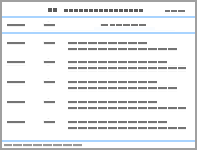
Tab.1
Main scale and parameters of PC456 propeller model
| 参数 | 取值 |
|---|---|
| 螺旋桨直径,D/m | 0.250 |
| 0.7R处螺距比,(P/D)0.7R | 0.700 |
| 盘面比,AE/A0 | 0.559 |
| 毂径比,d/D | 0.147 |
| 0.7R处弦长,C0.7R/mm | 77.288 |
| 0.7R处最大厚度,T0.7R/mm | 4.125 |
| 侧斜角,θs/(°) | 20 |

Fig.1
Model of PC456 propeller


Fig.2
Arrangement of experimental setup

Tab.2
Main test instruments and parameters
| 仪器名称 | 型号 | 量程 | 不确定 度/% |
|---|---|---|---|
| 动力仪 | H51 | 推力:3 000 N | 0.2 |
| 转矩:200 N·m | 0.2 | ||
| 压力测量变送器 | 3151DP | 0.2 MPa | 0.3 |
| 水速测量变送器 | 1151DP | 0.3 MPa | 0.3 |
| 频率计 | FC4-490F | 10.0 MHz | 0.1 |
| 直流放大器 | DH3840H | 0~10.0 V | — |
| 空气含量仪 | Van-slyke | 0.1~1.0 | 0.2 |
| 实时信号分析仪 | SP-01 | 0~80 kHz | — |

Fig.3
Computational domain of cavitation flow


Fig.4
Computational grid


Fig.5
Y+ distribution on propeller surface


Fig.6
Local mesh refinement

Tab.3
Grid information
| 网格 | 网格尺寸 | 网格总数 | |
|---|---|---|---|
| 桨叶表面 | 旋转区域 | ||
| G1 | 0.004 6D | 0.018 4D | 1 220 201 |
| G2 | 0.003 4D | 0.013 6D | 2 723 755 |
| G3 | 0.002 6D | 0.010 4D | 4 860 005 |
Tab.4
Thrust coefficients and torque coefficients of calculation results of each grid
| 网格 | KT | 10KQ | |||||
|---|---|---|---|---|---|---|---|
| 模拟值 | 实验值 | 误差/% | 模拟值 | 实验值 | 误差/% | ||
| G1 | 0.172 9 | 0.169 1 | 2.23 | 0.211 3 | 0.202 8 | 4.17 | |
| G2 | 0.172 0 | 0.169 1 | 1.75 | 0.209 0 | 0.202 8 | 3.06 | |
| G3 | 0.171 4 | 0.169 1 | 1.35 | 0.207 6 | 0.202 8 | 2.38 | |
Tab.5
Numerical results of hydrodynamic forces of PC456 propeller under oblique flow conditions
| α/(°) | σv | KT | 10KQ | |||||
|---|---|---|---|---|---|---|---|---|
| 模拟值 | 实验值 | 误差/% | 模拟值 | 实验值 | 误差/% | |||
| 0 | 7.27 | 0.169 5 | 0.166 4 | 1.86 | 0.206 2 | 0.200 8 | 2.69 | |
| 8.49 | 0.169 7 | 0.171 6 | -1.11 | 0.206 6 | 0.204 9 | 0.83 | ||
| 10.53 | 0.169 8 | 0.173 8 | -2.30 | 0.206 5 | 0.207 1 | -0.29 | ||
| 常压 | 0.170 7 | 0.173 5 | -1.61 | 0.207 4 | 0.208 0 | -0.29 | ||
| 7 | 7.27 | 0.169 3 | 0.162 2 | 4.39 | 0.206 0 | 0.196 5 | 4.82 | |
| 8.49 | 0.171 4 | 0.169 1 | 1.35 | 0.207 6 | 0.202 8 | 2.38 | ||
| 10.53 | 0.171 8 | 0.176 4 | -2.61 | 0.208 5 | 0.209 7 | -0.55 | ||
| 常压 | 0.172 0 | 0.178 9 | -3.86 | 0.209 3 | 0.210 6 | -0.62 | ||
| 12 | 7.27 | 0.171 3 | 0.168 1 | 1.90 | 0.208 8 | 0.201 5 | 3.65 | |
| 8.49 | 0.174 6 | 0.175 7 | -0.61 | 0.211 0 | 0.209 1 | 0.91 | ||
| 10.53 | 0.174 6 | 0.183 6 | -4.90 | 0.211 3 | 0.216 2 | -2.27 | ||
| 常压 | 0.174 7 | 0.186 3 | -6.23 | 0.211 3 | 0.217 2 | -2.67 | ||
| 17 | 7.27 | 0.172 8 | — | — | 0.210 0 | — | — | |
| 8.49 | 0.177 7 | — | — | 0.213 6 | — | — | ||
| 10.53 | 0.178 4 | — | — | 0.213 6 | — | — | ||
| 常压 | 0.178 2 | — | — | 0.213 5 | — | — | ||

Fig.7
Definition of blade phase

Tab.6
Comparison of numerical and experimental blade back vacuoles area
| θ/(°) | σv | α=7° | α=12° | |||||
|---|---|---|---|---|---|---|---|---|
| 实验值/mm2 | 模拟值/mm2 | 误差/% | 实验值/mm2 | 模拟值/mm2 | 误差/% | |||
| -90 | 7.27 | 1 525 | 1 538 | 0.87 | 1 623 | 1 948 | 20.02 | |
| 8.49 | 1 071 | 797 | -25.59 | 1 364 | 1 163 | -14.72 | ||
| 10.53 | 720 | 313 | -56.55 | 841 | 476 | -43.46 | ||
| -70 | 7.27 | 1 495 | 1 707 | 14.19 | 1 710 | 2 005 | 17.25 | |
| 8.49 | 1 126 | 892 | -20.76 | 1 412 | 1 383 | -2.05 | ||
| 10.53 | 713 | 352 | -50.62 | 847 | 585 | -30.97 | ||
| -50 | 7.27 | 1 614 | 1 757 | 8.86 | 1 673 | 2 144 | 28.16 | |
| 8.49 | 1 206 | 951 | -21.21 | 1 360 | 1 522 | 11.92 | ||
| 10.53 | 681 | 386 | -43.33 | 853 | 647 | -24.13 | ||
| -20 | 7.27 | 1 732 | 1 709 | -1.34 | 1 890 | 2 154 | 13.99 | |
| 8.49 | 1 085 | 988 | -8.98 | 1 681 | 1 478 | -12.06 | ||
| 10.53 | 656 | 404 | -38.36 | 1 073 | 659 | -38.56 | ||
| 0 | 7.27 | 1 576 | 1 657 | 5.15 | 1 795 | 1 997 | 11.25 | |
| 8.49 | 1 209 | 951 | -21.30 | 1 459 | 1 394 | -4.44 | ||
| 10.53 | 722 | 374 | -48.21 | 905 | 595 | -34.31 | ||
| 20 | 7.27 | 1 304 | 1 509 | 15.71 | 1 680 | 1 852 | 10.22 | |
| 8.49 | 1 029 | 868 | -15.63 | 1 429 | 1 235 | -13.61 | ||
| 10.53 | 545 | 341 | -37.43 | 895 | 516 | -42.33 | ||
| 40 | 7.27 | 1 472 | 1 355 | -7.95 | 1 721 | 1 728 | 0.39 | |
| 8.49 | 1 058 | 750 | -29.07 | 1 287 | 1 044 | -18.89 | ||
| 10.53 | 511 | 284 | -44.33 | 702 | 413 | -41.25 | ||

Fig.8
Numerical and experimental results of propeller cavitation pattern at σv=7.27


Fig.9
Numerical and experimental results of propeller cavitation pattern at σv=8.49


Fig.10
Numerical and experimental results of propeller cavitation pattern at σv=10.53


Fig.11
Morphology of complete propeller cavitation

| [1] |
DUBBIOSO G, MUSCARI. Analysis of the performances of a marine propeller operating in oblique flow[J]. Computers & Fluids, 2013, 75: 86-102.
doi: 10.1016/j.compfluid.2013.01.017 URL |
| [2] |
YAO J. Investigation on hydrodynamic performance of a marine propeller in oblique flow by RANS computations[J]. International Journal of Naval Architecture and Ocean Engineering, 2015, 7(1): 56-69.
doi: 10.1515/ijnaoe-2015-0005 URL |
| [3] | 常欣, 梁宁, 王超, 等. 斜流中螺旋桨非定常水动力性能的数值分析[J]. 哈尔滨工程大学学报, 2017, 38(7): 1048-1055. |
| CHANG Xin, LIANG Ning, WANG Chao, et al. Numerical analysis of unsteady hydrodynamic performance of propellers in oblique flow[J]. Journal of Harbin Engineering University, 2017, 38 (7): 1048-1055. | |
| [4] |
ORTOLANI F, VIVIANI M, TANI G, et al. Experimental investigation of single blade loads by captive model tests in pure oblique flow[J]. Ocean Engineering, 2020, 196: 106789.
doi: 10.1016/j.oceaneng.2019.106789 URL |
| [5] |
SUN S, ZHANG Y, GUO Z, et al. Fluctuation characteristics of hull surface force of a four-screw vessel in oblique flow[J]. Physics of Fluids, 2023, 35(1): 17130.
doi: 10.1063/5.0135551 URL |
| [6] | 王雅楠, 代潞, 匡恒. 斜流中螺旋桨水动力及梢涡流场数值模拟[J]. 船电技术, 2023, 43(5): 62-66. |
| WANG Yanan, DAI Lu, KUANG Heng. Numerical simulation of propeller hydrodynamics and tip vortex flow field in oblique flow[J]. Ship Electric and Electronic Engineering, 2023, 43 (5): 62-66. | |
| [7] |
JI B, LUO X, PENG X, et al. Numerical analysis of cavitation evolution and excited pressure fluctuation around a propeller in non-uniform wake[J]. International Journal of Multiphase Flow, 2012, 43: 13-21.
doi: 10.1016/j.ijmultiphaseflow.2012.02.006 URL |
| [8] | 王超, 李亮, 叶礼裕, 等. 均匀流与非均匀流条件下螺旋桨空泡及噪声试验分析[J]. 船舶工程, 2016, 38 (Sup.2): 124-129. |
| WANG Chao, LI Liang, YE Liyu, et al. Experimental analysis of propeller cavitation and noise under uniform up and non-uniform flow conditions[J]. Ship Engineering, 2016, 38 (Sup.2): 124-129. | |
| [9] | GAGGERO S, VILLA D. Cavitating propeller performance in inclined shaft conditions with OpenFOAM: PPTC 2015 test case[J]. Journal of Marine Science and Applications, 2018, 17(1): 1-20. |
| [10] |
MORGUT M, JOST D, SKERLAVAJ A, et al. Numerical simulations of a cavitating propeller in uniform and oblique flow[J]. International Shipbuilding Progress, 2019, 66(1): 77-90.
doi: 10.3233/ISP-180257 URL |
| [11] | SAJEDI H, MAHDI M. Numerical investigation of the rake angle effect on the hydrodynamic performance of propeller in a uniform and nonuniform flow[J]. Journal of the Institution of Mechanical Engineers, Part C: Journal of Mechanical Engineering Science, 2019, 233(18): 6326-6338. |
| [12] |
GONG Z X, CHEN Y, LI J, et al. Numerical study on the unsteady characteristics of the propeller cavitation in uniform and nonuniform wake flows[J]. China Ocean Engineering, 2020, 34(5): 688-696.
doi: 10.1007/s13344-020-0062-0 |
| [13] | 赵旻晟, 赵伟文, 万德成. E779A螺旋桨斜流工况下的空泡数值模拟[J]. 中国造船, 2021, 62(3): 94-102. |
| ZHAO Minsheng, ZHAO Weiwen, WAN Decheng. Numerical simulation of cavitation under oblique flow conditions of E779A propeller[J]. Shipbuilding of China, 2021, 62 (3): 94-102. | |
| [14] |
HAN C, LONG Y, BAI X, et al. Numerical investigation of unsteady cavitation flow around E779A propeller in a nonuniform wake with an insight on how cavitation influences vortex[J]. Shock and Vibration, 2021, 2021(1): 5577517.
doi: 10.1155/vib.v2021.1 URL |
| [15] | 朱显玲, 齐江辉, 陈艳霞. 斜流中七叶侧斜螺旋桨水动力及空泡性能研究[J]. 推进技术, 2022, 43(8): 425-433. |
| ZHU Xianling, QI Jianghui, CHEN Yanxia. A study on hydrodynamics and cavitation performance of a seven bladed diagonal propeller in diagonal flow[J]. Journal of Propulsion Technology, 2022, 43 (8): 425-433. | |
| [16] | VIITANEN V, SIPILA T, SANCHEZ-CAJA A, et al. CFD predictions of unsteady cavitation for a marine propeller in oblique inflow[J]. Ocean Engineering, 2022, 26: 112596. |
| [17] | 翟树成, 马艳, 刘登成, 等. 简化伴流中螺旋桨空泡性能数值模拟方法[J]. 船海工程, 2022, 15(5): 99-101. |
| ZHAI Shucheng, MA Yan, LIU Dengcheng, et al. Simplified numerical simulation method for propeller cavitation performance in wake flow[J]. Ship & Ocean Engineering, 2022, 15 (5): 99-101. | |
| [18] | 何朝晖, 韩承灶, 季斌, 等. 非均匀流下桨叶侧斜对螺旋桨空化和压力脉动的影响[J]. 水动力学研究与进展A辑, 2022, 37(2): 152-158. |
| HE Chaohui, HAN Chengzao, JI Bin, et al. The effect of blade skewness on propeller cavitation and pressure pulsation under non-uniform flow[J]. Research and Progress in Hydrodynamics Series A, 2022, 37 (2): 152-158. | |
| [19] | 何朝晖, 龙云, 韩承灶, 等. 非均匀流中E779A螺旋桨空化涡流演变及压力脉动数值分析[J]. 船舶力学, 2023, 27(1): 36-44. |
| HE Chaohui, LONG Yun, HAN Chengzao, et al. Numerical analysis of cavitation vortex evolution and pressure pulsation of E779A propeller in non-uniform flow[J]. Journal of Ship Mechanics, 2023, 27 (1): 36-44. | |
| [20] |
刘恒, 伍锐, 孙硕. 非均匀流场螺旋桨空泡数值模拟[J]. 上海交通大学学报, 2021, 55(8): 976-983.
doi: 10.16183/j.cnki.jsjtu.2020.211 |
| LIU Heng, WU Rui, SUN Shuo. Numerical simulation of propeller cavitation in non-uniform flow field[J]. Journal of Shanghai Jiao Tong University, 2021, 55 (8): 976-983. | |
| [21] | 刘京. 建筑环境计算流体力学及其应用[M]. 哈尔滨: 哈尔滨工业大学出版社, 2017. |
| LIU Jing. Computational fluid dynamics in building environment and its applications[M]. Harbin: Harbin Institute of Technology Press, 2017. | |
| [22] | MENTER F R, KUNTZ M, LANGTRY R. Ten years of industrial experience with the SST turbulence model[J]. Turbulence, Heat and Mass Transfer, 2003, 4(1): 625-632. |
| [1] | GUO Haipeng, ZOU Zaojian, LI Guangnian. Numerical Simulation of Crashback Condition of a Propeller Based on OpenFOAM [J]. Journal of Shanghai Jiao Tong University, 2023, 57(2): 168-176. |
| [2] | ZHANG Qin, WANG Xinyu, WANG Zhicheng, WANG Tianyuan. Wake Field Characteristics of Non-Ducted and Ducted Propellers in Large-Angle Oblique Flow [J]. Journal of Shanghai Jiao Tong University, 2023, 57(11): 1432-1441. |
| [3] | TIAN Kang, ZHANG Yao, LI Jinlong, ZHANG Xinshu, YOU Yunxiang. Numerical Wave Simulation Using Geometrical VOF Method Based on OpenFOAM [J]. Journal of Shanghai Jiao Tong University, 2021, 55(1): 1-10. |
| [4] | MA Zhe,ZHOU Ting,SUN Jiawen,FANG Kezhao,ZHAI Gangjun. Numerical Simulation of Nonlinear Wave Based on an Improved Source Wave Method [J]. Journal of Shanghai Jiaotong University, 2020, 54(1): 60-68. |
| [5] | OU Shan,MAO Xiaofei,LIU Zuyuan,HUANG Tianqi,YU Zeshuang. Roll Damping of Damaged Ship Based on OpenFOAM [J]. Journal of Shanghai Jiaotong University, 2019, 53(3): 305-314. |
| [6] | KONG Dan-ya, MA Zhe, WANG Yin, ZHAI Gang-jun. Analysis of Sampling Rate and Ground Contact Posture of Two-Dimension Gravity Sampling Device [J]. Ocean Engineering Equipment and Technology, 2018, 5(增刊): 172-176. |
| [7] | ZHAO Ji,ZHU Renchuan,MIAO Guoping. Approach of Viscous/Potential Flow Based on Helmholtz Velocity Decomposition [J]. Journal of Shanghai Jiaotong University, 2016, 50(01): 103-109. |
| [8] | YANG Qiong-Fang-a, WANG Yong-Sheng-a, ZHANG Zhi-Hong-b. Multi-phase Numerical Simulation of Propeller Turbulent Cavitation Inception Flow [J]. Journal of Shanghai Jiaotong University, 2012, 46(08): 1251-1262. |
| [9] | YANG Qiong-Fang-a, WANG Yong-Sheng-a, ZHANG Zhi-Hong-b. Determination of Propeller Cavitation Initial Inception and Numerical Analysis of the Inception Bucket [J]. Journal of Shanghai Jiaotong University, 2012, 46(03): 410-416. |
| Viewed | ||||||
|
Full text |
|
|||||
|
Abstract |
|
|||||
