

Journal of Shanghai Jiao Tong University ›› 2026, Vol. 60 ›› Issue (3): 399-407.doi: 10.16183/j.cnki.jsjtu.2024.144
• Naval Architecture, Ocean and Civil Engineering • Previous Articles Next Articles
CHEN Zhenwei( ), LU Jialin, CHEN Xupeng
Received:2024-04-26
Revised:2024-08-25
Accepted:2024-09-04
Online:2026-03-28
Published:2026-03-30
CLC Number:
CHEN Zhenwei, LU Jialin, CHEN Xupeng. Effect of Tip Skew Coupled Rake on Hydrodynamic Performance of Kappel Propellers[J]. Journal of Shanghai Jiao Tong University, 2026, 60(3): 399-407.
Add to citation manager EndNote|Ris|BibTeX
URL: https://xuebao.sjtu.edu.cn/EN/10.16183/j.cnki.jsjtu.2024.144

Fig.1
Geometric parameters of the end-plate propeller


Fig.2
Radial distribution of rake and skew


Fig.3
Geometry of Kappel propellers with variable skew

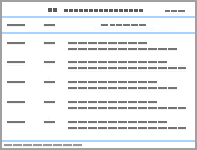
Tab.1
Other major geometrical parameters of Kappel propellers with variable skew
| 参数 | 取值 |
|---|---|
| 直径/mm | 250 |
| 螺距比(0.7R处) | 1.033 8 |
| 叶数 | 5 |
| 盘面比 | 0.478 8 |
| 毂径比 | 0.2 |
Tab.2
Ratio of water-immersed area of Kappel propellers with variable skew
| 螺旋桨代号 | 浸水面积比 |
|---|---|
| R1S1 | 1.000 0 |
| R1S2 | 1.000 6 |
| R1S3 | 1.001 5 |
| R1S4 | 1.002 6 |
| R2S1 | 1.030 0 |
| R2S2 | 1.030 4 |
| R2S3 | 1.031 1 |
| R2S4 | 1.032 0 |

Fig.4
Setting of calculation domain


Fig.5
Meshing example with a base grid size of 0.04D

Tab.3
Correspondence between base size of mesh and total number of grids
| 基础尺寸 | 网格总数×10-6 | y+ |
|---|---|---|
| 0.120D | 0.908 0 | 0~105 |
| 0.100D | 1.210 2 | 0~50 |
| 0.080D | 1.762 7 | 0~25 |
| 0.060D | 2.394 1 | 0~15 |
| 0.050D | 3.045 4 | 0~8 |
| 0.040D | 4.533 4 | 0~3 |
| 0.036D | 5.421 6 | 0~2 |
| 0.032D | 6.758 7 | 0~2 |

Fig.6
Verification of mesh independence


Fig.7
y+ distribution on blade surface


Fig.8
Verification of calculation accuracy of the SST k-ω turbulence model with γ transition


Fig.9
Open-water performance curves of Kappel propellers with variable skew


Fig.10
Comparison of efficiency of Kappel propellers with variable skew (J=0.8)


Fig.11
Radial distribution of KT and KQ of Kappel propellers with variable skew


Fig.12
Pressure distribution on suction side of Kappel propellers (J=0.9)


Fig.13
Tip vortex structures of Kappel propellers with variable skew (J=0.9)

| [1] |
KEHR Y Z, XU H J, KAO J H. An innovative propeller with experimental and sea trial verifications[J]. Journal of Marine Science and Technology, 2020, 25(2): 609-619.
doi: 10.1007/s00773-019-00665-w |
| [2] |
EBRAHIMI A, TOOTIAN A, SEIF M S. The effect of different endplate geometries on the hydrodynamic and acoustic performance of the tip-loaded propeller[J]. Ocean Engineering, 2023, 272: 113885.
doi: 10.1016/j.oceaneng.2023.113885 URL |
| [3] |
CHEN C W, CHEN X P, ZHOU Z Y, et al. Effect of tip rake distribution on the hydrodynamic performance of non-planar Kappel propeller[J]. Journal of Marine Science and Engineering, 2023, 11(4): 748.
doi: 10.3390/jmse11040748 URL |
| [4] |
ANDERSEN P, FRIESCH J, KAPPEL J J, et al. Development of a marine propeller with non-planar lifting surfaces[J]. Marine Technology and SNAME News, 2005, 42(3): 144-158.
doi: 10.5957/mt1.2005.42.3.144 URL |
| [5] |
ZHU Z F. Numerical study on characteristic correlation between cavitating flow and skew of ship propellers[J]. Ocean Engineering, 2015, 99: 63-71.
doi: 10.1016/j.oceaneng.2014.12.023 URL |
| [6] |
WANG L Z, GUO C Y, SU Y M, et al. A numerical study on the correlation between the evolution of propeller trailing vortex wake and skew of propellers[J]. International Journal of Naval Architecture and Ocean Engineering, 2018, 10(2): 212-224.
doi: 10.1016/j.ijnaoe.2017.07.001 URL |
| [7] |
NOURI N M, MOHAMMADI S. Numerical investigation of the effects of camber ratio on the hydrodynamic performance of a marine propeller[J]. Ocean Engineering, 2018, 148: 632-636.
doi: 10.1016/j.oceaneng.2017.06.026 URL |
| [8] | 王超, 熊鹰, 何苗, 等. 粒子群算法在大侧斜螺旋桨侧斜分布优化中的应用[J]. 上海交通大学学报, 2012, 46(3): 398-403. |
| WANG Chao, XIONG Ying, HE Miao, et al. Application of particle swarm optimization theory in skew distribution of highly skewed propeller[J]. Journal of Shanghai Jiao Tong University, 2012, 46(3): 398-403. | |
| [9] |
ZHU Z F. Numerical study of the effect of propellers skew on cavitation performance[J]. Advanced Materials Research, 2013, 705: 405-409.
doi: 10.4028/www.scientific.net/AMR URL |
| [10] |
HU J, ZHANG W, WANG C, et al. Impact of skew on propeller tip vortex cavitation[J]. Ocean Engineering, 2021, 220: 108479.
doi: 10.1016/j.oceaneng.2020.108479 URL |
| [11] | KERWIN J E, HADLER J B. The principles of naval architecture series[M]. New Jersey, USA: The Society of Naval Architects and Marine Engineers, 2010: 95-98. |
| [12] | 吴俊明. 大翼尖倾斜螺桨之设计与空间几何表示[D]. 基隆: 台湾海洋大学, 2008. |
| WU Junming. Design and spatial geometry representation of large wingtip tilting propellers[D]. Jilong: Taiwan Ocean University, 2008. | |
| [13] | 盛振邦, 刘应中. 船舶原理(下)[M]. 上海: 上海交通大学出版社, 2004: 37-40. |
| SHENG Zhenbang, LIU Yingzhong. Principles of ships (II)[M]. Shanghai: Shanghai Jiao Tong University Press, 2004: 37-40. | |
| [14] | 姚仁太, 郭栋鹏. 计算流体力学基础与STAR-CD工程应用[M]. 北京: 国防工业出版社, 2015: 16-43. |
| YAO Rentai, GUO Dongpeng. Fundamentals of computational fluid dynamics and STAR-CD engineering applications[M]. Beijing: National Defense Industry Press, 2015: 16-43. | |
| [15] | 庄靖秋. 非平面螺桨之效率与空化性能探讨II[D]. 基隆: 台湾海洋大学, 2009. |
| ZHUANG Jingqiu. On the study of efficiency and cavitation characteristics of non-planar propeller II[D]. Jilong: Taiwan Ocean University, 2009. |
| [1] | ZHONG Peixuan, ZHANG Baoyu, LI Songqing, SHEN Pengyu, DENG Wenjun. Simulation and Experiments on Fabrication of Strain Controllable Aluminum Strips by Stepped Rake Angle Tool [J]. Journal of Shanghai Jiao Tong University, 2026, 60(2): 338-348. |
| [2] | Li Bin, Li Zonggang, Li Haoyu, Du Yajiang. Optimization of Three-Degree-of-Freedom Biomimetic Pectoral Fin Propulsion Law [J]. J Shanghai Jiaotong Univ Sci, 2026, 31(1): 195-208. |
| [3] | LIU Yi, ZHANG Kailin, SHAO Shuai, XIANG Hongxu. Investigation on Steady-State Thermal Performance of Gear Box Based on Thermal-Fluid-Solid Coupling [J]. Journal of Shanghai Jiao Tong University, 2025, 59(5): 666-674. |
| [4] | ZHENG Mao, DING Shigan, LAN Jiafen. Maneuvering Motion Modeling of Unconventional Ship Based on Numerical Calculation [J]. Journal of Shanghai Jiao Tong University, 2025, 59(12): 1824-1836. |
| [5] | GAO Nan, HU Ankang, HOU Lixun, CHANG Xin. An Rapid Prediction Method for Propeller Hydrodynamic Performance Based on Deep Learning [J]. Journal of Shanghai Jiao Tong University, 2024, 58(2): 188-200. |
| [6] | ZHANG Geng, YAO Jianxi. Numerical Analysis of Hydrodynamic Performance of Propeller in Waves [J]. Journal of Shanghai Jiao Tong University, 2024, 58(2): 175-187. |
| [7] | MAO Jia, XIAO Jingwen, ZHAO Lanhao, DI Yingtang. A Resolved CFD-DEM Approach Based on Immersed Boundary Method [J]. Journal of Shanghai Jiao Tong University, 2023, 57(8): 988-995. |
| [8] | YUAN Yaqi1(袁亚琦),LI Shiyangl*(李世阳),ZHENG Jia1(郑佳),LI Mingrui2(李明睿). CFD-Aided Investigation of Combined Flow Conditioners for Gas Ultrasonic Flow Meter [J]. J Shanghai Jiaotong Univ Sci, 2023, 28(5): 611-620. |
| [9] | GUO Haipeng, ZOU Zaojian, LI Guangnian. Numerical Simulation of Crashback Condition of a Propeller Based on OpenFOAM [J]. Journal of Shanghai Jiao Tong University, 2023, 57(2): 168-176. |
| [10] | WANG Zhiwei, HE Yanping, LI Mingzhi, QIU Ming, HUANG Chao, LIU Yadong. Numerical Simulation and Flow Pattern Evolution of Gas-Liquid Two-Phase Flow Passing Through a 90° Pipe Bend Based on CFD [J]. Journal of Shanghai Jiao Tong University, 2022, 56(9): 1159-1167. |
| [11] | SONG Shenke, XIA Li, ZOU Zaojian, ZOU Lu. A Numerical Study of Hydrodynamic Interactions Between a Large Cruise Ship and a Container Ship [J]. Journal of Shanghai Jiao Tong University, 2022, 56(7): 919-928. |
| [12] | SUN Jian, PENG Bin, ZHU Bingguo. Numerical Simulation and Experimental Study of Oil-Free Double-Warp Air Scroll Compressor [J]. Journal of Shanghai Jiao Tong University, 2022, 56(5): 611-621. |
| [13] | LI Peng, WANG Chao, SUN Huawei, GUO Chunyu. Numerical Simulation Strategy Optimization Analysis of Submarine Resistance and Flow Field [J]. Journal of Shanghai Jiao Tong University, 2022, 56(4): 506-515. |
| [14] | PEREIRA Eric Joseph1 (佩雷拉·埃里克·约瑟夫), TEH Hee-Min1,2∗ (郑希铭), MA Zhe3 (马 哲). Hydrodynamic Performance of Air-Filled Wave Attenuator for Wave Control: Experimental Study [J]. J Shanghai Jiaotong Univ Sci, 2022, 27(3): 316-325. |
| [15] | DAI Mengyi, ZHANG Zhihao, TU Jiahuang, HAN Zhaolong, ZHOU Dai, ZHU Hongbo. Aerodynamic Effect of Deflection Angle of Trailing Edge Flap on Vertical Axis Wind Turbine with Different Airfoils [J]. Journal of Shanghai Jiao Tong University, 2022, 56(12): 1619-1629. |
| Viewed | ||||||
|
Full text |
|
|||||
|
Abstract |
|
|||||
