

Journal of Shanghai Jiao Tong University ›› 2026, Vol. 60 ›› Issue (3): 364-376.doi: 10.16183/j.cnki.jsjtu.2024.251
• Naval Architecture, Ocean and Civil Engineering • Previous Articles Next Articles
JING Jionglin, XU Yuwang( ), YANG Zhou, SONG Bin, ZHANG Mengmeng, REN Haojie
Received:2024-06-28
Revised:2024-08-07
Accepted:2024-08-26
Online:2026-03-28
Published:2026-03-30
CLC Number:
JING Jionglin, XU Yuwang, YANG Zhou, SONG Bin, ZHANG Mengmeng, REN Haojie. Coupled Hydro-Aero-Servo Dynamic Response Analysis of Floating Wind Turbines Based on Frequency-Domain Method[J]. Journal of Shanghai Jiao Tong University, 2026, 60(3): 364-376.
Add to citation manager EndNote|Ris|BibTeX
URL: https://xuebao.sjtu.edu.cn/EN/10.16183/j.cnki.jsjtu.2024.251

Fig.1
Flow chart of frequency-domain calculation program


Fig.2
Numerical model of OC4-Hywind floating wind turbine

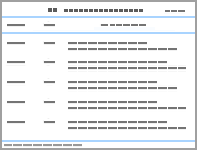
Tab.1
Parameters of wind turbine
| 参数 | 设计值 | 参数 | 设计值 |
|---|---|---|---|
| 功率/MW | 5 | 悬垂/m,仰角/(°),锥角/(°) | 5,5,2.5 |
| 机型 | 三叶片迎风式 | 齿轮箱减速比 | 97: 1 |
| 叶片直径/m,轮毂直径/m | 126,3 | 切入,额定,切出风速/(m·s-1) | 3,11.4,25 |
| 轮毂高度/m | 90 | 叶片质量/kg | 110 000 |
| 塔架高度/m | 87.6 | 机舱质量/kg | 240 000 |
| 塔架底端直径/m | 6 | 塔筒质量/kg | 347 460 |
| 塔架顶端直径/m | 3.87 | 风轮额定推力/kN | 712.4 |
Tab.2
Parameters of floating structure
| 参数 | 设计值 | 参数 | 设计值 |
|---|---|---|---|
| 平台吃水/m | 20 | 斜撑直径/m | 1.6 |
| 中浮筒直径/m | 6.5 | 侧浮筒中心距/m | 50 |
| 中浮筒高度/m | 32 | 平台总质量/kg | 1.347 3×10⁷ |
| 侧底部浮筒直径/m | 24 | 平台质心高度/m | -13.46 |
| 侧底部浮筒高度/m | 6 | 横摇转动惯量/(kg·m2) | 6.827×10⁹ |
| 侧上部浮筒直径/m | 12 | 纵摇转动惯量/(kg·m2) | 6.827×10⁹ |
| 侧上部浮筒高度/m | 26 | 艏摇转动惯量/(kg·m2) | 1.226×10⁷ |

Fig.3
Mooring system of OC4-Hywind floating wind turbine

Tab.3
Environment parameters for validation case
| 工况号 | 工况 | Hs/m | Tp/s | v/(m·s-1) | 浮式风力机状态 |
|---|---|---|---|---|---|
| C1 | 额定海况无风 | 1.86 | 8.98 | — | 停机 |
| C2 | 风浪同向 | 1.86 | 8.98 | 16 | 运行、不变桨 |
| C3 | 风浪同向 | 1.86 | 8.98 | 16 | 运行、变桨 |
| C4 | 停机 | 7.3 | 12 | 46.2 | 停机、顺桨 |

Fig.4
Example of wave spectrum and turbulent wind spectrum


Fig.5
PSD of floating wind turbine motion response under condition C1


Fig.6
PSD of floating wind turbine motion response under condition C2


Fig.7
PSD of floating wind turbine motion response under condition C3


Fig.8
PSD of floating wind turbine motion response under condition C4

Tab.4
Comparison of the average of motion responses
| 工况 号 | 纵荡/m | 垂荡/m | 纵摇/(°) | |||||
|---|---|---|---|---|---|---|---|---|
| 频域 | 时域 | 频域 | 时域 | 频域 | 时域 | |||
| C1 | 0.22 | 0.24 | -0.06 | -0.06 | 0.01 | 0.01 | ||
| C2 | 5.06 | 5.30 | -0.08 | -0.09 | 1.84 | 2.05 | ||
| C3 | 5.11 | 6.17 | -0.08 | -0.09 | 1.87 | 2.06 | ||
| C4 | 1.42 | 1.44 | -0.06 | -0.06 | 0.01 | 0.01 | ||
Tab.5
Comparison of standard deviation of motion responses
| 工况 号 | 纵荡/m | 垂荡/m | 纵摇/(°) | |||||
|---|---|---|---|---|---|---|---|---|
| 频域 | 时域 | 频域 | 时域 | 频域 | 时域 | |||
| C1 | 0.301 | 0.337 | 0.060 0 | 0.057 8 | 0.130 | 0.122 | ||
| C2 | 6.27 | 6.55 | 0.060 5 | 0.063 7 | 1.39 | 1.88 | ||
| C3 | 2.89 | 3.16 | 0.060 1 | 0.060 3 | 1.14 | 1.43 | ||
| C4 | 1.91 | 1.80 | 0.469 | 0.448 | 5.91 | 5.44 | ||

Fig.9
PSD of tension in mooring line #2 under different conditions

Tab.6
Comparison of average and standard deviation of tension in mooring line #2
| 工况 号 | 张力均值/MN | 张力标准差/MN | |||
|---|---|---|---|---|---|
| 频域 | 时域 | 频域 | 时域 | ||
| C1 | 1.16 | 1.11 | 0.014 | 0.015 | |
| C2 | 1.43 | 1.49 | 0.403 | 0.488 | |
| C3 | 1.39 | 1.46 | 0.186 | 0.232 | |
| C4 | 1.22 | 1.16 | 0.101 | 0.092 | |

Fig.10
Comparison of standard deviation of dynamic response of floating wind turbines under different wave height and period combinations


Fig.11
Comparison of time-domain and frequency-domain results for second-order forces under condition C4


Fig.12
Comparison of responses with and without second-order forces under condition C4


Fig.13
Comparison of the influence of wind turbine pitch control and blade angle control

| [1] | WILLIAMS R, ZHAO F. Global offshore wind report 2023[DB/OL]. (2023-08-23)[2024-06-20]. https://gwec.net/gwecs-global-offshore-wind-report-2023. |
| [2] | 张洪建, 蔡新, 许波峰. 浮式风机半潜式平台动力响应研究[J]. 可再生能源, 2021, 39(9): 1210-1216. |
| ZHANG Hongjian, CAI Xin, XU Bofeng. Study on dynamic response of floating wind turbine semi-submersible platform[J]. Renewable Energy Resources, 2021, 39(9): 1210-1216. | |
| [3] | JONKMAN J M. Dynamics modeling and loads analysis of an offshore floating wind turbine[M]. Boulder, USA: University of Colorado at Boulder, 2007. |
| [4] |
KARIMIRAD M, MOAN T. Wave- and wind-induced dynamic response of a Spar-type offshore wind turbine[J]. Journal of Waterway, Port, Coastal, and Ocean Engineering, 2012, 138(1): 9-20.
doi: 10.1061/(ASCE)WW.1943-5460.0000087 URL |
| [5] | MASCIOLA M, ROBERTSON A, JONKMAN J, et al. Investigation of a FAST-OrcaFlex coupling module for integrating turbine and mooring dynamics of offshore floating wind turbines[M]. Golden, CO, USA: National Renewable Energy Lab (NREL), 2011. |
| [6] |
TIAN X L, XIAO J R, LIU H X, et al. A novel dynamics analysis method for Spar-type floating offshore wind turbine[J]. China Ocean Engineering, 2020, 34: 99-109.
doi: 10.1007/s13344-020-0010-z |
| [7] |
SHEN X, HU P, CHEN J, et al. The unsteady ae-rodynamics of floating wind turbine under platform pitch motion[J]. Proceedings of the Institution of Mechanical Engineers, Part A: Journal of Power and Energy, 2018, 232(8): 1019-1036.
doi: 10.1177/0957650918766606 URL |
| [8] | 闫发锁, 门骥远, 彭成. 深水SPAR风机系统全耦合动力响应分析研究[J]. 船舶力学, 2017, 21(2): 159-167. |
| YAN Fasuo, MEN Jiyuan, PENG Cheng. Study on full coupling dynamic responses of a deepwater SPAR wind turbine system[J]. Ship Mechanics, 2017, 21(2): 159-167. | |
| [9] |
CHEN J, HU Z, LIU G, et al. Coupled aero-hydro-servo-elastic methods for floating wind turbines[J]. Renewable Energy, 2019, 130(1): 139-153.
doi: 10.1016/j.renene.2018.06.060 URL |
| [10] |
CHENG P, HUANG Y, WAN D. A numerical model for fully coupled aero-hydrodynamic analysis of floating offshore wind turbine[J]. Ocean Engineering, 2019, 173: 183-196.
doi: 10.1016/j.oceaneng.2018.12.021 URL |
| [11] | 周盛涛. 基于快速动力响应分析的半潜式风机下部结构主尺寸优化[D]. 哈尔滨: 哈尔滨工业大学, 2021. |
| ZHOU Shengtao. Substructure optimization of semi-submersible floating wind turbines based on quick dynamic analysis[D]. Harbin: Harbin Institute of Technology, 2021. | |
| [12] |
HEGSETH J M, BACHYNSKI E E. A semi-analytical frequency domain model for efficient design evaluation of spar floating wind turbines[J]. Marine Structures, 2019, 64: 186-210.
doi: 10.1016/j.marstruc.2018.10.015 URL |
| [13] | VAN ENGELEN T, BRAAM H. TURBU offshore, computer program for frequency domain analysis of horizontal axis offshore wind turbines[M]. Sittard, Netherlands: Energy Research Centre of the Netherlands, 2004. |
| [14] | LUPTON R. Frequency-domain modelling of floating wind turbines[D]. Cambridge, UK: University of Cambridge, 2015. |
| [15] |
PEGALAJAR-JURADO A, BORG M, BREDMOSE H. An efficient frequency-domain model for quick load analysis of floating offshore wind turbines[J]. Wind Energy Science, 2018, 3(2): 693-712.
doi: 10.5194/wes-3-693-2018 URL |
| [16] | HALL M, HOUSNER S, ZALKIND D, et al. An open-source frequency-domain model for floating wind turbine design optimization[C]// Proceedings of the Journal of Physics: Conference Series. Denver, USA: IOP Publishing, 2022. |
| [17] | 朱仁传. 船舶在波浪上的运动理论[M]. 上海: 上海交通大学出版社, 2019. |
| ZHU Renchuan. The theory of ship motion in waves[M]. Shanghai: Shanghai Jiao Tong University Press, 2019. | |
| [18] | 王树青, 梁丙臣. 海洋工程波浪力学[M]. 青岛: 中国海洋大学出版社, 2013. |
| WANG Shuqing, LIANG Bingchen. Wave mechanics for ocean engineering[M]. Qingdao: China Ocean University Press, 2013. | |
| [19] |
NEWMAN J N. The drift force and moment on ships in waves[J]. Journal of Ship Research, 1967, 11(1): 51-60.
doi: 10.5957/jsr.1967.11.1.51 URL |
| [20] | NEWMAN J N. Second-order slowly varying forces on vessels in irregular waves[C]// Proceedings of the International Symposium on Dynamics of Marine Vehicles and Structures in Waves. London, UK: IOP Publishing, 1974. |
| [21] | SOUZA C E S, HEGSETH J M, BACHYNSKI E E. Frequency-dependent aerodynamic damping and inertia in linearized dynamic analysis of floating wind turbines[C]// Proceedings of the Journal of Physics: Conference Series. Denver, USA: IOP Publishing, 2020. |
| [22] | ABBAS N, ZALKIND D, PAO L, et al. A reference open-source controller for fixed and floating offshore wind turbines[J]. Wind Energy Science Discussions, 2022, 7: 53-73. |
| [23] | BORGMAN L E. Random hydrodynamic forces on objects[J]. The Annals of Mathematical Statistics, 1967: 37-51. |
| [24] | JONKMAN J, BUTTERFIELD S, MUSIAL W, et al. Definition of a 5-MW reference wind turbine for offshore system development[M]. Golden, CO, USA: National Renewable Energy Lab (NREL), 2009. |
| [25] | ROBERTSON A, JONKMAN J, MASCIOLA M, et al. Definition of the semisubmersible floating system for phase II of OC4[M]. Golden, CO, USA: National Renewable Energy Lab (NREL), 2014. |
| [26] | 刘志成. 新型半潜式海上风机基础水动力性能分析[D]. 哈尔滨: 哈尔滨工程大学, 2023. |
| LIU Zhicheng. Hydrodynamic performance analysis of a new semi-submersible foundation for offshore wind turbine[D]. Harbin: Harbin Engineering University, 2023. | |
| [27] | IEC. IEC 61400-1. Wind turbines—Part 1: Design requirements[M]. London, UK: International Electrotechnical Commission, 2005. |
| [28] |
陈嘉豪, 胡志强. 半潜式海上浮式风机气动阻尼特性研究[J]. 力学学报, 2019, 51(4): 1255-1265.
doi: 10.6052/0459-1879-18-148 |
|
CHEN Jiahao, HU Zhiqiang. Study on areodynamic damping of semi-submersible floating wind turbines[J]. Chinese Journal of Theoretical and Applied Mechanics, 2019, 51(4): 1255-1265.
doi: 10.6052/0459-1879-18-148 |
|
| [29] | DENG L, HUANG M X, XIAO Z Y, et al. Analysis on frequency response of floating wind turbine considering the influence of aerodynamic damping[J]. Journal of Hunan University (Natural Sciences), 2017, 44(1): 1-8. |
| [1] | WAN Zhipeng, CUI Lin, JENG Dongsheng. A Semi-Dynamic Coupled Model of Seabed Oscillatory and Residual Response Under Wave-Current Interaction [J]. Journal of Shanghai Jiao Tong University, 2026, 60(1): 142-153. |
| [2] | JIA Zhichao, LIU Mingyue, GUO Lin. Study on the Dynamic Response Characteristics of a Cantilever Intake Pipe under Internal Flow [J]. Ocean Engineering Equipment and Technology, 2026, 13(1): 46-57. |
| [3] | ZHU Yiqing, WU Feng, ZHOU Dai, HAN Zhaolong, ZHUO Yang, ZHU Hongbo, ZHANG Kai. Structural Dynamic Response of Offshore Horizontal Axis Wind Turbine Subjected to Wake-Induced Action [J]. Journal of Shanghai Jiao Tong University, 2025, 59(8): 1081-1091. |
| [4] | ZHANG Qiang, CHEN Zhenhua, WANG Wenlong, SU Huaiwei, CHI Dejian. Numerical Simulation Study on Damage Characteristics of Reinforced Concrete T-Beam Bridge Under Blast Point Control [J]. Air & Space Defense, 2025, 8(5): 83-90. |
| [5] | CHEN Wei, WANG Zhizhou, WU Hehe. Research on Key Technologies of Offshore Construction for Mooring Systems of Floating Wind Turbines [J]. Ocean Engineering Equipment and Technology, 2025, 12(4): 124-132. |
| [6] | LI Xiaoyong, ZHANG Hang, JI Weidong, et al. Experimental Study on the Dynamic Response Characteristics of Buoys in Floating Wind Turbine Mooring Systems under Current Loads [J]. Ocean Engineering Equipment and Technology, 2025, 12(4): 49-54. |
| [7] | Li Pengju, Fu Rongchang, Yang Xiaozheng, Wang Kun. Dynamic Response of Idiopathic Scoliosis and Kyphosis Spine [J]. J Shanghai Jiaotong Univ Sci, 2025, 30(3): 482-492. |
| [8] | ZHANG Lei, FENG Shaoxiong, TAN Kun, GUO Tao, SONG Chengguo, CHU Xiumin, MIAO Yang. A Design Method of Inland River Channel Based on Hydrodynamic Response of Ship [J]. Journal of Shanghai Jiao Tong University, 2025, 59(1): 89-98. |
| [9] | ZENG Weijie, ZHANG Ying, DENG Yanfei, GUO Chuanrui, REN Weixin. Vibration Control of Semi-Submersible Offshore Wind Turbines Using Inerter-Based Absorbers [J]. Journal of Shanghai Jiao Tong University, 2024, 58(7): 983-994. |
| [10] | FENG Zhongju, WANG Wei, ZHANG Cong, ZHU Jixin, WANG Yiran, MENG Yingying. Dynamic Response Difference of Single Pile and Pile Group with Variable Section in Variation of Seismic Subsidence Soil Layer [J]. Journal of Shanghai Jiao Tong University, 2024, 58(7): 1086-1096. |
| [11] | CHEN Yiren, YAO Jinyu, LI Mingxuan, ZHANG Xinshu. Hydrodynamic Performance of a Barge-Type Floating Offshore Wind Turbine with Moonpool [J]. Journal of Shanghai Jiao Tong University, 2024, 58(7): 965-982. |
| [12] | XU Minjie1, 2 (徐敏杰), WANG Quanbao1∗ (王全保), DUAN Dengping1 (段登平). Longitudinal Motion Simulation of Stratospheric Airship Under Dynamic Response of Moving-Mass Actuator [J]. J Shanghai Jiaotong Univ Sci, 2024, 29(6): 1139-1150. |
| [13] | PEI Feia (裴斐), LIN Yanb∗ (林焰). Numerical Study of Wave Energy Converter Platform Geometry Layout Design [J]. J Shanghai Jiaotong Univ Sci, 2024, 29(5): 780-790. |
| [14] | LIN Zeyin, WANG Yibing, LI Dongsheng. Overview of the Development and Design of Dynamic Cable for Floating Offshore Wind Power in China [J]. Ocean Engineering Equipment and Technology, 2024, 11(4): 41-46. |
| [15] | WANG Zhiwei(王志伟), HE Yanping(何炎平), LI Mingzhi(李铭志), QIU Ming(仇明), HUANG Chao(黄超), LIU Yadong(亚东),WANG Zi(王梓). Numerical Investigation on Dynamic Response Characteristics of Fluid-Structure Interaction of Gas-Liquid Two-Phase Flow in Horizontal Pipe [J]. J Shanghai Jiaotong Univ Sci, 2024, 29(2): 237-244. |
| Viewed | ||||||
|
Full text |
|
|||||
|
Abstract |
|
|||||
