

Journal of Shanghai Jiao Tong University ›› 2026, Vol. 60 ›› Issue (2): 246-255.doi: 10.16183/j.cnki.jsjtu.2024.079
• New Type Power System and the Integrated Energy • Previous Articles Next Articles
GUO Qi1,2, YAN Jun1, HAO Qianpeng1, HAN Dong1, YANG Zhihao1, YAN Xinyue3, ZHANG Haipeng4, LI Ran3,4,5( )
)
Received:2024-03-11
Revised:2024-05-16
Accepted:2024-06-11
Online:2026-02-28
Published:2026-03-06
Contact:
LI Ran
E-mail:rl272@sjtu.edu.cn.
CLC Number:
GUO Qi, YAN Jun, HAO Qianpeng, HAN Dong, YANG Zhihao, YAN Xinyue, ZHANG Haipeng, LI Ran. Short-Term Wind Power Prediction Method Based on Closed-Loop Clustering and Multi-Objective Optimization[J]. Journal of Shanghai Jiao Tong University, 2026, 60(2): 246-255.
Add to citation manager EndNote|Ris|BibTeX
URL: https://xuebao.sjtu.edu.cn/EN/10.16183/j.cnki.jsjtu.2024.079

Fig.1
Typical wind power prediction curves


Fig.2
Flow chart of closed-loop clustering algorithm


Fig.3
Flow chart of Bootstrap and multi-objective optimization methods


Fig.4
Prediction results of single forecast models and proposed model

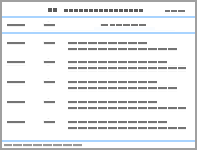
Tab.1
Comparison of evaluation indices for single prediction models
| 预测模型 | MAE | RMSE | MAPE/ % | 准确率/ % | 合格率/ % |
|---|---|---|---|---|---|
| 预测产品1 | 785.06 | 1002.08 | 17.49 | 95.89 | 98.82 |
| 预测产品2 | 1503.47 | 1736.69 | 45.15 | 92.87 | 97.20 |
| SVR | 1257.81 | 1494.41 | 38.90 | 93.87 | 97.03 |
| MLP | 952.01 | 1147.00 | 21.75 | 95.29 | 98.58 |
| LSTM | 759.44 | 963.75 | 18.76 | 96.04 | 100.00 |
| 本文模型 | 553.34 | 637.89 | 14.27 | 97.34 | 100.00 |

Fig.5
Prediction results of different combined forecasting models

Tab.2
Comparison of evaluation indices for different combined forecasting models
| 模型 | MAE | RMSE | MAPE/ % | 准确率/ % | 合格率/ % |
|---|---|---|---|---|---|
| 优化法 | 816.70 | 980.80 | 18.64 | 95.97 | 99.10 |
| XGBoost法 | 757.71 | 911.64 | 27.27 | 96.26 | 100.00 |
| CNN组合法 | 732.84 | 840.21 | 20.52 | 96.55 | 100.00 |
| 本文模型 | 553.34 | 637.89 | 14.27 | 97.34 | 100.00 |
Tab.3
Comparison of evaluation indices for different clustering methods
| 聚类方法 | MAE | RMSE | MAPE/ % | 准确率/ % | 合格率/ % |
|---|---|---|---|---|---|
| 单体法 | 640.96 | 763.060 | 23.50 | 96.87 | 100.00 |
| 总体法 | 575.55 | 746.204 | 19.82 | 96.93 | 100.00 |
| K-means | 631.86 | 742.160 | 16.46 | 96.95 | 100.00 |
| 闭环聚类 | 553.34 | 637.890 | 14.27 | 97.34 | 100.00 |
| [1] | 梁以恒, 杨冬梅, 刘刚, 等. 基于功率预测精度提升和市场交易的平抑新能源出力波动策略[J]. 上海交通大学学报, 2025, 59(2): 221-229. |
| LIANG Yiheng, YANG Dongmei, LIU Gang, et al. A strategy for smoothing power fluctuations of new energy based on improved power prediction accuracy and market transaction[J]. Journal of Shanghai Jiao Tong University, 2025, 59(2): 221-229. | |
| [2] | 罗逸夫, 胡秦然, 钱涛, 等. 计及多工况对机组寿命损耗影响的机组组合优化模型[J]. 上海交通大学学报, 2025, 59(6): 768-779. |
| LUO Yifu, HU Qinran, QIAN Tao, et al. Unit commitment optimization model considering impact of multiple operating conditions on unit life loss[J]. Journal of Shanghai Jiao Tong University, 2025, 59(6): 768-779. | |
| [3] | 殷高文, 沈非凡, 黄晟, 等. 面向电力市场多时间尺度场景应用的风储系统调度方法[J]. 上海交通大学学报, 2024, 58(9): 1410-1419. |
| YIN Gaowen, SHEN Feifan, HUANG Sheng, et al. Dispatching method of combined wind-storage system for multi-time scale scenarios application in electricity markets[J]. Journal of Shanghai Jiao Tong University, 2024, 58(9): 1410-1419. | |
| [4] | 叶林, 路朋, 赵永宁, 等. 含风电电力系统有功功率模型预测控制方法综述[J]. 中国电机工程学报, 2021, 41(18): 6181-6198. |
| YE Lin, LU Peng, ZHAO Yongning, et al. Review of model predictive control for power system with large-scale wind power grid-connected[J]. Proceedings of the CSEE, 2021, 41(18): 6181-6198. | |
| [5] | 苗长新, 王霞, 李昊, 等. 基于数值天气预报风速误差修正的风电功率日前预测[J]. 电网技术, 2022, 46(9): 3455-3464. |
| MIAO Changxin, WANG Xia, LI Hao, et al. Day-ahead prediction of wind power based on NWP wind speed error correction[J]. Power System Technology, 2022, 46(9): 3455-3464. | |
| [6] |
YUNUS K, THIRINGER T, CHEN P Y. ARIMA-based frequency-decomposed modeling of wind speed time series[J]. IEEE Transactions on Power Systems, 2016, 31(4): 2546-2556.
doi: 10.1109/TPWRS.59 URL |
| [7] | MA J Y, YANG M, HAN X S, et al. Ultra-short-term wind generation forecast based on multivariate empirical dynamic modeling[C]// 2017 IEEE Industry Applications Society Annual Meeting. Cincinnati, USA: IEEE, 2017: 1-8. |
| [8] | 王于波, 郝玲, 徐飞, 等. 分布式光伏集群发电功率波动模式识别与超短期概率预测[J]. 上海交通大学学报, 2024, 58(9): 1334-1343. |
| WANG Yubo, HAO Ling, XU Fei, et al. Pattern recognition and ultra-short-term probabilistic forecasting of power fluctuating in aggregated distributed photovoltaics clusters[J]. Journal of Shanghai Jiao Tong University, 2024, 58(9): 1334-1343. | |
| [9] | 李芬, 孙凌, 王亚维, 等. 基于CEEMDAN-GSA-LSTM和SVR的光伏功率短期区间预测[J]. 上海交通大学学报, 2024, 58(6): 806-818. |
| LI Fen, SUN Ling, WANG Yawei, et al. Short-term interval forecasting of photovoltaic power based on CEEMDAN-GSA-LSTM and SVR[J]. Journal of Shanghai Jiao Tong University, 2024, 58(6): 806-818. | |
| [10] |
LI M L, YANG M, YU Y X, et al. Adaptive weighted combination approach for wind power forecast based on deep deterministic policy gradient method[J]. IEEE Transactions on Power Systems, 2024, 39(2): 3075-3087.
doi: 10.1109/TPWRS.2023.3294839 URL |
| [11] |
TATINATI S, WANG Y B, KHONG A W H. Hybrid method based on random convolution nodes for short-term wind speed forecasting[J]. IEEE Transactions on Industrial Informatics, 2022, 18(10): 7019-7029.
doi: 10.1109/TII.2020.3043451 URL |
| [12] |
DU P W. Ensemble machine learning-based wind forecasting to combine NWP output with data from weather station[J]. IEEE Transactions on Sustainable Energy, 2019, 10(4): 2133-2141.
doi: 10.1109/TSTE.5165391 URL |
| [13] |
BATES J M, GRANGER C W J. The combination of forecasts[J]. Journal of the Operational Research Society, 1969, 20(4): 451-468.
doi: 10.1057/jors.1969.103 URL |
| [14] | 王丽婕, 刘田梦, 王勃, 等. 基于奇异值分解与卡尔曼滤波修正多位置NWP的短期风电功率预测[J]. 太阳能学报, 2022, 43(12): 392-398. |
| WANG Lijie, LIU Tianmeng, WANG Bo, et al. Short-term wind power prediction based on SVD and Kalman filter correction of multi-position NWP[J]. Acta Energiae Solaris Sinica, 2022, 43(12): 392-398. | |
| [15] | 丁婷婷, 杨明, 于一潇, 等. 基于误差修正的短期风电功率集成预测方法[J]. 高电压技术, 2022, 48(2): 488-496. |
| DING Tingting, YANG Ming, YU Yixiao, et al. Short-term wind power integration prediction method based on error correction[J]. High Voltage Engineering, 2022, 48(2): 488-496. | |
| [16] | 刘大贵, 王维庆, 张慧娥, 等. 马尔科夫修正的组合模型在新疆风电中长期可用电量预测中的应用[J]. 电网技术, 2020, 44(9): 3290-3297. |
| LIU Dagui, WANG Weiqing, ZHANG Hui’e, et al. Application of Markov modified combination model mid-long term available quantity of electricity forecasting in Xinjiang wind power[J]. Power System Technology, 2020, 44(9): 3290-3297. | |
| [17] |
WANG S, WANG J Z, LU H Y, et al. A novel combined model for wind speed prediction—Combination of linear model, shallow neural networks, and deep learning approaches[J]. Energy, 2021, 234: 121275.
doi: 10.1016/j.energy.2021.121275 URL |
| [18] | CUI W K, WAN C, SONG Y H. Ensemble deep learning-based non-crossing quantile regression for nonparametric probabilistic forecasting of wind power generation[J]. IEEE Transactions on Power Systems, 2023, 38(4): 3163-3178. |
| [19] | WANG J J, LIU Y F. An attention mechanism based deep nonlinear ensemble paradigm of strengthened feature extraction method for wind power prediction[J]. Journal of Renewable & Sustainable Energy, 2023, 15(6): 063305. |
| [20] | 吴杰, 丁明, 张晶晶. 基于云模型和K-means聚类的风电场储能容量优化配置方法[J]. 电力系统自动化, 2018, 42(24): 67-73. |
| WU Jie, DING Ming, ZHANG Jingjing. Capacity configuration method of energy storage system for wind farm based on cloud model and K-means clustering[J]. Automation of Electric Power Systems, 2018, 42(24): 67-73. | |
| [21] |
WAN C, CUI W K, SONG Y H. Machine learning-based probabilistic forecasting of wind power generation: A combined bootstrap and cumulant method[J]. IEEE Transactions on Power Systems, 2024, 39(1): 1370-1383.
doi: 10.1109/TPWRS.2023.3264821 URL |
| [22] | 邵成成, 任孟极, 徐天元, 等. 基于分类-回归卷积神经网络的新能源电力系统可靠性评估方法[J]. 中国电机工程学报, 2024, 44(23): 9134-9145. |
| SHAO Chengcheng, REN Mengji, XU Tianyuan, et al. Renewable power system reliability evaluation method based on classification-regression convolutional neural networks[J]. Proceedings of the CSEE, 2024, 44(23): 9134-9145. | |
| [23] | 曾金灿, 何耿生, 李姚旺, 等. 基于卷积神经网络与轻量级梯度提升树组合模型的电力行业短期以电折碳方法[J]. 上海交通大学学报, 2025, 59(6): 746-757. |
| ZENG Jincan, HE Gengsheng, LI Yaowang, et al. A short-term carbon emission accounting method using electricity data based on convolutional neural networks and light gradient boosting machine combined model in power industry[J]. Journal of Shanghai Jiao Tong University, 2025, 59(6): 746-757. | |
| [24] | 陆文安, 朱清晓, 李兆伟, 等. 基于卷积神经网络的新型电力系统频率特性预测方法[J]. 上海交通大学学报, 2024, 58(10): 1500-1512. |
| LU Wenan, ZHU Qingxiao, LI Zhaowei, et al. A prediction method of new power system frequency characteristics based on convolutional neural network[J]. Journal of Shanghai Jiao Tong University, 2024, 58(10): 1500-1512. | |
| [25] | 张良, 郑丽冬, 冷祥彪, 等. 基于灰狼算法的风-光-抽水蓄能联合系统多目标优化策略[J]. 上海交通大学学报, 2024, 58(10): 1554-1566. |
| ZHANG Liang, ZHENG Lidong, LENG Xiangbiao, et al. Multi-objective optimization strategy for wind-photovoltaic-pumped storage combined system based on gray wolf algorithm[J]. Journal of Shanghai Jiao Tong University, 2024, 58(10): 1554-1566. | |
| [26] |
RIBEIRO M H D M, DA SILVA R G, MORENO S R, et al. Efficient bootstrap stacking ensemble learning model applied to wind power generation forecasting[J]. International Journal of Electrical Power & Energy Systems, 2022, 136: 107712.
doi: 10.1016/j.ijepes.2021.107712 URL |
| [27] |
WOO S, PARK J, PARK J, et al. Wind field-based short-term turbine response forecasting by stacked dilated convolutional LSTMs[J]. IEEE Transactions on Sustainable Energy, 2020, 11(4): 2294-2304.
doi: 10.1109/TSTE.5165391 URL |
| [28] |
XIA M, SHAO H D, MA X D, et al. A stacked GRU-RNN-based approach for predicting renewable energy and electricity load for smart grid operation[J]. IEEE Transactions on Industrial Informatics, 2021, 17(10): 7050-7059.
doi: 10.1109/TII.2021.3056867 URL |
| [29] | 王亚伦, 周涛, 陈中, 等. 基于堆叠式降噪自动编码器和深度神经网络的风电调频逐步惯性智能控制[J]. 上海交通大学学报, 2023, 57(11): 1477-1491. |
| WANG Yalun, ZHOU Tao, CHEN Zhong, et al. Stepwise inertial intelligent control of wind power for frequency regulation based on stacked denoising autoencoder and deep neural network[J]. Journal of Shanghai Jiao Tong University, 2023, 57(11): 1477-1491. | |
| [30] | LIU H, LI Y, DUAN Z, et al. A review on multi-objective optimization framework in wind energy forecasting techniques and applications[J]. Energy Conversion & Management, 2020, 224: 113324. |
| [1] | Liu Peijin, Ding Haojian, Yan Dongyang, Sun Haofeng, Huang Tao, Li Jie. Multi-Objective Approach for Optimizing Production Parameters of Low-Permeability Oil Well to Enhance Energy Efficiency [J]. J Shanghai Jiaotong Univ Sci, 2026, 31(2): 486-498. |
| [2] | Dong Ruyi, Shi Cong. Traffic Light Recognition Based on Improved YOLOv5l [J]. J Shanghai Jiaotong Univ Sci, 2026, 31(2): 319-333. |
| [3] | FAN Hong, WEI Xinwu, JIA Qingshan, LUO Jiayi. Collaborative Optimization Scheduling Method for Electric-Gas-Thermal Multi-Energy System Under Energy-Transportation Integration [J]. Journal of Shanghai Jiao Tong University, 2026, 60(2): 211-223. |
| [4] | CHEN Liangwen, ZHU Yuxin, SHEN Tao, YU Yifan, LING Xiao, SHENG Qinghong. Deep Learning-Based Infrared Ship Target Wake Matching and Detection Algorithm [J]. Air & Space Defense, 2026, 9(1): 80-90. |
| [5] | LUO Zhijun, WANG Jianrui, YIN Jiawei. A Survey of Task-Driven Intelligent Target Recognition Methods in Complex Battlefield Environments [J]. Air & Space Defense, 2026, 9(1): 1-11. |
| [6] | SHEN Fu, YANG Zhiwen, XU Xiaoyuan, ZHANG Wei, WANG Zhe, CAO Yang. Unit Model of Integrated Energy System Based on Statistical Clustering [J]. Journal of Shanghai Jiao Tong University, 2025, 59(9): 1348-1358. |
| [7] | LIU Jiahui, WANG Cong, ZHANG Hongli, MA Ping, LI Xinkai, DONG Yingchao. Multi-Objective Optimization Design of Micro-Site Selection of Complex Terrain Wind Farms Assisted by Proxy Model [J]. Journal of Shanghai Jiao Tong University, 2025, 59(9): 1315-1326. |
| [8] | ZHU Feng, SHAN Chao, WU Ning, CAI Qixin, ZHU Yunan, LIU Yunpeng, ZUO Qiang. Feature Extraction and Anomaly Identification Method for Power Customer Price in Power Market Enviroment [J]. Journal of Shanghai Jiao Tong University, 2025, 59(7): 995-1006. |
| [9] | RONG Guang, ZHANG Yexin, TANG Chao, CHEN Jinbao, ZHOU Yiling, WANG Jianyuan. Study on Simulation Data-Driven Fault Diagnosis Technology for Unmanned Aerial Vehicles [J]. Air & Space Defense, 2025, 8(6): 73-84. |
| [10] | TAHIR Rizwana, CAI Yunze. Multi-Human Pose Estimation by Deep Learning-Based Sequential Approach for Human Keypoint Position and Human Body Detection [J]. J Shanghai Jiaotong Univ Sci, 2025, 30(6): 1103-1113. |
| [11] | CHEN Cheng, PENG Pan, TAO Wei, ZHAO Hui. Hyperspectral Satellite Image Classification Based on Feature Pyramid Networks With 3D Convolution [J]. J Shanghai Jiaotong Univ Sci, 2025, 30(6): 1073-1084. |
| [12] | MA Changxi, HUANG Xiaoting, MENG Wei. Predicting Parking Spaces Using CEEMDAN and GRU [J]. J Shanghai Jiaotong Univ Sci, 2025, 30(5): 962-975. |
| [13] | XIA Yilin, LIU Gang, YAN Congqiang, CAI Yunze. Research on Deep Learning-Based Rotation Detection Algorithms for Ship Wakes in SAR Images [J]. Air & Space Defense, 2025, 8(5): 64-74. |
| [14] | XU Qiang, MA Yuehua, XU Ke, PAN Jun. A Review on Intelligent Radar Target Recognition Methods [J]. Air & Space Defense, 2025, 8(5): 1-9. |
| [15] | YANG Zhuang, LI Zhaofei, WANG Jihua, WEI Xudong, ZHANG Yijie. Named Entity Identification of Chinese Poetry and Wine Culture Based on ALBERT [J]. J Shanghai Jiaotong Univ Sci, 2025, 30(5): 1065-1072. |
| Viewed | ||||||
|
Full text |
|
|||||
|
Abstract |
|
|||||
