

Journal of Shanghai Jiao Tong University ›› 2026, Vol. 60 ›› Issue (2): 256-269.doi: 10.16183/j.cnki.jsjtu.2024.063
• New Type Power System and the Integrated Energy • Previous Articles Next Articles
ZENG Jupeng1, ZENG Xiangjun1( ), BAI Hao2, YU Kun1, YANG Weichen2, LONG Xuanlin1, ZHUANG Jie1
Received:2024-02-29
Revised:2024-04-08
Accepted:2024-04-24
Online:2026-02-28
Published:2026-03-06
Contact:
ZENG Xiangjun
E-mail:eexjzeng@163.com.
CLC Number:
ZENG Jupeng, ZENG Xiangjun, BAI Hao, YU Kun, YANG Weichen, LONG Xuanlin, ZHUANG Jie. Fault Location Method for Active Distribution Networks Based on Holographic-Mapping of Time-Frequency Traveling Waves[J]. Journal of Shanghai Jiao Tong University, 2026, 60(2): 256-269.
Add to citation manager EndNote|Ris|BibTeX
URL: https://xuebao.sjtu.edu.cn/EN/10.16183/j.cnki.jsjtu.2024.063

Fig.1
A typical 10 kV active distribution line


Fig.2
Fault traveling wave transmission network for F1


Fig.3
Fault traveling wave transmission network for F3


Fig.4
Fault traveling waveforms in the same line segment


Fig.5
Attenuation function of fault traveling waves in overhead line segment


Fig.6
Fault traveling wave transmission network for F4


Fig.7
Fault traveling waveforms in different line segments


Fig.8
Attenuation function of fault traveling waves in overhead and cable line segments


Fig.9
Cumulative trend of traveling wave energy amplitude deviation between real and virtual fault points


Fig.10
Flow chart of fault location in active distribution networks


Fig.11
Simulation model of a 10 kV active distribution network

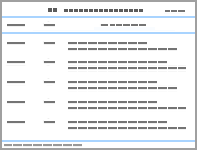
Tab.1
Different real fault location results
| 真实故障点 | 故障区段 | 定位结果(参考端)/km | 定位误差/m | ||
|---|---|---|---|---|---|
| F1 | [V(1), 0.9877] | [V(2), 0.9502] | E1E2 | 1.3296(E1) | 29.6 |
| F2 | [V(17), 0.9413] | [V(18), 0.9995] | E1E6 | 0.0081(E6) | 8.1 |
| F3 | [V(32), 0.9464] | [V(33), 0.9986] | E8E9 | 2.8665(E8) | 33.5 |

Fig.12
Location analysis of fault F1

Tab.2
Simulation results of different fault types
| 故障类型 | 故障区段 | 定位结果(参考端)/km | 定位误差/m | ||
|---|---|---|---|---|---|
| AG | [V(1), 0.9877] | [V(2), 0.9502] | E1E2 | 1.3296(E1) | 29.6 |
| CG | [V(1), 0.9878] | [V(2), 0.9502] | E1E2 | 1.3255(E1) | 25.5 |
| AB | [V(1), 0.9877] | [V(2), 0.9502] | E1E2 | 1.3140(E1) | 14.0 |
| BCG | [V(1), 0.9880] | [V(2), 0.9503] | E1E2 | 1.3201(E1) | 20.1 |
| ABC | [V(1), 0.9878] | [V(2), 0.9500] | E1E2 | 1.3099(E1) | 9.9 |
Tab.3
Simulation results of different fault resistances
| 过渡电阻/Ω | 故障区段 | 定位结果(参考端)/km | 定位误差/m | ||
|---|---|---|---|---|---|
| 0 | [V(17), 0.9412] | [V(18), 0.9997] | E1E6 | 0.0152(E6) | 15.2 |
| 50 | [V(17), 0.9410] | [V(18), 0.9998] | E1E6 | 0.0105(E6) | 10.5 |
| 500 | [V(17), 0.9413] | [V(18), 0.9997] | E1E6 | 0.0077(E6) | 7.7 |
| 1 000 | [V(17), 0.9413] | [V(18), 0.9995] | E1E6 | 0.0081(E6) | 8.1 |
| 5 000 | [V(17), 0.9395] | [V(18), 0.9987] | E1E6 | 0.0128(E6) | 12.8 |
Tab.4
Simulation results of different fault initial angles
| 故障初相角/(°) | 故障区段 | 定位结果(参考端)/km | 定位误差/m | ||
|---|---|---|---|---|---|
| 1.5 | [V(32), 0.9376] | [V(33), 0.9811] | E8E9 | 2.8891(E8) | 10.9 |
| 5 | [V(32), 0.9424] | [V(33), 0.9903] | E8E9 | 2.8658(E8) | 34.2 |
| 30 | [V(32), 0.9464] | [V(33), 0.9986] | E8E9 | 2.8665(E8) | 33.5 |
| 60 | [V(32), 0.9465] | [V(33), 0.9986] | E8E9 | 2.8780(E8) | 22.0 |
| 90 | [V(32), 0.9460] | [V(33), 0.9985] | E8E9 | 2.8747(E8) | 25.3 |
Tab.5
Simulation results of different DG types and capacities
| DG类型 | DG1容量/MW | 故障区段 | 定位结果 (参考端)/km | 定位 误差/m | ||
|---|---|---|---|---|---|---|
| 燃料电池 | 0.1 | [V(32), 0.9465] | [V(33), 0.9989] | E8E9 | 2.8668(E8) | 33.2 |
| 4 | [V(32), 0.9464] | [V(33), 0.9986] | E8E9 | 2.8665(E8) | 33.5 | |
| 10 | [V(32), 0.9464] | [V(33), 0.9987] | E8E9 | 2.8665(E8) | 33.5 | |
| 光伏电池 | 0.1 | [V(32), 0.9465] | [V(33), 0.9986] | E8E9 | 2.8665(E8) | 33.5 |
| 4 | [V(32), 0.9464] | [V(33), 0.9986] | E8E9 | 2.8665(E8) | 33.5 | |
| 10 | [V(32), 0.9468] | [V(33), 0.9987] | E8E9 | 2.8665(E8) | 33.5 |

Fig.13
Topology of real field model

Tab.6
Fault location results of real field model
| 过渡电阻 | 故障区段 | 定位结果(参考端)/km | 定位误差/m | ||
|---|---|---|---|---|---|
| 50 | [V(6), 0.8945] | [V(7), 0.9976] | #380-2-#10 | 0.0087(2-#10) | 8.7 |
| 500 | [V(6), 0.8968] | [V(7), 0.9977] | #380-2-#10 | 0.0099(2-#10) | 9.9 |
| 2 500 | [V(6), 0.8762] | [V(7), 0.9954] | #380-2-#10 | 0.0145(2-#10) | 14.5 |

Fig.14
Line-mode traveling wave signal at real fault point


Fig.15
Real fault location analysis of real field model

| [1] | 陈雨婷, 赵毅, 吴俊达, 等. 考虑碳排放指标的配电网经济调度方法[J]. 上海交通大学学报, 2023, 57(4): 442-451. |
| CHEN Yuting, ZHAO Yi, WU Junda, et al. Economic dispatch method of distribution network considering carbon emission index[J]. Journal of Shanghai Jiao Tong University, 2023, 57(4): 442-451. | |
| [2] |
GHOLAMI M, ABBASPOUR A, MOEINI-AGHTAIE M, et al. Detecting the location of short-circuit faults in active distribution network using PMU-based state estimation[J]. IEEE Transactions on Smart Grid, 2020, 11(2): 1396-1406.
doi: 10.1109/TSG.5165411 URL |
| [3] | 詹惠瑜, 刘科研, 盛万兴, 等. 有源配电网故障诊断与定位方法综述及展望[J]. 高电压技术, 2023, 49(2): 660-671. |
| ZHAN Huiyu, LIU Keyan, SHENG Wanxing, et al. Review and prospects of fault diagnosis and location method in active distribution network[J]. High Voltage Engineering, 2023, 49(2): 660-671. | |
| [4] | LI W Y, JI Z S, DONG F G. Global renewable energy power generation efficiency evaluation and influencing factors analysis[J]. Sustainable Production & Consumption, 2022, 33: 438-453. |
| [5] | 谢李为, 李勇, 罗隆福, 等. 基于距离矩阵与分支系数的配电网故障定位方法[J]. 中国电机工程学报, 2020, 40(7): 2180-2191. |
| XIE Liwei, LI Yong, LUO Longfu, et al. Fault location method for distribution networks based on distance matrix and branch coefficient[J]. Proceedings of the CSEE, 2020, 40(7): 2180-2191. | |
| [6] |
REN X F, PAN Y H, HOU M, et al. Fault location of the renewable energy sources connected distribution networks based on time differences of the modal traveling waves[J]. IEEE Access, 2023, 11: 129671-129682.
doi: 10.1109/ACCESS.2023.3332633 URL |
| [7] | 毕忠勤, 余晓婉, 王宝楠, 等. 基于量子蚁群算法的配电网故障区段快速定位技术[J]. 上海交通大学学报, 2024, 58(5): 693-708. |
| BI Zhongqin, YU Xiaowan, WANG Baonan, et al. Fast fault location technology for distribution network based on quantum ant colony algorithm[J]. Journal of Shanghai Jiao Tong University, 2024, 58(5): 693-708. | |
| [8] |
CHEN K J, HU J, ZHANG Y, et al. Fault location in power distribution systems via deep graph convolutional networks[J]. IEEE Journal on Selected Areas in Communications, 2020, 38(1): 119-131.
doi: 10.1109/JSAC.49 URL |
| [9] | 和敬涵, 罗国敏, 程梦晓, 等. 新一代人工智能在电力系统故障分析及定位中的研究综述[J]. 中国电机工程学报, 2020, 40(17): 5506-5516. |
| HE Jinghan, LUO Guomin, CHENG Mengxiao, et al. A research review on application of artificial intelligence in power system fault analysis and location[J]. Proceedings of the CSEE, 2020, 40(17): 5506-5516. | |
| [10] |
MAJIDI M, ETEZADI-AMOLI M, SAMI FADALI M. A novel method for single and simultaneous fault location in distribution networks[J]. IEEE Transactions on Power Systems, 2015, 30(6): 3368-3376.
doi: 10.1109/TPWRS.2014.2375816 URL |
| [11] | 邓丰, 李欣然, 曾祥君, 等. 基于多端故障行波时差的含分布式电源配电网故障定位新方法[J]. 中国电机工程学报, 2018, 38(15): 4399-4409. |
| DENG Feng, LI Xinran, ZENG Xiangjun, et al. A novel multi-terminal fault location method based on traveling wave time difference for radial distribution systems with distributed generators[J]. Proceedings of the CSEE, 2018, 38(15): 4399-4409. | |
| [12] | 邓丰, 史鸿飞, 冯思旭, 等. CNN-LSTM全景故障特征挖掘的配电网单端定位方法[J]. 中国电机工程学报, 2023, 43 (Sup. 1): 114-126. |
| DENG Feng, SHI Hongfei, FENG Sixu, et al. Single-ended traveling wave location method for distribution network based on CNN-LSTM panoramic fault feature mining[J]. Proceedings of the CSEE, 2023, 43 (Sup. 1): 114-126. | |
| [13] | 李泽文, 刘基典, 席燕辉, 等. 基于暂态波形相关性的配电网故障定位方法[J]. 电力系统自动化, 2020, 44(21): 72-79. |
| LI Zewen, LIU Jidian, XI Yanhui, et al. Fault location method for distribution network based on transient waveform correlation[J]. Automation of Electric Power Systems, 2020, 44(21): 72-79. | |
| [14] | 刘晓琴, 王大志, 江雪晨, 等. 利用行波到达时差关系的配电网故障定位算法[J]. 中国电机工程学报, 2017, 37(14): 4109-4115. |
| LIU Xiaoqin, WANG Dazhi, JIANG Xuechen, et al. Fault location algorithm for distribution power network based on relationship in time difference of arrival of traveling wave[J]. Proceedings of the CSEE, 2017, 37(14): 4109-4115. | |
| [15] |
ROBSON S, HADDAD A, GRIFFITHS H. Fault location on branched networks using a multiended approach[J]. IEEE Transactions on Power Delivery, 2014, 29(4): 1955-1963.
doi: 10.1109/TPWRD.2014.2302137 URL |
| [16] | 李小鹏, 何正友, 夏璐璐. 同杆双回输电线路的固有频率测距算法[J]. 电力系统自动化, 2011, 35(12): 47-51. |
| LI Xiaopeng, HE Zhengyou, XIA Lulu. Natural frequencies based fault location algorithm for parallel transmission lines on the same tower[J]. Automation of Electric Power Systems, 2011, 35(12): 47-51. | |
| [17] | 黄忠棋. 采用行波固有频率的混合线路故障测距新方法[J]. 电力系统及其自动化学报, 2015, 27(11): 73-79. |
| HUANG Zhongqi. New method of fault location for hybrid lines by using traveling wave natural frequencies[J]. Proceedings of the CSU-EPSA, 2015, 27(11): 73-79. | |
| [18] | 张媛媛, 朱永利. 基于行波固有频率的多分支输电线路故障定位[J]. 电力科学与技术学报, 2016, 31(3): 65-72. |
| ZHANG Yuanyuan, ZHU Yongli. A fault location method for multi-terminal transmission lines based on traveling wave natural frequencies[J]. Journal of Electric Power Science & Technology, 2016, 31(3): 65-72. | |
| [19] | 许德志, 汪飞, 毛华龙, 等. 多并网逆变器与电网的谐波交互建模与分析[J]. 中国电机工程学报, 2013, 33(12): 64-71. |
| XU Dezhi, WANG Fei, MAO Hualong, et al. Modeling and analysis of harmonic interaction between multiple grid-connected inverters and the utility grid[J]. Proceedings of the CSEE, 2013, 33(12): 64-71. | |
| [20] |
SHI S X, ZHU B E, LEI A Y, et al. Fault location for radial distribution network via topology and reclosure-generating traveling waves[J]. IEEE Transactions on Smart Grid, 2019, 10(6): 6404-6413.
doi: 10.1109/TSG.5165411 URL |
| [21] | 刘丰, 曾祥君, 谢李为, 等. 基于相电压差值极性的配电网单相接地故障检测方法[J]. 电力系统保护与控制, 2023, 51(15): 155-165. |
| LIU Feng, ZENG Xiangjun, XIE Liwei, et al. Single-phase grounding fault detection method for a distribution network based on phase voltage difference polarity value[J]. Power System Protection & Control, 2023, 51(15): 155-165. | |
| [22] | 肖文波, 胡方雨, 戴锦, 等. 太阳电池工程数学模型精确度对比分析研究[J]. 太阳能学报, 2016, 37(3): 703-708. |
| XIAO Wenbo, HU Fangyu, DAI Jin, et al. Comparison and investigation on the accuracy of the photovoltaic cells engerineering mathematical model[J]. Acta Energiae Solaris Sinica, 2016, 37(3): 703-708. | |
| [23] |
WANG L, LEE D J. Load-tracking performance of an autonomous SOFC-based hybrid power generation/energy storage system[J]. IEEE Transactions on Energy Conversion, 2010, 25(1): 128-139.
doi: 10.1109/TEC.2009.2032586 URL |
| [1] | WU Dongge, CHANG Xinyue, XUE Yixun, HUANG Yuxi, SU Jia, LI Zening, SUN Hongbin. Low-Carbon Energy Management in Active Distribution Networks Based on Dynamic Carbon Entropy [J]. Journal of Shanghai Jiao Tong University, 2025, 59(12): 1795-1804. |
| [2] | GAO Chong, DUAN Yao, CHENG Ran, CHEN Peidong, ZHOU Shucan, ZHANG Shenxi, CHEN Weilin, LIU Zhiwen. Collaborative Optimization Scheduling Method for Active Distribution Networks Considering Dispatchable Backup Batteries of 5G Base Station and Soft Open Point [J]. Journal of Shanghai Jiao Tong University, 2025, 59(11): 1603-1617. |
| [3] | MI Yang, CHEN Yuyang, CHEN Boyang, HAN Yunhao, YUAN Minghan. Shared Energy Storage Multi-Objective Allocation Strategy Considering Integrated Energy Microgrid Access to Active Distribution Network [J]. Journal of Shanghai Jiao Tong University, 2024, 58(9): 1309-1322. |
| [4] | WANG Guanyang, LI Chen, YU Yingjie, DENG Xiaobo, LU Da, LIANG Junli, WANG Tao. Helicopter Target Recognition Based on Micro-Doppler Feature [J]. Air & Space Defense, 2024, 7(2): 63-73. |
| [5] | ZENG Bo, MU Hongwei, DONG Houqi, ZENG Ming. Optimization of Active Distribution Network Operation Considering Decarbonization Endowment from 5G Base Stations [J]. Journal of Shanghai Jiao Tong University, 2022, 56(3): 279-292. |
| [6] | DU Chenyang, SHEN Junyi, LIU Yangyang, LI Chen, CHEN Chen. Target Detection and Range Estimation Based on Time-frequency Analysis and Correlation Coefficient Calculation [J]. Air & Space Defense, 2020, 3(3): 71-77. |
| [7] | LIN Haibo (林海波), GAO Zhibin (高志彬), YI Chuijie (仪垂杰), LIN Tianran (林天然). Simulation Study on Multi-Rate Time-Frequency Analysis of Non-Stationary Signals [J]. Journal of Shanghai Jiao Tong University (Science), 2018, 23(6): 798-802. |
| Viewed | ||||||
|
Full text |
|
|||||
|
Abstract |
|
|||||
