

上海交通大学学报 ›› 2026, Vol. 60 ›› Issue (3): 452-462.doi: 10.16183/j.cnki.jsjtu.2024.100
赵烜1,2,3, 赵齐4, 张大旭1,2,3( ), 张沛涪1,2,3
收稿日期:2024-03-22
修回日期:2024-05-13
接受日期:2024-05-29
出版日期:2026-03-28
发布日期:2026-03-30
通讯作者:
张大旭,教授,博士生导师;E-mail:作者简介:赵 烜(1999—),硕士生,从事复合材料力学与纤维增强聚合物的损伤研究.
ZHAO Xuan1,2,3, ZHAO Qi4, ZHANG Daxu1,2,3(), ZHANG Peifu1,2,3
Received:2024-03-22
Revised:2024-05-13
Accepted:2024-05-29
Online:2026-03-28
Published:2026-03-30
摘要:
为研究不同基体类型的玻璃纤维增强聚合物(GFRP)筋在海水海砂混凝土(SWSSC)环境下的层间剪切强度(ILSS)退化规律与性能劣化机理,对环氧基和乙烯基GFRP筋进行了SWSSC模拟孔溶液环境下加速腐蚀试验,以及层间剪切与扫描电镜(SEM)检测,其中环氧基GFRP筋分别采用甲基六氢化邻苯二甲酸酐(MHHPA)与二氨基二苯甲烷(MDA)两种固化剂固化.结果表明: MHHPA固化环氧基GFRP筋的初始层间剪切强度最高(42.44 MPa),乙烯基GFRP筋次之(37.10 MPa),MDA固化环氧基GFRP筋的初始层间剪切强度最低(27.20 MPa).在55 ℃的孔溶液中浸泡84 d后,MHHPA固化环氧基GFRP筋的层间剪切强度保留率仅为7.43%,MDA固化环氧基GFRP筋的强度保留率为39.51%,而乙烯基GFRP筋的保留率则有71.06%.3种GFRP筋的层间剪切强度均随SWSSC模拟孔溶液温度和浸泡时间的增加呈下降趋势,强度退化的主要原因为纤维-基体的界面脱黏以及基体的水解流失.乙烯基GFRP筋对SWSSC模拟孔溶液的抗腐蚀能力最强,MHHPA固化环氧基GFRP筋的最弱,MDA固化环氧基GFRP筋则介于两者之间.
中图分类号:
赵烜, 赵齐, 张大旭, 张沛涪. 聚合物基体类型对海水海砂混凝土环境下GFRP筋层间剪切强度影响[J]. 上海交通大学学报, 2026, 60(3): 452-462.
ZHAO Xuan, ZHAO Qi, ZHANG Daxu, ZHANG Peifu. Effects of Polymer Matrices on Interlaminar Shear Strength of GFRP Rebars in Seawater Sea-Sand Concrete Environment[J]. Journal of Shanghai Jiao Tong University, 2026, 60(3): 452-462.

图1
3种GFRP筋(G/E、G/V与G/P)试件

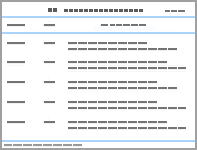
表1
模拟SWSSC孔溶液成分配比
| 组分质量浓度/(g·L-1) | pH | |||
|---|---|---|---|---|
| NaOH | KOH | Ca(OH)2 | NaCl | |
| 2.4 | 19.6 | 2 | 35 | 13.4 |
表2
试验GFRP筋工况编号
| GFRP筋种类 | 浸泡温度/℃ | 浸泡龄期 | |||
|---|---|---|---|---|---|
| 21 d | 42 d | 63 d | 84 d | ||
| MHHPA固化环氧基 | 25 | G/E T25D21 | G/E T25D42 | G/E T25D63 | G/E T25D84 |
| 40 | G/E T40D21 | G/E T40D42 | G/E T40D63 | G/E T40D84 | |
| 55 | G/E T55D21 | G/E T55D42 | G/E T55D63 | G/E T55D84 | |
| MDA固化环氧基 | 25 | G/P T25D21 | G/P T25D42 | G/P T25D63 | G/P T25D84 |
| 40 | G/P T40D21 | G/P T40D42 | G/P T40D63 | G/P T40D84 | |
| 55 | G/P T55D21 | G/P T55D42 | G/P T55D63 | G/P T55D84 | |
| 乙烯基 | 25 | G/V T25D21 | G/V T25D42 | G/V T25D63 | G/V T25D84 |
| 40 | G/V T40D21 | G/V T40D42 | G/V T40D63 | G/V T40D84 | |
| 55 | G/V T55D21 | G/V T55D42 | G/V T55D63 | G/V T55D84 | |

图2
G/E RF试件层间剪切破坏


图3
G/E试件层间剪切应力-位移曲线


图4
G/P RF试件层间剪切破坏


图5
G/P试件层间剪切应力-位移曲线


图6
G/V RF试件层间剪切破坏


图7
G/V试件层间剪切应力-位移曲线


图8
40 ℃加速腐蚀条件下不同基体GFRP筋层间剪切应力-位移曲线


图9
G/E、G/P和G/V试件层间剪切强度退化规律


图10
G/E、G/P与G/V试件的归一化层间剪切强度退化规律


图11
G/E、G/P与G/V试件的表观退化


图12
G/E RF与G/E T55D42的SEM图像对比


图13
G/P RF与G/P T55D84的SEM图像对比


图14
G/V RF与G/V T55D84的SEM图像对比


图15
MHHPA固化环氧基体水解示意图


图16
MDA固化环氧基体水解示意图


图17
乙烯基体水解示意图

| [1] |
OBANDO M, IQBAL M, ZHANG D X, et al. Axial strength prediction of seawater sea sand concrete-filled circular FRP tubes under alkaline environment based on ensemble learning models[J]. Thin-Walled Structures, 2024, 195: 111530.
doi: 10.1016/j.tws.2023.111530 URL |
| [2] |
LIU J, AN R, JIANG Z L, et al. Effects of w/b ratio, fly ash, limestone calcined clay, seawater and sea-sand on workability, mechanical properties, drying shrinkage behavior and micro-structural characteristics of concrete[J]. Construction and Building Materials, 2022, 321: 126333.
doi: 10.1016/j.conbuildmat.2022.126333 URL |
| [3] |
ZHANG P F, IQBAL M, ZHANG D X, et al. Bond strength prediction of FRP bars to seawater sea sand concrete based on ensemble learning models[J]. Engineering Structures, 2024, 302: 117382.
doi: 10.1016/j.engstruct.2023.117382 URL |
| [4] | 冯鹏, 王杰, 张枭, 等. FRP与海砂混凝土组合应用的发展与创新[J]. 玻璃钢/复合材料, 2014(12): 13-18. |
| FENG Peng, WANG Jie, ZHANG Xiao, et al. Development and innovation on combining FRP and sea sand concrete for structures[J]. Fiber Reinforced Plastics/Composites, 2014(12): 13-18. | |
| [5] |
GUO F, AL-SAADI S, SINGH RAMAN R K, et al. Durability of fiber reinforced polymer (FRP) in simulated seawater sea sand concrete (SWSSC) environment[J]. Corrosion Science, 2018, 141: 1-13.
doi: 10.1016/j.corsci.2018.06.022 URL |
| [6] | 肖建庄, 张鹏, 张青天, 等. 海水海砂再生混凝土的基本力学性能[J]. 建筑科学与工程学报, 2018, 35(2): 16-22. |
| XIAO Jianzhuang, ZHANG Peng, ZHANG Qingtian, et al. Basic mechanical properties of seawater sea-sand recycled concrete[J]. Journal of Architecture and Civil Engineering, 2018, 35(2): 16-22. | |
| [7] |
BAZLI M, ZHAO X L, JAFARI A, et al. Mechanical properties of pultruded GFRP profiles under seawater sea sand concrete environment coupled with UV radiation and moisture[J]. Construction and Building Materials, 2020, 258: 120369.
doi: 10.1016/j.conbuildmat.2020.120369 URL |
| [8] |
WANG D H, GONG Q N, YUAN Q, et al. Review of the properties of fiber-reinforced polymer-reinforced seawater-sea sand concrete[J]. Journal of Materials in Civil Engineering, 2021, 33(10): 04021285.
doi: 10.1061/(ASCE)MT.1943-5533.0003894 URL |
| [9] |
WU W W, HE X J, YANG W R, et al. Durability and microstructure degradation mechanism of FRP-seawater seasand concrete structures: A review[J]. Construction and Building Materials, 2023, 391: 131825.
doi: 10.1016/j.conbuildmat.2023.131825 URL |
| [10] |
ZHAO Q, ZHANG D X, ZHAO X L, et al. Modelling damage evolution of carbon fiber-reinforced epoxy polymer composites in seawater sea sand concrete environment[J]. Composites Science and Technology, 2021, 215: 108961.
doi: 10.1016/j.compscitech.2021.108961 URL |
| [11] |
王文华, 赵齐, 张大旭, 等. 相对湿度对海水海砂混凝土环境下GFRP筋拉伸性能影响[J]. 上海交通大学学报, 2023, 57(2): 148-160.
doi: 10.16183/j.cnki.jsjtu.2022.034 |
| WANG Wenhua, ZHAO Qi, ZHANG Daxu, et al. Effects of relative humidity on tensile property degradation of GFRP rebars in seawater and sea sand concrete envirnment[J]. Journal of Shanghai Jiao Tong University, 2023, 57(2): 148-160. | |
| [12] |
LI Y L, ZHAO X L, SINGH RAMAN R K, et al. Tests on seawater and sea sand concrete-filled CFRP, BFRP and stainless steel tubular stub columns[J]. Thin-Walled Structures, 2016, 108: 163-184.
doi: 10.1016/j.tws.2016.08.016 URL |
| [13] | 滕锦光. 新材料组合结构[J]. 土木工程学报, 2018, 51(12): 1-11. |
| TENG Jinguang. New-material hybrid structures[J]. China Civil Engineering Journal, 2018, 51(12): 1-11. | |
| [14] |
WU G, DONG Z Q, WANG X, et al. Prediction of long-term performance and durability of BFRP bars under the combined effect of sustained load and corrosive solutions[J]. Journal of Composites for Construction, 2015, 19(3): 04014058.
doi: 10.1061/(ASCE)CC.1943-5614.0000517 URL |
| [15] | 董志强, 吴刚. FRP筋增强混凝土结构耐久性能研究进展[J]. 土木工程学报, 2019, 52(10): 1-19. |
| DONG Zhiqiang, WU Gang. Research progress on durability of FRP bars reinforced concrete structures[J]. China Civil Engineering Journal, 2019, 52(10): 1-19. | |
| [16] |
AHMED A, GUO S C, ZHANG Z H, et al. A review on durability of fiber reinforced polymer (FRP) bars reinforced seawater sea sand concrete[J]. Construction and Building Materials, 2020, 256: 119484.
doi: 10.1016/j.conbuildmat.2020.119484 URL |
| [17] |
WEN S Y, CAO M L. Review on degradation behavior of fiber-reinforced polymer bars in marine environments[J]. Journal of Materials Science, 2023, 58(24): 9861-9893.
doi: 10.1007/s10853-023-08667-1 |
| [18] |
WANG Z K, ZHAO X L, XIAN G J, et al. Durability study on interlaminar shear behaviour of basalt-, glass-and carbon-fibre reinforced polymer (B/G/CFRP) bars in seawater sea sand concrete environment[J]. Construction and Building Materials, 2017, 156: 985-1004.
doi: 10.1016/j.conbuildmat.2017.09.045 URL |
| [19] |
YI Y, GUO S C, LI S, et al. Effect of alkalinity on the shear performance degradation of basalt fiber-reinforced polymer bars in simulated seawater sea sand concrete environment[J]. Construction and Building Materials, 2021, 299: 123957.
doi: 10.1016/j.conbuildmat.2021.123957 URL |
| [20] |
BENMOKRANE B, ALI A H, MOHAMED H M, et al. Laboratory assessment and durability performance of vinyl-ester, polyester, and epoxy glass-FRP bars for concrete structures[J]. Composites Part B: Engineering, 2017, 114: 163-174.
doi: 10.1016/j.compositesb.2017.02.002 URL |
| [21] |
SUN Y N, JIN Z Q, ZHANG X Y, et al. Degradation of GFRP bars in alkaline environments: An experimental and molecular dynamics study[J]. Journal of Building Engineering, 2023, 77: 107449.
doi: 10.1016/j.jobe.2023.107449 URL |
| [22] |
ALI A H, MOHAMED H M, BENMOKRANE B, et al. Durability performance and long-term prediction models of sand-coated basalt FRP bars[J]. Composites Part B: Engineering, 2019, 157: 248-258.
doi: 10.1016/j.compositesb.2018.08.065 URL |
| [23] | 王自柯, 段建新, 赵军, 等. FRP筋在不同腐蚀环境下的层间剪切性能劣化试验[J]. 复合材料学报, 2024, 41(4): 2031-2042. |
| WANG Zike, DUAN Jianxin, ZHAO Jun, et al. Experimental study on the degradation of interlaminar shear performance of FRP bars in different corrosive environments[J]. Acta Materiae Compositae Sinica, 2024, 41(4): 2031-2042. | |
| [24] |
BARNEYBACK R S, DIAMOND S. Expression and analysis of pore fluids from hardened cement pastes and mortars[J]. Cement and Concrete Research, 1981, 11(2): 279-285.
doi: 10.1016/0008-8846(81)90069-7 URL |
| [25] | 赵齐, 张大旭, 赵晓林, 等. 环氧基GFRP筋在海水海砂混凝土孔溶液环境下的损伤演化试验与模型研究[J]. 土木工程学报, 2022, 55(9): 25-41. |
| ZHAO Qi, ZHANG Daxu, ZHAO Xiaolin, et al. Experimental and modelling studies on damage evolution of epoxy-based GFRP bars in pore solution environment of seawater sea-sand concrete[J]. China Civil Engineering Journal, 2022, 55(9): 25-41. | |
| [26] | SHI C, STEGEMANN J A, CALDWELL R J. Effect of supplementary cementing materials on the specific conductivity of pore solution and its implications on the rapid chloride permeability test (AASHTO T277 and ASTM C1202) results[J]. Aci Materials Journal, 1998, 95(4): 389-394. |
| [27] |
CHEN Y, DAVALOS J F, RAY I. Durability prediction for GFRP reinforcing bars using short-term data of accelerated aging tests[J]. Journal of Composites for Construction, 2006, 10(4): 279-286.
doi: 10.1061/(ASCE)1090-0268(2006)10:4(279) URL |
| [28] | ASTM. Standard test method for apparent horizontal shear strength of pultruded reinforced plastic rods by the short-beam method:ASTM D4475-21[S]. West Conshohocken, PA, USA: American Society of Testing Materials, 2021. |
| [29] |
ZHAO Q, ZHAO X L, ZHANG D X, et al. Degradation of GFRP bars with epoxy and vinyl ester matrices in a marine concrete environment: An experimental study and theoretical modeling[J]. Journal of Composites for Construction, 2024, 28(2): 04024004.
doi: 10.1061/JCCOF2.CCENG-4474 URL |
| [1] | 王阳达, 王建国, 连冠, 张大骋. 基于弛豫时间的不同工况下直接甲醇燃料电池性能退化分析[J]. 上海交通大学学报, 2026, 60(2): 289-299. |
| [2] | 王汉禹, 陈震, 周笛, 陈兆祥, 潘尔顺. 基于核函数-Wiener过程的轧辊非线性退化建模与剩余寿命预测[J]. 上海交通大学学报, 2023, 57(8): 1037-1045. |
| [3] | 王文华, 赵齐, 张大旭, 张沛涪, 陈鹏. 相对湿度对海水海砂混凝土环境下GFRP筋拉伸性能影响[J]. 上海交通大学学报, 2023, 57(2): 148-160. |
| [4] | 郭闻雨,张秀芳,修玉皎,夏唐斌,潘尔顺. 考虑动态性能退化的生产系统预防维护和缓存配置策略[J]. 上海交通大学学报, 2019, 53(9): 1107-1114. |
| [5] | 蔡忠义, 陈云翔, 李韶亮, 项华春, 王泽洲. 考虑随机退化和信息融合的剩余寿命预测方法[J]. 上海交通大学学报, 2016, 50(11): 1778-1783. |
| [6] | 胡友涛, 胡昌华. 一种基于遗传算法优化小波支持向量回归机的实时寿命预测方法[J]. 上海交通大学学报(自然版), 2011, 45(08): 1216-1220. |
| 阅读次数 | ||||||
|
全文 |
|
|||||
|
摘要 |
|
|||||
