

上海交通大学学报 ›› 2025, Vol. 59 ›› Issue (10): 1407-1418.doi: 10.16183/j.cnki.jsjtu.2024.334
• 新型电力系统与综合能源 • 下一篇
程昊文1, 李克成2, 柳璐1( ), 程浩忠1, 桑丙玉2
收稿日期:2024-08-19
修回日期:2024-09-14
接受日期:2024-10-20
出版日期:2025-10-28
发布日期:2025-10-24
通讯作者:
柳 璐,副研究员,电话(Tel.):021-34204813;E-mail:liulu52@sjtu.edu.cn.
作者简介:程昊文(1998—),硕士,研究电源优化规划、电池储能优化配置、电力系统频率控制.
基金资助:
CHENG Haowen1, LI Kecheng2, LIU Lu1(), CHENG Haozhong1, SANG Bingyu2
Received:2024-08-19
Revised:2024-09-14
Accepted:2024-10-20
Online:2025-10-28
Published:2025-10-24
摘要:
多样化调频资源是保障新型电力系统频率安全的有效手段和必然趋势.基于风电、光伏、火电与储能协同的差异化调频策略, 提出一种多场景下耦合长时间尺度规划与短时间尺度机组组合的电源侧电池储能优化配置方法.分别构建火储、风储、光储联合调频策略, 细化配套电池储能的不同功能, 增强其在调频过程中的灵活性.优化模型以风光火储全系统投资与运行成本最小为目标, 将系统可释放的频率响应功率作为安全约束; 通过高阶多机系统频率响应的时域仿真进行校验, 并反馈频率安全割迭代求解. 改进IEEE 24节点系统的算例表明, 所提方法下电池储能可在平抑功率波动、减少新能源弃电与参与电力系统调频之间灵活选择,验证了方法的有效性.
中图分类号:
程昊文, 李克成, 柳璐, 程浩忠, 桑丙玉. 基于风光火差异化调频策略的电池储能协同优化配置[J]. 上海交通大学学报, 2025, 59(10): 1407-1418.
CHENG Haowen, LI Kecheng, LIU Lu, CHENG Haozhong, SANG Bingyu. Optimization Configuration of Battery Storage Coordinated with Differentiated Frequency Regulation Strategy of Wind, Solar, and Thermal Power[J]. Journal of Shanghai Jiao Tong University, 2025, 59(10): 1407-1418.

图1
高阶多机系统频率响应模型


图2
规划模块示意图

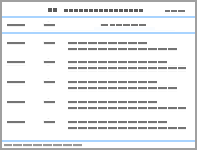
表1
不同对比方案的装机结果
| 对比方案 | 火电容量/GW | 风电容量/GW | 光伏容量/MW | 火储容量/MW | 风储容量/MW | 光储容量/MW |
|---|---|---|---|---|---|---|
| 1 | 4.57 | 1.54 | 260 | 0 | 0 | 0 |
| 2 | 4.57 | 1.24 | 160 | 15 | 126 | 22 |
| 3 | 4.57 | 1.16 | 260 | 135 | 116 | 36 |
| 4 | 4.57 | 1.16 | 260 | 63 | 116 | 80 |
表2
不同对比方案的成本和发电情况
| 对比 方案 | 电源年投 资成本/ 亿元 | 储能年投 资成本/ 亿元 | 年燃料 成本/ 亿元 | 年开机 成本/ 亿元 | 年切负荷 成本/ 亿元 | 年风光运 维成本/ 亿元 | 年弃能 成本/ 亿元 | 总成本/ 亿元 | 火电机组 | 新能源机组 | |||
|---|---|---|---|---|---|---|---|---|---|---|---|---|---|
| 发电量/ (GW·h) | 发电量 占比/% | 发电量/ (GW·h) | 发电量 占比/% | ||||||||||
| 1 | 7.008 | 0 | 14.313 | 0.200 | 0 | 0.374 | 2.323 | 24.218 | 5969 | 46.7 | 6818 | 53.3 | |
| 2 | 5.368 | 1.251 | 14.357 | 0.220 | 0 | 0.314 | 0 | 21.510 | 6972 | 54.8 | 5753 | 45.2 | |
| 3 | 5.336 | 2.298 | 14.426 | 0.220 | 0 | 0.303 | 0 | 22.584 | 7212 | 56.7 | 5513 | 43.3 | |
| 4 | 5.336 | 1.817 | 14.468 | 0.220 | 0 | 0.295 | 0.151 | 22.285 | 7363 | 57.9 | 5363 | 42.1 | |

图3
方案4全时段频率响应过程


图4
极端情况频率响应过程

表3
不同对比方案的频率响应结果
| 对比 方案 | 频率跌落 最低值/Hz | 调频 时长/s | 准稳态 频率/Hz | 频率变化速率/ (Hz·s-1) |
|---|---|---|---|---|
| 1 | 48.47 | 25.06 | 48.91 | 0.24 |
| 2 | 48.86 | 24.84 | 49.19 | 0.17 |
| 3 | 49.40 | 14.98 | 49.50 | 0.20 |
| 4 | 49.42 | 14.92 | 49.57 | 0.21 |
表4
不同弃能率下规划结果
| 弃能比例 上限/% | 年电源投资 成本/亿元 | 年储能投资 成本/亿元 | 年燃料成本/ 亿元 | 年风光运维 成本/亿元 | 年开机 成本/亿元 | 年弃能 成本/亿元 | 年切负荷 成本/亿元 | 总成本/ 亿元 | 弃能率/% |
|---|---|---|---|---|---|---|---|---|---|
| 0 | 5.336 | 2.057 | 14.42 | 0.303 | 0.22 | 0 | 0 | 22.34 | 0 |
| 0.5 | 5.336 | 2.009 | 14.43 | 0.302 | 0.22 | 0.027 | 0 | 22.32 | 0.50 |
| 1 | 5.336 | 1.973 | 14.43 | 0.300 | 0.22 | 0.050 | 0 | 22.31 | 0.91 |
| 1.5 | 5.336 | 1.937 | 14.44 | 0.299 | 0.22 | 0.073 | 0 | 22.30 | 1.32 |
| 2 | 5.336 | 1.901 | 14.45 | 0.298 | 0.22 | 0.096 | 0 | 22.30 | 1.74 |
| 2.5 | 5.336 | 1.853 | 14.46 | 0.296 | 0.22 | 0.128 | 0 | 22.29 | 2.32 |
| 3 | 5.336 | 1.817 | 14.46 | 0.295 | 0.22 | 0.151 | 0 | 22.28 | 2.73 |
| 5 | 5.336 | 1.817 | 14.46 | 0.295 | 0.22 | 0.151 | 0 | 22.28 | 2.73 |

图5
不同弃能费用及弃能率下总成本

| [1] | 辛保安, 单葆国, 李琼慧, 等. “双碳” 目标下“能源三要素” 再思考[J]. 中国电机工程学报, 2022, 42(9): 3117-3126. |
| XIN Baoan, SHAN Baoguo, LI Qionghui, et al. Rethinking of the “three elements of energy” toward carbon peak and carbon neutrality[J]. Proceedings of the CSEE, 2022, 42(9): 3117-3126. | |
| [2] | 汪梦军, 郭剑波, 马士聪, 等. 新能源电力系统暂态频率稳定分析与调频控制方法综述[J]. 中国电机工程学报, 2023, 43(5): 1672-1693. |
| WANG Mengjun, GUO Jianbo, MA Shicong, et al. Review of transient frequency stability analysis and frequency regulation control methods for renewable power systems[J]. Proceedings of the CSEE, 2023, 43(5): 1672-1693. | |
| [3] | 滕贤亮, 谈超, 昌力, 等. 高比例新能源电力系统有功功率与频率控制研究综述及展望[J]. 电力系统自动化, 2023, 47(15): 12-35. |
| TENG Xianliang, TAN Chao, CHANG Li, et al. Review and prospect of research on active power and frequency control in power system with high proportion of renewable energy[J]. Automation of Electric Power Systems, 2023, 47(15): 12-35. | |
| [4] | 张程铭, 柳璐, 程浩忠, 等. 考虑频率安全的电力系统规划与运行优化研究综述与展望[J]. 电网技术, 2022, 46(1): 250-265. |
| ZHANG Chengming, LIU Lu, CHENG Haozhong, et al. Review and prospects of planning and operation optimization for electrical power systems considering frequency security[J]. Power System Technology, 2022, 46(1): 250-265. | |
| [5] | SUN M, MIN Y, XIONG X J, et al. Practical realization of optimal auxiliary frequency control strategy of wind turbine generator[J]. Journal of Modern Power Systems and Clean Energy, 2022, 10(3): 617-626. |
| [6] |
周涛, 黄菊, 韩汝帅, 等. 综合惯性控制下风力机惯性支撑能力分析及等效惯量评估[J]. 上海交通大学学报, 2024, 58(12): 1915-1924.
doi: 10.16183/j.cnki.jsjtu.2023.161 |
| ZHOU Tao, HUANG Ju, HAN Rushuai, et al. Inertial support capacity analysis and equivalent inertia estimation of wind turbines in integrated inertial control[J]. Journal of Shanghai Jiao Tong University, 2024, 58(12): 1915-1924. | |
| [7] | 米阳, 何进, 卢长坤, 等. 计及新能源并网的火储联合调峰运行优化研究[J]. 中国电机工程学报, 2025, 45(5): 1704-1715. |
| MI Yang, HE Jin, LU Changkun, et al. Research on optimization of thermal storage combined peak shaving operation considering new energy grid connection[J]. Proceedings of the CSEE, 2025, 45(5): 1704-1715. | |
| [8] | 梁恺, 彭晓涛, 秦世耀, 等. 基于协同控制优化风储系统频率响应的策略研究[J]. 中国电机工程学报, 2021, 41(8): 2628-2640. |
| LIANG Kai, PENG Xiaotao, QIN Shiyao, et al. Study on synergetic control strategy for optimizing frequency response of wind farm augmented with energy storage system[J]. Proceedings of the CSEE, 2021, 41(8): 2628-2640. | |
| [9] | 李忠文, 柏宁宁, 程志平, 等. 新型电力系统中异质调频机组分布式协同AGC方法研究[J]. 电网技术, 2024, 48(6): 2327-2335. |
| LI Zhongwen, BAI Ningning, CHENG Zhiping, et al. Distributed collaborative AGC method for heterogeneous frequency regulation units in new power systems[J]. Power System Technology, 2024, 48(6): 2327-2335. | |
| [10] | 王语阳, 张琛, 张宇, 等. 提升弱网有功稳定输出能力的光伏逆变器Q-V下垂系数在线调整方法[J/OL]. 上海交通大学学报. https://doi.org/10.16183/j.cnki.jsjtu.2023.353. |
| WANG Yuyang, ZHANG Chen, ZHANG Yu, et al. Online adjustment method for Q-V droop coefficient of photovoltaic inverters to enhance the stable output capability of weak grid active power[J/OL]. Journal of Shanghai Jiao Tong University. https://doi.org/10.16183/j.cnki.jsjtu.2023.353. | |
| [11] | 高建瑞, 李国杰, 汪可友, 等. 考虑储能充放电功率限制的并网光储虚拟同步机控制[J]. 电力系统自动化, 2020, 44(4): 134-141. |
| GAO Jianrui, LI Guojie, WANG Keyou, et al. Control of grid-connected PV-battery virtual synchronous machine considering battery charging/discharging power limit[J]. Automation of Electric Power Systems, 2020, 44(4): 134-141. | |
| [12] | ZHU Y H, ZHAO D B, LI X J, et al. Control-limited adaptive dynamic programming for multi-battery energy storage systems[J]. IEEE Transactions on Smart Grid, 2019, 10(4): 4235-4244. |
| [13] | 李兆伟, 方勇杰, 李威, 等. 电化学储能应用于电网频率安全防御三道防线的探讨[J]. 电力系统自动化, 2020, 44(8): 1-7. |
| LI Zhaowei, FANG Yongjie, LI Wei, et al. Discussion on application of electrochemical energy storage in three defense lines of power grid frequency[J]. Automation of Electric Power Systems, 2020, 44(8): 1-7. | |
| [14] |
李建林, 屈树慷, 马速良, 等. 电池储能系统辅助电网调频控制策略研究[J]. 太阳能学报, 2023, 44(3): 326-335.
doi: 10.19912/j.0254-0096.tynxb.2021-1297 |
| LI Jianlin, QU Shukang, MA Suliang, et al. Research on frequency modulation control strategy of auxiliary power grid in battery energy storage system[J]. Acta Energiae Solaris Sinica, 2023, 44(3): 326-335. | |
| [15] | 许高秀, 王旭, 邓晖, 等. 考虑调频需求及风光出力不确定性的储能系统参与能量-调频市场运行策略[J]. 电网技术, 2023, 47(6): 2317-2330. |
| XU Gaoxiu, WANG Xu, DENG Hui, et al. Optimal operation strategy of energy storage system’s participation in energy and regulation market considering uncertainties of regulation requirements and wind-photovoltaic output[J]. Power System Technology, 2023, 47(6): 2317-2330. | |
| [16] | 陆秋瑜, 杨银国, 谢平平, 等. 适应储能参与的调频辅助服务市场机制设计及调度策略[J]. 电网技术, 2023, 47(12): 4971-4989. |
| LU Qiuyu, YANG Yinguo, XIE Pingping, et al. Market mechanism design and scheduling strategy of auxiliary services for frequency control adapting to energy storage participation[J]. Power System Technology, 2023, 47(12): 4971-4989. | |
| [17] | ZHANG Y J A, ZHAO C H, TANG W R, et al. Profit-maximizing planning and control of battery energy storage systems for primary frequency control[J]. IEEE Transactions on Smart Grid, 2018, 9(2): 712-723. |
| [18] | 杨银国, 冯胤颖, 魏韡, 等. 基于可消纳区间的风-火-储大基地日前-实时协同调度[J/OL]. 上海交通大学学报. https://xuebao.sjtu.edu.cn/CN/10.16183/j.cnki.jsjtu.2023.509. |
| YANG Yinguo, FENG Yinying, WEI Wei, et al. Wind-fire-storage base day-ahead real-time collaborative scheduling based on the dissipable interval[J/OL]. Journal of Shanghai Jiao Tong University. https://xuebao.sjtu.edu.cn/CN/10.16183/j.cnki.jsjtu.2023.509. | |
| [23] | ZHOU Xia, CHEN Wenjian, DAI Jianfeng, et al. Black-start coordinated control strategy of optical storage microgrid considering distributed energy storage SOC balance[J/OL]. Journal of Shanghai Jiao Tong University. https://xuebao.sjtu.edu.cn/CN/10.16183/j.cnki.jsjtu.2023.395. |
| [24] | 毛颖群, 张建平, 程浩忠, 等. 考虑频率安全约束及风电综合惯性控制的电力系统机组组合[J]. 电力系统保护与控制, 2022, 50(11): 61-70. |
| MAO Yingqun, ZHANG Jianping, CHENG Haozhong, et al. Unit commitment of a power system considering frequency safety constraint and wind power integrated inertial control[J]. Power System Protection and Control, 2022, 50(11): 61-70. | |
| [19] |
沈阳武, 宋兴荣, 罗紫韧, 等. 基于模型预测控制的分布式储能型风力发电场惯性控制策略[J]. 上海交通大学学报, 2022, 56(10): 1285-1293.
doi: 10.16183/j.cnki.jsjtu.2022.134 |
| SHEN Yangwu, SONG Xingrong, LUO Ziren, et al. Inertial control strategy for wind farm with distributed energy storage system based on model predictive control[J]. Journal of Shanghai Jiao Tong University, 2022, 56(10): 1285-1293. | |
| [20] | NGUYEN N, ALMASABI S, BERA A, et al. Optimal power flow incorporating frequency security constraint[J]. IEEE Transactions on Industry Applications, 2019, 55(6): 6508-6516. |
| [21] | 成明洋, 邢海军, 米阳, 等. 考虑风光储场站参与灵活爬坡的两阶段市场联合出清[J/OL]. 上海交通大学学报. https://xuebao.sjtu.edu.cn/CN/10.16183/j.cnki.jsjtu.2023.570. |
| CHENG Mingyang, XING Haijun, MI Yang, et al. Considering the participation of wind and solar storage stations in the two-stage market joint clearing of flexible climbing[J/OL]. Journal of Shanghai Jiao Tong University. https://xuebao.sjtu.edu.cn/CN/10.16183/j.cnki.jsjtu.2023.570. | |
| [22] |
郭咏涛, 向月, 刘俊勇. 面向高比例清洁能源消纳的含灵活性资源电力系统规划方案优选[J]. 上海交通大学学报, 2023, 57 (9): 1146-1155.
doi: 10.16183/j.cnki.jsjtu.2022.269 |
| GUO Yongtao, XIANG Yue, LIU Junyong. Optimal planning of power systems with flexible resources for high penetrated renewable energy accommodation[J]. Journal of Shanghai Jiao Tong University, 2023, 57 (9): 1146-1155. | |
| [23] | 周霞, 陈文剑, 戴剑丰, 等. 考虑分布式储能SOC均衡的光储微网黑启动协调控制策略[J/OL]. 上海交通大学学报. https://xuebao.sjtu.edu.cn/CN/10.16183/j.cnki.jsjtu.2023.395. |
| [1] | 冯梦圆, 文书礼, 时珊珊, 王皓靖, 朱淼, 杨雯. 满足新型电力系统调峰调频需求的储能优化配置及运行研究综述[J]. 上海交通大学学报, 2026, 60(1): 1-18. |
| [2] | 郑雨翕, 曾龙, 刘健哲, 崔一阳, 朱红, 曹亮, 苏运, 韦磊. 大规模电网机组组合中线路传输约束有效性规律及相似性挖掘方法[J]. 上海交通大学学报, 2025, 59(9): 1260-1269. |
| [3] | 邓倩文, 李奇, 邱宜彬, 李豆萌, 霍莎莎, 陈维荣. 考虑多灵活性资源联合运行的综合能源系统优化配置方法[J]. 上海交通大学学报, 2025, 59(7): 912-922. |
| [4] | 罗逸夫, 胡秦然, 钱涛, 陈涛, 张远实, 章飞, 王琦. 计及多工况对机组寿命损耗影响的机组组合优化模型[J]. 上海交通大学学报, 2025, 59(6): 768-779. |
| [5] | 崔一阳, 潘斗南, 黎灿兵, 刘健哲. 大规模电网机组组合状态迭代路径搜索优化方法[J]. 上海交通大学学报, 2025, 59(6): 711-719. |
| [6] | 张磊, 李然, 唐伦, 陈思捷, 赵世振, 苏福. 计及算力需求响应的神经分支电-算网快速优化方法[J]. 上海交通大学学报, 2025, 59(11): 1592-1602. |
| [7] | 朱兰, 张学涵, 唐陇军, 仇念航, 田英杰. 计及紧急可中断负荷的电能、惯性与一次调频联合出清模型[J]. 上海交通大学学报, 2025, 59(1): 16-27. |
| [8] | 陈晖, 何耿生, 刘昱良, 曾红梅, 张世旭, 李姚旺. 考虑热力系统等效储能特性的低碳园区储能容量优化配置[J]. 上海交通大学学报, 2024, 58(6): 863-871. |
| [9] | 陆文安, 朱清晓, 李兆伟, 刘辉, 余一平. 基于卷积神经网络的新型电力系统频率特性预测方法[J]. 上海交通大学学报, 2024, 58(10): 1500-1512. |
| [10] | 夏芹芹, 罗永捷, 王荣茂, 邹尧, 罗桓桓, 李金灿, 周念成, 王强钢. 考虑新能源爬坡的风光火耦合系统源荷匹配性分析及容量优化配置[J]. 上海交通大学学报, 2024, 58(1): 69-81. |
| [11] | 叶伦, 欧阳旭, 姚建刚, 杨胜杰, 尹骏刚. 考虑多重不确定性因素的可靠性指标计算与备用容量优化[J]. 上海交通大学学报, 2024, 58(1): 30-39. |
| [12] | 米阳, 李海鹏, 陈博洋, 彭建伟, 魏炜, 姚艳. 基于模糊场景聚类的微电网两阶段优化配置[J]. 上海交通大学学报, 2023, 57(9): 1137-1145. |
| [13] | 俞发强, 张名捷, 程语, 陈达伟, 杨函煜, 黎灿兵. 需求响应下的并网型风-光-沼微能源网优化配置[J]. 上海交通大学学报, 2023, 57(1): 10-16. |
| [14] | 陆秋瑜, 于珍, 杨银国, 李力. 考虑源荷功率不确定性的海上风力发电多微网两阶段优化调度[J]. 上海交通大学学报, 2022, 56(10): 1308-1316. |
| [15] | 杨博, 王俊婷, 俞磊, 曹璞璘, 束洪春, 余涛. 基于孔雀优化算法的配电网储能系统双层多目标优化配置[J]. 上海交通大学学报, 2022, 56(10): 1294-1307. |
| 阅读次数 | ||||||
|
全文 |
|
|||||
|
摘要 |
|
|||||
