

上海交通大学学报 ›› 2025, Vol. 59 ›› Issue (11): 1603-1617.doi: 10.16183/j.cnki.jsjtu.2024.020
高崇1, 段瑶1, 程苒1, 陈沛东1, 周姝灿1, 张沈习2( ), 陈玮林2, 刘志文3
收稿日期:2024-01-12
修回日期:2024-03-28
接受日期:2024-04-10
出版日期:2025-11-28
发布日期:2025-12-02
通讯作者:
张沈习
E-mail:willzsx@163.com
作者简介:高 崇(1983—),高级工程师,从事电力系统规划与运行方面的研究.
基金资助:
GAO Chong1, DUAN Yao1, CHENG Ran1, CHEN Peidong1, ZHOU Shucan1, ZHANG Shenxi2(), CHEN Weilin2, LIU Zhiwen3
Received:2024-01-12
Revised:2024-03-28
Accepted:2024-04-10
Online:2025-11-28
Published:2025-12-02
Contact:
ZHANG Shenxi
E-mail:willzsx@163.com
摘要:
随着以风电、光伏为主的分布式电源在终端能源消费中占比不断提升,充分调度电网内部的灵活性资源、提升主动配电网(ADN)的调控能力具有重要意义.为此,提出一种考虑5G基站可调度备用储能和智能软开关的ADN协同优化调度方法.首先,分析5G基站功耗模型,建立计及5G基站通信负载和ADN供电节点可靠性的备用储能容量评估模型.在此基础上,以最小化ADN综合运行费用为目标函数,综合考虑风电、光伏出力和负荷需求的不确定性,构建基于机会约束的ADN协同优化调度模型.为提高模型求解效率,采用二阶锥松弛和基于拉丁超立方采样的机会约束确定性转化法,将模型转化为混合整数二阶锥规划问题.最后,通过IEEE 33节点ADN算例验证了所提方法的可行性和有效性.
中图分类号:
高崇, 段瑶, 程苒, 陈沛东, 周姝灿, 张沈习, 陈玮林, 刘志文. 考虑5G基站可调度备用储能和智能软开关的主动配电网协同优化调度方法[J]. 上海交通大学学报, 2025, 59(11): 1603-1617.
GAO Chong, DUAN Yao, CHENG Ran, CHEN Peidong, ZHOU Shucan, ZHANG Shenxi, CHEN Weilin, LIU Zhiwen. Collaborative Optimization Scheduling Method for Active Distribution Networks Considering Dispatchable Backup Batteries of 5G Base Station and Soft Open Point[J]. Journal of Shanghai Jiao Tong University, 2025, 59(11): 1603-1617.

图1
典型5G宏基站架构


图2
修改的IEEE 33节点配电系统

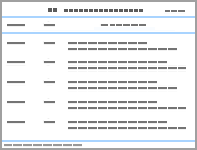
表1
5G基站设备参数
| 设备 | 参数 | 数值 |
|---|---|---|
| 储能电池 | 最大充放电功率/kW | 6 |
| 充放电效率 | 0.95 | |
| 储能电池额定容量/(kW·h) | 30 | |
| 基站储能初始容量/(kW·h) | 15 | |
| 通信设备 | AAU功率放大器最大功耗/(kW·h) | 1.2 |
| AAU射频单元最大功耗/(kW·h) | 1.7 | |
| BBU功耗/(kW·h) | 0.5 | |
| 传输设备功耗/(kW·h) | 0.5 | |
| 供电电源 | 额定功率/ kW | 10 |

图3
TNO预测数据和ADN预测数据


图4
仅计及通信负载可靠性的5G基站备用储能容量评估结果


图5
负荷节点可靠性指标和基站最小备电时间评估结果


图6
计及通信负载和供电节点可靠性的5G基站备用储能容量评估结果

表2
各场景参与ADN协同优化调度的灵活性资源
| 场景 | OLTC | DG功率 调节 | 网络 重构 | SOP | 5G基站可调度 备用储能 |
|---|---|---|---|---|---|
| 1 | √ | √ | √ | × | × |
| 2 | √ | √ | √ | √ | × |
| 3 | √ | √ | √ | × | √ |
| 4 | √ | √ | √ | √ | √ |
表3
各场景的ADN协同优化调度模型求解结果
| 场景 | 系统购 电费用/元 | 弃风惩罚 费用/元 | 弃光惩罚 费用/元 | TNO储能 收益/元 | ADN综合 运行费用/元 |
|---|---|---|---|---|---|
| 1 | 68032.84 | 1571.44 | 1352.45 | 0 | 70956.73 |
| 2 | 64858.01 | 776.34 | 680.14 | 0 | 66314.49 |
| 3 | 61053.27 | 244.89 | 165.16 | 1416.73 | 62880.05 |
| 4 | 59458.04 | 0 | 0 | 2020.95 | 61478.99 |

图7
不同场景的SOP 12-22功率输出曲线


图8
不同场景的5G基站可调度备用储能充放电功率


图9
不同场景的节点电压幅值分布

表4
不同置信水平下的ADN协同优化调度模型求解结果
| 置信水 平/% | 系统购电 费用/元 | 弃风惩罚 费用/元 | 弃光惩罚 费用/元 | TNO储能 收益/元 | ADN综合 运行费用/元 |
|---|---|---|---|---|---|
| 100 | 61828.03 | 137.75 | 123.87 | 1516.73 | 63606.38 |
| 97.5 | 60861.24 | 106.56 | 89.72 | 1616.73 | 62674.25 |
| 95 | 59458.04 | 0 | 0 | 2020.95 | 61478.99 |
| 92.5 | 58649.41 | 0 | 0 | 2054.49 | 60703.90 |
| 90 | 57797.23 | 0 | 0 | 2054.49 | 59851.72 |
| [1] | 鲁宗相, 林弋莎, 乔颖, 等. 极高比例可再生能源电力系统的灵活性供需平衡[J]. 电力系统自动化, 2022, 46(16): 3-16. |
| LU Zongxiang, LIN Yisha, QIAO Ying, et al. Flexibility supply-demand balance in power system with ultra-high proportion of renewable energy[J]. Automation of Electric Power Systems, 2022, 46(16): 3-16. | |
| [2] | 吕小东, 高红均, 贺帅佳, 等. 计及混合通信组网的信息物理主动配电系统协调规划[J]. 中国电机工程学报, 2023, 43(13): 4987-5001. |
| LÜ Xiaodong, GAO Hongjun, HE Shuaijia, et al. Integrated planning of cyber-physical active distribution system considering hybrid communication networking[J]. Proceedings of the CSEE, 2023, 43(13): 4987-5001. | |
| [3] | 雍培, 张宁, 慈松, 等. 5G通信基站参与需求响应: 关键技术与前景展望[J]. 中国电机工程学报, 2021, 41(16): 5540-5552. |
| YONG Pei, ZHANG Ning, CI Song, et al. 5G communication base stations participating in demand response: Key technologies and prospects[J]. Proceedings of the CSEE, 2021, 41(16): 5540-5552. | |
| [4] |
曾博, 穆宏伟, 董厚琦, 等. 考虑5G基站低碳赋能的主动配电网优化运行[J]. 上海交通大学学报, 2022, 56(3): 279-292.
doi: 10.16183/j.cnki.jsjtu.2021.367 |
| ZENG Bo, MU Hongwei, DONG Houqi, et al. Optimization of active distribution network operation considering decarbonization endowment from 5G base stations[J]. Journal of Shanghai Jiao Tong University, 2022, 56(3): 279-292. | |
| [5] |
HAN J P, LIU N, CATALÃO J P S. Optimization of distribution network and mobile network with interactive balance of flexibility and power[J]. IEEE Transactions on Power Systems, 2023, 38(3): 2512-2524.
doi: 10.1109/TPWRS.2022.3180792 URL |
| [6] | 麻秀范, 孟祥玉, 朱秋萍, 等. 计及通信负载的5G基站储能调控策略[J]. 电工技术学报, 2022, 37(11): 2878-2887. |
| MA Xiufan, MENG Xiangyu, ZHU Qiuping, et al. Control strategy of 5G base station energy storage considering communication load[J]. Transactions of China Electrotechnical Society, 2022, 37(11): 2878-2887. | |
| [7] |
李俊双, 胡炎, 邰能灵. 计及通信负载与供电可靠性的5G基站储能与配电网协同优化调度[J]. 上海交通大学学报, 2023, 57(7): 791-802.
doi: 10.16183/j.cnki.jsjtu.2021.542 |
| LI Junshuang, HU Yan, TAI Nengling. Collaborative optimization scheduling of 5G base station energy storage and distribution network considering communication load and power supply reliability[J]. Journal of Shanghai Jiao Tong University, 2023, 57(7): 791-802. | |
| [8] | 陈实, 郭正伟, 周步祥, 等. 考虑5G基站储能可调度容量的有源配电网协同优化调度方法[J]. 电网技术, 2023, 47(12): 5225-5241. |
| CHEN Shi, GUO Zhengwei, ZHOU Buxiang, et al. Coordinated optimization scheduling for active distribution networks considering schedulable capacity of energy storage for 5G base stations[J]. Power System Technology, 2023, 47(12): 5225-5241. | |
| [9] | 乔锐勋, 王军华, 韦道明, 等. 计及后备储能及空调调度潜力的5G基站多时间尺度优化方法[J]. 电力系统自动化, 2023, 47(4): 111-120. |
| QIAO Ruixun, WANG Junhua, WEI Daoming, et al. Multi-time-scale optimization method for 5G base station considering backup energy storage and air-conditioning scheduling potential[J]. Automation of Electric Power Systems, 2023, 47(4): 111-120. | |
| [10] | 王成山, 季节, 冀浩然, 等. 配电系统智能软开关技术及应用[J]. 电力系统自动化, 2022, 46(4): 1-14. |
| WANG Chengshan, JI Jie, JI Haoran, et al. Technologies and application of soft open points in distribution networks[J]. Automation of Electric Power Systems, 2022, 46(4): 1-14. | |
| [11] | 张宁, 杨经纬, 王毅, 等. 面向泛在电力物联网的5G通信: 技术原理与典型应用[J]. 中国电机工程学报, 2019, 39(14): 4015-4025. |
| ZHANG Ning, YANG Jingwei, WANG Yi, et al. 5G communication for the ubiquitous Internet of Things in electricity: Technical principles and typical applications[J]. Proceedings of the CSEE, 2019, 39(14): 4015-4025. | |
| [12] |
YONG P, ZHANG N, HOU Q C, et al. Evaluating the dispatchable capacity of base station backup batteries in distribution networks[J]. IEEE Transactions on Smart Grid, 2021, 12(5): 3966-3979.
doi: 10.1109/TSG.2021.3074754 URL |
| [13] | 刘传铨, 张焰. 计及分布式电源的配电网供电可靠性[J]. 电力系统自动化, 2007, 31(22): 46-49. |
| LIU Chuanquan, ZHANG Yan. Distribution network reliability considering distribution generation[J]. Automation of Electric Power Systems, 2007, 31(22): 46-49. | |
| [14] | 熊小萍, 杨露, 李宁, 等. 基于仿射最小路法的含分布式电源配电网可靠性分析[J]. 电力系统自动化, 2017, 41(17): 43-50. |
| XIONG Xiaoping, YANG Lu, LI Ning, et al. Reliability analysis of distribution network with distributed generators based on affine minimal path method[J]. Automation of Electric Power Systems, 2017, 41(17): 43-50. | |
| [15] |
YONG P, ZHANG N, LIU Y X, et al. Exploring the cellular base station dispatch potential towards power system frequency regulation[J]. IEEE Transactions on Power Systems, 2022, 37(1): 820-823.
doi: 10.1109/TPWRS.2021.3124141 URL |
| [16] |
YONG P, BOTTERUD A, ZHANG N, et al. Capacity value of uninterruptible power supply storage[J]. IEEE Transactions on Power Systems, 2023, 38(2): 1763-1766.
doi: 10.1109/TPWRS.2022.3233773 URL |
| [17] | 高聪哲, 黄文焘, 余墨多, 等. 基于智能软开关的主动配电网电压模型预测控制优化方法[J]. 电工技术学报, 2022, 37(13): 3263-3274. |
| GAO Congzhe, HUANG Wentao, YU Moduo, et al. A model predictive control method to optimize voltages for active distribution networks with soft open point[J]. Transactions of China Electrotechnical Society, 2022, 37(13): 3263-3274. | |
| [18] |
AHMADI H, MARTÍ J R. Mathematical representation of radiality constraint in distribution system reconfiguration problem[J]. International Journal of Electrical Power & Energy Systems, 2015, 64: 293-299.
doi: 10.1016/j.ijepes.2014.06.076 URL |
| [19] | 王强强, 姚良忠, 盛万兴, 等. 基于机会约束规划的配电网分布式光伏承载力提升方法[J]. 电力系统自动化, 2023, 47(18): 132-141. |
| WANG Qiangqiang, YAO Liangzhong, SHENG Wanxing, et al. Enhancement method for distributed photovoltaic hosting capacity of distribution network based on chance-constrained programming[J]. Automation of Electric Power Systems, 2023, 47(18): 132-141. | |
| [20] |
JIANG X, ZHOU Y, MING W L, et al. An overview of soft open points in electricity distribution networks[J]. IEEE Transactions on Smart Grid, 2022, 13(3): 1899-1910.
doi: 10.1109/TSG.2022.3148599 URL |
| [21] |
ZHOU A P, YANG M, WANG Z Y, et al. A linear solution method of generalized robust chance constrained real-time dispatch[J]. IEEE Transactions on Power Systems, 2018, 33(6): 7313-7316.
doi: 10.1109/TPWRS.59 URL |
| [22] | 董志辉, 林凌雪. 基于改进模糊C均值聚类时段划分的配电网动态重构[J]. 电网技术, 2019, 43(7): 2299-2305. |
| DONG Zhihui, LIN Lingxue. Dynamic reconfiguration of distribution network based on improved fuzzy C-means clustering of time division[J]. Power System Technology, 2019, 43(7): 2299-2305. | |
| [23] | 张雁钦. 移动通信网流量数据分析及预测研究[D]. 合肥: 中国科学技术大学, 2016. |
| ZHANG Yanqin. Traffic data analysis and forecasting in mobile communication networks[D]. Hefei: University of Science and Technology of China, 2016. | |
| [24] | 徐韩伟, 刘丽军, 黄惠钰, 等. 基于P-Box和CVaR并考虑灵活性的配电网区间优化方法[J]. 高电压技术, 2024, 50(4): 1478-1487. |
| XU Hanwei, LIU Lijun, HUANG Huiyu, et al. Interval optimization dispatching method considering flexibility of the distribution net-work based on P-Box and CVaR[J]. High Voltage Engineering, 2024, 50(4): 1478-1487. |
| [1] | 解大, 李子怡, 田洲, 王凯. 构建灾害风险图谱提高电力系统安全调度能力[J]. 上海交通大学学报, 2025, 59(9): 1338-1347. |
| [2] | 叶婧, 何杰辉, 张磊, 蔡俊文, 林宇琦, 谢继豪. 考虑动态频率约束和多重不确定性的风电装机容量优化[J]. 上海交通大学学报, 2025, 59(9): 1292-1303. |
| [3] | 邓倩文, 李奇, 邱宜彬, 李豆萌, 霍莎莎, 陈维荣. 考虑多灵活性资源联合运行的综合能源系统优化配置方法[J]. 上海交通大学学报, 2025, 59(7): 912-922. |
| [4] | 胡龙, 方八零, 樊飞龙, 陈达伟, 李新喜, 曾润. 用户-基站-充电站能量互动和储能共享优化方法[J]. 上海交通大学学报, 2025, 59(7): 877-888. |
| [5] | 孟毓, 郭瑞, 石子川, 薛俊逸, 吕嘉文, 樊飞龙. 含高比例风电低碳园区灵活性资源鲁棒协调运行[J]. 上海交通大学学报, 2025, 59(2): 165-174. |
| [6] | 邬东格, 常馨月, 薛屹洵, 黄昱熙, 苏珈, 李泽宁, 孙宏斌. 基于动态碳熵的主动配电网低碳能量管理策略[J]. 上海交通大学学报, 2025, 59(12): 1795-1804. |
| [7] | 米阳, 陈宇阳, 陈博洋, 韩云昊, 袁明瀚. 考虑微能网接入主动配电网的共享储能多目标配置[J]. 上海交通大学学报, 2024, 58(9): 1309-1322. |
| [8] | 郭咏涛, 向月, 刘俊勇. 面向高比例清洁能源消纳的含灵活性资源电力系统规划方案优选[J]. 上海交通大学学报, 2023, 57(9): 1146-1155. |
| [9] | 刘飞, 车琰瑛, 田旭, 许德操, 周慧洁, 李知艺. 新型电力系统下的抽水蓄能电站成本疏导机制:综述与展望[J]. 上海交通大学学报, 2023, 57(7): 757-768. |
| [10] | 彭思佳, 邢海军, 成明洋. 多重不确定环境下考虑阶梯型碳交易的虚拟电厂低碳经济调度[J]. 上海交通大学学报, 2023, 57(12): 1571-1582. |
| [11] | 曾博, 穆宏伟, 董厚琦, 曾鸣. 考虑5G基站低碳赋能的主动配电网优化运行[J]. 上海交通大学学报, 2022, 56(3): 279-292. |
| [12] | 孙华丽1,周战杰1,薛耀锋2 . 考虑路径风险的不确定需求应急物流定位-路径问题[J]. 上海交通大学学报(自然版), 2013, 47(06): 962-966. |
| [13] | 张艳1, 丁茂森1, 毛宏燕2. 基于机会约束规划的生产全过程实时优化[J]. 上海交通大学学报(自然版), 2011, 45(07): 975-979. |
| 阅读次数 | ||||||
|
全文 |
|
|||||
|
摘要 |
|
|||||
