

上海交通大学学报 ›› 2025, Vol. 59 ›› Issue (9): 1370-1382.doi: 10.16183/j.cnki.jsjtu.2023.516
张仕鹏1, 李培强1,2( ), 张亦君1, 刘喜凤1
收稿日期:2023-10-12
修回日期:2023-11-20
接受日期:2023-12-20
出版日期:2025-09-28
发布日期:2025-09-25
通讯作者:
李培强,教授,博士生导师;E-mail:作者简介:张仕鹏(1994—),硕士生,研究方向为储能建模与控制技术及其在电力系统中的应用.
基金资助:
ZHANG Shipeng1, LI Peiqiang1,2(), ZHANG Yijun1, LIU Xifeng1
Received:2023-10-12
Revised:2023-11-20
Accepted:2023-12-20
Online:2025-09-28
Published:2025-09-25
摘要:
在复合储能系统中,协调不同类型储能之间的运行是提高储能调频性能的重要手段.为充分挖掘储能调频潜力,提出一种电池储能联合抽水蓄能的复合储能二次调频策略.针对传统一阶低通滤波器截止频率固定的缺点,提出滤波时间常数根据电网频率变化进行动态调整的方法,实现对复合储能内部调频指令分配.在调频阶段,考虑电池储能荷电状态(SOC)约束,设计电池储能-抽水蓄能协调控制的双模糊控制策略.在非调频阶段,根据logistic函数构建电池储能SOC自恢复曲线,利用抽水蓄能剩余容量对电池储能进行SOC自恢复.在两种典型工况下对该策略进行仿真分析,结果表明所提策略在改善调频效果和电池储能SOC状态方面具有优势.
中图分类号:
张仕鹏, 李培强, 张亦君, 刘喜凤. 基于变滤波时间常数和模糊控制的复合储能二次调频策略[J]. 上海交通大学学报, 2025, 59(9): 1370-1382.
ZHANG Shipeng, LI Peiqiang, ZHANG Yijun, LIU Xifeng. Secondary Frequency Modulation Strategy of Composite Energy Storage Based on Variable Filter Time Constant and Fuzzy Control[J]. Journal of Shanghai Jiao Tong University, 2025, 59(9): 1370-1382.

图1
复合储能控制方式


图2
含复合储能的两区域系统调频模型


图3
ΔTa与|dΔf/dt|曲线


图4
复合储能二次调频指令分配策略


图5
模糊控制器1隶属度函数

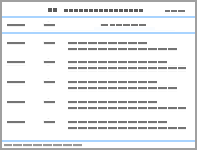
表1
模糊控制器1控制规则
| SOC | Pref,B | ||||||
|---|---|---|---|---|---|---|---|
| NB | NM | NS | ZO | PS | PM | PB | |
| NB | NB | NM | NS | ZO | ZO | ZO | ZO |
| NM | NB | NM | NS | ZO | ZO | ZO | ZO |
| NS | NB | NM | NS | ZO | PS | PM | PB |
| ZO | NB | NM | NS | ZO | PS | PM | PB |
| PS | NB | NM | NS | ZO | PS | PM | PB |
| PM | ZO | ZO | ZO | ZO | PS | PM | PB |
| PB | ZO | ZO | ZO | ZO | PS | PM | PB |

图6
模糊控制器1中输入输出关系


图7
模糊控制器2隶属度函数

表2
模糊控制器2控制规则
| ΔPref,B | KH | ||||||
|---|---|---|---|---|---|---|---|
| NB | NM | NS | ZO | PS | PM | PB | |
| NB | NB | NB | NB | NB | NB | NS | ZO |
| NM | NM | NM | NM | NM | NM | NS | ZO |
| NS | NS | NS | NS | NS | NS | NS | ZO |
| ZO | ZO | ZO | ZO | ZO | ZO | ZO | ZO |
| PS | ZO | PS | PS | PS | PS | PS | PS |
| PM | ZO | PS | PM | PM | PM | PM | PM |
| PB | ZO | PS | PB | PB | PB | PB | PB |

图8
模糊控制2中输入输出关系


图9
双模糊控制策略框架图


图10
电池储能自恢复功率限制


图11
复合储能参与二次调频综合控制策略流程图

表3
系统仿真参数
| 参数 | 数值 | 参数 | 数值 |
|---|---|---|---|
| H1, H2/s | 5 | 1 | |
| 21 | 1.18,1.6 | ||
| 0.05, 0.04 | TG, TH, TB/s | 0.1, 0.1, 0.01 | |
| 0.5 | TCH, TRH/s | 0.3,10 | |
| 3, 0.8, 2 | Tw/s | 2.5 |
表4
控制策略相关参数
| 参数 | 数值 | 参数 | 数值 |
|---|---|---|---|
| Ssoc,max | 0.9 | Ssoc,min | 0.1 |
| Ssoc,high | 0.55 | Ssoc,low | 0.45 |
| Ssoc,1 | 0.725 | Ssoc,0 | 0.275 |
| np.u. | 15 | 0.01 | |
| Δfdb/Hz | 0.0333 | α | 0.9 |

图12
阶跃扰动下仿真结果

表5
阶跃扰动下调频效果评价指标
| 调频指标 | Δ | Δ | Srms | |||
|---|---|---|---|---|---|---|
| 方案一 | -0.003664 | 0.000419 | 0.001913 | |||
| 方案二 | -0.001929 | 0.000361 | 0.079035 | 0.000446 | 0.001422 | 0.000111 |
| 方案三 | -0.001852 | 0.000344 | 0.071824 | 0.000425 | 0.001459 | 0.000095 |
| 所提方案 | -0.001851 | 0.000340 | 0.070526 | 0.000418 | 0.001470 | 0.000092 |

图13
阶跃扰动下滤波时间常数及区域一调频需求变化


图14
连续负荷扰动曲线


图15
连续扰动下仿真结果

表6
连续扰动下调频效果评价指标
| 调频指标 | Δ | Δ | Srms | |||
|---|---|---|---|---|---|---|
| 方案一 | -0.000998 | 0.000371 | 0.003348 | |||
| 方案二 | -0.000936 | 0.000325 | 0.082826 | 0.000889 | 0.003103 | 0.000858 |
| 方案三 | -0.000828 | 0.000321 | 0.053945 | 0.000858 | 0.003186 | 0.000743 |
| 所提方案 | -0.000688 | 0.000317 | 0.042094 | 0.000861 | 0.003177 | 0.000688 |

图16
连续扰动下滤波时间常数及区域一调频需求变化

| [1] | 李晖, 刘栋, 姚丹阳. 面向碳达峰碳中和目标的我国电力系统发展研判[J]. 中国电机工程学报, 2021, 41(18): 6245-6259. |
| LI Hui, LIU Dong, YAO Danyang. Analysis and reflection on the development of power system towards the goal of carbon emission peak and carbon neutrality[J]. Proceedings of the CSEE, 2021, 41(18): 6245-6259. | |
| [2] | 钱韦廷, 赵长飞, 万灿, 等. 基于概率预测的混合储能平抑风电波动随机优化调控方法[J]. 电力系统自动化, 2021, 45(18): 18-27. |
| QIAN Weiting, ZHAO Changfei, WAN Can, et al. Probabilistic forecasting based stochastic optimal dispatch and control method of hybrid energy storage for smoothing wind power fluctuations[J]. Automation of Electric Power Systems, 2021, 45(18): 18-27. | |
| [3] | 卓振宇, 张宁, 谢小荣, 等. 高比例可再生能源电力系统关键技术及发展挑战[J]. 电力系统自动化, 2021, 45(9): 171-191. |
| ZHUO Zhenyu, ZHANG Ning, XIE Xiaorong, et al. Key technologies and developing challenges of power system with high proportion of renewable energy[J]. Automation of Electric Power Systems, 2021, 45(9): 171-191. | |
| [4] | 李欣然, 崔曦文, 黄际元, 等. 电池储能电源参与电网一次调频的自适应控制策略[J]. 电工技术学报, 2019, 34(18): 3897-3908. |
| LI Xinran, CUI Xiwen, HUANG Jiyuan, et al. The self-adaption control strategy of energy storage batteries participating in the primary frequency regulation[J]. Transactions of China Electrotechnical Society, 2019, 34(18): 3897-3908. | |
| [5] | MAKAROV Y V, DU P W, KINTNER-MEYER M C W, et al. Sizing energy storage to accommodate high penetration of variable energy resources[J]. IEEE Transactions on Sustainable Energy, 2012, 3(1): 34-40. |
| [6] | XU Y W, MA Y C, HAN Y H, et al. Load frequency control for renewable energy power system based on sliding mode control with hybrid energy storage[C]// 2020 Chinese Control and Decision Conference. Hefei, China: IEEE, 2020: 1340-1345. |
| [7] | 邹金, 赖旭, 汪宁渤. 大规模风电并网下的抽水蓄能机组调频控制研究[J]. 中国电机工程学报, 2017, 37(2): 564-572. |
| ZOU Jin, LAI Xu, WANG Ningbo. Study on control of pumped storage units for frequency regulation in power systems integrated with large-scale wind power generation[J]. Proceedings of the CSEE, 2017, 37(2): 564-572. | |
| [8] |
鲍珣珣, 高伏英, 顾丽鸿, 等. 抽水蓄能电站区域负荷频率控制[J]. 上海交通大学学报, 2015, 49(11): 1701-1705.
doi: 10.16183/j.cnki.jsjtu.2015.11.020 |
| BAO Xunxun, GAO Fuying, GU Lihong, et al. Area load frequency control with pumped storage power station[J]. Journal of Shanghai Jiao Tong University, 2015, 49(11): 1701-1705. | |
| [9] | 单华, 和婧, 范立新, 等. 面向抽水蓄能电站区域负荷频率的分数阶PID控制研究[J]. 电网技术, 2020, 44(4): 1410-1418. |
| SHAN Hua, HE Jing, FAN Lixin, et al. Research on fractional order PID control of regional load frequency of pumped storage power station[J]. Power System Technology, 2020, 44(4): 1410-1418. | |
| [10] | 李辉, 刘海涛, 宋二兵, 等. 双馈抽水蓄能机组参与电网调频的改进虚拟惯性控制策略[J]. 电力系统自动化, 2017, 41(10): 58-65. |
| LI Hui, LIU Haitao, SONG Erbing, et al. Improved virtual inertia control strategy of doubly fed pumped storage unit for power network frequency modulation[J]. Automation of Electric Power Systems, 2017, 41(10): 58-65. | |
| [11] | 李辉, 王坤, 刘海涛, 等. 交流励磁抽水蓄能机组变下垂系数调频控制策略[J]. 电力自动化设备, 2018, 38(7): 68-73. |
| LI Hui, WANG Kun, LIU Haitao, et al. Variable droop coefficient frequency control strategy of AC excited pumped storage unit[J]. Electric Power Automation Equipment, 2018, 38(7): 68-73. | |
| [12] | 陈亚红, 邓长虹, 刘玉杰, 等. 抽水工况双馈可变速抽蓄机组机电暂态建模及有功-频率耦合特性[J]. 中国电机工程学报, 2022, 42(3): 942-957. |
| CHEN Yahong, DENG Changhong, LIU Yujie, et al. Electromechanical transient modelling and active power-frequency coupling characteristics of doubly-fed variable speed pumped storage under pumping mode[J]. Proceedings of the CSEE, 2022, 42(3): 942-957. | |
| [13] |
秦昊, 秦立军, 白雪辰, 等. 辅助抽水蓄能调频的飞轮控制策略[J]. 储能科学与技术, 2022, 11(12): 3915-3925.
doi: 10.19799/j.cnki.2095-4239.2022.0422 |
| QIN Hao, QIN Lijun, BAI Xuechen, et al. A control strategy of flywheel energy storage system participating frequency regulation with pumped storage[J]. Energy Storage Science & Technology, 2022, 11(12): 3915-3925. | |
| [14] | 汤杰, 李欣然, 黄际元, 等. 以净效益最大为目标的储能电池参与二次调频的容量配置方法[J]. 电工技术学报, 2019, 34(5): 963-972. |
| TANG Jie, LI Xinran, HUANG Jiyuan, et al. Capacity allocation of BESS in secondary frequency regulation with the goal of maximum net benefit[J]. Transactions of China Electrotechnical Society, 2019, 34(5): 963-972. | |
| [15] | 王凯丰, 谢丽蓉, 乔颖, 等. 电池储能提高电力系统调频性能分析[J]. 电力系统自动化, 2022, 46(1): 174-181. |
| WANG Kaifeng, XIE Lirong, QIAO Ying, et al. Analysis of frequency regulation performance of power system improved by battery energy storage[J]. Automation of Electric Power Systems, 2022, 46(1): 174-181. | |
| [16] | 黄际元, 李欣然, 常敏, 等. 考虑储能电池参与一次调频技术经济模型的容量配置方法[J]. 电工技术学报, 2017, 32(21): 112-121. |
| HUANG Jiyuan, LI Xinran, CHANG Min, et al. Capacity allocation of BESS in primary frequency regulation considering its technical-economic model[J]. Transactions of China Electrotechnical Society, 2017, 32(21): 112-121. | |
| [17] | 李若, 李欣然, 谭庄熙, 等. 考虑储能电池参与二次调频的综合控制策略[J]. 电力系统自动化, 2018, 42(8): 74-82. |
| LI Ruo, LI Xinran, TAN Zhuangxi, et al. Integrated control strategy considering energy storage battery participating in secondary frequency regulation[J]. Automation of Electric Power Systems, 2018, 42(8): 74-82. | |
| [18] | 陈雪梅, 陆超, 刘杰, 等. 考虑调频性能考核的储能-机组联合调频控制策略[J]. 中国电机工程学报, 2021, 41(10): 3383-3391. |
| CHEN Xuemei, LU Chao, LIU Jie, et al. Control strategy considering AGC performance assessment for BESS coordinated with thermal power unit in AGC[J]. Proceedings of the CSEE, 2021, 41(10): 3383-3391. | |
| [19] | GOYA T, OMINE E, KINJYO Y, et al. Frequency control in isolated island by using parallel operated battery systems applying H∞ control theory based on droop characteristics[J]. IET Renewable Power Generation, 2011, 5(2): 160-166. |
| [20] | 崔红芬, 杨波, 蒋叶, 等. 基于模糊控制和SOC自恢复储能参与二次调频控制策略[J]. 电力系统保护与控制, 2019, 47(22): 89-97. |
| CUI Hongfen, YANG Bo, JIANG Ye, et al. Strategy based on fuzzy control and self adaptive modification of SOC involved in secondary frequency regulation with battery energy storage[J]. Power System Protection & Control, 2019, 47(22): 89-97. | |
| [21] | 张舒鹏, 董树锋, 徐成司, 等. 大规模储能参与电网调频的双层控制策略[J]. 电力系统自动化, 2020, 44(19): 55-62. |
| ZHANG Shupeng, DONG Shufeng, XU Chengsi, et al. Bi-level control strategy for power grid frequency regulation with participation of large-scale energy storage[J]. Automation of Electric Power Systems, 2020, 44(19): 55-62. | |
| [22] | 毛志宇, 李培强, 郭思源. 基于自适应时间尺度小波包和模糊控制的复合储能控制策略[J]. 电力系统自动化, 2023, 47(9): 158-165. |
| MAO Zhiyu, LI Peiqiang, GUO Siyuan. Control strategy of composite energy storage based on wavelet packet with adaptive time scale and fuzzy control[J]. Automation of Electric Power Systems, 2023, 47(9): 158-165. | |
| [23] | 李学斌, 刘建伟. 采用二阶滤波的混合储能系统实时功率分配方法[J]. 电网技术, 2019, 43(5): 1650-1657. |
| LI Xuebin, LIU Jianwei. Real-time power distribution method adopting second-order filtering for hybrid energy storage system[J]. Power System Technology, 2019, 43(5): 1650-1657. | |
| [24] | 车泉辉, 吴耀武, 祝志刚, 等. 基于碳交易的含大规模光伏发电系统复合储能优化调度[J]. 电力系统自动化, 2019, 43(3): 76-82. |
| CHE Quanhui, WU Yaowu, ZHU Zhigang, et al. Carbon trading based optimal scheduling of hybrid energy storage system in power systems with large-scale photovoltaic power generation[J]. Automation of Electric Power Systems, 2019, 43(3): 76-82. | |
| [25] |
韩健民, 薛飞宇, 梁双印, 等. 模糊控制优化下的混合储能系统辅助燃煤机组调频仿真[J]. 储能科学与技术, 2022, 11(7): 2188-2196.
doi: 10.19799/j.cnki.2095-4239.2021.0664 |
| HAN Jianmin, XUE Feiyu, LIANG Shuangyin, et al. Hybrid energy storage system assisted frequency modulation simulation of the coal-fired unit under fuzzy control optimization[J]. Energy Storage Science & Technology, 2022, 11(7): 2188-2196. | |
| [26] | JIN C L, LU N, LU S, et al. A coordinating algorithm for dispatching regulation services between slow and fast power regulating resources[J]. IEEE Transactions on Smart Grid, 2014, 5(2): 1043-1050. |
| [27] | 李欣然, 黄际元, 陈远扬, 等. 基于灵敏度分析的储能电池参与二次调频控制策略[J]. 电工技术学报, 2017, 32(12): 224-233. |
| LI Xinran, HUANG Jiyuan, CHEN Yuanyang, et al. Battery energy storage control strategy in secondary frequency regulation considering its action moment and depth[J]. Transactions of China Electrotechnical Society, 2017, 32(12): 224-233. |
| [1] | 黄自鑫, 于澄嵩, 汪伟, 林梦颖, 徐达. 基于等价输入干扰误差估计的欠驱动脉宽调制整流器自抗扰控制[J]. 上海交通大学学报, 2025, 59(8): 1203-1215. |
| [2] | 周霞, 陈文剑, 戴剑丰, 解相朋. 考虑分布式储能荷电状态均衡的光储微网黑启动协调控制策略[J]. 上海交通大学学报, 2025, 59(7): 938-951. |
| [3] | 曹永吉, 张江丰, 王天宇, 郑可轲, 吴秋伟. 基于分布式模型预测控制的自适应二次调频策略[J]. 上海交通大学学报, 2025, 59(3): 333-341. |
| [4] | 魏茂华, 杨苓, 翁亮涛, 杨继沛, 陈泳桥. 考虑容量差异的孤岛直流微网分布式储能单元SOC均衡策略[J]. 上海交通大学学报, 2025, 59(3): 376-387. |
| [5] | 赵永熹, 高鹏超, 范宏. 基于虚拟阻抗-模糊算法的交直流微电网混合储能功率协调策略[J]. 上海交通大学学报, 2025, 59(3): 388-399. |
| [6] | 陈子杰, 宋柄兵, 李语桐, 王利峰, 滕晓毕, 严正, 陈思捷. 面向现货市场的省间联络线功率考核机制与模型[J]. 上海交通大学学报, 2025, 59(12): 1773-1783. |
| [7] | 李建林, 孙浩元, 赵文鼎, 梁策, 梁忠豪, 袁晓冬. 基于变分模态分解-多模糊控制的风电混储系统功率分配策略[J]. 上海交通大学学报, 2025, 59(10): 1498-1509. |
| [8] | 唐荻音, 王预夫, 郑文健, 黄旭聪, 邢雅兰. 基于等效模型的锂离子电池荷电状态估计算法综述[J]. 空天防御, 2024, 7(6): 104-111. |
| [9] | 乌江, 张燕, 刘泽龙, 程刚, 雷冬, 焦朝勇. 考虑驾驶工况及老化程度的锂电池荷电状态估算[J]. 上海交通大学学报, 2024, 58(12): 1935-1945. |
| [10] | 刘传斌, 矫文书, 吴秋伟, 陈健, 周前. 基于模型预测控制的风储联合电场参与电网二次调频策略[J]. 上海交通大学学报, 2024, 58(1): 91-101. |
| [11] | 钱虹, 邹明耀. 变论域自适应模糊非线性控制在蒸汽发生器液位控制中的应用[J]. 上海交通大学学报, 2023, 57(1): 116-126. |
| [12] | 杜宇石, 琚长江, 杨根科. 基于非线性观测器的超级电容器荷电状态在线估计[J]. 上海交通大学学报, 2022, 56(12): 1630-1637. |
| [13] | 陈玉珊, 秦琳琳, 吴刚, 毛俊鑫. 基于渐消记忆递推最小二乘法的电动汽车电池荷电状态在线估计[J]. 上海交通大学学报, 2020, 54(12): 1340-1346. |
| [14] | 柳江, 林晨, 叶明, 黎晓伟. 馈能悬架变论域模糊控制[J]. 上海交通大学学报, 2016, 50(8): 1139-1143. |
| [15] | 吕学勤, 马玉超, 刘文明. 机器人燃料电池混合动力系统优化控制[J]. 上海交通大学学报, 2016, 50(12): 1936-1939. |
| 阅读次数 | ||||||
|
全文 |
|
|||||
|
摘要 |
|
|||||
