

上海交通大学学报 ›› 2026, Vol. 60 ›› Issue (2): 319-330.doi: 10.16183/j.cnki.jsjtu.2024.225
唐建1( ), 余文秀1, 张秋平1, 焦向东1, 丁学鹏2
收稿日期:2024-06-17
修回日期:2024-07-18
接受日期:2024-09-09
出版日期:2026-02-28
发布日期:2026-03-06
作者简介:唐 建(1978—),副教授,主要从事长输管道检测、信号处理等研究.电话(Tel.):010-81292149;E-mail:tangjian@bipt.edu.cn.
基金资助:
TANG Jian1(), YU Wenxiu1, ZHANG Qiuping1, JIAO Xiangdong1, DING Xuepeng2
Received:2024-06-17
Revised:2024-07-18
Accepted:2024-09-09
Online:2026-02-28
Published:2026-03-06
摘要:
针对输油管道内检测器运行速度控制问题,提出了一种新型的泄流调速装置,该装置由泄流阀座、泄流阀芯、弹簧、导杆等组成.通过分析检测器泄流调速装置在水平管道内的受力情况,建立了泄流调速装置的数学模型.利用数值模拟的方法研究了泄流阀座弧度、泄流阀芯-检测器后端距离以及入口流体速度对管道内检测器运动状态的影响.研究结果表明,在相同边界条件下,流体介质通过检测器时,泄流调速装置前后两端压差、总水头损失系数、流场的湍流动能值与泄流阀座左侧弧度成反比关系,而与右侧弧度成正比关系,当泄流阀座左侧弧度为60° 、右侧弧度为15° 时,各参数均为最小值;入口流体速度的增加会导致泄流调速装置前后两端压差、流场湍流动能值增大,当泄流阀座弧度相同、入口流体速度从0.6 m/s增加到2 m/s时,压差增加了106 290 Pa,湍流动能增加了1.831 m2/s2;泄流阀芯-检测器后端距离与泄流调速装置前后两端压差、检测器速度成反比关系,当阀芯-检测器后端距离从15 mm增加到35 mm时,泄流调速装置前后两端的压差减小了240 Pa.本研究为优化输油管道内检测器的运行性能、提高检测效率提供了重要的理论基础与实践指导.
中图分类号:
唐建, 余文秀, 张秋平, 焦向东, 丁学鹏. 一种新型管道内检测器泄流调速装置的数值模拟分析[J]. 上海交通大学学报, 2026, 60(2): 319-330.
TANG Jian, YU Wenxiu, ZHANG Qiuping, JIAO Xiangdong, DING Xuepeng. Numerical Simulation Analysis of a Novel Discharge Speed-Regulation Device for Detector in the Pipeline[J]. Journal of Shanghai Jiao Tong University, 2026, 60(2): 319-330.

图1
检测器调速装置受力分析示意图


图2
简化的泄流调速装置内部结构

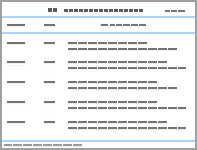
表1
局部水头损失系数$\zeta_{2}$值
| θ2/(°) | ζ2 |
|---|---|
| 2 | 0.03 |
| 5 | 0.04 |
| 10 | 0.08 |
| 12 | 0.10 |
| 15 | 0.16 |
| 20 | 0.31 |
| 25 | 0.40 |
| 30 | 0.49 |
| 40 | 0.60 |
| 50 | 0.67 |
| 60 | 0.72 |
表2
不同泄流阀座弧度的表示方法
| 泄流阀座弧度编号 | θ1/(°) | θ2/(°) |
|---|---|---|
| 1 | 30 | 40 |
| 2 | 40 | 30 |
| 3 | 50 | 25 |
| 4 | 55 | 20 |
| 5 | 60 | 15 |

图3
总水头损失系数与泄流阀座弧度之间的关系

表3
压缩弹簧的相关参数
| 参数 | 取值 |
|---|---|
| d/mm | 0.8 |
| Dm/mm | 9 |
| D1/mm | 8.2 |
| D2/mm | 9.8 |
| H0/mm | 58 |
| Pj/N | 14.56 |
| fj/mm | 2.97 |
| k/(N·mm-1) | 0.62 |
| Fj/mm | 26.73 |

图4
重力导致驱动皮碗变形示意图


图5
管壁对皮碗的压强


图6
液体对皮碗的压强


图7
检测器在管道内的模型图


图8
网格质量标准图

表4
不同网格单元尺寸对应物理量的变化
| 网格编号 | 网格单元 尺寸/mm | 网格数量×10-6 | 流场平均速度/ (m·s-1) |
|---|---|---|---|
| 1 | 10 | 0.636 2 | 0.748 |
| 2 | 8 | 0.799 8 | 0.667 |
| 3 | 6 | 1.128 2 | 0.554 |
| 4 | 4 | 2.036 5 | 0.458 |
| 5 | 3 | 3.336 9 | 0.427 |
| 6 | 2 | 7.441 0 | 0.416 |

图9
流场平均速度与网格数量之间的关系


图10
入口速度为0.6 m/s时不同弧度泄流阀座的压力云图


图11
泄流阀座弧度与压差关系


图12
入口速度为0.6 m/s时不同弧度泄流阀座的湍流云图


图13
泄流阀座弧度与湍流动能之间的关系


图14
入口速度为0.6 m/s时泄流阀芯-检测器后端距离不同时的流场压力云图


图15
泄流阀芯-检测器后端的不同距离与泄流调速装置前后两端压差关系


图16
入口速度为0.6 m/s时,泄流阀芯-检测器后端距离不同时的流场速度云图

表5
泄流阀芯所受的冲击力
| 泄流阀芯-检测器 后端的距离/mm | Δp/Pa | S/m2 | F/N |
|---|---|---|---|
| 15 | 7 490 | 0.004 28 | 32.057 |
| 20 | 7 460 | 0.004 28 | 31.929 |
| 25 | 7 420 | 0.004 28 | 31.758 |
| 30 | 7 380 | 0.004 28 | 31.587 |
| 35 | 7 350 | 0.004 28 | 31.458 |
| [1] | 李岩松, 丁鼎倩, 韩东, 等. 起伏输油管道临界完全携积水油速数值模拟[J]. 上海交通大学学报, 2021, 55(7): 878-890. |
| LI Yansong, DING Dingqian, HAN Dong, et al. Numerical simulation of critical oil velocity required to completely remove water lump deposited in hilly oil pipelines[J]. Journal of Shanghai Jiao Tong University, 2021, 55(7): 878-890. | |
| [2] | 蔡文超, 唐岩, 石斌. 输油管道安全生产运行控制措施分析[J]. 全面腐蚀控制, 2021, 35(11): 88-90. |
| CAI Wenchao, TANG Yan, SHI Bin. Analysis of oil pipeline safety production operation control measures[J]. Total Corrosion Control, 2021, 35(11): 88-90. | |
| [3] |
MA Q, TIAN G, ZENG Y, et al. Pipeline in-line inspection method, instrumentation and data management[J]. Sensors, 2021, 21(11): 3862.
doi: 10.3390/s21113862 URL |
| [4] | 施涛, 袁锐波, 邵禹然, 等. 一种流体驱动式管道机器人的结构设计与运动分析[J]. 重庆理工大学学报(自然科学), 2023, 37(9): 322-331. |
| SHI Tao, YUAN Ruibo, SHAO Yuran, et al. The invention relates to the structure of a fluid driven pipeline robot optimization design and motion analysis[J]. Journal of Chongqing University of Technology (Natural Science), 2023, 37(9): 322-331. | |
| [5] |
MIRSHAMSI M, RAFEEYAN M. Speed control of inspection pig in gas pipelines using sliding mode control[J]. Journal of Process Control, 2019, 77: 134-140.
doi: 10.1016/j.jprocont.2019.03.001 URL |
| [6] | SAMAD K A A, NADZERI M S M, LIEW P F, et al. Simplify bypass pig speed calculation using probabilistic method[C]// SPE Asia Pacific Oil and Gas Conference and Exhibition. Bali, Indonesia: SPE, 2019: 501-509. |
| [7] |
PATRICIO R A C, BAPTISTA R M, RACHID F B D F, et al. Numerical simulation of pig motion in gas and liquid pipelines using the flux-corrected transport method[J]. Journal of Petroleum Science and Engineering, 2020, 189: 106970.
doi: 10.1016/j.petrol.2020.106970 URL |
| [8] |
FENG J, LIU J, ZHANG H. Speed control of pipeline inner detector based on interval dynamic matrix control with additional margin[J]. IEEE Transactions on Industrial Electronics, 2020, 68(12): 12657-12667.
doi: 10.1109/TIE.2020.3047061 URL |
| [9] | 唐建华, 王增国, 林晓, 等. 基于CEL方法的管道内检测器动力学数值分析[J]. 焊管, 2022, 45(1): 10-15. |
| TANG Jianhua, WANG Zengguo, LIN Xiao, et al. Numerical analysis of in-pipe detector dynamics based on CEL approach[J]. Welded Pipe, 2022, 45(1): 10-15. | |
| [10] | HENDRIX M H W, IJSSELDIJK H P, BREUGEM W P, et al. Development of speed controlled pigging for low pressure pipelines[C]// The 18th International Conference on Multiphase Production Technology. Cannes, France: OnePetro, 2017: 501-509. |
| [11] | CHAURASIYA K L, PAWAR V, BHATTACHARYA B. An innovative method and apparatus for speed control of pipe health monitoring robot during gas pipeline inspection[C]// Health Monitoring of Structural and Biological Systems XVII. Long Beach, California, USA: SPIE, 2023: 372-379. |
| [12] |
TU Q, LIU Q, JI S, et al. Speed simulation of hydraulic automatic speed-controlled pipeline inspection gauge in liquid pipelines[J]. Journal of Pressure Vessel Technology, 2020, 142(1): 011802.
doi: 10.1115/1.4045132 URL |
| [13] |
CHEN J, WANG Y, LIU H, et al. A novel study on bypass module in self-regulated pipeline inspection gauge to enhance anti-blocking capability for secure and efficient natural gas transportation[J]. Journal of Natural Gas Science and Engineering, 2022, 108: 104850.
doi: 10.1016/j.jngse.2022.104850 URL |
| [14] | 蒋新生. 工程流体力学[M]. 重庆: 重庆大学出版社, 2017. |
| JIANG Xinsheng. Engineering fluid mechanics[M]. Chongqing: Chongqing University Press, 2017. | |
| [15] | 成大先. 机械设计手册[M]. 6版. 北京: 化学工业出版社, 2017. |
| CHENG Daxian. Mechanical design manual[M]. 6th ed. Beijing: Chemical Industry Press, 2017. | |
| [16] |
ZHU X X, FU C M, WANG Y T, et al. Experimental research on the contact force of the bi-directional pig in oil and gas pipeline[J]. Petroleum Science, 2023, 20(1): 474-481.
doi: 10.1016/j.petsci.2022.08.021 URL |
| [17] | 李同林. 弹塑性力学[M]. 武汉: 中国地质大学出版社, 2015. |
| LI Tonglin. Elastic-plastic mechanics[M]. Wuhan: China University of Geosciences Press, 2015. | |
| [18] |
CHEN J, HE L, LUO X, et al. Characterization of bypass pig velocity in gas pipeline: An experimental and analytical study[J]. Journal of Natural Gas Science and Engineering, 2020, 73: 103059.
doi: 10.1016/j.jngse.2019.103059 URL |
| [19] | US-NACE. In-line inspection of pipelines: NACE SP0102-2010[S]. Houston, USA: NACE International, 2010. |
| [20] | 詹旭明. 长输原油管道内检测器速度控制技术开发[D]. 北京: 北京石油化工学院, 2015. |
| ZHAN Xuming. Development of the technology for controlling the inner detector’s velocity in long distance oil pipeline[D]. Beijing: Beijing Institute of Petrochemical Technology, 2015. |
| [1] | 邱康. 多因素约束的低孔渗基质砂岩气藏测试生产压差模型[J]. 上海交通大学学报, 2023, 57(S1): 30-36. |
| [2] | 李岩松, 丁鼎倩, 韩东, 刘静, 梁永图. 起伏输油管道临界完全携积水油速数值模拟[J]. 上海交通大学学报, 2021, 55(7): 878-890. |
| [3] | 刘健,陈自强,黄德扬,郑昌文,周诗尧,姜余. 基于等压差充电时间的锂离子电池寿命预测[J]. 上海交通大学学报, 2019, 53(9): 1058-1065. |
| 阅读次数 | ||||||
|
全文 |
|
|||||
|
摘要 |
|
|||||
