

Journal of Shanghai Jiao Tong University ›› 2026, Vol. 60 ›› Issue (2): 175-185.doi: 10.16183/j.cnki.jsjtu.2024.092
• New Type Power System and the Integrated Energy • Next Articles
HE Ruiwen1, YANG Changxin1, XIE Haijun1, YANG Shenghui1, MOHAMMAD Shahidehpour2( )
)
Received:2024-03-18
Revised:2024-04-23
Accepted:2024-09-06
Online:2026-02-28
Published:2026-03-06
Contact:
MOHAMMAD Shahidehpour
E-mail:ms@iit.edu.
CLC Number:
HE Ruiwen, YANG Changxin, XIE Haijun, YANG Shenghui, MOHAMMAD Shahidehpour. Analysis Methods and Simulation Technology Implementation for Power Secondary Systems in New Power Systems[J]. Journal of Shanghai Jiao Tong University, 2026, 60(2): 175-185.
Add to citation manager EndNote|Ris|BibTeX
URL: https://xuebao.sjtu.edu.cn/EN/10.16183/j.cnki.jsjtu.2024.092

Fig.1
Mechanism of OPNET simulation


Fig.2
Component library for smart substations (screenshot)


Fig.3
Node model and process model of PU


Fig.4
Schematic diagram of path tracing technology


Fig.5
OPNET integrated solution for substation secondary system

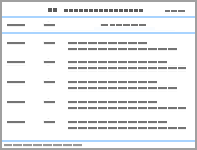
Tab.1
Message parameters in steady-state scenario
| 设备 | 报文类型 | 报文大小/B | 发送时间间隔/s |
|---|---|---|---|
| 互感器 | FT3 | 60 | 0.00025 |
| 保护单元 | GOOSE | 300 | 5 |
| MMS | 700 | 1 | |
| 多功能测控单元 | GOOSE | 300 | 5 |
| MMS | 700 | 1 | |
| PMU | 136 | 0.01 | |
| 采集执行单元 | SV | 315 | 0.000 25 |
| GOOSE | 300 | 5 | |
| 站控主机 | MMS | 200 | 1 |
Tab.2
Communication delay of secondary services
| 业务类型 | 平均时延/s | 最大时延/s |
|---|---|---|
| SV | 0.000049 | 0.000051 |
| 心跳GOOSE | 0.000042 | 0.000043 |
| 站控层GOOSE | 0.00012 | 0.00012 |
| 保护信息 | 0.0015 | 0.00175 |
| 遥测 | 0.00105 | 0.00145 |
| 遥信 | 0.00067 | 0.00069 |
| 同步相量测量 | 0.00023 | 0.00024 |
| 电量测量 | 0.000103 | 0.000135 |

Fig.6
Flow distribution of substation secondary system


Fig.7
Bandwidth utilization of link from isolation switch to C1 network switch


Fig.8
Simulation results of different background flows


Fig.9
Results of remote-metering and signaling message delay


Fig.10
Results of message path tracing and delay recording


Fig.11
Output of three-phase current test of Line 1


Fig.12
Output of action characteristics display (screenshot)

| [1] | 吴克河, 王继业, 李为, 等. 面向能源互联网的新一代电力系统运行模式研究[J]. 中国电机工程学报, 2019, 39(4): 966-979. |
| WU Kehe, WANG Jiye, LI Wei, et al. Research on the operation mode of new generation electric power system for the future energy Internet[J]. Proceedings of the CSEE, 2019, 39(4): 966-979. | |
| [2] |
HE R W, LIANG H Y, WU J S, et al. Reliability assessment of cyber-physical distribution system using multi-dimensional information network model[J]. IEEE Transactions on Smart Grid, 2023, 14(6): 4683-4692.
doi: 10.1109/TSG.2023.3246955 URL |
| [3] |
HE R W, YANG S H, DENG J H, et al. Reliability analyses of wide-area protection system considering cyber-physical system constraints[J]. IEEE Transactions on Smart Grid, 2021, 12(4): 3458-3467.
doi: 10.1109/TSG.2021.3060941 URL |
| [4] | 陈颖, 高仕林, 宋炎侃, 等. 面向新型电力系统的高性能电磁暂态云仿真技术[J]. 中国电机工程学报, 2022, 42(8): 2854-2864. |
| CHEN Ying, GAO Shilin, SONG Yankan, et al. High-performance electromagnetic transient simulation for new-type power system based on cloud computing[J]. Proceedings of the CSEE, 2022, 42(8): 2854-2864. | |
| [5] | 何瑞文, 谢海骏, 陆嘉亮, 等. 新型电力系统下电力二次系统仿真的建模方法[J]. 上海交通大学学报, 2025, 59(11): 1581-1591. |
| HE Ruiwen, XIE Haijun, LU Jialiang, et al. Modeling methods for power secondary system simulation under new power systems[J]. Journal of Shanghai Jiao Tong University, 2025, 59(11): 1581-1591. | |
| [6] | 何瑞文, 陆嘉亮, 杨长鑫, 等. 新型电力系统下电力二次系统仿真的设计方法[J]. 上海交通大学学报, 2025, 59(10): 1419-1430. |
| HE Ruiwen, LU Jialiang, YANG Changxin, et al. Design methods for power secondary system simulation under new power systems[J]. Journal of Shanghai Jiao Tong University, 2025, 59(10): 1419-1430. | |
| [7] |
HE R W, XIE H J, DENG J H, et al. Reliability modeling and assessment of cyber space in cyber-physical power systems[J]. IEEE Transactions on Smart Grid, 2020, 11(5): 3763-3773.
doi: 10.1109/TSG.5165411 URL |
| [8] | HE R W, DENG J H, LAI L L. Reliability evaluation of communication-constrained protection systems using stochastic-flow network models[J]. IEEE Transactions on Smart Grid, 2018, 9(3): 2371-2381. |
| [9] | 何瑞文, 龙隆, 张宝仁, 等. 电力信息物理系统中信息系统物理化的建模及分析方法[J]. 中国电机工程学报, 2024, 44(1): 72-85. |
| HE Ruiwen, LONG Long, ZHANG Baoren, et al. Cyber system physicalizing modeling and analysis method in cyber-physical power systems[J]. Proceedings of the CSEE, 2024, 44(1): 72-85. | |
| [10] | 何瑞文, 汪东, 张延旭, 等. 智能电网信息流的建模和静态计算方法研究[J]. 中国电机工程学报, 2016, 36(6): 1527-1535. |
| HE Ruiwen, WANG Dong, ZHANG Yanxu, et al. Modeling and static calculation method of the information flow on smart grid[J]. Proceedings of the CSEE, 2016, 36(6): 1527-1535. | |
| [11] | 何瑞文, 陈卫, 陈少华, 等. 电力系统继电保护[M]. 2版. 北京: 机械工业出版社, 2017: 127-152. |
| HE Ruiwen, CHEN Wei, CHEN Shaohua, et al. Power system relay protection[M]. 2nd ed. Beijing: China Machine Press, 2017: 127-152. | |
| [12] | IEC. Communication networks and systems for power utility automation—Part 1: Introduction and overview:IEC TR 61850-1:2013[S/OL]. [2023-11-29]. https://webstore.iec.ch/publication/6007. |
| [13] | OPNET Technologies. OPNET modeler[EB/OL]. [2023-08-18]. https://opnetprojects.com/opnet-modeler/. |
| [14] | HE R W, LU J L, WANG Y Y, et al. Simulation design method for bay layer devices of smart substation: US11405313[P]. 2022-08-02 [2023-08-18]. |
| [15] | 何瑞文, 陆嘉亮, 王伊尹, 等. 一种智能变电站间隔层设备仿真设计方法: CN111884852B[P]. 2021-03-16[2023-08-18]. |
| HE Ruiwen, LU Jialiang, WANG Yiyin, et al. A method for simulation and design of intelligent substation spacer layer equipment:CN111884852B[P]. 2021-03-16 [2023-08-18]. | |
| [16] | 何瑞文, 杨长鑫, 陆嘉亮, 等. 智能电子设备的仿真方法、电子设备和存储介质: CN114615358B[P]. 2022-09-02 [2023-08-18]. |
| HE Ruiwen, YANG Changxin, LU Jialiang, et al. Simulation method of intelligent electronic equipment, electronic equipment and storage medium: CN114615358B[P]. 2022-09-02[2023-08-18]. | |
| [17] | 何瑞文, 梁慧榆, 杨盛辉, 等. 一种智能变电站过程层设备仿真设计方法: CN111884851B[P]. 2021-08-13[2023-08-19]. |
| HE Ruiwen, LIANG Huiyu, YANG Shenghui, et al. Simulation design method for process level equipment of intelligent substation: CN111884851B[P]. 2021-08-13[2023-08-19]. | |
| [18] | 肖智宏, 闫培丽, 韩柳, 等. 智能变电站一次系统与二次系统的联合仿真方法及系统: CN111884211B[P]. 2021-09-28[2023-08-19]. |
| XIAO Zhihong, YAN Peili, HAN Liu, et al. Joint simulation method and system for primary system and secondary system of intelligent substation: CN111884211B[P]. 2021-09-28[2023-08-19]. | |
| [19] | 冯腾, 肖智宏, 刘颖, 等. 一种智能变电站保护单元仿真系统及其构建方法: CN111884212B[P]. 2021-10-01[2023-08-19]. |
| FENG Teng, XIAO Zhihong, LIU Ying, et al. Intelligent substation protection unit simulation system and construction method thereof: CN111884212B[P]. 2021-10-01[2023-08-19]. | |
| [20] | 高鹤庭, 王伊尹, 杨盛辉, 等. 智能变电站的信息流处理方法、计算机设备和存储介质: CN112436601B[P]. 2021-07-23[2023-08-19]. |
| GAO Heting, WANG Yiyin, YANG Shenghui, et al. Information flow processing method of intelligent substation, computer equipment and storage medium: CN112436601B[P]. 2021-07-23[2023-08-19]. | |
| [21] | 韩柳, 冯腾, 肖智宏, 等. 一种智能电子设备的端口识别方法、电子设备和存储介质: CN114244916B[P]. 2022-11-18[2023-08-20]. |
| HAN Liu, FENG Teng, XIAO Zhihong, et al. Port identification method of intelligent electronic equipment, electronic equipment and storage medium: CN114244916B[P]. 2022-11-18[2023-08-20]. | |
| [22] | 何瑞文, 金园, 高鹤庭, 等. 一种智能变电站仿真测试装置及方法: CN112800637B[P]. 2021-08-27[2023-08-20]. |
| HE Ruiwen, JIN Yuan, GAO Heting, et al. Intelligent substation simulation test device and method: CN112800637B[P]. 2021-08-27[2023-08-20]. | |
| [23] | 何瑞文, 龙隆, 林逸禹, 等. 一种智能变电站仿真测试方法、装置、终端及存储介质: CN112800638B[P]. 2021-08-13[2023-08-20]. |
| HE Ruiwen, LONG Long, LIN Yiyu, et al. Intelligent substation simulation test method and device, terminal and storage medium: CN112800638B[P]. 2021-08-13[2023-08-20]. | |
| [24] | 国家电网公司. 自主可控新一代变电站二次系统技术规范设计类系列规范1:110(66) kV-220 kV 变电站二次系统(试行 V1.0)[S]. 北京: 国家电网公司, 2020. |
| State Grid Corporation of China. Technical specification for a new generation of autonomous and controllable substation secondary system, design class series specification 1:110(66) kV-220 kV substation secondary system (trial V1.0)[S]. Beijing: State Grid Corporation of China, 2020. |
| [1] | HE Ruiwen, XIE Haijun, LU Jialiang, YANG Changxin, MOHAMMAD Shahidehpour. Modeling Methods for Power Secondary System Simulation in New Power Systems [J]. Journal of Shanghai Jiao Tong University, 2025, 59(11): 1581-1591. |
| [2] | HE Ruiwen, LU Jialiang, YANG Changxin, PENG Hao, MOHAMMAD Shahidehpour. Design Methods for Power Secondary System Simulation in New Power Systems [J]. Journal of Shanghai Jiao Tong University, 2025, 59(10): 1419-1430. |
| [3] | DENG Xiaoyu, LIU Muyang, CHANG Xiqiang, NAN Dongliang, MO Ruo, CHEN Junru. Online Monitoring Method for Inertial Support Capacity of Point-to-Grid in New Power Systems [J]. Journal of Shanghai Jiao Tong University, 2024, 58(9): 1390-1399. |
| [4] | ZHOU Tao, HUANG Ju, HAN Rushuai, HU Qinran, QUAN Hao. Inertial Support Capacity Analysis and Equivalent Inertia Estimation of Wind Turbines in Integrated Inertial Control [J]. Journal of Shanghai Jiao Tong University, 2024, 58(12): 1915-1924. |
| [5] | LU Wen’an, ZHU Qingxiao, LI Zhaowei, LIU Hui, YU Yiping. A Prediction Method of New Power System Frequency Characteristics Based on Convolutional Neural Network [J]. Journal of Shanghai Jiao Tong University, 2024, 58(10): 1500-1512. |
| [6] | YU Miao, HU Jingxuan, ZHANG Shouzhi, WEI Jingjing, SUN Jianqun, WU Yixiao. Fast Stability of New Power System Based on a PMU Gradient Dynamic Deviation Method [J]. Journal of Shanghai Jiao Tong University, 2024, 58(1): 40-49. |
| [7] |
SHENG Hongyu 1, LI Heping 1,YE Jianqiao 2,WU Xutao 1 . State Variable Method for Transient Heat Conduction Analysis of Composite Sold Cylinder [J]. Journal of Shanghai Jiaotong University, 2011, 45(02): 247-0251. |
| Viewed | ||||||
|
Full text |
|
|||||
|
Abstract |
|
|||||
