

Journal of Shanghai Jiao Tong University ›› 2026, Vol. 60 ›› Issue (5): 835-847.doi: 10.16183/j.cnki.jsjtu.2024.238
• Mechanical Engineering • Previous Articles Next Articles
ZHANG Daochen1, LU Yingying1( ), QIAN Yi1, CHEN Yufeng2
Received:2024-06-21
Revised:2024-08-13
Accepted:2024-08-30
Online:2026-05-28
Published:2026-06-03
Contact:
LU Yingying
E-mail:yingyinglu1981@njtech.edu.cn
CLC Number:
ZHANG Daochen, LU Yingying, QIAN Yi, CHEN Yufeng. Effect of Prechamber Passage Parameters on Performance and Emissions of a Heavy-Duty Diesel Engine[J]. Journal of Shanghai Jiao Tong University, 2026, 60(5): 835-847.
Add to citation manager EndNote|Ris|BibTeX
URL: https://xuebao.sjtu.edu.cn/EN/10.16183/j.cnki.jsjtu.2024.238
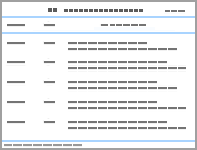
Tab.1
Engine specifications
| 参数 | 取值 |
|---|---|
| 缸径/mm | 116 |
| 行程/mm | 150 |
| 连杆长度/mm | 224.5 |
| 发动机转速/(r·min-1) | 1 200 |
| 喷油系统 | 高压共轨 |
| 喷油压力/MPa | 180 |
| 喷孔数量 | 8 |
| 喷孔直径/mm | 0.169 |
| 喷孔之间夹角/(°) | 149 |
| 排量/L | 9.5 |
| 压缩比 | 18.5 |
| 燃油种类 | 国V0号柴油 |

Fig.1
Calculation grid at top dead center of the original engine

Tab.2
Initial and boundary conditions of simulations
| 参数 | 取值 |
|---|---|
| 进气门关闭/(°) | -110 |
| 排气门开启/(°) | 126 |
| 涡流比 | 1.1 |
| 缸内初始压力/MPa | 0.45 |
| 进气温度/K | 360 |
| 气缸壁温度/K | 455 |
| 气缸盖温度/K | 534 |
| 活塞温度/K | 524 |
| 喷油量/mg | 180 |
| 主燃烧室喷油定时/(°) | -2 |
Tab.3
Model used in simulation calculations
| 模型 | 来源 |
|---|---|
| 破碎模型 | KH-RT |
| 液滴碰撞模型 | NTC |
| 撞壁模型 | Wall film |
| 蒸发模型 | Frossling |
| 燃烧模型 | SAGE |
| NOx排放模型 | Extended Zeldovich机理 |
| 碳烟排放模型 | Hiroyasu |
| 湍流模型 | RNG k-ε |
| 壁面传热模型 | Boundary Heat Flux |
| 燃油化学性质 | 正庚烷 |
| 燃油物理性质 | DIESEL2 |

Fig.2
Verification of grid independence


Fig.3
Comparison of test and simulation of in-cylinder pressure and heat release rate of original engine


Fig.4
Comparison of test and simulation of NOx and soot in main combustion chamber of original engine

Tab.4
Structural parameters of prechamber
| 参数 | 取值 |
|---|---|
| 预燃室容积比例/% | 3 |
| 预燃室喷油量比例/% | 1 |
| 预燃室喷油定时/(°) | -2 |
| 通孔长度/mm | 3.6 |
| 单通道通孔直径/mm | 2 |
| β/(°) | 30 |
| α/(°) | 30/45/60/90/120 |
| d/mm | 1/1.4/2 |
Tab.5
Effect of angle and diameter of passage in prechamber on indicated thermal efficiency and emissions
| 工况 序号 | α/(°) | β/(°) | d/mm | 喷油 比例/% | 预燃室 容积比例/% | 指示 热效率/% | NOx比排放量/ [g·(kW·h)-1] | 碳烟比排放量/ [g·(kW·h)-1] |
|---|---|---|---|---|---|---|---|---|
| 0 | — | — | — | — | — | 46.94 | 13.29 | 0.00 336 |
| 1 | — | — | 2 | 1 | 3 | 46.88 | 12.74 | 0.00 297 |
| 2 | 30 | 30 | 1 | 1 | 3 | 46.91 | 13.41 | 0.00 188 |
| 3 | 30 | 30 | 1.4 | 1 | 3 | 46.96 | 13.67 | 0.00 233 |
| 4 | 30 | 30 | 2 | 1 | 3 | 47.06 | 13.37 | 0.00 229 |
| 5 | 45 | 30 | 1 | 1 | 3 | 46.98 | 13.00 | 0.00 221 |
| 6 | 45 | 30 | 1.4 | 1 | 3 | 47.00 | 13.50 | 0.00 231 |
| 7 | 45 | 30 | 2 | 1 | 3 | 46.95 | 12.82 | 0.00 260 |
| 8 | 60 | 30 | 1 | 1 | 3 | 46.90 | 13.07 | 0.00 241 |
| 9 | 60 | 30 | 1.4 | 1 | 3 | 46.75 | 12.86 | 0.00 298 |
| 10 | 60 | 30 | 2 | 1 | 3 | 46.93 | 12.77 | 0.00 250 |
| 11 | 90 | 30 | 1 | 1 | 3 | 46.76 | 12.72 | 0.00 212 |
| 12 | 90 | 30 | 1.4 | 1 | 3 | 46.96 | 13.40 | 0.00 215 |
| 13 | 90 | 30 | 2 | 1 | 3 | 46.98 | 13.22 | 0.00 239 |
| 14 | 120 | 30 | 1 | 1 | 3 | 46.65 | 12.86 | 0.00 210 |
| 15 | 120 | 30 | 1.4 | 1 | 3 | 46.87 | 13.44 | 0.00 198 |
| 16 | 120 | 30 | 2 | 1 | 3 | 46.92 | 13.28 | 0.00 239 |

Fig.5
Three-view diagram of 3D model of prechamber combustion system and a partial view of prechamber


Fig.6
Calculation grid at top dead center of single passage prechamber combustion system


Fig.7
Indicated thermal efficiency and soot versus NOx emissions of prechamber system under different operating conditions


Fig.8
Influence of passage angle of prechamber on peak average temperature,exhaust temperature, and peak cylinder pressure in cylinder


Fig.9
Combustion phase and combustion duration at different prechamber passage angles


Fig.10
Mass fractions at varying equivalence ratios for original engine and prechamber combustion system


Fig.11
Influence of different prechamber passage angles on turbulent kinetic energy history in main combustion chamber


Fig.12
Distribution of energy of original engine and prechamber system


Fig.13
NOx and soot emission history at different through-hole angles of prechamber


Fig.14
Effect of diameter of passage in prechamber on the pressure in cylinder


Fig.15
Combustion phase and combustion duration at different prechamber passage diameters


Fig.16
Effect of diameter of passage in prechamber on the turbulent kinetic energy course in main combustion chamber


Fig.17
Distribution of energy of original engine and prechamber system


Fig.18
NOx and soot emission history at different prechamber passage diameters

| [1] |
LIU X L, SHARMA P, SILVA M, et al. Computational investigation of methanol pre-chamber combustion in a heavy-duty engine[J]. Applications in Energy and Combustion Science, 2023, 15: 100192.
doi: 10.1016/j.jaecs.2023.100192 URL |
| [2] |
KORB B, KUPPA K, NGUYEN H D, et al. Expe-rimental and numerical investigations of charge motion and combustion in lean-burn natural gas engines[J]. Combustion and Flame, 2020, 212: 309-322.
doi: 10.1016/j.combustflame.2019.11.005 URL |
| [3] |
LIU F N, ZHOU L, HUA J X, et al. Effects of pre-chamber jet ignition on knock and combustion characteristics in a spark ignition engine fueled with kerosene[J]. Fuel, 2021, 293: 120278.
doi: 10.1016/j.fuel.2021.120278 URL |
| [4] |
TALEI M, JAFARMADAR S, KHALILARYA S, et al. Experimental and numerical analyses of cold EGR effect on combustion, performance and emissions of natural gas lean-burn engine with pre-chamber combustion system[J]. Fuel, 2020, 276: 118061.
doi: 10.1016/j.fuel.2020.118061 URL |
| [5] |
HLAING P, MARQUEZ M E, CENKER E, et al. Effects of volume and nozzle area in narrow-throat spark-ignited pre-chamber combustion engines[J]. Fuel, 2022, 313: 123029.
doi: 10.1016/j.fuel.2021.123029 URL |
| [6] |
ZHOU L, SONG Y T, HUA J X, et al. Effects of different hole structures of pre-chamber with turbulent jet ignition on the flame propagation and lean combustion performance of a single-cylinder engine[J]. Fuel, 2022, 308: 121902.
doi: 10.1016/j.fuel.2021.121902 URL |
| [7] |
SANTOS N D S A, ALVAREZ C E C, ROSO V R, et al. Combustion analysis of an SI engine with stratified and homogeneous prechamber ignition system using ethanol and hydrogen[J]. Applied Thermal Engineering, 2019, 160: 113985.
doi: 10.1016/j.applthermaleng.2019.113985 URL |
| [8] |
HUA J X, ZHOU L, GAO Q, et al. Influence of prechamber structure and injection parameters on engine performance and combustion characteristics in a turbulent jet ignition (TJI) engine[J]. Fuel, 2021, 283: 119236.
doi: 10.1016/j.fuel.2020.119236 URL |
| [9] |
ZEMAN J, DEMPSEY A. Numerical investigation of equivalence ratio effects on flex-fuel mixing controlled combustion enabled by prechamber ignition[J]. Applied Thermal Engineering, 2024, 249: 123445.
doi: 10.1016/j.applthermaleng.2024.123445 URL |
| [10] | 陈泓, 祁宏钟, 江枭枭, 等. 预燃室结构参数对汽油机稀薄燃烧的影响[J]. 内燃机学报, 2024, 42(2): 106-113. |
| CHEN Hong, QI Hongzhong, JIANG Xiaoxiao, et al. Effect of pre-chamber structure parameters on lean-burn characteristics for a gasoline engine[J]. Transactions of CSICE, 2024, 42(2): 106-113. | |
| [11] | 王志刚, 刘宗宽, 车胜楠, 等. 预燃室湍流射流点火甲醇发动机稀薄燃烧和排放特性试验研究[J]. 内燃机工程, 2024, 45(2): 1-7. |
| WANG Zhigang, LIU Zongkuan, CHE Shengnan, et al. Experimental investigation on the lean combustion and emission characteristics of the methanol engine by prechamber turbulent jet ignition[J]. Chinese Internal Combustion Engine Engineering, 2024, 45(2): 1-7. | |
| [12] | 聂靖宇, 刘一泽, 王家勇, 等. 柴油机预燃室射流扰动燃烧系统的设计与试验[J]. 内燃机学报, 2023, 41(4): 289-297. |
| NIE Jingyu, LIU Yize, WANG Jiayong, et al. Design and experiment of a prechamber jet disturbed combustion system for diesel engine[J]. Transactions of CSICE, 2023, 41(4): 289-297. | |
| [13] | 周洪杰, 张明, 席鸿远, 等. 预燃室及喷射阀对双燃料发动机性能的影响[J]. 内燃机学报, 2024, 42(2): 134-143. |
| ZHOU Hongjie, ZHANG Ming, XI Hongyuan, et al. Effect of pre-chamber and injection valve on the performance of a dual-fuel engine[J]. Transactions of CSICE, 2024, 42(2): 134-143. | |
| [14] | 马哲, 杨豪, 邓俊, 等. 被动预燃室引燃的氩氧氛围氢燃料燃烧特性研究[C]// 2023中国汽车工程学会年会论文集(3). 北京,中国: 同济大学汽车学院, 2023: 8. |
| MA Zhe, YANG Hao, DENG Jun, et al. Combustion characteristies of hydrogen fuel in argon-oxygen atmosphereIgnited by passive pre-chamber[C]// SAECCE2023-IEE035. Beijing, China: School of Automotive Studies, Tongji University, 2023: 8. | |
| [15] |
LU Y Y, QIAN Y, ZHANG D C, et al. Parameters optimization of prechamber jet disturbance combustion system—Effect of prechamber volume and fuel injection mass ratios on performance and exhausts in a diesel engine[J]. Fuel, 2024, 373: 132360.
doi: 10.1016/j.fuel.2024.132360 URL |
| [16] | LU Y Y, CHEN Y F, ZHANG D C, et al. Effect of pre-chamber fuel injection parameters and EGR on the combustion and emissions of a heavy-duty diesel engine[J]. Energy Sources, Part A: Recovery, Utilization, and Environmental Effects, 2024, 46(1): 1-23. |
| [17] | 鹿盈盈, 裴毅强, 刘一泽, 等. 转速对柴油机中负荷预混压燃燃烧和排放的影响[J]. 内燃机学报, 2022, 40(6): 495-503. |
| LU Yingying, PEI Yiqiang, LIU Yize, et al. Effect of speed on PCCL combustion and emissions in a diesel engine at medium load[J]. Transactions of CSICE, 2022, 40(6): 495-503. | |
| [18] | 归明月, 范宝春, 叶经方, 等. 甲烷/空气中对撞射流火焰的实验和数值研究[J]. 推进技术, 2008, 29(6): 651-654. |
| GUI Mingyue, FAN Baochun, YE Jingfang, et al. Experimental and numerical research of impinging jet flames of methane/air[J]. Journal of Propulsion Technology, 2008, 29(6): 651-654. | |
| [19] | 范超. 预燃室式柴油机射流扰动强化混合后燃烧和排放特性研究[D]. 南京: 南京工业大学, 2023. |
| FAN Chao. Research on the enhanced mixing combustion and emission characteristics of pre-chamber diesel engine with jet disturbance[D]. Nanjing: Nanjing University of Technology, 2023. | |
| [20] |
JAMROZIK A, TUTAK W, KOCISZEWSKI A, et al. Numerical simulation of two-stage combustion in SI engine with prechamber[J]. Applied Mathematical Modelling, 2013, 37(5): 2961-2982.
doi: 10.1016/j.apm.2012.07.040 URL |
| [21] | 聂靖宇. 柴油机预燃室射流扰动燃烧系统的设计优化及试验研究[D]. 天津: 天津大学, 2022. |
| NIE Jingyu. Design optimization and experimental of jet disturbance combustion system by prechamber of diesel engines[D]. Tianjin: Tianjin University, 2022. | |
| [22] | 马仪. 双通道涡流室式风冷柴油机涡流特性的研究[D]. 邵阳: 邵阳学院, 2015. |
| MA Yi. Study on the swirl characteristics of air cooled diesel engine with swirl chamber of two-pass channels[D]. Shaoyang: Shaoyang College, 2015. | |
| [23] | 王家勇. 柴油机射流扰动室强化燃烧系统仿真与实验研究[D]. 天津: 天津大学, 2023. |
| WANG Jiayong. Simulation and experimental study on the enhanced combustion system of diesel jet disturbance chamber[D]. Tianjin: Tianjin University, 2023. |
| [1] | Liu Ziyan, Jiang Zuhua. Hybrid Meta-Heuristic Algorithm for a Pickup and Delivery Problem of Ship Outfitting Pallets Distribution Considering Carbon Emissions [J]. J Shanghai Jiaotong Univ Sci, 2026, 31(2): 440-457. |
| [2] | ZENG Jincan, HE Gengsheng, LI Yaowang, DU Ershun, ZHANG Ning, ZHU Haojun. A Short-Term Carbon Emission Accounting Method for Power Industry Using Electricity Data Based on a Combined Model of CNN and LightGBM [J]. Journal of Shanghai Jiao Tong University, 2025, 59(6): 746-757. |
| [3] | CHEN Hui, HE Gengsheng, LIU Yuliang, ZENG Hongmei, ZHANG Shixu, LI Yaowang. Capacity Allocation Strategy of Energy Storage in Low-Carbon Park Considering Equivalent Energy Storage Characteristics of Thermal System [J]. Journal of Shanghai Jiao Tong University, 2024, 58(6): 863-871. |
| [4] | SUN Yi, GU Jiaxun, ZHENG Shunlin, LI Xiong, LU Chunguang, LIU Wei. Low-Carbon Optimal Operation Strategy of Integrated Energy System Considering Generalized Energy Storage and LCA Carbon Emission [J]. Journal of Shanghai Jiao Tong University, 2024, 58(5): 647-658. |
| [5] | FAN Chao, LU Yingying, LIU Yize. Effect of Injection Strategy on Low Load Premixed Combustion of a Diesel Engine in Engine Speed Extension [J]. Journal of Shanghai Jiao Tong University, 2023, 57(8): 1055-1066. |
| [6] | ZHANG Pengfei, XU Jingyi, GUO Wei, WU Wei, ZHONG Chen, WEI Wendong. Low-Carbon Transformation of the Power System in the Guangdong-Hong Kong-Macao Greater Bay Area [J]. Journal of Shanghai Jiao Tong University, 2022, 56(3): 293-302. |
| [7] | CHEN Wenxule, XIANG Yue, PENG Guangbo, LIU Youbo, LIU Junyong. System Dynamic Modeling and Analysis of Power System Supply Side Morphological Development with Dual Carbon Targets [J]. Journal of Shanghai Jiao Tong University, 2021, 55(12): 1567-1576. |
| [8] | CHEN Wenhao, XIA Chun, MAO Kerang, TAO Jie, FANG Junhua, HUANG Zhen. The Effects of Operating Conditions and Direct Injection Timing on the Particulates Emissions in a Dual-Injection Gasoline Engine [J]. Journal of Shanghai Jiaotong University, 2019, 53(11): 1269-1275. |
| [9] | WANG Zhongcheng (王忠诚), LIU Xiaoyu (刘晓宇), ZHOU Peilin (周培林), XU Leping (许乐平). Impacts of CaO Solid Particles in Carbon Dioxide Absorption Process from Ship Emission with NaOH Solution [J]. Journal of Shanghai Jiao Tong University (Science), 2018, 23(2): 320-326. |
| [10] | LIU Weijie,GE Bing,JIANG Zhijian,ZANG Shusheng,WENG Shilie. Experimental Study of Performance of LowSwirl MultiNozzle Burner [J]. Journal of Shanghai Jiaotong University, 2016, 50(04): 545-550. |
| [11] | ZHANG Tingting,XIE Xiaomin,HUANG Zhen. Life Cycle Analysis of Microalgal Biodiesel in China [J]. Journal of Shanghai Jiaotong University, 2014, 48(06): 750-755. |
| [12] | XU Yuan1,GU Haiying1,LI Nan2. Measurement of CO2 Embodied in International Trade in China ——Based on Noncompetitive Inputoutput Model [J]. Journal of Shanghai Jiaotong University, 2013, 47(10): 1643-1648. |
| [13] | LI Chen1 (李琛), CUI Su-ping1 (崔素萍), WANG Zhi-hong1 (王志宏). CO2 Emissions from Typical Cement Plants in China [J]. Journal of shanghai Jiaotong University (Science), 2012, 17(3): 341-344. |
| [14] | ZHENG Hua-Hang-1, ZHANG Xu-Zhou-1, LI Zhong-Zhao-1, SHEN Yi-Tao-2, ZHANG Jian-Yong-2, FANG Jun-Hua-1, 吕Xing-Cai-1 , HUANG Zhen-1. Effects of Spark Assisted HCCI on Combustion and Emissions in Multicylinder Gasoline Engine [J]. Journal of Shanghai Jiaotong University, 2012, 46(05): 695-700. |
| [15] |
SHI Xiuyong1,2,QIAO Xinqi2,NI Jimin1,ZHENG Yuanyuan3 . Experimental and CFD Study on Combustion Noise and Pollutant Emissions of Diesel Engine with Split Injections of Common Rail System [J]. Journal of Shanghai Jiaotong University, 2010, 44(11): 1566-1572. |
| Viewed | ||||||
|
Full text |
|
|||||
|
Abstract |
|
|||||
