

Journal of Shanghai Jiao Tong University ›› 2026, Vol. 60 ›› Issue (1): 61-73.doi: 10.16183/j.cnki.jsjtu.2024.036
• New Type Power System and the Integrated Energy • Previous Articles Next Articles
LIU Donglin1, ZHOU Xia1( ), DAI Jianfeng2, XIE Xiangpeng1, TANG Yi3, LI Juanshi3
Received:2024-01-24
Revised:2024-04-23
Accepted:2024-06-06
Online:2026-01-28
Published:2026-01-27
Contact:
ZHOU Xia
E-mail:zhouxia@njupt.edu.cn.
CLC Number:
LIU Donglin, ZHOU Xia, DAI Jianfeng, XIE Xiangpeng, TANG Yi, LI Juanshi. Bi-Level Optimization Scheduling Strategy for Building Integrated Energy System Considering Virtual Energy Storage[J]. Journal of Shanghai Jiao Tong University, 2026, 60(1): 61-73.
Add to citation manager EndNote|Ris|BibTeX
URL: https://xuebao.sjtu.edu.cn/EN/10.16183/j.cnki.jsjtu.2024.036

Fig.1
Model of building comprehensive energy system


Fig.2
Framework of Stackelberg game interaction


Fig.3
New energy output and initial load on user side of building

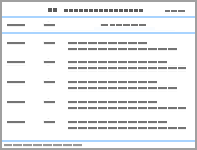
Tab.1
Basic parameters of each equipment
| 设备 | 容量/kW | 效率/% | 爬坡率/% |
|---|---|---|---|
| 燃气轮机 | 40 | 26 | 20 |
| 燃气锅炉 | 40 | 85 | 20 |
| 电制冷机 | 30 | 80 | |
| 吸收式制冷机 | 40 | 33 | |
| 储能装置 | 95 | 90 | |
| P2G装置 | 80 | 60 | |
| 风机 | 预测值 | ||
| 光伏 | 预测值 |
Tab.2
Coefficients of heating system time series model
| j | αj | βj | γj | θj | ϕj | ωj |
|---|---|---|---|---|---|---|
| 0 | 0.2112 | 0.3317 | ||||
| 1 | 0.5721 | -0.0243 | -0.3169 | 0.6991 | 0.1011 | 0.1998 |
| 2 | 0.0607 | -0.0104 | 0.1741 |

Fig.4
Game convergence curves


Fig.5
Optimization of electricity price


Fig.6
Distribution of electricity load on user side after optimization


Fig.7
Electrical load response versus electricity price


Fig.8
Electrical load and power balance before and after optimization


Fig.9
Indoor and outdoor temperatures in buildings during cooling and heating periods


Fig.10
Cooling and heating power balance


Fig.11
Natural gas power balance


Fig.12
Impact of PMV index on heating buildings


Fig.13
Impact of equivalent thermal resistance R on cooling buildings


Fig.14
System operation in Scenario 1


Fig.15
System operating costs and carbon emissions in different scenarios

| [1] | 邱迪, 刘东, 高飞, 等. 基于离散混合自动机的园区综合能源系统多模式建模与日前优化[J]. 中国电机工程学报, 2023, 43(1): 135-147. |
| QIU Di, LIU Dong, GAO Fei, et al. Multi-scenario modeling and day-ahead optimization of park multiple energy system based on discrete hybrid automaton[J]. Proceedings of the CSEE, 2023, 43(1): 135-147. | |
| [2] |
WANG Y D, HU J J, LIU N. Energy management in integrated energy system using energy-carbon integrated pricing method[J]. IEEE Transactions on Sustainable Energy, 2023, 14(4): 1992-2005.
doi: 10.1109/TSTE.2023.3295573 URL |
| [3] |
褚旭, 鲍泽宏. 综合能源系统电力网架继电保护原理综述[J]. 上海交通大学学报, 2023, 57(4): 379-392.
doi: 10.16183/j.cnki.jsjtu.2021.492 |
| CHU Xu, BAO Zehong. Overview of protection principle of power grid in integrated energy system[J]. Journal of Shanghai Jiao Tong University, 2023, 57(4): 379-392. | |
| [4] | 李九阳, 陈立, 郭金鹏. 严寒地区被动式超低能耗建筑发展现状及前景展望[J]. 工业建筑, 2023, 53 (Sup.1): 31-33. |
| LI Jiuyang, CHEN Li, GUO Jinpeng. Present situation and prospect of passive ultra-low energy consumption buildings in cold regions[J]. Industrial Construction, 2023, 53 (Sup.1): 31-33. | |
| [5] | 任炬光, 张力, 金立, 等. 考虑可再生能源消纳的建筑综合能源系统日前经济调度模型[J]. 工程科学与技术, 2023, 55(2): 160-170. |
| REN Juguang, ZHANG Li, JIN Li, et al. Day-ahead economic dispatch model of building integrated energy systems considering the renewable energy consumption[J]. Advanced Engineering Sciences, 2023, 55(2): 160-170. | |
| [6] |
SHARMA S, VERMA A, XU Y, et al. Robustly coordinated bi-level energy management of a multi-energy building under multiple uncertainties[J]. IEEE Transactions on Sustainable Energy, 2021, 12(1): 3-13.
doi: 10.1109/TSTE.5165391 URL |
| [7] |
LOGGIA R, FLAMINI A, MASSACCESI A, et al. A case study of a renovation of a historical university department: The nearly zero-energy refurbished buildings[J]. IEEE Transactions on Industry Applications, 2022, 58(6): 6970-6980.
doi: 10.1109/TIA.2022.3195823 URL |
| [8] |
ALYAMI S H, ALMUTLAQA A A, ALQAHTANY A M, et al. Likelihood of reaching zero energy building design in hot dry climate: Saudi Arabia[J]. IEEE Access, 2021, 9: 167054-167066.
doi: 10.1109/ACCESS.2021.3134365 URL |
| [9] | 黄子硕, 何桂雄, 闫华光, 等. 园区级综合能源系统优化模型功能综述及展望[J]. 电力自动化设备, 2020, 40(1): 10-18. |
| HUANG Zishuo, HE Guixiong, YAN Huaguang, et al. Overview and prospect of optimization model function for community-scale integrated energy system[J]. Electric Power Automation Equipment, 2020, 40(1): 10-18. | |
| [10] |
胡博, 程欣, 邵常政, 等. 计及建筑热负荷弹性的综合能源系统调度方法[J]. 上海交通大学学报, 2023, 57(7): 803-813.
doi: 10.16183/j.cnki.jsjtu.2021.534 |
| HU Bo, CHENG Xin, SHAO Changzheng, et al. Optimal dispatch of integrated energy system based on flexibility of thermal load[J]. Journal of Shanghai Jiao Tong University, 2023, 57(7): 803-813. | |
| [11] |
JIN X L, WU Q W, JIA H J, et al. Optimal integration of building heating loads in integrated heating/electricity community energy systems: A bi-level MPC approach[J]. IEEE Transactions on Sustainable Energy, 2021, 12(3): 1741-1754.
doi: 10.1109/TSTE.2021.3064325 URL |
| [12] |
BAHRAMARA S, SHEIKHAHMADI P, CHICCO G, et al. Modeling the microgrid operator participation in day-ahead energy and reserve markets consi-dering stochastic decisions in the real-time market[J]. IEEE Transactions on Industry Applications, 2022, 58(5): 5747-5762.
doi: 10.1109/TIA.2022.3178386 URL |
| [13] | SCHICK C, KLEMPP N, HUFENDIEK K. Role and impact of prosumers in a sector-integrated energy system with high renewable shares[J]. IEEE Tran-sactions on Power Systems, 2022, 37(4): 3286-3298. |
| [14] |
张虹, 张瑞芳, 周建丞, 等. 基于主从博弈和混合碳政策的园区综合能源系统低碳经济调度[J]. 太阳能学报, 2023, 44(9): 9-17.
doi: 10.19912/j.0254-0096.tynxb.2022-0715 |
|
ZHANG Hong, ZHANG Ruifang, ZHOU Jiancheng, et al. Low-carbon economic dispatch of integrated energy system in campus based on Stackelberg game and hybrid carbon policy[J]. Acta Energiae Solaris Sinica, 2023, 44(9): 9-17.
doi: 10.19912/j.0254-0096.tynxb.2022-0715 |
|
| [15] | 王瑞, 程杉, 徐建宇, 等. 基于主从博弈和混合需求响应的能量枢纽多时间尺度优化调度策略[J]. 电力自动化设备, 2023, 43(1): 32-40. |
| WANG Rui, CHENG Shan, XU Jianyu, et al. Multi-time scale optimal scheduling strategy of energy hub based on master-slave game and hybrid demand response[J]. Electric Power Automation Equipment, 2023, 43(1): 32-40. | |
| [16] |
桑国臣, 程芳玥, 刘瑶, 等. 围护结构太阳辐射吸收系数对太阳能采暖建筑外墙热性能的影响[J]. 太阳能学报, 2023, 44(12): 33-40.
doi: 10.19912/j.0254-0096.tynxb.2022-1235 |
|
SANG Guochen, CHENG Fangyue, LIU Yao, et al. Influence of solar absorptivity of building envelope on thermal performance of exterior wall of solar heating building[J]. Acta Energiae Solaris Sinica, 2023, 44(12): 33-40.
doi: 10.19912/j.0254-0096.tynxb.2022-1235 |
|
| [17] |
朱新荣, 梁嘉, 邱杨, 等. 外保温复合墙体热惰性指标修正研究[J]. 太阳能学报, 2023, 44(3): 482-488.
doi: 10.19912/j.0254-0096.tynxb.2020-1058 |
|
ZHU Xinrong, LIANG Jia, QIU Yang, et al. Revising study on thermal inertia index according to external insulation composite wall[J]. Acta Energiae Solaris Sinica, 2023, 44(3): 482-488.
doi: 10.19912/j.0254-0096.tynxb.2020-1058 |
|
| [18] |
黄旭, 祖国强, 司威, 等. 配电台区灵活资源多时间尺度优化调度方法: 以含虚拟储能的建筑微网为例[J]. 储能科学与技术, 2024, 13(2): 568-577.
doi: 10.19799/j.cnki.2095-4239.2023.0677 |
| HUANG Xu, ZU Guoqiang, SI Wei, et al. Multi-time-scale optimal scheduling method for flexible resources at distribution stations: A case study of building microgrid considering virtual storage system[J]. Energy Storage Science & Technology, 2024, 13(2): 568-577. | |
| [19] | 李东东, 陈天旭, 沈运帷, 等. 基于联合虚拟储能系统的海岛微电网协同优化策略[J]. 中国电机工程学报, 2023, 43(20): 7842-7856. |
| LI Dongdong, CHEN Tianxu, SHEN Yunwei, et al. Collaborative optimization of island microgrid based on joint virtual energy storage system strategy[J]. Proceedings of the CSEE, 2023, 43(20): 7842-7856. | |
| [20] | 穆云飞, 唐志鹏, 吴志军, 等. 计及虚拟储能的电-水-热综合能源系统日前优化调度方法[J]. 电力系统自动化, 2023, 47(24): 11-21. |
| MU Yunfei, TANG Zhipeng, WU Zhijun, et al. Optimal day-ahead scheduling method for electricity-water-heat integrated energy system considering virtual energy storage[J]. Automation of Electric Power Systems, 2023, 47(24): 11-21. | |
| [21] |
MITRA J, NGUYEN N. Grid-scale virtual energy storage to advance renewable energy penetration[J]. IEEE Transactions on Industry Applications, 2022, 58(6): 7952-7965.
doi: 10.1109/TIA.2022.3202515 URL |
| [22] | 张岩, 李瑞芳, 赵健, 等. 考虑碳配额及综合需求响应双重激励的综合能源系统多主体博弈协同优化[J]. 可再生能源, 2024, 42(3): 388-397. |
| ZHANG Yan, LI Ruifang, ZHAO Jian, et al. Multi agent game collaborative optimization of integrated energy system considering carbon quota and integra-ted demand response[J]. Renewable Energy Resources, 2024, 42(3): 388-397. | |
| [23] |
高波, 李飞, 史轮, 等. 基于实时碳强度评估的社区综合能源系统低碳互动管理策略[J]. 上海交通大学学报, 2025, 59(5): 580-591.
doi: 10.16183/j.cnki.jsjtu.2023.329 |
| GAO Bo, LI Fei, SHI Lun, et al. A low-carbon interactive management strategy for community integrated energy system based on real-time carbon intensity assessment[J]. Journal of Shanghai Jiao Tong University, 2025, 59(5): 580-591. | |
| [24] | HA T, XUE Y, LIN K D, et al. Optimal operation of energy hub based micro-energy network with integration of renewables and energy storages[J]. Journal of Modern Power Systems & Clean Energy, 2022, 10(1): 100-108. |
| [25] |
尚梦琪, 高红均, 贺帅佳, 等. 考虑阶梯碳奖惩和综合需求响应的楼宇低碳规划[J]. 上海交通大学学报, 2024, 58(6): 926-940.
doi: 10.16183/j.cnki.jsjtu.2022.527 |
| SHANG Mengqi, GAO Hongjun, HE Shuaijia, et al. Low-carbon planning for buildings considering ladder carbon reward and punishment and integrated demand response[J]. Journal of Shanghai Jiao Tong University, 2024, 58(6): 926-940. | |
| [26] | 刘铠诚, 王关涛, 白星振, 等. 基于主从博弈的园区级综合能源系统动态定价与低碳经济调度[J]. 高电压技术, 2024, 50(4): 1436-1445. |
| LIU Kaicheng, WANG Guantao, BAI Xingzhen, et al. Dynamic pricing and low-carbon economic dispatch of integrated energy system based on Stackelberg game[J]. High Voltage Engineering, 2024, 50(4): 1436-1445. | |
| [27] | 陈晚晴, 项康利, 林晓凡, 等. 基于主从博弈的综合能源系统电氢碳运行优化[J]. 电力系统及其自动化学报, 2023, 35(11): 143-151. |
| CHEN Wanqing, XIANG Kangli, LIN Xiaofan, et al. Optimization of electricity, hydrogen and carbon operation in integrated energy system based on master-slave game[J]. Proceedings of the CSU-EPSA, 2023, 35(11): 143-151. | |
| [28] |
高建伟, 黄宁泊, 高芳杰, 等. 基于改进信息间隙决策理论的考虑决策者风险态度的社区虚拟电厂经济-能源-环境调度策略选择[J]. 电力建设, 2024, 45(3): 39-57.
doi: 10.12204/j.issn.1000-7229.2024.03.004 |
|
GAO Jianwei, HUANG Ningbo, GAO Fangjie, et al. Selection of economics-energy-environment sche-duling strategy for a community virtual power plant considering decision-makers’ risk attitudes based on improved information gap decision theory[J]. Electric Power Construction, 2024, 45(3): 39-57.
doi: 10.12204/j.issn.1000-7229.2024.03.004 |
| [1] | BAI Yunjie, XIE Kaigui, SHAO Changzheng, HU Bo. Game Optimization Scheduling of Wind-Solar-Hydro-Thermal Power Alliance in Upstream and Downstream Regions of Cascade Hydropower [J]. Journal of Shanghai Jiao Tong University, 2026, 60(2): 224-234. |
| [2] | HU Long, FANG Baling, FAN Feilong, CHEN Dawei, LI Xinxi, ZENG Run. Energy Interaction and Energy Storage Sharing Optimization Method for Users, Base Stations, and Charging Stations [J]. Journal of Shanghai Jiao Tong University, 2025, 59(7): 877-888. |
| [3] | LOU Wei, HU Rong, YU Jinming, ZHANG Xipeng, FAN Feilong, LIU Songyuan. Multi-Agent Coordinated Dispatch of Power Grid and Pumped Hydro Storage with Embedded Market Game Model [J]. Journal of Shanghai Jiao Tong University, 2025, 59(3): 365-375. |
| [4] | HU Bo, CHENG Xin, SHAO Changzheng, HUANG Wei, SUN Yue, XIE Kaigui. Optimal Dispatch of Integrated Energy System Based on Flexibility of Thermal Load [J]. Journal of Shanghai Jiao Tong University, 2023, 57(7): 803-813. |
| [5] | FAN Hong, WANG Lankun, XING Mengqing, TIAN Shuxin, YU Weinan. Coordinated Scheduling of Multiple Buildings with Electric-Hydrogen Complementary Considering Frequency Stability Constraints [J]. Journal of Shanghai Jiao Tong University, 2023, 57(12): 1559-1570. |
| [6] |
LI Ke,TAI Nengling,ZHANG Shenxi.
Comprehensive Optimal Dispatch of Distribution Network Based on Improved Particle Swarm Optimization Algorithm [J]. Journal of Shanghai Jiao Tong University, 2017, 51(8): 897-902. |
| [7] | Guang-hua HAN, Xu-jin PU, Geng-xi DAI. Fairness-Embedded Governmental Coordination by Dominated Retailer in Heterogeneous Circumstance [J]. Journal of Shanghai Jiao Tong University(Science), 2015, 20(6): 743-751. |
| [8] | XIAO Xiao,LUO Jianwen. Customer-Oriented Group Buying Strategy in DualChannel Supply Chain [J]. Journal of Shanghai Jiaotong University, 2015, 49(08): 1237-1243. |
| [9] | ZOU Xi-bing,WANG Li-ya. The Value of Information Sharing in a Dualchannel Supply Chain [J]. Journal of Shanghai Jiaotong University, 2008, 42(11): 1839-1841. |
| Viewed | ||||||
|
Full text |
|
|||||
|
Abstract |
|
|||||
