

Journal of Shanghai Jiao Tong University ›› 2026, Vol. 60 ›› Issue (5): 743-750.doi: 10.16183/j.cnki.jsjtu.2024.141
• Electronic Information and Electrical Engineering • Previous Articles Next Articles
SUN Fujun1, MA Ming1, FU Haijun1( ), DAI Jisheng2
Received:2024-04-22
Revised:2024-05-13
Accepted:2024-05-27
Online:2026-05-28
Published:2026-06-03
Contact:
FU Haijun
E-mail:fuhaijun21@ujs.edu.cn
CLC Number:
SUN Fujun, MA Ming, FU Haijun, DAI Jisheng. OTFS Channel Estimation Based on Sparse Bayesian Learning[J]. Journal of Shanghai Jiao Tong University, 2026, 60(5): 743-750.
Add to citation manager EndNote|Ris|BibTeX
URL: https://xuebao.sjtu.edu.cn/EN/10.16183/j.cnki.jsjtu.2024.141

Fig.1
Illustration for the adopted coarse grid model

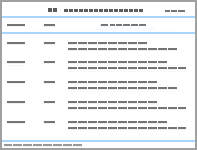
Tab.1
Complexity comparison of methods
| 方法 | 计算复杂度 |
|---|---|
| On-grid SBL | O( |
| Delay SBL | O( |
| Doppler SBL | O( |
| Off-grid SBL | O( |
| 所提方法 | O(E2NML) |

Fig.2
NMSE of OTFS channel estimation versus SNR


Fig.3
NMSE of OTFS channel estimation versus number of paths


Fig.4
NMSE of OTFS channel estimation versus the number of grids

| [1] | HADANI R, RAKIB S, TSATSANIS M, et al. Orthogonal time frequency space modulation[C]// 2017 IEEE Wireless Communications and Networking Conference. San Francisco, USA: IEEE, 2017: 1-6. |
| [2] |
MOHAMMED K S. Derivation of OTFS modulation from first principles[J]. IEEE Transactions on Vehicular Technology, 2021, 70(8): 7619-7636.
doi: 10.1109/TVT.2021.3069913 URL |
| [3] | WEI Z Q, YUAN W J, LI S Y, et al. Orthogonal time-frequency space modulation: A promising next-generation waveform[J]. IEEE Wireless Communications, 2021, 28(4): 136-144. |
| [4] |
ZHAO J W, LIU J, GAO F F, et al. Gridless compressed sensing based channel estimation for UAV wideband communications with beam squint[J]. IEEE Transactions on Vehicular Technology, 2021, 70(10): 10265-10277.
doi: 10.1109/TVT.2021.3103153 URL |
| [5] |
ZHANG C Y, ZHANG W Z, WANG W, et al. Research challenges and opportunities of UAV millimeter-wave communications[J]. IEEE Wireless Communications, 2019, 26(1): 58-62.
doi: 10.1109/MWC.2018.1800214 URL |
| [6] |
MA Y Y, MA G Y, WANG N, et al. OTFS-TSMA for massive internet of things in high-speed railway[J]. IEEE Transactions on Wireless Communications, 2022, 21(1): 519-531.
doi: 10.1109/TWC.2021.3098033 URL |
| [7] |
SRIVASTAVA S, SINGH R K, JAGANNATHAM A K, et al. Bayesian learning aided simultaneous row and group sparse channel estimation in orthogonal time frequency space modulated MIMO systems[J]. IEEE Transactions on Communications, 2022, 70(1): 635-648.
doi: 10.1109/TCOMM.2021.3123354 URL |
| [8] |
SHEN W Q, DAI L L, AN J P, et al. Channel estimation for orthogonal time frequency space (OTFS) massive MIMO[J]. IEEE Transactions on Signal Processing, 2019, 67(16): 4204-4217.
doi: 10.1109/TSP.78 URL |
| [9] |
ZHAO L, GAO W J, GUO W B. Sparse Bayesian learning of delay-Doppler channel for OTFS system[J]. IEEE Communications Letters, 2020, 24(12): 2766-2769.
doi: 10.1109/COML.4234 URL |
| [10] |
LIU Y S, ZHANG S, GAO F F, et al. Uplink-aided high mobility downlink channel estimation over massive MIMO-OTFS system[J]. IEEE Journal on Selected Areas in Communications, 2020, 38(9): 1994-2009.
doi: 10.1109/JSAC.49 URL |
| [11] |
ZHANG K C, LI Z J, YUAN W J, et al. Radar sensing via OTFS signaling[J]. China Communications, 2023, 20(9): 34-45.
doi: 10.23919/JCC.fa.2023-0060.202309 |
| [12] |
RAVITEJA P, PHAN K, HONG Y, et al. Interference cancellation and iterative detection for orthogonal time frequency space modulation[J]. IEEE Transactions on Wireless Communications, 2018, 17(10): 6501-6515.
doi: 10.1109/TWC.2018.2860011 URL |
| [13] | 蒋占军, 刘庆达. 高速移动通信系统中OTFS信道估计算法研究[J]. 电子与信息学报, 2021, 43(10): 2878-2885. |
| JIANG Zhanjun, LIU Qingda. Study on OTFS channel estimation algorithm in high-speed mobile communication system[J]. Journal of Electronics & Information Technology, 2021, 43(10): 2878-2885. | |
| [14] |
SHI D, WANG W J, YOU L, et al. Deterministic pilot design and channel estimation for downlink massive MIMO-OTFS systems in presence of the fractional Doppler[J]. IEEE Transactions on Wireless Communications, 2021, 20(11): 7151-7165.
doi: 10.1109/TWC.2021.3081164 URL |
| [15] |
HE X L, FAN P Z, WANG Q L. A two-stage channel estimation algorithm for OTFS in fractional Doppler channels[J]. IEEE Communications Letters, 2023, 27(7): 1839-1843.
doi: 10.1109/LCOMM.2023.3270296 URL |
| [16] |
LIU F, YUAN Z D, GUO Q H, et al. Message passing-based structured sparse signal recovery for estimation of OTFS channels with fractional Doppler shifts[J]. IEEE Transactions on Wireless Communications, 2021, 20(12): 7773-7785.
doi: 10.1109/TWC.2021.3087501 URL |
| [17] | WEI Z Q, YUAN W J, LIT S Y, et al. A new off-grid channel estimation method with sparse Bayesian learning for OTFS systems[C]// 2021 IEEE Global Communications Conference. Madrid, Spain: IEEE, 2021: 1-7. |
| [18] |
YANG Z, XIE L H, ZHANG C S. Off-grid direction of arrival estimation using sparse Bayesian inference[J]. IEEE Transactions on Signal Processing, 2013, 61(1): 38-43.
doi: 10.1109/TSP.2012.2222378 URL |
| [19] |
WANG Q L, LIANG Y, ZHANG Z Q, et al. 2D off-grid decomposition and SBL combination for OTFS channel estimation[J]. IEEE Transactions on Wireless Communications, 2023, 22(5): 3084-3098.
doi: 10.1109/TWC.2022.3215991 URL |
| [20] | 蒋占军, 刘庆达, 张鈜, 等. 高速移动通信系统中OTFS分数多普勒信道估计加窗研究[J]. 电子与信息学报, 2022, 44(2): 646-653. |
| JIANG Zhanjun, LIU Qingda, ZHANG Hong, et al. Study on OTFS fractional Doppler channel estimation and windowing in high-speed mobile communication systems[J]. Journal of Electronics & Information Technology, 2022, 44(2): 646-653. | |
| [21] |
WEI Z Q, YUAN W J, LI S Y, et al. Off-grid channel estimation with sparse Bayesian learning for OTFS systems[J]. IEEE Transactions on Wireless Communication, 2022, 21(9): 7407-7426.
doi: 10.1109/TWC.2022.3158616 URL |
| [22] |
李红光, 郭英, 眭萍, 等. 基于稀疏贝叶斯的多跳频信号二维波达方向估计[J]. 上海交通大学学报, 2020, 54(4): 359-368.
doi: 10.16183/j.cnki.jsjtu.2020.04.004 |
| LI Hongguang, GUO Ying, SUI Ping, et al. Two-dimensional DOA estimation for multi-hopping signals based on sparse Bayes[J]. Journal of Shanghai Jiao Tong University, 2020, 54(4): 359-368. | |
| [23] |
CAO Z, ZHOU L, DAI J S. Sparse Bayesian approach for DOD and DOA estimation with bistatic MIMO radar[J]. IEEE Access, 2019, 7: 155335-155346.
doi: 10.1109/Access.6287639 URL |
| [24] |
董祥祥, 吕润妍, 蔡云泽. 基于变分贝叶斯理论的不确定厚尾噪声滤波方法[J]. 上海交通大学学报, 2020, 54(9): 881-889.
doi: 10.16183/j.cnki.jsjtu.2020.99.014 |
| DONG Xiangxiang, LÜ Runyan, CAI Yunze. A variational Bayes-based filter with uncertain heavy-tailed noise[J]. Journal of Shanghai Jiao Tong University, 2020, 54(9): 881-889. | |
| [25] | TZIKAS D G, LIKAS A C, GALATSANOS N P. The variational approximation for Bayesian inference[J]. IEEE Signal Processing Magazine, 2008, 25(6): 131-146. |
| [26] | FRANCIS J, VEMIREDDY P R. Delay-Doppler channel estimation in OTFS systems using DoA estimation techniques[C]// 2022 IEEE 95th Vehicular Technology Conference. Helsinki, Finland: IEEE, 2022: 1-5. |
| [1] | ZHAO Ting, WANG Shentao, NIU Lin, XI Peili, CAI Yunze. Detection Algorithm of Ship Wake in SAR Images [J]. Journal of Shanghai Jiao Tong University, 2020, 54(12): 1259-1268. |
| [2] | XU Xiaoling (徐晓玲), LIU Yiling (刘沂玲), LIU Qiegen (刘且根),LU Hongyang (卢红阳), ZHANG Minghui (张明辉). Gradient-Based Low Rank Method for Highly Undersampled Magnetic Resonance Imaging Reconstruction [J]. Journal of Shanghai Jiao Tong University (Science), 2018, 23(3): 384-. |
| [3] | WANG Xing, ZHOU Yipeng, TIAN Yuanrong, CHEN You, ZHOU Dongqing, HE Jiyuan. Sparse Decomposition for Frequency Modulation Radar Signal Based on#br# Advanced Genetic Algorithm and SinChirplet Atom [J]. Journal of Shanghai Jiao Tong University, 2017, 51(9): 1124-1130. |
| [4] | L ¨U Wentao1* (吕文涛), WANG Junfeng2 (王军锋), YU Wenxian2 (郁文贤), BAO Xiaomin1 (包晓敏). Range Profile Target Recognition Using Sparse Representation Based on Feature Space [J]. Journal of shanghai Jiaotong University (Science), 2017, 22(5): 615-623. |
| [5] | BAI Caijuan1,LIU Jing1,JIANG Xiaoyu2,ZHANG Guoxian1,HUANG Kaiyu1. The Reconstruction of Digital Holography Based on Iterative De-Noising Shrinkage-Thresholding Algorithm [J]. Journal of Shanghai Jiao Tong University, 2017, 51(12): 1435-1442. |
| [6] | Ming-hui ZHANG, Xiao-yang HE, Shen-yuan DU, Qie-gen* LIU. A Generalized Two-Level Bregman Method with Dictionary Updating for Non-Convex Magnetic Resonance Imaging Reconstruction [J]. Journal of Shanghai Jiao Tong University(Science), 2015, 20(6): 660-669. |
| [7] | GUO Tianxu,CHEN Maoyin,ZHOU Donghua. A Fault Detection Method of Non-Gaussian Processes and Small Shift [J]. Journal of Shanghai Jiaotong University, 2015, 49(06): 775-779. |
| [8] | WANG Rui,DU Linfeng,CHEN Junli,WAN Wanggen. Image Fusion Based on Random Projection and Sparse Representation [J]. Journal of Shanghai Jiaotong University, 2014, 48(10): 1421-1427. |
| [9] | LUO Yasong1,XU Jianghu1,LIU Zhong1,XIAO Jinshi1,WU Shiye2. Self-Adjusting Underwater Acoustic Channel Estimation and Communication Algorithms Based on Decision Feedback Equalizer [J]. Journal of Shanghai Jiaotong University, 2014, 48(05): 685-692. |
| [10] | ZHOU Bao-long1,2* (周宝龙), JIANG Ling-ge1 (蒋铃鸽), HE Chen1 (何 晨). Robust Ergodic Rate Transmission for Time Division Duplex Beamforming Systems [J]. Journal of shanghai Jiaotong University (Science), 2013, 18(5): 535-541. |
| [11] |
ZHANG Xianyu,LIU Yulin,ZHANG Jianxin . Sparse Channel Estimation for MBOFDM System Based on Superimposed Pilots [J]. Journal of Shanghai Jiaotong University, 2010, 44(09): 1261-1265. |
| [12] | ZHANG Jing,LUO Hanwen,JIN Ronghong(. A Hybrid Particle Filter for Symbol and Carrier Frequency Synchronization in MIMO Systems [J]. Journal of Shanghai Jiaotong University, 2010, 44(02): 189-0192. |
| Viewed | ||||||
|
Full text |
|
|||||
|
Abstract |
|
|||||
