

Journal of Shanghai Jiao Tong University ›› 2026, Vol. 60 ›› Issue (2): 319-330.doi: 10.16183/j.cnki.jsjtu.2024.225
• Mechanical Engineering • Previous Articles Next Articles
TANG Jian1( ), YU Wenxiu1, ZHANG Qiuping1, JIAO Xiangdong1, DING Xuepeng2
Received:2024-06-17
Revised:2024-07-18
Accepted:2024-09-09
Online:2026-02-28
Published:2026-03-06
CLC Number:
TANG Jian, YU Wenxiu, ZHANG Qiuping, JIAO Xiangdong, DING Xuepeng. Numerical Simulation Analysis of a Novel Discharge Speed-Regulation Device for Detector in the Pipeline[J]. Journal of Shanghai Jiao Tong University, 2026, 60(2): 319-330.
Add to citation manager EndNote|Ris|BibTeX
URL: https://xuebao.sjtu.edu.cn/EN/10.16183/j.cnki.jsjtu.2024.225

Fig.1
Schematic diagram of force analysis for detector speed-regulation device


Fig.2
Simplified internal structure of discharge speed-regulation device

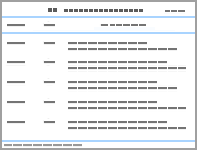
Tab.1
$\zeta_{2}$ values of the local head loss coefficient
| θ2/(°) | ζ2 |
|---|---|
| 2 | 0.03 |
| 5 | 0.04 |
| 10 | 0.08 |
| 12 | 0.10 |
| 15 | 0.16 |
| 20 | 0.31 |
| 25 | 0.40 |
| 30 | 0.49 |
| 40 | 0.60 |
| 50 | 0.67 |
| 60 | 0.72 |
Tab.2
Representation method of different radians of relief valve seat
| 泄流阀座弧度编号 | θ1/(°) | θ2/(°) |
|---|---|---|
| 1 | 30 | 40 |
| 2 | 40 | 30 |
| 3 | 50 | 25 |
| 4 | 55 | 20 |
| 5 | 60 | 15 |

Fig.3
Relationship between total head loss coefficient and radians of relief valve seat

Tab.3
Related parameters of compression spring
| 参数 | 取值 |
|---|---|
| d/mm | 0.8 |
| Dm/mm | 9 |
| D1/mm | 8.2 |
| D2/mm | 9.8 |
| H0/mm | 58 |
| Pj/N | 14.56 |
| fj/mm | 2.97 |
| k/(N·mm-1) | 0.62 |
| Fj/mm | 26.73 |

Fig.4
Schematic diagram of deformation of the drive cup seal due to gravity


Fig.5
Pressure of pipe wall on the cup seal


Fig.6
Pressure of liquid on the cup seal


Fig.7
Model of detector inside pipeline


Fig.8
Standard of mesh quality

Tab.4
Variation of physical quantities at different grid cell sizes
| 网格编号 | 网格单元 尺寸/mm | 网格数量×10-6 | 流场平均速度/ (m·s-1) |
|---|---|---|---|
| 1 | 10 | 0.636 2 | 0.748 |
| 2 | 8 | 0.799 8 | 0.667 |
| 3 | 6 | 1.128 2 | 0.554 |
| 4 | 4 | 2.036 5 | 0.458 |
| 5 | 3 | 3.336 9 | 0.427 |
| 6 | 2 | 7.441 0 | 0.416 |

Fig.9
Relationship between mean velocity of the flow field and number of meshes


Fig.10
Pressure cloud map of the relief valve seats with different radians at inlet velocity 0.6 m/s


Fig.11
Relationship between radians of relief valve seat and differential pressure


Fig.12
Turbulent cloud map of the relief valve seats with different radians at inlet velocity 0.6 m/s


Fig.13
Relationship between radians of relief valve seat and turbulent kinetic energy


Fig.14
Pressure cloud map of flow field with different distances between the relief valve core and the back end of the detector at inlet velocity 0.6 m/s


Fig.15
Relationship between different distances from the relief valve core and the back end of the detector and the pressure different at the front and back ends of discharge speed regulation device


Fig.16
Velocity cloud map of the flow field with different distances between the relief valve core and the back end of the detector at inlet velocity 0.6 m/s

Tab.5
Impact force on relief valve core
| 泄流阀芯-检测器 后端的距离/mm | Δp/Pa | S/m2 | F/N |
|---|---|---|---|
| 15 | 7 490 | 0.004 28 | 32.057 |
| 20 | 7 460 | 0.004 28 | 31.929 |
| 25 | 7 420 | 0.004 28 | 31.758 |
| 30 | 7 380 | 0.004 28 | 31.587 |
| 35 | 7 350 | 0.004 28 | 31.458 |
| [1] | 李岩松, 丁鼎倩, 韩东, 等. 起伏输油管道临界完全携积水油速数值模拟[J]. 上海交通大学学报, 2021, 55(7): 878-890. |
| LI Yansong, DING Dingqian, HAN Dong, et al. Numerical simulation of critical oil velocity required to completely remove water lump deposited in hilly oil pipelines[J]. Journal of Shanghai Jiao Tong University, 2021, 55(7): 878-890. | |
| [2] | 蔡文超, 唐岩, 石斌. 输油管道安全生产运行控制措施分析[J]. 全面腐蚀控制, 2021, 35(11): 88-90. |
| CAI Wenchao, TANG Yan, SHI Bin. Analysis of oil pipeline safety production operation control measures[J]. Total Corrosion Control, 2021, 35(11): 88-90. | |
| [3] |
MA Q, TIAN G, ZENG Y, et al. Pipeline in-line inspection method, instrumentation and data management[J]. Sensors, 2021, 21(11): 3862.
doi: 10.3390/s21113862 URL |
| [4] | 施涛, 袁锐波, 邵禹然, 等. 一种流体驱动式管道机器人的结构设计与运动分析[J]. 重庆理工大学学报(自然科学), 2023, 37(9): 322-331. |
| SHI Tao, YUAN Ruibo, SHAO Yuran, et al. The invention relates to the structure of a fluid driven pipeline robot optimization design and motion analysis[J]. Journal of Chongqing University of Technology (Natural Science), 2023, 37(9): 322-331. | |
| [5] |
MIRSHAMSI M, RAFEEYAN M. Speed control of inspection pig in gas pipelines using sliding mode control[J]. Journal of Process Control, 2019, 77: 134-140.
doi: 10.1016/j.jprocont.2019.03.001 URL |
| [6] | SAMAD K A A, NADZERI M S M, LIEW P F, et al. Simplify bypass pig speed calculation using probabilistic method[C]// SPE Asia Pacific Oil and Gas Conference and Exhibition. Bali, Indonesia: SPE, 2019: 501-509. |
| [7] |
PATRICIO R A C, BAPTISTA R M, RACHID F B D F, et al. Numerical simulation of pig motion in gas and liquid pipelines using the flux-corrected transport method[J]. Journal of Petroleum Science and Engineering, 2020, 189: 106970.
doi: 10.1016/j.petrol.2020.106970 URL |
| [8] |
FENG J, LIU J, ZHANG H. Speed control of pipeline inner detector based on interval dynamic matrix control with additional margin[J]. IEEE Transactions on Industrial Electronics, 2020, 68(12): 12657-12667.
doi: 10.1109/TIE.2020.3047061 URL |
| [9] | 唐建华, 王增国, 林晓, 等. 基于CEL方法的管道内检测器动力学数值分析[J]. 焊管, 2022, 45(1): 10-15. |
| TANG Jianhua, WANG Zengguo, LIN Xiao, et al. Numerical analysis of in-pipe detector dynamics based on CEL approach[J]. Welded Pipe, 2022, 45(1): 10-15. | |
| [10] | HENDRIX M H W, IJSSELDIJK H P, BREUGEM W P, et al. Development of speed controlled pigging for low pressure pipelines[C]// The 18th International Conference on Multiphase Production Technology. Cannes, France: OnePetro, 2017: 501-509. |
| [11] | CHAURASIYA K L, PAWAR V, BHATTACHARYA B. An innovative method and apparatus for speed control of pipe health monitoring robot during gas pipeline inspection[C]// Health Monitoring of Structural and Biological Systems XVII. Long Beach, California, USA: SPIE, 2023: 372-379. |
| [12] |
TU Q, LIU Q, JI S, et al. Speed simulation of hydraulic automatic speed-controlled pipeline inspection gauge in liquid pipelines[J]. Journal of Pressure Vessel Technology, 2020, 142(1): 011802.
doi: 10.1115/1.4045132 URL |
| [13] |
CHEN J, WANG Y, LIU H, et al. A novel study on bypass module in self-regulated pipeline inspection gauge to enhance anti-blocking capability for secure and efficient natural gas transportation[J]. Journal of Natural Gas Science and Engineering, 2022, 108: 104850.
doi: 10.1016/j.jngse.2022.104850 URL |
| [14] | 蒋新生. 工程流体力学[M]. 重庆: 重庆大学出版社, 2017. |
| JIANG Xinsheng. Engineering fluid mechanics[M]. Chongqing: Chongqing University Press, 2017. | |
| [15] | 成大先. 机械设计手册[M]. 6版. 北京: 化学工业出版社, 2017. |
| CHENG Daxian. Mechanical design manual[M]. 6th ed. Beijing: Chemical Industry Press, 2017. | |
| [16] |
ZHU X X, FU C M, WANG Y T, et al. Experimental research on the contact force of the bi-directional pig in oil and gas pipeline[J]. Petroleum Science, 2023, 20(1): 474-481.
doi: 10.1016/j.petsci.2022.08.021 URL |
| [17] | 李同林. 弹塑性力学[M]. 武汉: 中国地质大学出版社, 2015. |
| LI Tonglin. Elastic-plastic mechanics[M]. Wuhan: China University of Geosciences Press, 2015. | |
| [18] |
CHEN J, HE L, LUO X, et al. Characterization of bypass pig velocity in gas pipeline: An experimental and analytical study[J]. Journal of Natural Gas Science and Engineering, 2020, 73: 103059.
doi: 10.1016/j.jngse.2019.103059 URL |
| [19] | US-NACE. In-line inspection of pipelines: NACE SP0102-2010[S]. Houston, USA: NACE International, 2010. |
| [20] | 詹旭明. 长输原油管道内检测器速度控制技术开发[D]. 北京: 北京石油化工学院, 2015. |
| ZHAN Xuming. Development of the technology for controlling the inner detector’s velocity in long distance oil pipeline[D]. Beijing: Beijing Institute of Petrochemical Technology, 2015. |
| [1] | HE Yixiong, DAI Yonggang, ZHAO Xingya, YU Deqing, HUANG Liwen. Navigation Decision-Making Method in Estuary Deep Trough with Varying Width of Navigable Waters [J]. Journal of Shanghai Jiao Tong University, 2025, 59(4): 489-502. |
| [2] | LI Yansong, DING Dingqian, HAN Dong, LIU Jing, LIANG Yongtu. Numerical Simulation of Critical Oil Velocity Required to Completely Remove Water Lump Deposited in Hilly Oil Pipelines [J]. Journal of Shanghai Jiao Tong University, 2021, 55(7): 878-890. |
| [3] | LU Ying-chuang, ZHANG Lei, XIE Shao-jie, HUANG Yi-fei, CHENG Ji-lin, WANG Li-kun. Analysis and Application of Frequency Control Technique in Gas Compressor Skid of Offshore Oil Platform [J]. Ocean Engineering Equipment and Technology, 2018, 5(增刊): 75-79. |
| [4] | Chuanzhi HU, Jianhua SHEN, Xiaojing PENG. DC Motor Speed Control System Based on Step-limiting Incremental PID [J]. Research and Exploration in Laboratory, 2017, 36(5): 24-27. |
| [5] | BAO Wenlong,YU Yuefeng. Speed Control Modeling of Modular Screw Expander Generation System [J]. Journal of Shanghai Jiaotong University, 2016, 50(04): 521-527. |
| Viewed | ||||||
|
Full text |
|
|||||
|
Abstract |
|
|||||
