

Journal of Shanghai Jiao Tong University ›› 2025, Vol. 59 ›› Issue (11): 1625-1636.doi: 10.16183/j.cnki.jsjtu.2023.580
• New Type Power System and the Integrated Energy • Previous Articles Next Articles
ZHANG Jiamin1, CAI Ye1( ), TANG Xiafei1, TAN Yudong2, CAO Yijia1, LI Junxiong3
Received:2023-11-17
Revised:2024-02-01
Accepted:2024-03-18
Online:2025-11-28
Published:2025-12-02
Contact:
CAI Ye
E-mail:caiye@csust.edu.cn
CLC Number:
ZHANG Jiamin, CAI Ye, TANG Xiafei, TAN Yudong, CAO Yijia, LI Junxiong. Information Gap Decision Theory-Spectrum Clustering Typical Scenario Generation Considering Source Load Uncertainty[J]. Journal of Shanghai Jiao Tong University, 2025, 59(11): 1625-1636.
Add to citation manager EndNote|Ris|BibTeX
URL: https://xuebao.sjtu.edu.cn/EN/10.16183/j.cnki.jsjtu.2023.580

Fig.1
Framework of IGDT-spectrum clustering considering source load uncertainty


Fig.2
Generation process of IGDT-spectrum clustering considering source load uncertainty

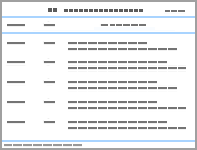
Tab.1
(2019)Unit composition of power grid system in a certain province
| 机组类型 | 机组容量/MW | 机组数量/台 | 总容量/MW |
|---|---|---|---|
| 火电机组 | 660 | 6 | 3960 |
| 600 | 13 | 7800 | |
| 300 | 20 | 6000 | |
| 抽水蓄能机组 | 300 | 4 | 1200 |
| 风电机组 | 6690 | ||
| 光伏机组 | 3906 | ||
| 水电机组 | 15806 |

Fig.3
Silhouette coefficients of different clustering numbers


Fig.4
Results of IGDT-spectral clustering

Tab.2
Seasonal distribution of each typical scenario
| 典型场景 | 对应季节 | 典型场景 | 对应季节 |
|---|---|---|---|
| 1 | 秋 | 8 | 夏 |
| 2 | 秋 | 9 | 夏 |
| 3 | 冬 | 10 | 夏 |
| 4 | 冬 | 11 | 春 |
| 5 | 冬 | 12 | 秋 |
| 6 | 春 | 13 | 春 |
| 7 | 冬 | 14 | 冬 |

Fig.5
Partial results of spectral clustering

Tab.3
Average Pearson correlation coefficient between each clustering scenario and actual scenario
| 方案 | 平均皮尔逊相关系数 | |||
|---|---|---|---|---|
| 风 | 光 | 负荷 | 综合 | |
| 1 | 0.5643 | 0.9751 | 0.9672 | 0.8355 |
| 2 | 0.7746 | 0.9838 | 0.9678 | 0.9087 |
Tab.4
Average Euclidean distance between each clustering scenario and actual scenario
| 方案 | 平均欧氏距离标幺值 | |||
|---|---|---|---|---|
| 风 | 光 | 负荷 | 综合 | |
| 1 | 0.6698 | 0.6680 | 0.1144 | 0.4841 |
| 2 | 0.4561 | 0.2402 | 0.1245 | 0.2736 |
Tab.5
Performance of different clustering methods
| 方法 | CH指标 | DB指标 | SIL |
|---|---|---|---|
| K均值 | 333.63 | 3.18 | 0.6788 |
| 谱聚类 | 480.42 | 3.03 | 0.6866 |
| IGDT-谱聚类 | 2597.45 | 2.46 | 0.6876 |
| [1] |
QIU S, LEI T, WU J T, et al. Energy demand and supply planning of China through 2060[J]. Energy, 2021, 234: 121193.
doi: 10.1016/j.energy.2021.121193 URL |
| [2] | 程奇. 弗兰克·奈特主要经济思想研究[D]. 杭州: 浙江大学, 2018. |
| CHENG Qi. A study of Frank Knight’s main economic thoughts[D]. Hangzhou: Zhejiang University, 2018. | |
| [3] | 张宁, 杜尔顺, 李晖, 等. 强不确定环境下的电力系统优化规划[M]. 北京: 中国电力出版社, 2021: 16-39. |
| ZHANG Ning, DU Ershun, LI Hui, et al. Optimal planning of power system under strong uncertainty environment[M]. Beijing: China Electric Power Press, 2021: 16-39. | |
| [4] | 李亮, 唐巍, 白牧可, 等. 考虑时序特性的多目标分布式电源选址定容规划[J]. 电力系统自动化, 2013, 37(3): 58-63. |
| LI Liang, TANG Wei, BAI Muke, et al. Multi-objective locating and sizing of distributed generators based on time-sequence characteristics[J]. Automation of Electric Power Systems, 2013, 37(3): 58-63. | |
| [5] | 丁明, 解蛟龙, 刘新宇, 等. 面向风电接纳能力评价的风资源/负荷典型场景集生成方法与应用[J]. 中国电机工程学报, 2016, 36(15): 4064-4072. |
| DING Ming, XIE Jiaolong, LIU Xinyu, et al. The generation method and application of wind resources/load typical scenario set for evaluation of wind power grid integration[J]. Proceedings of the CSEE, 2016, 36(15): 4064-4072. | |
| [6] | POULADKHAY M, MIRHOSSEINI MOGHADDAM M, SAHAB A. Market-based two-stage stochastic scheduling programming considering demand side provider and wind power penetration[J]. Iranian Journal of Science & Technology, Transactions of Electrical Engineering, 2023, 47(4): 1459-1472. |
| [7] |
BHURT F, ALI A, KEERIO M U, et al. Stochastic multi-objective optimal reactive power dispatch with the integration of wind and solar generation[J]. Energies, 2023, 16(13): 4896.
doi: 10.3390/en16134896 URL |
| [8] |
李嘉森, 王进, 杨蒙, 等. 基于随机优化的虚拟电厂热电联合经济优化调度[J]. 太阳能学报, 2023, 44(9): 57-65.
doi: 10.19912/j.0254-0096.tynxb.2022-0804 |
|
LI Jiasen, WANG Jin, YANG Meng, et al. Combined heat and power economic optimal dispatching in virtual power plant based on stochastic optimization[J]. Acta Energiae Solaris Sinica, 2023, 44(9): 57-65.
doi: 10.19912/j.0254-0096.tynxb.2022-0804 |
|
| [9] |
ZHANG W G, HE X L. A new scenario reduction method based on higher-order moments[J]. INFORMS Journal on Computing, 2022, 34(4): 1903-1918.
doi: 10.1287/ijoc.2021.1155 URL |
| [10] | 赵源上, 林伟芳. 基于皮尔逊相关系数融合密度峰值和熵权法典型场景研究[J]. 中国电力, 2023, 56(5): 193-202. |
| ZHAO Yuanshang, LIN Weifang. Research on typical scenarios based on fusion density peak value and entropy weight method of Pearson’s correlation coefficient[J]. Electric Power, 2023, 56(5): 193-202. | |
| [11] |
KRISHNA A B, ABHYANKAR A R. Time-coupled day-ahead wind power scenario generation: A combined regular vine copula and variance reduction method[J]. Energy, 2023, 265: 126173.
doi: 10.1016/j.energy.2022.126173 URL |
| [12] | 赵岳恒, 刘民伟, 王文飞, 等. 采用谱聚类的风电典型出力场景选取方法[J]. 云南电力技术, 2020, 48(1): 17-20. |
| ZHAO Yueheng, LIU Minwei, WANG Wenfei, et al. Generation of typical wind power scenario based on spectral clustering method[J]. Yunnan Electric Power, 2020, 48(1): 17-20. | |
| [13] |
LIU Y X, SIOSHANSI R, CONEJO A J. Hierarchical clustering to find representative operating periods for capacity-expansion modeling[J]. IEEE Transactions on Power Systems, 2018, 33(3): 3029-3039.
doi: 10.1109/TPWRS.2017.2746379 URL |
| [14] |
PINEDA S, MORALES J M. Chronological time-period clustering for optimal capacity expansion planning with storage[J]. IEEE Transactions on Power Systems, 2018, 33(6): 7162-7170.
doi: 10.1109/TPWRS.2018.2842093 URL |
| [15] | 鲁思棋. 考虑场景聚类的分布式光伏布点规划研究[D]. 北京: 北京交通大学, 2018. |
| LU Siqi. Location andsize planning of distributed photovoltaic generations considering scene clustering[D]. Beijing: Beijing Jiaotong University, 2018. | |
| [16] |
GAO S P, HU B, XIE K G, et al. Spectral clustering based demand-oriented representative days selection method for power system expansion planning[J]. International Journal of Electrical Power & Energy Systems, 2021, 125: 106560.
doi: 10.1016/j.ijepes.2020.106560 URL |
| [17] |
AN Y, ZENG B. Exploring the modeling capacity of two-stage robust optimization: Variants of robust unit commitment model[J]. IEEE Transactions on Power Systems, 2015, 30(1): 109-122.
doi: 10.1109/TPWRS.2014.2320880 URL |
| [18] |
YANG X H, CHEN Z X, HUANG X, et al. Robust capacity optimization methods for integrated energy systems considering demand response and thermal comfort[J]. Energy, 2021, 221: 119727.
doi: 10.1016/j.energy.2020.119727 URL |
| [19] |
AL-AWAMI A T, AMLEH N A, MUQBEL A M. Optimal demand response bidding and pricing mechanism with fuzzy optimization: Application for a virtual power plant[J]. IEEE Transactions on Industry Applications, 2017, 53(5): 5051-5061.
doi: 10.1109/TIA.2017.2723338 URL |
| [20] | 赵冬梅, 殷加玞. 考虑源荷双侧不确定性的模糊随机机会约束优先目标规划调度模型[J]. 电工技术学报, 2018, 33(5): 1076-1085. |
| ZHAO Dongmei, YIN Jiafu. Fuzzy random chance constrained preemptive goal programming scheduling model considering source-side and load-side uncertainty[J]. Transactions of China Electrotechnical Society, 2018, 33(5): 1076-1085. | |
| [21] |
LI K, YANG F, WANG L P, et al. A scenario-based two-stage stochastic optimization approach for multi-energy microgrids[J]. Applied Energy, 2022, 322: 119388.
doi: 10.1016/j.apenergy.2022.119388 URL |
| [22] | GUO M H, WANG W, CHEN R H, et al. Research on bi-level model power dispatch considering the uncertainty of source and load[J]. Sustainable Energy Technologies & Assessments, 2022, 53: 102689. |
| [23] |
潘昭旭, 刘三明, 王致杰, 等. 基于信息间隙决策理论的含风电电力系统调度[J]. 电力建设, 2018, 39(9): 87-94.
doi: 10.3969/j.issn.1000-7229.2018.09.011 |
|
PAN Zhaoxu, LIU Sanming, WANG Zhijie, et al. Dispatch based on information gap decision theory for power system with wind power[J]. Electric Power Construction, 2018, 39(9): 87-94.
doi: 10.3969/j.issn.1000-7229.2018.09.011 |
|
| [24] | BEN-HAIM Y. Info-gap decision theory: Decisions under severe uncertainty[M]. San Diego, USA: Academic Press, 2001. |
| [25] |
CAO X Y, WANG J X, ZENG B. A chance constrained information-gap decision model for multi-period microgrid planning[J]. IEEE Transactions on Power Systems, 2018, 33(3): 2684-2695.
doi: 10.1109/TPWRS.2017.2747625 URL |
| [26] |
MAVALIZADEH H, AHMADI A, GANDOMAN F H, et al. Multiobjective robust power system expansion planning considering generation units retirement[J]. IEEE Systems Journal, 2018, 12(3): 2664-2675.
doi: 10.1109/JSYST.4267003 URL |
| [27] | 赵琛, 张少华. 基于信息间隙决策理论的发电商电量分配策略[J]. 控制与决策, 2017, 32(4): 751-754. |
| ZHAO Chen, ZHANG Shaohua. Generation asset allocation strategies based on IGDT[J]. Control & Decision, 2017, 32(4): 751-754. | |
| [28] |
ZARE K, MOGHADDAM M P, SHEIKH EL ESLAMI M K. Demand bidding construction for a large consumer through a hybrid IGDT-probability methodology[J]. Energy, 2010, 35(7): 2999-3007.
doi: 10.1016/j.energy.2010.03.036 URL |
| [29] |
DOLATABADI A, JADIDBONAB M, MOHAMMADI-IVATLOO B. Short-term scheduling strategy for wind-based energy hub: A hybrid stochastic/IGDT approach[J]. IEEE Transactions on Sustainable Energy, 2019, 10(1): 438-448.
doi: 10.1109/TSTE.2017.2788086 URL |
| [30] | 汪超群, 韦化, 吴思缘. 基于信息间隙决策理论的多源联合优化机组组合[J]. 中国电机工程学报, 2018, 38(12): 3431-3440. |
| WANG Chaoqun, WEI Hua, WU Siyuan. Multi-power combined unit commitment based on information gap decision theory[J]. Proceedings of the CSEE, 2018, 38(12): 3431-3440. | |
| [31] | 叶鹤林, 刘松, 胡剑, 等. 基于IGDT的含光热电站电力系统多源联合调度策略[J]. 电力系统保护与控制, 2021, 49(23): 35-43. |
| YE Helin, LIU Song, HU Jian, et al. Multi-source joint dispatching strategy for a power system with concentrating solar power plants based on IGDT[J]. Power System Protection & Control, 2021, 49(23): 35-43. | |
| [32] | 颜宇飞, 唐早, 刘友波, 等. 双重不确定性下考虑风险偏好的风储系统日前报量策略[J]. 电网技术, 2023, 47(3): 1078-1087. |
| YAN Yufei, TANG Zao, LIU Youbo, et al. Day-ahead bidding strategy of combined wind storage system considering risk preference under dual uncertainties[J]. Power System Technology, 2023, 47(3): 1078-1087. | |
| [33] | DAVIES D L, BOULDIN D W. A cluster separation measure[J]. IEEE Transactions on Pattern Analysis & Machine Intelligence, 1979, 1(2): 224-227. |
| [34] |
KIM M, RAMAKRISHNA R S. New indices for cluster validity assessment[J]. Pattern Recognition Letters, 2005, 26(15): 2353-2363.
doi: 10.1016/j.patrec.2005.04.007 URL |
| [1] | ZHU Feng, SHAN Chao, WU Ning, CAI Qixin, ZHU Yunan, LIU Yunpeng, ZUO Qiang. Feature Extraction and Anomaly Identification Method for Power Customer Price in Power Market Enviroment [J]. Journal of Shanghai Jiao Tong University, 2025, 59(7): 995-1006. |
| [2] | SUN Yi, LIU Zhuang, HUANG Ting, PENG Jie, WANG Xiaotian, LIU Chuang. Decision-Making Model of Electricity Procurement and Sale for Electricity Retailers Considering the Uncertainty of Prosumers [J]. Journal of Shanghai Jiao Tong University, 2025, 59(10): 1476-1486. |
| Viewed | ||||||
|
Full text |
|
|||||
|
Abstract |
|
|||||
