

上海交通大学学报 ›› 2026, Vol. 60 ›› Issue (2): 277-288.doi: 10.16183/j.cnki.jsjtu.2024.094
郭子腾1, 王晗1, 王富文2, 曹云峰1, 张建文1, 蔡旭1( )
)
收稿日期:2024-03-21
修回日期:2024-07-25
接受日期:2024-09-23
出版日期:2026-02-28
发布日期:2026-03-06
通讯作者:
蔡旭
E-mail:xucai@sjtu.edu.cn.
作者简介:郭子腾(2001—),博士生,从事新能源电力变换与并网技术研究.
基金资助:
GUO Ziteng1, WANG Han1, WANG Fuwen2, CAO Yunfeng1, ZHANG Jianwen1, CAI Xu1()
Received:2024-03-21
Revised:2024-07-25
Accepted:2024-09-23
Online:2026-02-28
Published:2026-03-06
Contact:
CAI Xu
E-mail:xucai@sjtu.edu.cn.
摘要:
新能源发电单元构网的主流方案之一是脉冲宽度调制(PWM)变换器做惯性同步控制,但现有研究重点关注逆变器状态下的变换器控制特性,忽略了其四象限控制特性及系统控制参数设计方法.针对上述问题,首先,构建考虑预同步环节的惯性同步控制变换器线性模型,推导直流电压-相角及无功功率-电压的频域解析表达式.然后,设计直流电压环路和无功功率环路的关键控制参数设计方法.最后,利用仿真和实验验证所提方法可行性,分析变换器的四象限控制特性及惯量支撑能力.结果表明:惯性同步控制变换器的直流电压环路与无功功率环路在四象限运行区间内强耦合,致使直流电压扰动引发无功功率显著波动;尽管其具备惯量支撑能力,但由于直流电容惯量较小,所以效果尚不明显.研究结果为下一步开展直流电压-无功解耦控制及惯量支撑能力增强控制方法研究奠定基础.
中图分类号:
郭子腾, 王晗, 王富文, 曹云峰, 张建文, 蔡旭. 惯性同步控制三相PWM变换器的四象限控制特性分析及参数设计[J]. 上海交通大学学报, 2026, 60(2): 277-288.
GUO Ziteng, WANG Han, WANG Fuwen, CAO Yunfeng, ZHANG Jianwen, CAI Xu. Analysis of Four-Quadrant Control Characteristics and Parameter Design of Inertia Synchronized Three-Phase PWM Converter[J]. Journal of Shanghai Jiao Tong University, 2026, 60(2): 277-288.

图1
惯性同步控制策略结构


图2
考虑预同步的惯性同步控制策略


图3
简化后的PWM变换器电路


图4
直流电压环控制回路


图5
无功功率环控制回路


图6
不同控制参数下直流电压环的控制特性


图7
不同控制参数下无功功率环的控制特性


图8
相位裕度的取值范围

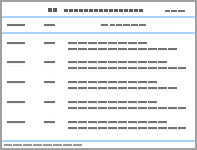
表1
PWM变换器的电气及控制参数
| 参数 | 取值 | 参数 | 取值 |
|---|---|---|---|
| UDC/V | 30 | C/μF | 8×330 |
| Ug/V | 11.5 | 电网频率,f/Hz | 50 |
| SB/W | 22.5 | Kpss | 1 |
| 开关频率,fsw/kHz | 10 | Kpq | 0.0488 |
| Td/μs | 2 | Kiq | 1.3329 |
| X/Ω | 0.346 | KpDC | 0.1013 |
| R/Ω | 0.315 | KiDC | 0.5748 |

图9
无功功率改变时的仿真波形


图10
直流电压改变时的仿真波形


图11
三相PWM变换器实验平台


图12
不同控制参数下直流电压阶跃扰动的实验结果


图13
不同控制参数下无功功率阶跃扰动的实验结果


图14
无功功率改变的实验波形


图15
直流电压改变的实验波形


图16
电网频率变化时的实验波形

| [1] | 徐晓娜, 王奎, 郑泽东, 等. 三相PWM变换器的共模电压抑制方法综述[J]. 中国电机工程学报, 2023, 43(22): 8833-8850. |
| XU Xiaona, WANG Kui, ZHENG Zedong, et al. A review on common-mode voltage reduction methods for three-phase PWM converters[J]. Proceedings of the CSEE, 2023, 43(22): 8833-8850. | |
| [2] | 王晗, 张建文, 蔡旭. 一种PWM整流器动态性能改进控制策略[J]. 中国电机工程学报, 2012, 32 (Sup.1): 194-202. |
| WANG Han, ZHANG Jianwen, CAI Xu. An improved control method of the dynamic ability for PWM rectifier[J]. Proceedings of the CSEE, 2012, 32 (Sup.1): 194-202. | |
| [3] | HUANG X J, CHANG D W, ZHENG T Q. Investigation of the RC-IGBT application in high speed railway converters[C]// 2017 IEEE Energy Conversion Congress and Exposition. Cincinnati, USA: IEEE, 2017: 2062-2067. |
| [4] |
CHEN X R, RUAN X B, YANG D S, et al. Injected grid current quality improvement for a voltage-controlled grid-connected inverter[J]. IEEE Transactions on Power Electronics, 2018, 33(2): 1247-1258.
doi: 10.1109/TPEL.2017.2678525 URL |
| [5] | 余光正, 胡越, 刘晨曦, 等. 含跟网/构网型混联多馈入系统协调优化配置方法[J]. 中国电机工程学报, 2025, 45(2): 588-601. |
| YU Guangzheng, HU Yue, LIU Chenxi, et al. Research on the coordinated optimization configuration method for hybrid multi-infeed systems with grid-following or grid-forming[J]. Proceedings of the CSEE, 2025, 45(2): 588-601. | |
| [6] | 迟永宁, 江炳蔚, 胡家兵, 等. 构网型变流器: 物理本质与特征[J]. 高电压技术, 2024, 50(2): 590-604. |
| CHI Yongning, JIANG Bingwei, HU Jiabing, et al. Grid-forming converters: Physical mechanism and characteristics[J]. High Voltage Engineering, 2024, 50(2): 590-604. | |
| [7] | 宗皓翔, 张琛, 鲍颜红, 等. 跟网型与构网型并网变换器系统的频域建模与同步视角交互稳定机理[J]. 上海交通大学学报, 2025, 59(2): 151-164. |
| ZONG Haoxiang, ZHANG Chen, BAO Yanhong, et al. Frequency-domain modeling and synchronization perspective interaction mechanism of GFL-GFM converter system[J]. Journal of Shanghai Jiao Tong University, 2025, 59(2): 151-164. | |
| [8] |
ROCABERT J, LUNA A, BLAABJERG F, et al. Control of power converters in AC microgrids[J]. IEEE Transactions on Power Electronics, 2012, 27(11): 4734-4749.
doi: 10.1109/TPEL.2012.2199334 URL |
| [9] |
XU J M, QIAN Q, ZHANG B F, et al. Harmonics and stability analysis of single-phase grid-connected inverters in distributed power generation systems considering phase-locked loop impact[J]. IEEE Transactions on Sustainable Energy, 2019, 10(3): 1470-1480.
doi: 10.1109/TSTE.5165391 URL |
| [10] |
RATHNAYAKE D B, AKRAMI M, PHURAILATPAM C, et al. Grid forming inverter modeling, control, and applications[J]. IEEE Access, 2021, 9: 114781-114807.
doi: 10.1109/ACCESS.2021.3104617 URL |
| [11] |
ZHANG L D, HARNEFORS L, NEE H P. Power-synchronization control of grid-connected voltage-source converters[J]. IEEE Transactions on Power Systems, 2010, 25(2): 809-820.
doi: 10.1109/TPWRS.2009.2032231 URL |
| [12] | 张兴, 李明, 郭梓暄, 等. 新能源并网逆变器控制策略研究综述与展望[J]. 全球能源互联网, 2021, 4(5): 506-515. |
| ZHANG Xing, LI Ming, GUO Zixuan, et al. Review and perspectives on control strategies for renewable energy grid-connected inverters[J]. Journal of Global Energy Interconnection, 2021, 4(5): 506-515. | |
| [13] | 蔡旭, 秦垚, 王晗, 等. 风电机组的自同步电压源控制研究综述[J]. 高电压技术, 2023, 49(6): 2478-2490. |
| CAI Xu, QIN Yao, WANG Han, et al. Review of self-synchronous voltage source control for wind turbine generator[J]. High Voltage Engineering, 2023, 49(6): 2478-2490. | |
| [14] | 张琛, 蔡旭, 李征. 具有自主电网同步与弱网稳定运行能力的双馈风电机组控制方法[J]. 中国电机工程学报, 2017, 37(2): 476-486. |
| ZHANG Chen, CAI Xu, LI Zheng. Control of DFIG-based wind turbines with the capability of automatic grid-synchronization and stable operation under weak grid condition[J]. Proceedings of the CSEE, 2017, 37(2): 476-486. | |
| [15] | DENG Z Y, WANG H, QIN Y, et al. An optimal short-circuit current control method for self-synchronization controlled wind turbines[C]// 2022 IEEE Transportation Electrification Conference and Expo, Asia-Pacific. Haining, China: IEEE, 2022: 1-6. |
| [16] |
SANG S, ZHANG C, CAI X, et al. Control of a type-IV wind turbine with the capability of robust grid-synchronization and inertial response for weak grid stable operation[J]. IEEE Access, 2019, 7: 58553-58569.
doi: 10.1109/Access.6287639 URL |
| [17] |
QIN Y, WANG H, DENG Z Y, et al. Control of inertia-synchronization controlled wind turbine generators under symmetrical grid faults[J]. IEEE Transactions on Energy Conversion, 2023, 38(2): 1085-1096.
doi: 10.1109/TEC.2022.3213874 URL |
| [18] | LIU Y H, CAI S L, PENG Y, et al. Coordinated control strategy with inertia of grid-forming two-stage energy storage converters[C]// 2020 IEEE Applied Power Electronics Conference and Exposition. New Orleans, USA: IEEE, 2020: 2358-2361. |
| [19] | 秦垚, 王晗, 杨志千, 等. 全功率变换风电机组的电压源控制(二)[J]. 中国电机工程学报, 2023, 43(2): 530-5436. |
| QIN Yao, WANG Han, YANG Zhiqian, et al. Voltage source control of wind turbine generators with full-scale converters (part II): Control and protection of grid fault ride-through[J]. Proceedings of the CSEE, 2023, 43(2): 530-543. | |
| [20] | 桑顺, 张琛, 蔡旭, 等. 全功率变换风电机组的电压源控制(一): 控制架构与弱电网运行稳定性分析[J]. 中国电机工程学报, 2021, 41(16): 5604-5616. |
| SANG Shun, ZHANG Chen, CAI Xu, et al. Voltage source control of wind turbines with full-scale converters(part Ⅰ): Control architecture and stability analysis under weak grid conditions[J]. Proceedings of the CSEE, 2021, 41(16): 5604-5616. |
| [1] | 姜 坤, 蔡青青, 李孙伟. 平台内TMD对新型Barge浮式风机振动抑制的研究[J]. 海洋工程装备与技术, 2023, 10(4): 122-129. |
| [2] | 杨路春, 杨晨俊, 汪志强, 李学斌. 基于分解的进化算法和多变量分析技术在船型参数设计中应用[J]. 上海交通大学学报, 2016, 50(8): 1200-1206. |
| [3] | 黄彬1, 邰能灵1, 傅晓红2, 王鹏2, 倪明杰2, 卫卫2. 基于混合滤波器的大型船舶电力系统谐波抑制分析[J]. 上海交通大学学报(自然版), 2011, 45(06): 787-792. |
| 阅读次数 | ||||||
|
全文 |
|
|||||
|
摘要 |
|
|||||
