

上海交通大学学报 ›› 2026, Vol. 60 ›› Issue (3): 364-376.doi: 10.16183/j.cnki.jsjtu.2024.251
京炅琳, 许玉旺( ), 杨舟, 宋斌, 张萌萌, 任浩杰
收稿日期:2024-06-28
修回日期:2024-08-07
接受日期:2024-08-26
出版日期:2026-03-28
发布日期:2026-03-30
通讯作者:
许玉旺,副教授,博士生导师;E-mail:作者简介:京炅琳(2000—),硕士生,从事浮式风力机动力响应研究.
基金资助:
JING Jionglin, XU Yuwang(), YANG Zhou, SONG Bin, ZHANG Mengmeng, REN Haojie
Received:2024-06-28
Revised:2024-08-07
Accepted:2024-08-26
Online:2026-03-28
Published:2026-03-30
摘要:
风浪流联合作用下浮式风力机动力响应时域计算方法已经得到较为充分的研究和发展,但是计算效率相对较低,在浮式风电场机组排布优化以及浮式风力机和系泊系统初步设计方案优化中应用时需要巨大计算资源,因此本文聚焦于可实现浮式风力机动力响应快速计算的频域分析方法,同时考虑一阶和二阶波浪载荷、风轮脉动风载荷、细长杆件黏性载荷、系泊系统以及风力机变桨控制策略等多种环境载荷因素.首先,针对风力机额定以下作业、变桨作业以及停机等不同工况,将频域方法计算结果与OrcaFlex软件时域预报结果进行了对比分析,二者在动态响应频谱及统计值方面都有较好的一致性,验证了本文频域分析方法的适用性及准确性,为浮式风力机的初步设计及参数敏感性分析提供可靠的参考价值;进一步,基于该频域方法,研究了风浪参数、二阶波浪力以及是否考虑风力机控制策略对浮式风力机动力响应特性的影响.
中图分类号:
京炅琳, 许玉旺, 杨舟, 宋斌, 张萌萌, 任浩杰. 基于频域方法的漂浮式风力机水动力-气动力-控制耦合动力响应特性研究[J]. 上海交通大学学报, 2026, 60(3): 364-376.
JING Jionglin, XU Yuwang, YANG Zhou, SONG Bin, ZHANG Mengmeng, REN Haojie. Coupled Hydro-Aero-Servo Dynamic Response Analysis of Floating Wind Turbines Based on Frequency-Domain Method[J]. Journal of Shanghai Jiao Tong University, 2026, 60(3): 364-376.

图1
频域计算程序流程图


图2
OC4-Hywind型浮式风力机数值模型

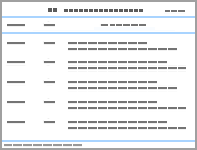
表1
风力机参数
| 参数 | 设计值 | 参数 | 设计值 |
|---|---|---|---|
| 功率/MW | 5 | 悬垂/m,仰角/(°),锥角/(°) | 5,5,2.5 |
| 机型 | 三叶片迎风式 | 齿轮箱减速比 | 97: 1 |
| 叶片直径/m,轮毂直径/m | 126,3 | 切入,额定,切出风速/(m·s-1) | 3,11.4,25 |
| 轮毂高度/m | 90 | 叶片质量/kg | 110 000 |
| 塔架高度/m | 87.6 | 机舱质量/kg | 240 000 |
| 塔架底端直径/m | 6 | 塔筒质量/kg | 347 460 |
| 塔架顶端直径/m | 3.87 | 风轮额定推力/kN | 712.4 |
表2
浮式平台参数
| 参数 | 设计值 | 参数 | 设计值 |
|---|---|---|---|
| 平台吃水/m | 20 | 斜撑直径/m | 1.6 |
| 中浮筒直径/m | 6.5 | 侧浮筒中心距/m | 50 |
| 中浮筒高度/m | 32 | 平台总质量/kg | 1.347 3×10⁷ |
| 侧底部浮筒直径/m | 24 | 平台质心高度/m | -13.46 |
| 侧底部浮筒高度/m | 6 | 横摇转动惯量/(kg·m2) | 6.827×10⁹ |
| 侧上部浮筒直径/m | 12 | 纵摇转动惯量/(kg·m2) | 6.827×10⁹ |
| 侧上部浮筒高度/m | 26 | 艏摇转动惯量/(kg·m2) | 1.226×10⁷ |

图3
OC4-Hywind浮式风力机系泊方案

表3
验证工况环境参数
| 工况号 | 工况 | Hs/m | Tp/s | v/(m·s-1) | 浮式风力机状态 |
|---|---|---|---|---|---|
| C1 | 额定海况无风 | 1.86 | 8.98 | — | 停机 |
| C2 | 风浪同向 | 1.86 | 8.98 | 16 | 运行、不变桨 |
| C3 | 风浪同向 | 1.86 | 8.98 | 16 | 运行、变桨 |
| C4 | 停机 | 7.3 | 12 | 46.2 | 停机、顺桨 |

图4
波浪谱及湍流风谱示例


图5
C1工况下浮式风力机运动响应功率谱密度


图6
C2工况下浮式风力机运动响应功率谱密度


图7
C3工况下浮式风力机运动响应功率谱密度


图8
C4工况下浮式风力机运动响应功率谱密度

表4
运动响应平均值对比
| 工况 号 | 纵荡/m | 垂荡/m | 纵摇/(°) | |||||
|---|---|---|---|---|---|---|---|---|
| 频域 | 时域 | 频域 | 时域 | 频域 | 时域 | |||
| C1 | 0.22 | 0.24 | -0.06 | -0.06 | 0.01 | 0.01 | ||
| C2 | 5.06 | 5.30 | -0.08 | -0.09 | 1.84 | 2.05 | ||
| C3 | 5.11 | 6.17 | -0.08 | -0.09 | 1.87 | 2.06 | ||
| C4 | 1.42 | 1.44 | -0.06 | -0.06 | 0.01 | 0.01 | ||
表5
运动响应标准差对比
| 工况 号 | 纵荡/m | 垂荡/m | 纵摇/(°) | |||||
|---|---|---|---|---|---|---|---|---|
| 频域 | 时域 | 频域 | 时域 | 频域 | 时域 | |||
| C1 | 0.301 | 0.337 | 0.060 0 | 0.057 8 | 0.130 | 0.122 | ||
| C2 | 6.27 | 6.55 | 0.060 5 | 0.063 7 | 1.39 | 1.88 | ||
| C3 | 2.89 | 3.16 | 0.060 1 | 0.060 3 | 1.14 | 1.43 | ||
| C4 | 1.91 | 1.80 | 0.469 | 0.448 | 5.91 | 5.44 | ||

图9
各工况锚链#2张力功率谱密度

表6
锚链#2张力均值及标准差对比
| 工况 号 | 张力均值/MN | 张力标准差/MN | |||
|---|---|---|---|---|---|
| 频域 | 时域 | 频域 | 时域 | ||
| C1 | 1.16 | 1.11 | 0.014 | 0.015 | |
| C2 | 1.43 | 1.49 | 0.403 | 0.488 | |
| C3 | 1.39 | 1.46 | 0.186 | 0.232 | |
| C4 | 1.22 | 1.16 | 0.101 | 0.092 | |

图10
不同波高和周期组合下浮式风力机动力响应标准差对比图


图11
C4工况下时域及频域二阶力对比


图12
C4工况下有无二阶力影响对比


图13
风力机变桨及桨矩控制影响对比

| [1] | WILLIAMS R, ZHAO F. Global offshore wind report 2023[DB/OL]. (2023-08-23)[2024-06-20]. https://gwec.net/gwecs-global-offshore-wind-report-2023. |
| [2] | 张洪建, 蔡新, 许波峰. 浮式风机半潜式平台动力响应研究[J]. 可再生能源, 2021, 39(9): 1210-1216. |
| ZHANG Hongjian, CAI Xin, XU Bofeng. Study on dynamic response of floating wind turbine semi-submersible platform[J]. Renewable Energy Resources, 2021, 39(9): 1210-1216. | |
| [3] | JONKMAN J M. Dynamics modeling and loads analysis of an offshore floating wind turbine[M]. Boulder, USA: University of Colorado at Boulder, 2007. |
| [4] |
KARIMIRAD M, MOAN T. Wave- and wind-induced dynamic response of a Spar-type offshore wind turbine[J]. Journal of Waterway, Port, Coastal, and Ocean Engineering, 2012, 138(1): 9-20.
doi: 10.1061/(ASCE)WW.1943-5460.0000087 URL |
| [5] | MASCIOLA M, ROBERTSON A, JONKMAN J, et al. Investigation of a FAST-OrcaFlex coupling module for integrating turbine and mooring dynamics of offshore floating wind turbines[M]. Golden, CO, USA: National Renewable Energy Lab (NREL), 2011. |
| [6] |
TIAN X L, XIAO J R, LIU H X, et al. A novel dynamics analysis method for Spar-type floating offshore wind turbine[J]. China Ocean Engineering, 2020, 34: 99-109.
doi: 10.1007/s13344-020-0010-z |
| [7] |
SHEN X, HU P, CHEN J, et al. The unsteady ae-rodynamics of floating wind turbine under platform pitch motion[J]. Proceedings of the Institution of Mechanical Engineers, Part A: Journal of Power and Energy, 2018, 232(8): 1019-1036.
doi: 10.1177/0957650918766606 URL |
| [8] | 闫发锁, 门骥远, 彭成. 深水SPAR风机系统全耦合动力响应分析研究[J]. 船舶力学, 2017, 21(2): 159-167. |
| YAN Fasuo, MEN Jiyuan, PENG Cheng. Study on full coupling dynamic responses of a deepwater SPAR wind turbine system[J]. Ship Mechanics, 2017, 21(2): 159-167. | |
| [9] |
CHEN J, HU Z, LIU G, et al. Coupled aero-hydro-servo-elastic methods for floating wind turbines[J]. Renewable Energy, 2019, 130(1): 139-153.
doi: 10.1016/j.renene.2018.06.060 URL |
| [10] |
CHENG P, HUANG Y, WAN D. A numerical model for fully coupled aero-hydrodynamic analysis of floating offshore wind turbine[J]. Ocean Engineering, 2019, 173: 183-196.
doi: 10.1016/j.oceaneng.2018.12.021 URL |
| [11] | 周盛涛. 基于快速动力响应分析的半潜式风机下部结构主尺寸优化[D]. 哈尔滨: 哈尔滨工业大学, 2021. |
| ZHOU Shengtao. Substructure optimization of semi-submersible floating wind turbines based on quick dynamic analysis[D]. Harbin: Harbin Institute of Technology, 2021. | |
| [12] |
HEGSETH J M, BACHYNSKI E E. A semi-analytical frequency domain model for efficient design evaluation of spar floating wind turbines[J]. Marine Structures, 2019, 64: 186-210.
doi: 10.1016/j.marstruc.2018.10.015 URL |
| [13] | VAN ENGELEN T, BRAAM H. TURBU offshore, computer program for frequency domain analysis of horizontal axis offshore wind turbines[M]. Sittard, Netherlands: Energy Research Centre of the Netherlands, 2004. |
| [14] | LUPTON R. Frequency-domain modelling of floating wind turbines[D]. Cambridge, UK: University of Cambridge, 2015. |
| [15] |
PEGALAJAR-JURADO A, BORG M, BREDMOSE H. An efficient frequency-domain model for quick load analysis of floating offshore wind turbines[J]. Wind Energy Science, 2018, 3(2): 693-712.
doi: 10.5194/wes-3-693-2018 URL |
| [16] | HALL M, HOUSNER S, ZALKIND D, et al. An open-source frequency-domain model for floating wind turbine design optimization[C]// Proceedings of the Journal of Physics: Conference Series. Denver, USA: IOP Publishing, 2022. |
| [17] | 朱仁传. 船舶在波浪上的运动理论[M]. 上海: 上海交通大学出版社, 2019. |
| ZHU Renchuan. The theory of ship motion in waves[M]. Shanghai: Shanghai Jiao Tong University Press, 2019. | |
| [18] | 王树青, 梁丙臣. 海洋工程波浪力学[M]. 青岛: 中国海洋大学出版社, 2013. |
| WANG Shuqing, LIANG Bingchen. Wave mechanics for ocean engineering[M]. Qingdao: China Ocean University Press, 2013. | |
| [19] |
NEWMAN J N. The drift force and moment on ships in waves[J]. Journal of Ship Research, 1967, 11(1): 51-60.
doi: 10.5957/jsr.1967.11.1.51 URL |
| [20] | NEWMAN J N. Second-order slowly varying forces on vessels in irregular waves[C]// Proceedings of the International Symposium on Dynamics of Marine Vehicles and Structures in Waves. London, UK: IOP Publishing, 1974. |
| [21] | SOUZA C E S, HEGSETH J M, BACHYNSKI E E. Frequency-dependent aerodynamic damping and inertia in linearized dynamic analysis of floating wind turbines[C]// Proceedings of the Journal of Physics: Conference Series. Denver, USA: IOP Publishing, 2020. |
| [22] | ABBAS N, ZALKIND D, PAO L, et al. A reference open-source controller for fixed and floating offshore wind turbines[J]. Wind Energy Science Discussions, 2022, 7: 53-73. |
| [23] | BORGMAN L E. Random hydrodynamic forces on objects[J]. The Annals of Mathematical Statistics, 1967: 37-51. |
| [24] | JONKMAN J, BUTTERFIELD S, MUSIAL W, et al. Definition of a 5-MW reference wind turbine for offshore system development[M]. Golden, CO, USA: National Renewable Energy Lab (NREL), 2009. |
| [25] | ROBERTSON A, JONKMAN J, MASCIOLA M, et al. Definition of the semisubmersible floating system for phase II of OC4[M]. Golden, CO, USA: National Renewable Energy Lab (NREL), 2014. |
| [26] | 刘志成. 新型半潜式海上风机基础水动力性能分析[D]. 哈尔滨: 哈尔滨工程大学, 2023. |
| LIU Zhicheng. Hydrodynamic performance analysis of a new semi-submersible foundation for offshore wind turbine[D]. Harbin: Harbin Engineering University, 2023. | |
| [27] | IEC. IEC 61400-1. Wind turbines—Part 1: Design requirements[M]. London, UK: International Electrotechnical Commission, 2005. |
| [28] |
陈嘉豪, 胡志强. 半潜式海上浮式风机气动阻尼特性研究[J]. 力学学报, 2019, 51(4): 1255-1265.
doi: 10.6052/0459-1879-18-148 |
|
CHEN Jiahao, HU Zhiqiang. Study on areodynamic damping of semi-submersible floating wind turbines[J]. Chinese Journal of Theoretical and Applied Mechanics, 2019, 51(4): 1255-1265.
doi: 10.6052/0459-1879-18-148 |
|
| [29] | DENG L, HUANG M X, XIAO Z Y, et al. Analysis on frequency response of floating wind turbine considering the influence of aerodynamic damping[J]. Journal of Hunan University (Natural Sciences), 2017, 44(1): 1-8. |
| [1] | 万志朋, 崔林, 郑东生. 波流作用下海床振荡与累积响应的半动态耦合模型[J]. 上海交通大学学报, 2026, 60(1): 142-153. |
| [2] | 贾志超, 刘明月, 郭琳. 内流作用下悬臂取水管动力响应特性研究[J]. 海洋工程装备与技术, 2026, 13(1): 46-57. |
| [3] | 祝怡情, 吴锋, 周岱, 韩兆龙, 卓杨, 朱宏博, 张凯. 海洋风电场尾流荷载作用下水平轴风力机结构动力响应[J]. 上海交通大学学报, 2025, 59(8): 1081-1091. |
| [4] | 张强, 陈振华, 王文龙, 苏怀维, 迟德建. 炸点控制对钢筋混凝土T梁桥的毁伤特性数值模拟研究[J]. 空天防御, 2025, 8(5): 83-90. |
| [5] | 张磊, 封少雄, 谭昆, 郭涛, 宋成果, 初秀民, 苗洋. 基于船舶-流场运动耦合的内河航道设计方法[J]. 上海交通大学学报, 2025, 59(1): 89-98. |
| [6] | 陈易人, 姚靳羽, 李明轩, 张新曙. 带月池驳船式浮式风力机水动力性能[J]. 上海交通大学学报, 2024, 58(7): 965-982. |
| [7] | 冯忠居, 王伟, 张聪, 朱继新, 王逸然, 孟莹莹. 震陷土层变化下变截面单、群桩动力响应差异[J]. 上海交通大学学报, 2024, 58(7): 1086-1096. |
| [8] | 裴斐a, 林焰b. 波浪能转换器平台几何布局设计的数值研究[J]. J Shanghai Jiaotong Univ Sci, 2024, 29(5): 780-790. |
| [9] | 占玲玉, 何文君, 周岱, 韩兆龙, 朱宏博, 张凯, 涂佳黄. 基于BESO算法的高桩承台式水平轴风力机支撑结构优化[J]. 上海交通大学学报, 2023, 57(8): 939-947. |
| [10] | 曲晓奇, 李红涛, 唐广银, 杜海越, 杨林林. 海上浮式风力机动力响应分析与数值仿真关键技术研究[J]. 海洋工程装备与技术, 2023, 10(2): 72-78. |
| [11] | 何文君, 苏捷, 周岱, 韩兆龙, 包艳, 赵永生, 许玉旺, 涂佳黄. 基于BESO算法的大型海洋垂直轴风力机支撑结构优化[J]. 上海交通大学学报, 2023, 57(2): 127-137. |
| [12] | 毕建巍, 苏雷, 解立波, 张昱, 凌贤长. 波浪作用下液化场地高桩码头动力响应试验研究[J]. 上海交通大学学报, 2023, 57(11): 1442-1454. |
| [13] | 邱杰凯, 丁肇伟, 宋春雨, 陈龙珠. 成层广义Gibson地基中桩的水平动力响应[J]. 上海交通大学学报, 2022, 56(4): 431-442. |
| [14] | 王锐, 薛鸿祥, 袁昱超, 唐文勇. 高温环境下海洋平台防爆墙结构冲击动力响应特性研究[J]. 上海交通大学学报, 2021, 55(8): 968-975. |
| [15] | 刘晨晨, 张琪, 李明广, 周香莲, 黎蔚杰. 波浪与地震荷载共同作用下桩的动力响应[J]. 上海交通大学学报, 2021, 55(6): 638-644. |
| 阅读次数 | ||||||
|
全文 |
|
|||||
|
摘要 |
|
|||||
