

上海交通大学学报 ›› 2025, Vol. 59 ›› Issue (10): 1464-1475.doi: 10.16183/j.cnki.jsjtu.2023.529
刘雁行1, 乔如妤1, 梁楠1, 陈宇1, 于凯1, 吴汉霄2( )
)
修回日期:2023-11-20
接受日期:2023-11-30
出版日期:2025-10-28
发布日期:2025-10-24
通讯作者:
吴汉霄,硕士生;E-mail:1362257580@qq.com.
作者简介:刘雁行(1986—),副高级工程师,从事电力营销服务研究.
LIU Yanhang1, QIAO Ruyu1, LIANG Nan1, CHEN Yu1, YU Kai1, WU Hanxiao2()
Revised:2023-11-20
Accepted:2023-11-30
Online:2025-10-28
Published:2025-10-24
摘要:
当前,我国正加快构建以新能源为主体的新型电力系统,然而大规模新能源的接入也使得弃风、弃光问题日益突出.为提升电力系统对新能源的消纳能力,提出一种基于负荷准线与深度强化学习的新能源消纳新方法.首先,建立基于线性化潮流计算的节点负荷准线生成模型,该模型能够引导可调负荷调整用电时段,从而促进新能源消纳.与直流潮流模型相比,该模型在考虑电压约束等电力系统的相关约束的基础上,实现了对全部非线性化约束的线性化处理,显著降低了计算复杂度.其次,构建基于负荷准线机制的市场框架,并以电动汽车集群作为可调负荷对象,研究负荷准线激励价格的求解方法.负荷准线机制框架包括独立系统运营商、区域电网售电商和电动汽车可调负荷聚合商3类主体,负荷准线激励价格的求解涉及三者之间的主从博弈问题.由于该模型数学解析求解难度较大,故采用深度强化学习算法求解:以各节点边际电价为状态空间,以负荷准线激励价格作为动作空间,以区域电网售电商的成本作为反馈,通过持续训练使智能体找到最大化区域电网售电商利益的负荷准线激励价格.最后,算例分析表明:所提出的负荷准线机制不仅能够有效提升新能源消纳水平,还可同时增加独立系统运营商、区域电网售电商和电动汽车聚合商的收益;同时,深度强化学习算法在实现区域电网售电商的利益最大化方面表现出良好效果.
中图分类号:
刘雁行, 乔如妤, 梁楠, 陈宇, 于凯, 吴汉霄. 基于负荷准线和深度强化学习的含电动汽车集群系统新能源消纳策略[J]. 上海交通大学学报, 2025, 59(10): 1464-1475.
LIU Yanhang, QIAO Ruyu, LIANG Nan, CHEN Yu, YU Kai, WU Hanxiao. Renewable Energy Consumption Strategies of Power System Integrated with Electric Vehicle Clusters Based on Load Alignment and Deep Reinforcement Learning[J]. Journal of Shanghai Jiao Tong University, 2025, 59(10): 1464-1475.

图1
分段线性化二次约束示意图


图2
DDPG算法框架


图3
节点3和节点13可调负荷的负荷准线

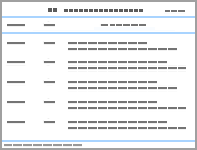
表1
3种算法的性能和收敛性
| 算法 | 是否 收敛 | 激励价格/ [美元·(MW·h)-1] | 利润/美元 |
|---|---|---|---|
| DDPG | 是 | 5.34 | 5926.62 |
| DQN | 是 | 0 | 5820.00 |
| Q_learning | 否 |

图4
区域电网售电商负荷准线的激励价格变化


图5
区域电网售电商利润变化

表2
响应负荷准线后新能源利用情况
| 新能源存在 未利用情况的 时段/h | 未响应负荷 准线新能源弃用 功率/(MW·h) | 响应负荷准线 新能源弃用 功率/(MW·h) |
|---|---|---|
| 2 | 2.76 | 6.99 |
| 3 | 10.57 | 6.85 |
| 4 | 11.92 | 0.29 |
| 5 | 13.21 | 7.27 |
| 24 | 3.76 | 3.63 |

图6
响应负荷准线后节点3电动汽车集群负荷形状

表3
各主体的利益变化
| 利益主体 | 成本/ 利润 | 未响应负荷 准线/美元 | 响应负荷 准线/美元 |
|---|---|---|---|
| 独立系统运营商 | 成本 | 55615.00 | 55531.00 |
| 节点3区域电网售电商 | 利润 | 5870.54 | 5926.62 |
| 节点3可调负荷聚合商 | 成本 | 274839.00 | 240310.00 |
| [1] | 张英杰. 构建以新能源为主体的新型电力系统的发展路径研究[J]. 电工技术, 2022(18): 172-174. |
| ZHANG Yingjie. Research on the development path of building a new electric power system based on new energy sources[J]. Electric Engineering, 2022(18): 172-174. | |
| [2] |
江婷, 邓晖, 陆承宇, 等. 电能量和旋转备用市场下电-热综合能源系统低碳优化运行[J]. 上海交通大学学报, 2021, 55(12): 1650-1662.
doi: 10.16183/j.cnki.jsjtu.2021.297 |
| JIANG Ting, DENG Hui, LU Chengyu, et al. Low-carbon optimal operation of an integrated electricity-heat energy system in electric energy and spinning reserve market[J]. Journal of Shanghai Jiao Tong University, 2021, 55(12): 1650-1662. | |
| [3] | 李志伟, 赵雨泽, 吴培. 基于制氢设备精细建模的综合能源系统绿氢蓝氢协调低碳优化策略[J]. 电网技术, 2024, 48(6): 2317-2326. |
| LI Zhiwei, ZHAO Yuze, WU Pei, et al. Low-carbon dispatching strategy of integrated energy system with coordination of green hydrogen and blue hydrogen based on fine modeling of hydrogen production equipment[J]. Power System Technology, 2024, 48(6): 2317-2326. | |
| [4] | 岑彬. “双碳”背景下可再生能源发展中“弃风弃光”的问题及消纳措施[J]. 中阿科技论坛(中英文), 2022(10): 60-63. |
| CEN Bin. Study on the “forced abandonment of wind and light” in the development of renewable energy under the background of “dual carbon” and its mitigation measures[J]. China-Arab States Science & Technology Forum, 2022(10): 60-63. | |
| [5] | 许高秀, 王旭, 邓晖, 等. 考虑调频需求及风光出力不确定性的储能系统参与能量-调频市场运行策略[J]. 电网技术, 2023, 47(6): 2317-2330. |
| XU Gaoxiu, WANG Xu, DENG Hui, et al. Optimal operation strategy of energy storage system’s participation in energy and regulation market considering uncertainties of regulation requirements and wind-photovoltaic output[J]. Power System Technology, 2023, 47(6): 2317-2330. | |
| [6] | 李艳梅, 任恒君, 张致远, 等. 考虑储能系统调度与风电消纳的峰谷分时电价优化模型研究[J]. 电网技术, 2022, 46(11): 4141-4149. |
| LI Yanmei, REN Hengjun, ZHANG Zhiyuan, et al. Optimization model of peak-valley time-of-use electricity prices considering energy storage system dispatching and wind power consumption[J]. Power System Technology, 2022, 46(11): 4141-4149. | |
| [7] | 尚文强, 李广磊, 丁月明, 等. 考虑源荷不确定性和新能源消纳的综合能源系统协同调度方法[J]. 电网技术, 2024, 48(2): 517-532. |
| SHANG Wenqiang, LI Guanglei, DING Yueming, et al. A collaborative scheduling method for integrated energy system considering the uncertainty of source load and the absorption of new energy[J]. Power System Technology. 2024, 48(2): 517-532. | |
| [8] | 赵雅雪, 王旭, 蒋传文, 等. 基于最大信息系数相关性分析和改进多层级门控LSTM的短期电价预测方法[J]. 中国电机工程学报, 2021, 41(1): 135-146. |
| ZHAO Yaxue, WANG Xu, JIANG Chuanwen, et al. A novel short-term electricity price forecasting method based on correlation analysis with the maximal information coefficient and modified multi-hierachy gated LSTM[J]. Proceedings of the CSEE, 2021, 41(1): 135-146. | |
| [9] | 范帅, 郏琨琪, 王芬, 等. 基于负荷准线的大规模需求响应[J]. 电力系统自动化, 2020, 44(15): 19-27. |
| FAN Shuai, JIA Kunqi, WANG Fen, et al. Large-scale demand response based on customer directrix load[J]. Automation of Electric Power Systems, 2020, 44(15): 19-27. | |
| [10] | 刘春阳, 李康平, 纪陵, 等. 基于聚类-估计联动的需求响应集群基线负荷估计方法[J]. 电力系统自动化, 2023, 47(2): 79-87. |
| LIU Chunyang, LI Kangping, JI Ling, et al. Clustering-estimation linkage based estimation method for aggregated baseline loads of demand response[J]. Automation of Electric Power Systems, 2023, 47(2): 79-87. | |
| [11] | 范帅, 危怡涵, 何光宇, 等. 面向新型电力系统的需求响应机制探讨[J]. 电力系统自动化, 2022, 46(7): 1-12. |
| FAN Shuai, WEI Yihan, HE Guangyu, et al. Discussion on demand response mechanism for new power systems[J]. Automation of Electric Power Systems, 2022, 46(7): 1-12. | |
| [12] | 孟琰, 肖居承, 洪居华, 等. 计及需求响应不确定性的节点负荷准线:概念与模型[J]. 电力系统自动化, 2023, 47(13): 28-39. |
| MENG Yan, XIAO Jucheng, HONG Juhua, et al. Nodal customer directrix load considering demand response uncertainty: Concept and model[J]. Automation of Electric Power Systems, 2023, 47(13): 28-39. | |
| [13] | 徐博强, 张沛超, 何光宇, 等. 基于主从博弈的热水器集群的负荷准线控制方法[J]. 中国电机工程学报, 2022, 42(21): 7785-7797. |
| XU Boqiang, ZHANG Peichao, HE Guangyu, et al. Stackelberg game based control method for water heater cluster using customer directrix line[J]. Proceedings of the CSEE, 2022, 42(21): 7785-7797. | |
| [14] | WANG X, SHAHIDEHPOUR M, JIANG C W, et al. Coordinated planning strategy for electric vehicle charging stations and coupled traffic-electric networks[J]. IEEE Transactions on Power Systems, 2019, 34(1): 268-279. |
| [15] | LI K, SHAO C C, ZHANG H C, et al. Strategic pricing of electric vehicle charging service providers in coupled power-transportation networks[J]. IEEE Transactions on Smart Grid, 2023, 14(3): 2189-2201. |
| [16] | YANG Z F, ZHONG H W, BOSE A, et al. A linearized OPF model with reactive power and voltage magnitude: A pathway to improve the MW-only DC OPF[J]. IEEE Transactions on Power Systems, 2018, 33(2): 1734-1745. |
| [17] | YANG Z F, ZHONG H W, BOSE A, et al. Optimal power flow in AC-DC grids with discrete control devices[J]. IEEE Transactions on Power Systems, 2018, 33(2): 1461-1472. |
| [18] |
周士超, 刘晓林, 熊展, 等. 考虑韧性提升的交直流配电网线路加固和储能配置策略[J]. 上海交通大学学报, 2021, 55(12): 1619-1630.
doi: 10.16183/j.cnki.jsjtu.2021.279 |
| ZHOU Shichao, LIU Xiaolin, XIONG Zhan, et al. Line hardening and energy storage system configuration strategies for resilience enhancement of a hybrid AC-DC distribution system[J]. Journal of Shanghai Jiao Tong University, 2021, 55(12): 1619-1630. | |
| [19] | GONG K, WANG X, JIANG C W, et al. Security-constrained optimal sizing and siting of BESS in hybrid AC/DC microgrid considering post-contingency corrective rescheduling[J]. IEEE Transactions on Sustainable Energy, 2021, 12(4): 2110-2122. |
| [20] | WANG X, SHAHIDEHPOUR M, JIANG C W, et al. Resilience enhancement strategies for power distribution network coupled with urban transportation system[J]. IEEE Transactions on Smart Grid, 2019, 10(4): 4068-4079. |
| [21] | 胡维昊, 曹迪, 黄琦, 等. 深度强化学习在配电网优化运行中的应用[J]. 电力系统自动化, 2023, 47(14): 174-191. |
| HU Weihao, CAO Di, HUANG Qi, et al. Application of deep reinforcement learning in optimal operation of distribution network[J]. Automation of Electric Power Systems, 2023, 47(14): 174-191. | |
| [22] | DUAN J J, YI Z H, SHI D, et al. Reinforcement-learning-based optimal control of hybrid energy storage systems in hybrid AC-DC microgrids[J]. IEEE Transactions on Industrial Informatics, 2019, 15(9): 5355-5364. |
| [23] | BUI V H, HUSSAIN A, KIM H M. Double deep Q-learning-based distributed operation of battery energy storage system considering uncertainties[J]. IEEE Transactions on Smart Grid, 2020, 11(1): 457-469. |
| [24] | WANG S Y, DU L, FAN X Y, et al. Deep reinforcement scheduling of energy storage systems for real-time voltage regulation in unbalanced LV networks with high PV penetration[J]. IEEE Transactions on Sustainable Energy, 2021, 12(4): 2342-2352. |
| [25] | 张继行, 张一, 王旭, 等. 基于多代理强化学习的多新型市场主体虚拟电厂博弈竞价及效益分配策略[J]. 电网技术, 2024, 48(5): 1980-1991. |
| ZHANG Jihang, ZHANG Yi, WANG Xu, et al. Game bidding and benefit allocation strategy for virtual power plants with multiple new market entities based on multi-agent reinforcement learning[J]. Power System Technology, 2024, 48(5): 1980-1991. | |
| [26] | LIANG Y C, GUO C L, DING Z H, et al. Agent-based modeling in electricity market using deep deterministic policy gradient algorithm[J]. IEEE Transactions on Power Systems, 2020, 35(6): 4180-4192. |
| [27] | 徐业琰, 姚良忠, 廖思阳, 等. 基于多智能体Actor-Double-Critic深度强化学习的源-网-荷-储实时优化调度方法研究[J/OL]. 中国电机工程学报. https://doi.org/10.13334/j.0258-8013.pcsee.231054. |
| XU Yeyan, YAO Liangzhong, LIAO Siyang, et al. Studies on real-time optimal dispatch method of source-grid-load-storage based on multi-agent actor-double-critic deep reinforcement learning[J/OL]. Proceedings of the CSEE. https://doi.org/10.13334/j.0258-8013.pcsee.231054. | |
| [28] | LIU D N, GAO Y, WANG W Y, et al. Research on bidding strategy of thermal power companies in electricity market based on multi-agent deep deterministic policy gradient[J]. IEEE Access, 2021, 9: 81750-81764. |
| [29] | 刘飞宇, 王吉文, 王正风, 等. 基于两阶段深度强化学习算法的多智能体自由合谋竞价机理研究[J]. 中国电机工程学报, 2024, 44(12): 4626-4639. |
| LIU Feiyu, WANG Jiwen, WANG Zhengfeng, et al. Study on free joint bidding mechanism in multi-agent environment based on two-stage deep reinforcement learning algorithm[J]. Proceedings of the CSEE, 2024, 44(12): 4626-4639. |
| [1] | 赵耀, 于文强, 李东东, 高少炜, 王岩. 计及产消者的激励型需求侧响应对配电网可靠性影响[J]. 上海交通大学学报, 2026, 60(1): 74-86. |
| [2] | . 触觉辅助导航车辆:增强盲区和透明物体场景中的障碍物检测[J]. J Shanghai Jiaotong Univ Sci, 2026, 31(1): 167-175. |
| [3] | . 融合鸟瞰图特征的模仿与强化学习自动驾驶规划方法[J]. J Shanghai Jiaotong Univ Sci, 2026, 31(1): 154-166. |
| [4] | 陈实, 杨林森, 刘艺洪, 罗欢, 臧天磊, 周步祥. 小样本数据驱动模式下的新建微电网优化调度策略[J]. 上海交通大学学报, 2025, 59(6): 732-745. |
| [5] | 王志博, 呼卫军, 马先龙, 全家乐, 周皓宇. 感知驱动控制的无人机拦截碰撞技术[J]. 空天防御, 2025, 8(4): 78-84. |
| [6] | 周文杰, 付昱龙, 郭相科, 戚玉涛, 张海宾. 基于博弈树与数字平行战场的空战决策方法[J]. 空天防御, 2025, 8(3): 50-58. |
| [7] | 杨映荷, 魏汉迪, 范迪夏, 李昂. 基于高斯过程回归和深度强化学习的水下扑翼推进性能寻优方法[J]. 上海交通大学学报, 2025, 59(1): 70-78. |
| [8] | 周毅, 周良才, 史迪, 赵小英, 闪鑫. 基于安全深度强化学习的电网有功频率协同优化控制[J]. 上海交通大学学报, 2024, 58(5): 682-692. |
| [9] | 董玉博1, 崔涛1, 周禹帆1, 宋勋2, 祝月2, 董鹏1. 基于长周期极坐标系追击问题的多智能体强化学习奖赏函数设计方法[J]. J Shanghai Jiaotong Univ Sci, 2024, 29(4): 646-655. |
| [10] | 李舒逸, 李旻哲, 敬忠良. 动态环境下基于改进DQN的多智能体路径规划方法[J]. J Shanghai Jiaotong Univ Sci, 2024, 29(4): 601-612. |
| [11] | 苗镇华1, 黄文焘2, 张依恋3, 范勤勤1. 基于深度强化学习的多模态多目标多机器人任务分配算法[J]. J Shanghai Jiaotong Univ Sci, 2024, 29(3): 377-387. |
| [12] | 全家乐, 马先龙, 沈昱恒. 基于近端策略动态优化的多智能体编队方法[J]. 空天防御, 2024, 7(2): 52-62. |
| [13] | 顾慧杰, 周华锋, 彭超逸, 胡亚平, 赵心怡, 谢俊, 施雄华. 含抽水蓄能电站的高比例新能源发电系统多时间尺度调度模型[J]. 上海交通大学学报, 2024, 58(12): 1957-1967. |
| [14] | 张威振, 何真, 汤张帆. 风扰下无人机栖落机动的强化学习控制设计[J]. 上海交通大学学报, 2024, 58(11): 1753-1761. |
| [15] | 马驰, 张国群, 孙俊格, 吕广喆, 张涛. 基于深度强化学习的综合电子系统重构方法[J]. 空天防御, 2024, 7(1): 63-70. |
| 阅读次数 | ||||||
|
全文 |
|
|||||
|
摘要 |
|
|||||
