

Journal of Shanghai Jiao Tong University ›› 2026, Vol. 60 ›› Issue (6): 915-924.doi: 10.16183/j.cnki.jsjtu.2024.252
• New Type Power System and the Integrated Energy • Previous Articles Next Articles
HE Yangyang1, ZHANG Chengming2( ), WANG Haoyu3, LI Yong4, FAN Cheng4, TAI Nengling1
Received:2024-06-28
Revised:2024-09-08
Accepted:2024-12-11
Online:2026-06-28
Published:2025-06-25
CLC Number:
HE Yangyang, ZHANG Chengming, WANG Haoyu, LI Yong, FAN Cheng, TAI Nengling. Distributionally Robust Planning Method for Power Generation and Transmission Considering Multi-Energy Complementarity and Direct Current Transmission[J]. Journal of Shanghai Jiao Tong University, 2026, 60(6): 915-924.
Add to citation manager EndNote|Ris|BibTeX
URL: https://xuebao.sjtu.edu.cn/EN/10.16183/j.cnki.jsjtu.2024.252

Fig.1
Framework of distributionally robust planning method of generation and transmission


Fig.2
Basic structure of C-DCGAN


Fig.3
Modified Garver-6 bus test system

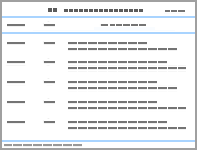
Tab.1
Comparison of planning results obtained by different planning methods
| 规划 方法 | 投建机组 | 投建线路(数量) | 费用/亿美元 | |||||
|---|---|---|---|---|---|---|---|---|
| 节点 | 容量/MW | 数量 | 年投资费用 | 弃风惩罚费用 | 运行费用 | 年综合费用 | ||
| 1 | 2 6 | 60 240,120 | 2 2,1 | 2-6(3),3-6(2), 4-6(3),3-5(1) | 0.6142 | 0.0082 | 0.6711 | 1.2853 |
| 2 | 6 | 240 | 2 | 2-6(3),4-6(2), 3-5(1),3-6(1) | 0.4587 | 0.0001 | 0.5154 | 0.9741 |
| 3 | 6 | 240 | 2 | 2-6(3),4-6(2), 3-5(1),3-6(1) | 0.4587 | 0 | 0.4624 | 0.9211 |
| 4 | 2 6 | 60 240 | 2 2 | 2-6(3),3-6(2), 4-6(1),3-5(1) | 0.4972 | 0.0092 | 0.4923 | 0.9895 |
| 5 | 2 6 | 60 240 | 2 2 | 2-6(3),3-6(1), 4-6(1),3-5(1) | 0.4955 | 0 | 0.4637 | 0.9592 |
Tab.2
Comparison of planning results obtained by different optimization methods
| 优化方法 | 投建机组 | 投建线路(数量) | 费用/亿美元 | ||||
|---|---|---|---|---|---|---|---|
| 节点 | 容量/MW | 数量 | 年投资费用 | 运行费用 | 年综合费用 | ||
| SO | 6 | 240 | 2 | 2-6(3),4-6(2), 3-5(1),3-6(1) | 0.4587 | 0.4869 | 0.9456 |
| RO | 2 6 | 60 240,120 | 2 2,1 | 2-6(3),3-6(3), 4-6(3),3-5(1) | 0.6202 | 0.4472 | 1.0674 |
| DRO | 2 6 | 60 240 | 2 2 | 2-6(3),3-6(1), 4-6(1),3-5(1) | 0.4955 | 0.4637 | 0.9592 |
Tab.3
Comparison of planning results with comprehensive norm constraint and 1-norm constraint (γ1=0.9)
| γ∞ | 年综合费用/亿美元 | |
|---|---|---|
| 考虑综合范数约束 | 仅考虑1-范数约束 | |
| 0.5 | 0.9169 | 1.0215 |
| 0.8 | 0.9378 | 1.0215 |
| 0.9 | 0.9541 | 1.0215 |
| 0.99 | 0.9586 | 1.0215 |
Tab.4
Comparison of planning results with comprehensive norm constraint and ∞-norm constraint (γ∞=0.9)
| γ1 | 年综合费用/亿美元 | |
|---|---|---|
| 考虑综合范数约束 | 仅考虑∞-范数约束 | |
| 0.5 | 0.9188 | 0.9592 |
| 0.8 | 0.9276 | 0.9592 |
| 0.9 | 0.9541 | 0.9592 |
| 0.99 | 0.9592 | 0.9592 |
Tab.5
Planning results under different scales of historical data
| 历史 场景数 | 年综合费用/ 亿美元 | 历史 场景数 | 年综合费用/ 亿美元 |
|---|---|---|---|
| 100 | 1.0155 | 1000 | 0.9592 |
| 500 | 0.9851 | 5000 | 0.9488 |
Tab.6
Iteration results of C&CG algorithm
| 迭代次数 | UB/亿美元 | LB/亿美元 | 计算用时/s |
|---|---|---|---|
| 1 | 1.1210 | 0.9163 | 0.73 |
| 2 | 0.9601 | 0.9351 | 0.77 |
| 3 | 0.9592 | 0.9592 | 1.22 |
| [1] | 张沈习, 王浩宇, 李然, 等. 考虑智能软开关接入的主动配电网扩展规划方法[J]. 中国电机工程学报, 2023, 43(1): 48-61. |
| ZHANG Shenxi, WANG Haoyu, LI Ran, et al. Active distribution network expansion planning method considering the integration of soft open point[J]. Proceedings of the CSEE, 2023, 43(1): 48-61. | |
| [2] | 史昭娣, 朱宁, 李政, 等. 计及源-荷匹配的多区域多类型新能源系统优化规划方法[J]. 电力工程技术, 2024, 43(4): 67-76. |
| SHI Zhaodi, ZHU Ning, LI Zheng, et al. Optimization planning method of multi-region and multi-type renewable energy generation considering source-load matching[J]. Electric Power Engineering Technology, 2024, 43(4): 67-76. | |
| [3] | 姚天亮, 刘乔, 刘金鹏, 等. 考虑风光互补的输储联合规划方法研究[J]. 电网与清洁能源, 2022, 38(7): 118-126. |
| YAO Tianliang, LIU Qiao, LIU Jinpeng, et al. Research on joint planning methods for energy storage and transmission network considering complementarity of wind power and PV[J]. Power System & Clean Energy, 2022, 38(7): 118-126. | |
| [4] |
赵振宇, 解冰清. 计及风光互补特性的风光容量优化配置模型[J]. 太阳能学报, 2023, 44(8): 149-156.
doi: 10.19912/j.0254-0096.tynxb.2022-0546 |
|
ZHAO Zhenyu, XIE Bingqing. Optimal allocation model of wind-solar capacity considering wind-solar complementary characteristics[J]. Acta Energiae Solaris Sinica, 2023, 44(8): 149-156.
doi: 10.19912/j.0254-0096.tynxb.2022-0546 |
|
| [5] | 蔡绍荣, 沈力, 江栗, 等. 考虑水风光互补与机会约束的电力系统源网荷协调扩展规划研究[J]. 电网与清洁能源, 2022, 38(11): 134-145. |
| CAI Shaorong, SHEN Li, JIANG Li, et al. A study on source-network-demand coordinated expansion planning of the power system considering hydro-wind-solar complementary and chance constraints[J]. Power System & Clean Energy, 2022, 38(11): 134-145. | |
| [6] | ZHANG Y S, MA C, LIAN J J, et al. Optimal photovoltaic capacity of large-scale hydro-photovoltaic complementary systems considering electricity delivery demand and reservoir characteristics[J]. Energy Conversion & Management, 2019, 195: 597-608. |
| [7] | 彭吕斌, 何剑, 谢开贵, 等. 特高压交流和直流输电系统可靠性与经济性比较[J]. 电网技术, 2017, 41(4): 1098-1107. |
| PENG Lübin, HE Jian, XIE Kaigui, et al. Comparison of reliability and economy between UHVAC and UHVDC transmission systems[J]. Power System Technology, 2017, 41(4): 1098-1107. | |
| [8] | 陈志永, 张倩茅, 秦梁栋, 等. 考虑大规模区外来电接入的输电网扩展规划方法[J]. 电网与清洁能源, 2022, 38(10): 87-97. |
| CHEN Zhiyong, ZHANG Qianmao, QIN Liangdong, et al. A transmission expansion planning method considering of large-scale external power access[J]. Advances of Power System & Hydroelectric Engineering, 2022, 38(10): 87-97. | |
| [9] | 卫凯, 张海波, 龚贤夫, 等. 提升多馈入受端电网安全性的储能电站规划方法[J]. 现代电力, 2024, 41(6): 1127-1137. |
| WEI Kai, ZHANG Haibo, GONG Xianfu, et al. Energy storage plants planning method for improving security of multi-infeed receiving-end system[J]. Modern Electric Power, 2024, 41(6): 1127-1137. | |
| [10] |
马骞, 邓卓明, 吴云亮, 等. 受端电网STATCOM布点及容量规划的凸松弛方法[J]. 南方电网技术, 2021, 15(6): 64-70.
doi: 10.13648/j.cnki.issn1674-0629.2021.06.010 |
|
MA Qian, DENG Zhuoming, WU Yunliang, et al. Convex relaxation method of STATCOM location and capacity planning in receiving-end power grid[J]. Southern Power System Technology, 2021, 15(6): 64-70.
doi: 10.13648/j.cnki.issn1674-0629.2021.06.010 |
|
| [11] |
PAPAVASILIOU A, OREN S S, O’NEILL R P. Reserve requirements for wind power integration: A scenario-based stochastic programming framework[J]. IEEE Transactions on Power Systems, 2011, 26(4): 2197-2206.
doi: 10.1109/TPWRS.2011.2121095 URL |
| [12] |
LÓPEZ J, POZO D, CONTRERAS J, et al. A multiobjective minimax regret robust VAr planning model[J]. IEEE Transactions on Power Systems, 2017, 32(3): 1761-1771.
doi: 10.1109/TPWRS.2016.2613544 URL |
| [13] | 贺帅佳, 阮贺彬, 高红均, 等. 分布鲁棒优化方法在电力系统中的理论分析与应用综述[J]. 电力系统自动化, 2020, 44(14): 179-191. |
| HE Shuaijia, RUAN Hebin, GAO Hongjun, et al. Overview on theory analysis and application of distributionally robust optimization method in power system[J]. Automation of Electric Power Systems, 2020, 44(14): 179-191. | |
| [14] |
BAGHERI A, WANG J H, ZHAO C Y. Data-driven stochastic transmission expansion planning[J]. IEEE Transactions on Power Systems, 2017, 32(5): 3461-3470.
doi: 10.1109/TPWRS.2016.2635098 URL |
| [15] | 税月, 刘俊勇, 高红均, 等. 考虑风电不确定性的电热综合系统分布鲁棒协调优化调度模型[J]. 中国电机工程学报, 2018, 38(24): 7235-7247. |
| SHUI Yue, LIU Junyong, GAO Hongjun, et al. A distributionally robust coordinated dispatch model for integrated electricity and heating systems considering uncertainty of wind power[J]. Proceedings of the CSEE, 2018, 38(24): 7235-7247. | |
| [16] | 阮贺彬, 高红均, 刘俊勇, 等. 考虑DG无功支撑和开关重构的主动配电网分布鲁棒无功优化模型[J]. 中国电机工程学报, 2019, 39(3): 685-695. |
| RUAN Hebin, GAO Hongjun, LIU Junyong, et al. A distributionally robust reactive power optimization model for active distribution network considering reactive power support of DG and switch reconfiguration[J]. Proceedings of the CSEE, 2019, 39(3): 685-695. | |
| [17] | 程浩忠, 张程铭, 柳璐, 等. 可再生能源接入下考虑短路电流限制的发输电鲁棒规划方法[J]. 电力系统自动化, 2021, 45(10): 68-76. |
| CHENG Haozhong, ZHANG Chengming, LIU Lu, et al. Robust planning method for power generation and transmission with renewable energy integration considering short-circuit current limit[J]. Automation of Electric Power Systems, 2021, 45(10): 68-76. | |
| [18] |
DEHGHAN S, AMJADY N. Robust transmission and energy storage expansion planning in wind farm-integrated power systems considering transmission switching[J]. IEEE Transactions on Sustainable Energy, 2016, 7(2): 765-774.
doi: 10.1109/TSTE.2015.2497336 URL |
| [19] | 谭晶, 何川, 陈保瑞, 等. 考虑水光蓄互补和直流外送的电力系统分布鲁棒优化调度方法[J]. 中国电机工程学报, 2024, 44(15): 5947-5960. |
| TAN Jing, HE Chuan, CHEN Baorui, et al. Distributionally robust optimal scheduling method of power system considering hydropower-photovoltaic-pumped storage complementarity and DC transmission[J]. Proceedings of the CSEE, 2024, 44(15): 5947-5960. | |
| [20] | MIRZA M, OSINDERO S. Conditional generative adversarial nets[PP/OL]. V1.arXiv (2014-11-06) [2024-06-27]. https://doi.org/10.48550/arXiv.1411.1784. |
| [21] | 洪绍云, 程浩忠, 曾平良, 等. 基于相关场景聚类的发输电联合扩展规划[J]. 电力系统自动化, 2016, 40(22): 71-76. |
| HONG Shaoyun, CHENG Haozhong, ZENG Pingliang, et al. Coordinated generation and transmission expansion planning with clusters of correlative scenarios[J]. Automation of Electric Power Systems, 2016, 40(22): 71-76. |
| [1] | PAN Wei, ZHAO Yong, LIU Yuming, LIN Qingyuan, GE Ende, WANG Wei. Assembly Deviation Prediction Method of Thin-Walled Structures Based on Conditional Generative Adversarial Network [J]. Journal of Shanghai Jiao Tong University, 2026, 60(5): 786-799. |
| [2] | JIANG Yilin, ZHANG Yilong, ZHANG Fangyuan. Infrared Single Pixel Imaging Based on Generative Adversarial Network [J]. J Shanghai Jiaotong Univ Sci, 2025, 30(6): 1114-1124. |
| [3] | CHEN Jinming, JIANG Wei, WANG Zhiwei, ZHU Zhenhan, CHEN Ye, ZHAO Yanchao. Automatic Mapping Method for Power Supply Units in Medium-Voltage Distribution Networks Based on Generative Adversarial Network [J]. Journal of Shanghai Jiao Tong University, 2025, 59(10): 1431-1441. |
| [4] | YAN Congqiang1,2 (鄢丛强), GUO Zhengyun3,4 (郭正玉), CAI Yunze1,2∗∗ (蔡云泽). Data Augmentation of Ship Wakes in SAR Images Based on Improved CycleGAN [J]. J Shanghai Jiaotong Univ Sci, 2024, 29(4): 702-711. |
| [5] | BI Jinmao, ZHANG Peng, ZHANG Jie, ZHAO Chuncai, CUI Li. Polyester Melt Characteristic Viscosity Prediction Method Under Incomplete Data [J]. Journal of Shanghai Jiao Tong University, 2024, 58(4): 534-544. |
| [6] | GUO Junfeng, WANG Miaosheng, WANG Zhiming. Fault Diagnosis of Rolling Bearing with Roller Spalling Based on Two-Step Transfer Learning on Unbalanced Dataset [J]. Journal of Shanghai Jiao Tong University, 2023, 57(11): 1512-1521. |
| [7] | LI Yu, YANG Daoyong, LIU Lingya, WANG Yiyin. Underwater Image Enhancement Based on Generative Adversarial Networks [J]. Journal of Shanghai Jiao Tong University, 2022, 56(2): 134-142. |
| [8] | HE Xinlin, QI Zongfeng, LI Jianxun. Unbalanced Learning of Generative Adversarial Network Based on Latent Posterior [J]. Journal of Shanghai Jiao Tong University, 2021, 55(5): 557-565. |
| [9] | QI Shengyong, ZANG Yuejin, LYU Guoyun, DU Ming. Research on Air Target Image Generation Algorithm Based on Generative Adversarial Networks [J]. Air & Space Defense, 2021, 4(2): 67-73. |
| [10] | ZHAO Chaowang (赵朝望), YANG Jian (杨健), XIONG Wuyue (熊吴越), LI Jiatong (李佳潼). Two Generative Design Methods of Hospital Operating Department Layouts Based on Healthcare Systematic Layout Planning and Generative Adversarial Network [J]. J Shanghai Jiaotong Univ Sci, 2021, 26(1): 103-115. |
| Viewed | ||||||
|
Full text |
|
|||||
|
Abstract |
|
|||||
