

Journal of Shanghai Jiao Tong University ›› 2026, Vol. 60 ›› Issue (5): 705-724.doi: 10.16183/j.cnki.jsjtu.2024.425
• Electronic Information and Electrical Engineering • Next Articles
WU Qinting1, FENG Yuzhe1, PAN Jinyan2, ZHANG Haifeng3, CAO Chao4, GAO Yunlong1,5( )
)
Received:2024-10-24
Revised:2024-12-10
Accepted:2025-02-14
Online:2026-05-28
Published:2026-06-03
Contact:
GAO Yunlong
E-mail:gaoyl@xmu.edu.cn
CLC Number:
WU Qinting, FENG Yuzhe, PAN Jinyan, ZHANG Haifeng, CAO Chao, GAO Yunlong. A Review of Clustering Algorithms Based on Anchor Point Acceleration Mechanism[J]. Journal of Shanghai Jiao Tong University, 2026, 60(5): 705-724.
Add to citation manager EndNote|Ris|BibTeX
URL: https://xuebao.sjtu.edu.cn/EN/10.16183/j.cnki.jsjtu.2024.425

Fig.1
Anchor-based clustering model


Fig.2
Clustering of generating anchor points based on K-means algorithm


Fig.3
Principle of BKHK algorithm


Fig.4
Structure of multi-layer anchor

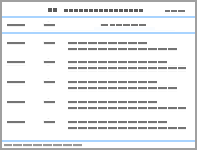
Tab.1
Performance comparison of anchor-based and non-anchor-based spectral clustering algorithms
| 数据集 | 算法 | 改进措施 | ACC | 运行时间/s |
|---|---|---|---|---|
| USPS | SC[ | 谱聚类算法(不使用锚点) | 0.433 | 430.350 |
| CF[ | 在核空间实现的扩展非负矩阵分解(不使用锚点) | 0.301 | 19.347 | |
| BKM[ | 快速双边K-means算法(不使用锚点) | 0.204 | 2.623 | |
| KMM[ | 扩展的K-means算法(不使用锚点) | 0.447 | 10.874 | |
| LSC-R[ | 使用随机采样来选择地标的SC(不使用锚点) | 0.592 | 7.000 | |
| LSC-K[ | 使用K-means来选择地标的SC(不使用锚点) | 0.668 | 13.100 | |
| ECCA[ | 引入相关熵准则 | 0.466 | 0.187 | |
| RPSC[ | 利用BKHK生成两层锚点 | 0.617 | 23.260 | |
| FDBC[ | 联合框架+改进的坐标下降优化算法 | 0.675 | 1.256 | |
| FANCEC[ | 统一的优化框架 | 0.705 | 20.154 | |
| FSSC[ | 结合标签信息 | 0.729 | 11.900 | |
| Mnist | BKM[ | 快速双边K-means算法(不使用锚点) | 0.134 | 7.956 |
| KMM[ | 扩展的K-means算法(不使用锚点) | 0.533 | 41.045 | |
| LSC-R[ | 使用随机采样来选择地标的SC(不使用锚点) | 0.492 | 102.900 | |
| LSC-K[ | 使用K-means来选择地标的SC(不使用锚点) | 0.583 | 447.600 | |
| FCC[ | 引入相关熵准则 | 0.362 | 6.118 | |
| RPSC[ | 利用BKHK生成两层锚点 | 0.535 | 49.930 | |
| TDT2 | CF[ | 在核空间实现的扩展非负矩阵分解(不使用锚点) | 0.450 | 129.103 |
| BKM[ | 快速双边K-means算法(不使用锚点) | 0.383 | 144.690 | |
| KMM[ | 扩展的K-means算法(不使用锚点) | 0.126 | 127.588 | |
| FDBC[ | 联合框架+改进的坐标下降优化算法 | 0.367 | 25.329 | |
| ECCA[ | 引入相关熵准则 | 0.452 | 0.726 | |
| FCC[ | 引入相关熵准则 | 0.522 | 62.036 | |
| Letter | SC[ | 谱聚类算法(不使用锚点) | 0.236 | 430.350 |
| LSC-R[ | 使用随机采样来选择地标的SC(不使用锚点) | 0.254 | 16.500 | |
| LSC-K[ | 使用K-means来选择地标的SC(不使用锚点) | 0.265 | 17.900 | |
| RPSC[ | 利用BKHK生成两层锚点 | 0.270 | 14.250 | |
| FSSC[ | 结合标签信息 | 0.339 | 13.900 |
Tab.2
Detailed information of datasets
| 数据集 | 样本个数 | 特征个数 | 类别个数 |
|---|---|---|---|
| USPS | 1854 | 256 | 10 |
| Mnist | 70000 | 784 | 10 |
| TDT2 | 653 | 6737 | 4 |
| Letter | 20000 | 16 | 26 |
| Waveform | 2746 | 21 | 3 |

Fig.5
Model of anchor-based fuzzy spectral clustering algorithm

Tab.3
Performance comparison of fixed anchor-based and non-anchor-based fuzzy spectral clustering algorithms
| 数据集 | 算法 | 改进措施 | ACC | 运行时间/s |
|---|---|---|---|---|
| USPS | KM[ | K-means(不使用锚点) | 0.630 | 0.102 |
| FCM[ | 模糊C均值(不使用锚点) | 0.639 | 1.193 | |
| GBFC[[49] | 引入正则化项 | 0.703 | 1.641 | |
| FFCAG[ | 引入锚点的先验知识+正则化项 | 0.802 | 2.917 | |
| TDT2 | KM[ | K-means(不使用锚点) | 0.224 | 7.582 |
| FCM[ | 模糊C均值(不使用锚点) | 0.143 | 393.831 | |
| GBFC[ | 引入正则化项 | 0.809 | 2.172 | |
| FFCAG[ | 引入锚点的先验知识+正则化项 | 0.953 | 68.265 | |
| Waveform | KM[ | K-means(不使用锚点) | 0.511 | 0.062 |
| FCM[ | 模糊C均值(不使用锚点) | 0.511 | 0.065 | |
| AFSEFK[ | 利用锚点同时学习局部和全局结构 | 0.571 | - | |
| GBFC[ | 引入正则化项 | 0.608 | 0.118 |

Fig.6
Multi-view clustering based on anchor points


Fig.7
Cross-view anchor inconsistency

Tab.4
Datasets ofmulti-view experiment
| 数据集 | 样本个数 | 视图个数 | 类别个数 |
|---|---|---|---|
| WebKB | 1051 | 2 | 2 |
| Minist4 | 4000 | 3 | 4 |
| Minist | 10000 | 3 | 10 |
| Caltech7 | 1474 | 5 | 7 |
| Reuters | 18758 | 5 | 6 |
| AWA | 4000 | 6 | 50 |
| NUS | 2400 | 6 | 12 |
| NUSW | 3000 | 5 | 25 |
| Caltech101-20 | 2386 | 6 | 20 |
| Caltech101-all | 9144 | 6 | 102 |
| SUNRGBD | 10335 | 2 | 45 |
| NUSWIDEOBJ | 30000 | 5 | 31 |
| YouTubeFace | 101499 | - | 31 |
Tab.5
Performance comparison of multi-view clustering algorithms based on fixed anchor points
| 数据集 | 算法 | 改进措施 | ACC | 运行时间/s |
|---|---|---|---|---|
| WebKB | EMKMC-L[ | 约束谱嵌入矩阵获取聚类标签矩阵+LLM优化 | 0.917 | 0.224 |
| ERMF-AGR[ | 引入相关熵 | 0.933 | 0.535 | |
| EMKMC-M[ | 约束谱嵌入矩阵获取聚类标签矩阵+快速优化 | 0.945 | 0.103 | |
| FMCSE[ | 将谱嵌入矩阵直接转化为聚类标签矩阵 | 0.952 | 0.310 | |
| Minist4 | EMKMC-L[ | 约束谱嵌入矩阵获取聚类标签矩阵+LLM优化 | 0.267 | 0.596 |
| FMCSE[ | 将谱嵌入矩阵直接转化为聚类标签矩阵 | 0.840 | 3.797 | |
| EMKMC-M[ | 约束谱嵌入矩阵获取聚类标签矩阵+快速优化 | 0.859 | 0.077 | |
| ERMF-AGR[ | 引入相关熵 | 0.893 | 5.528 | |
| Minist | EMKMC-L[ | 约束谱嵌入矩阵获取聚类标签矩阵+LLM优化 | 0.116 | 0.028 |
| ERMF-AGR[ | 引入相关熵 | 0.701 | 26.184 | |
| EMKMC-M[ | 约束谱嵌入矩阵获取聚类标签矩阵+快速优化 | 0.711 | 0.220 | |
| Caltech7 | EMKMC-M[ | 约束谱嵌入矩阵获取聚类标签矩阵+快速优化 | 0.516 | 0.147 |
| EMKMC-L[ | 约束谱嵌入矩阵获取聚类标签矩阵+LLM优化 | 0.518 | 0.373 | |
| ERMF-AGR[ | 引入相关熵 | 0.570 | 0.003 | |
| Reuters | EMKMC-L[ | 约束谱嵌入矩阵获取聚类标签矩阵+LLM优化 | 0.173 | 33.782 |
| EMKMC-M[ | 约束谱嵌入矩阵获取聚类标签矩阵+快速优化 | 0.467 | 24.580 | |
| FMCSE[ | 将谱嵌入矩阵直接转化为聚类标签矩阵 | 0.491 | 87.787 | |
| ERMF-AGR[ | 引入相关熵 | 0.559 | 0.600 | |
| FMGL-MC[ | 引入低秩约束,确保学习到的共识图具有恰好c个连接分量 | 0.755 | 558.260 | |
| TBGL[ | 基于方差的去相关性锚点选择 | 0.795 | 697.430 | |
| NUS | EMKMC-L[ | 约束谱嵌入矩阵获取聚类标签矩阵+LLM优化 | 0.183 | 0.490 |
| EMKMC-M[ | 约束谱嵌入矩阵获取聚类标签矩阵+快速优化 | 0.223 | 0.157 | |
| FMCSE[ | 将谱嵌入矩阵直接转化为聚类标签矩阵 | 0.224 | 2.440 | |
| TBGL[ | 基于方差的去相关性锚点选择 | 0.274 | 552.350 |
Tab.6
Performance comparison of multi-view clustering algorithms based on dynamic anchor points
| 数据集 | 算法 | 改进措施 | 改进方面 | ACC |
|---|---|---|---|---|
| Caltech101-20 | TAGL-MC[ | 将多视图数据映射至潜在嵌入空间 | 锚点质量 | 0.588 |
| BIGMC[ | 构建特殊的锚点来捕捉视图间的共识信息 | 高效地融合多视图信息 | 0.611 | |
| MVFCAG[ | 引入模糊约束直接获得聚类标签 | 解决采用两阶段方案获取离散聚类标签的问题 | 0.614 | |
| LAGAR-MC[ | 构建特殊的锚点来捕捉视图间的共识信息 | 高效地融合多视图信息 | 0.633 | |
| FPFAG-MC[ | 引入正则化项 | 避免得到平凡解并进一步优化聚类效果 | 0.655 | |
| 2C-MEAL[ | 使用嵌入学习过滤不良信息 | 锚点质量 | 0.664 | |
| PIAL[ | 将锚点学习与图构造整合至统一的优化框架 | 锚点质量 | 0.671 | |
| FMVSC-BAG[ | 将锚点、图和标签学习集成至统一框架 | 锚点质量 | 0.751 | |
| CCV | FMVSC-BAG[ | 将锚点、图和标签学习集成至统一框架 | 锚点质量 | 0.237 |
| FPFAG-MC[ | 引入正则化项 | 避免得到平凡解并进一步优化聚类效果 | 0.240 | |
| PIAL[ | 将锚点学习与图构造整合至统一的优化框架 | 锚点质量 | 0.242 | |
| 2C-MEAL[ | 使用嵌入学习过滤不良信息 | 锚点质量 | 0.258 | |
| TAGL-MC[ | 将多视图数据映射至潜在嵌入空间 | 锚点质量 | 0.445 | |
| Caltech101-all | FMVSC-BAG[ | 将锚点、图和标签学习集成至统一框架 | 锚点质量 | 0.232 |
| 2C-MEAL[ | 使用嵌入学习过滤不良信息 | 锚点质量 | 0.290 | |
| FPFAG-MC[ | 引入正则化项 | 避免得到平凡解并进一步优化聚类效果 | 0.302 | |
| PIAL[ | 将锚点学习与图构造整合至统一的优化框架 | 锚点质量 | 0.308 | |
| TAGL-MC[ | 将多视图数据映射至潜在嵌入空间 | 锚点质量 | 0.547 | |
| SUNRGBD | TAGL-MC[ | 将多视图数据映射至潜在嵌入空间 | 锚点质量 | 0.227 |
| FPFAG-MC[ | 引入正则化项 | 避免得到平凡解并进一步优化聚类效果 | 0.239 | |
| FMVSC-BAG[ | 将锚点、图和标签学习集成至统一框架 | 锚点质量 | 0.244 | |
| 2C-MEAL[ | 使用嵌入学习过滤不良信息 | 锚点质量 | 0.247 | |
| PIAL[ | 将锚点学习与图构造整合至统一的优化框架 | 锚点质量 | 0.252 | |
| NUSWIDEOBJ | FMVSC-BAG[ | 将锚点、图和标签学习集成至统一框架 | 锚点质量 | 0.193 |
| FPFAG-MC[ | 引入正则化项 | 避免得到平凡解并进一步优化聚类效果 | 0.195 | |
| PIAL[ | 将锚点学习与图构造整合至统一的优化框架 | 锚点质量 | 0.202 | |
| Minist | EDMC[ | 充分利用数据集中列的聚类表示空间 | 探究锚点本身的性质与信息 | 0.738 |
| LAGAR-MC[ | 引入模糊约束直接获得聚类标签 | 解决采用两阶段方案获取离散聚类标签的问题 | 0.867 | |
| MVFCAG[ | 首先融合多视图信息,进而构建统一的锚点图 | 高效地融合多视图信息 | 0.975 | |
| FPFAG-MC[ | 引入正则化项 | 避免得到平凡解并进一步优化聚类效果 | 0.988 |
Tab.7
Time comparison of multi-view clustering algorithms based on dynamic anchor points
| 数据集 | 算法 | 改进措施 | 改进方面 | 运行时间/s |
|---|---|---|---|---|
| Caltech101-20 | MVFCAG[ | 首先融合多视图信息,进而构建统一的锚点图 | 高效地融合多视图信息 | 3.208 |
| LAGAR-MC[ | 引入模糊约束直接获得聚类标签 | 解决采用两阶段方案获取离散聚类标签的问题 | 6.330 | |
| BIGMC[ | 构建特殊的锚点来捕捉视图间的共识信息 | 高效地融合多视图信息 | 11.421 | |
| NUSWIDEOBJ | 2C-MEAL[ | 使用嵌入学习过滤不良信息 | 锚点质量 | 145.440 |
| FMVSC-BAG[ | 将锚点、图和标签学习集成至统一框架 | 锚点质量 | 146.110 | |
| PIAL[ | 将锚点学习与图构造整合至统一的优化框架 | 锚点质量 | 789.230 | |
| AWA | 2C-MEAL[ | 使用嵌入学习过滤不良信息 | 锚点质量 | 240.920 |
| FMVSC-BAG[ | 将锚点、图和标签学习集成至统一框架 | 锚点质量 | 241.890 | |
| PIAL[ | 将锚点学习与图构造整合至统一的优化框架 | 锚点质量 | 1103.560 | |
| YouTubeFace | 2C-MEAL[ | 使用嵌入学习过滤不良信息 | 锚点质量 | 1245.280 |
| PIAL[ | 将锚点学习与图构造整合至统一的优化框架 | 锚点质量 | 3520.540 | |
| Minist | MVFCAG[ | 首先融合多视图信息,进而构建统一的锚点图 | 高效地融合多视图信息 | 20.790 |
| LAGAR-MC[ | 引入模糊约束直接获得聚类标签 | 解决采用两阶段方案获取离散聚类标签的问题 | 27.940 |
| [1] | MACQUEEN J. Some methods for classification and analysis of multivariate observations[C]// Proceedings of the Fifth Berkeley Symposium on Mathematical Statistics and Probability. Oakland, USA: [s.n.], 1967: 281-297. |
| [2] |
DUNN J C. A fuzzy relative of the ISODATA process and its use in detecting compact well-separated clusters[J]. Journal of Cybernetics, 1973, 3(3): 32-57.
doi: 10.1080/01969727308546046 URL |
| [3] |
赵嘉, 王刚, 吕莉, 等. 面向流形数据的测地距离与余弦互逆近邻密度峰值聚类算法[J]. 电子学报, 2022, 50(11): 2730-2737.
doi: 10.12263/DZXB.20211273 |
|
ZHAO Jia, WANG Gang, LÜ Li, et al. Density peaks clustering algorithm based on geodesic distance and cosine mutual reverse nearest neighbors for manifold datasets[J]. Acta Electronica Sinica, 2022, 50(11): 2730-2737.
doi: 10.12263/DZXB.20211273 |
|
| [4] |
ELHAMIFAR E, VIDAL R. Sparse subspace clustering: Algorithm, theory, and applications[J]. IEEE Transactions on Pattern Analysis and Machine Intelligence, 2013, 35(11): 2765-2781.
doi: 10.1109/TPAMI.2013.57 pmid: 24051734 |
| [5] | ANDREW Y N, MICHAEL I J, WEISS Y. On spectral clustering: Analysis and an algorithm[C]// Proceedings of the 15th International Conference on Neural Information Processing Systems:Natural and Synthetic. Vancouver, British Columbia, Canada: MIT Press, 2001: 849-856. |
| [6] | BICKEL S, SCHEFFER T. Multi-view clustering[C]// Fourth IEEE International Conference on Data Mining. Brighton, UK: IEEE, 2005: 19-26. |
| [7] | SCHROFF F, KALENICHENKO D, PHILBIN J. Facenet: A unified embedding for face recognition and clustering[C]// 2015 IEEE Conference on Computer Vision and Pattern Recognition. Boston, USA: IEEE, 2015: 815-823. |
| [8] |
OYEWOLE G J, THOPIL G A. Data clustering: Application and trends[J]. Artificial Intelligence Review, 2023, 56(7): 6439-6475.
doi: 10.1007/s10462-022-10325-y |
| [9] |
LIU Q, CHEN S Q, JIANG R, et al. Simultaneous deep generative modelling and clustering of single-cell genomic data[J]. Nature Machine Intelligence, 2021, 3(6): 536-544.
doi: 10.1038/s42256-021-00333-y |
| [10] |
雷涛, 张肖, 加小红, 等. 基于模糊聚类的图像分割研究进展[J]. 电子学报, 2019, 47(8): 1776-1791.
doi: 10.3969/j.issn.0372-2112.2019.08.023 |
|
LEI Tao, ZHANG Xiao, JIA Xiaohong, et al. Research progress on image segmentation based on fuzzy clustering[J]. Acta Electronica Sinica, 2019, 47(8): 1776-1791.
doi: 10.3969/j.issn.0372-2112.2019.08.023 |
|
| [11] | ZHU W, NIE F P, LI X L. Fast spectral clustering with efficient large graph construction[C]// 2017 IEEE International Conference on Acoustics, Speech and Signal Processing. New Orleans, LA, USA: IEEE, 2017: 2492-2496. |
| [12] | NIE F P, WANG X Q, JORDAN M, et al. The constrained Laplacian rank algorithm for graph-based clustering[C]// Proceedings of the AAAI Conference on Artificial Intelligence. Arizona, USA: AAAI Press, 2016: 1969-1976. |
| [13] |
ZHANG K, KWOK J T. Clustered Nyström method for large scale manifold learning and dimension reduction[J]. IEEE Transactions on Neural Networks, 2010, 21(10): 1576-1587.
doi: 10.1109/TNN.2010.2064786 pmid: 20805054 |
| [14] |
WEI K B, LI H F, LIU Q, et al. Self-supervised, multi-view, semantics-aware anchor clustering[J]. Electronics, 2024, 13(23): 4782-4800.
doi: 10.3390/electronics13234782 URL |
| [15] |
XUE J J, NIE F P, WANG R, et al. Rank-r discrete matrix factorization for anchor graph clustering[J]. IEEE Transactions on Knowledge and Data Engineering, 2022, 35(7): 7371-7381.
doi: 10.1109/TKDE.2022.3198800 URL |
| [16] | LI J, GAO Q, WANG Q, et al. Orthogonal non-negative tensor factorization based multi-view clustering[C]// Proceedings of the 37th Conference on Neural Information Processing Systems. New Orleans, LA, USA: Curran Associates Inc., 2023: 18186-18202. |
| [17] |
NIU F, ZHAO X W, GUO J, et al. Fast and robust unsupervised dimensionality reduction with adaptive bipartite graphs[J]. Knowledge-Based Systems, 2023, 276: 110680.
doi: 10.1016/j.knosys.2023.110680 URL |
| [18] |
WANG J Y, WANG H M, NIE F P, et al. Sparse feature selection via fast embedding spectral analysis[J]. Pattern Recognition, 2023, 139: 109472.
doi: 10.1016/j.patcog.2023.109472 URL |
| [19] |
DONG L J, YAO H, LI D, et al. Improving graph neural network via complex-network-based anchor structure[J]. Knowledge-Based Systems, 2021, 233: 107528.
doi: 10.1016/j.knosys.2021.107528 URL |
| [20] |
ZHANG P L, CHEN J T, CHE C, et al. IEA-GNN: Anchor-aware graph neural network fused with information entropy for node classification and link prediction[J]. Information Sciences, 2023, 634: 665-676.
doi: 10.1016/j.ins.2023.03.022 URL |
| [21] | ARTHUR D, VASSILVITSKII S. K-means++: The advantages of careful seeding[C]// Proceedings of the 18th ACM-SIAM Symposium on Discrete Algorithms. New Orleans, LA, USA: SIAM, 2007: 1027-1035. |
| [22] |
WANG R, NIE F P, YU W Z. Fast spectral clustering with anchor graph for large hyperspectral images[J]. IEEE Geoscience and Remote Sensing Letters, 2017, 14(11): 2003-2007.
doi: 10.1109/LGRS.2017.2746625 URL |
| [23] |
CAI D, CHEN X L. Large scale spectral clustering via landmark-based sparse representation[J]. IEEE Transactions on Cybernetics, 2015, 45(8): 1669-1680.
doi: 10.1109/TCYB.2014.2358564 pmid: 25265642 |
| [24] | NIE F P, ZHU W, LI X L. Unsupervised large graph embedding[J]. Proceedings of the AAAI Conference on Artificial Intelligence, 2017, 31(1): 2422-2428. |
| [25] |
QIANG Q Y, ZHANG B, WANG F, et al. Fast multi-view discrete clustering with anchor graphs[J]. Proceedings of the AAAI Conference on Artificial Intelligence, 2021, 35(11): 9360-9367.
doi: 10.1609/aaai.v35i11.17128 URL |
| [26] | ZHU J Y, TAO L H, YANG H, et al. Unsupervised optimized bipartite graph embedding[J]. IEEE Transactions on Knowledge and Data Engineering, 2021, 35(3): 3224-3238. |
| [27] | ZELNIK-MANOR L, PERONA P. Self-tuning spectral clustering[C]// Proceedings of the 18th International Conference on Neural Information Processing Systems. Vancouver, British Columbia, Canada: MIT Press, 2004: 1601-1608. |
| [28] | NIE F P, WANG X Q, HUANG H. Clustering and projected clustering with adaptive neighbors[C]// Proceedings of the 20th ACM SIGKDD International Conference on Knowledge Discovery and Data Mining. New York, USA: ACM, 2014: 977-986. |
| [29] | 李中衡, 杨奔, 张劲节, 等. 基于相关熵的快速聚类算法[J]. 西安交通大学学报, 2021, 55(6): 121-130. |
| LI Zhongheng, YANG Ben, ZHANG Jinjie, et al. Fast correntropy-based clustering algorithm[J]. Journal of Xi’an Jiaotong University, 2021, 55(6): 121-130. | |
| [30] |
YANG B, ZHANG X T, NIE F P, et al. ECCA: Efficient correntropy-based clustering algorithm with orthogonal concept factorization[J]. IEEE Transactions on Neural Networks and Learning Systems, 2023, 34(10): 7377-7390.
doi: 10.1109/TNNLS.2022.3142806 URL |
| [31] |
WANG J Y, MA Z Y, NIE F P, et al. Fast self-supervised clustering with anchor graph[J]. IEEE Transactions on Neural Networks and Learning Systems, 2022, 33(9): 4199-4212.
doi: 10.1109/TNNLS.2021.3056080 URL |
| [32] | YANG L B, LIU X M, NIE F P, et al. Large-scale spectral clustering based on representative points[J]. Mathematical Problems in Engineering, 2019, 2019(1): 1-7. |
| [33] |
罗兴隆, 贺兴时, 杨新社. 二分k-means锚点提取的快速谱聚类[J]. 计算机工程与应用, 2023, 59(16): 74-81.
doi: 10.3778/j.issn.1002-8331.2205-0036 |
|
LUO Xinglong, HE Xingshi, YANG Xinshe. Fast spectral clustering based on anchor point extraction with bisecting k-means[J]. Computer Engineering and Applications, 2023, 59(16): 74-81.
doi: 10.3778/j.issn.1002-8331.2205-0036 |
|
| [34] |
YANG X, YU W, WANG R, et al. Fast spectral clustering learning with hierarchical bipartite graph for large-scale data[J]. Pattern Recognition Letters, 2020, 130: 345-352.
doi: 10.1016/j.patrec.2018.06.024 URL |
| [35] |
ZHAO Y, YUAN Y, WANG Q. Fast spectral clustering for unsupervised hyperspectral image classification[J]. Remote Sensing, 2019, 11(4): 399-420.
doi: 10.3390/rs11040399 URL |
| [36] |
WANG R, NIE F P, WANG Z, et al. Scalable graph-based clustering with nonnegative relaxation for large hyperspectral image[J]. IEEE Transactions on Geoscience and Remote Sensing, 2019, 57(10): 7352-7364.
doi: 10.1109/TGRS.36 URL |
| [37] |
YANG Y, SHEN F M, HUANG Z, et al. Discrete nonnegative spectral clustering[J]. IEEE Transactions on Knowledge and Data Engineering, 2017, 29(9): 1834-1845.
doi: 10.1109/TKDE.2017.2701825 URL |
| [38] | YE F H, CHEN C, ZHENG Z B, et al. Discrete overlapping community detection with pseudo supervision[C]// 2019 IEEE International Conference on Data Mining. Beijing, China: IEEE, 2019: 708-717. |
| [39] | CHEN X J, HONG W J, NIE F P, et al. Spectral clustering of large-scale data by directly solving normalized cut[C]// Proceedings of the 24th ACM SIGKDD International Conference on Knowledge Discovery & Data Mining. London, UK: ACM, 2018: 1206-1215. |
| [40] |
LIU Y J, CAI Y D, YANG X J, et al. Fast adaptive neighbors clustering via embedded clustering[J]. Neurocomputing, 2020, 399: 331-341.
doi: 10.1016/j.neucom.2020.02.087 URL |
| [41] | WANG Z, DAI X F, ZHU P C, et al. Fast optimization of spectral embedding and improved spectral rotation[J]. IEEE Transactions on Knowledge and Data Engineering, 2021, 35(2): 1515-1527. |
| [42] |
WANG R, CHEN H M, LU Y H, et al. Discrete and balanced spectral clustering with scalability[J]. IEEE Transactions on Pattern Analysis and Machine Intelligence, 2023, 45(12): 14321-14336.
doi: 10.1109/TPAMI.2023.3311828 pmid: 37669200 |
| [43] |
NIE F P, XUE J J, WANG R, et al. Fast clustering by directly solving bipartite graph clustering problem[J]. IEEE Transactions on Neural Networks and Learning Systems, 2022, 35(7): 9174-9185.
doi: 10.1109/TNNLS.2022.3219131 URL |
| [44] |
CHEN J W, ZHU J Y, XIE S Y, et al. FGC_SS: Fast graph clustering method by joint spectral embedding and improved spectral rotation[J]. Information Sciences, 2022, 613: 853-870.
doi: 10.1016/j.ins.2022.08.109 URL |
| [45] | YANG X J, XU Y X, LI S Y, et al. Fuzzy embedded clustering based on bipartite graph for large-scale hyperspectral image[J]. IEEE Geoscience and Remote Sensing Letters, 2021, 19: 5505605. |
| [46] |
任奇泽, 贾洪杰, 陈东宇. 融合局部结构学习的大规模子空间聚类算法[J]. 计算机应用, 2023, 43(12): 3747-3754.
doi: 10.11772/j.issn.1001-9081.2022111750 |
|
REN Qize, JIA Hongjie, CHEN Dongyu. Large-scale subspace clustering algorithm with local structure learning[J]. Journal of Computer Applications, 2023, 43(12): 3747-3754.
doi: 10.11772/j.issn.1001-9081.2022111750 |
|
| [47] |
ZHU J Y, ZHAO W J, YANG H, et al. Joint learning of anchor graph-based fuzzy spectral embedding and fuzzy K-means[J]. IEEE Transactions on Fuzzy Systems, 2023, 31(11): 4097-4108.
doi: 10.1109/TFUZZ.2023.3283261 URL |
| [48] |
WANG J Y, GUO S Z, NIE F P, et al. Local-global fuzzy clustering with anchor graph[J]. IEEE Transactions on Fuzzy Systems, 2024, 32(1): 188-202.
doi: 10.1109/TFUZZ.2023.3294921 URL |
| [49] |
LIU C D, NIE F P, WANG R, et al. Graph-based soft-balanced fuzzy clustering[J]. IEEE Transactions on Fuzzy Systems, 2023, 31(6): 2044-2055.
doi: 10.1109/TFUZZ.2022.3218371 URL |
| [50] |
NIE F P, LIU C D, WANG R, et al. Fast fuzzy clustering based on anchor graph[J]. IEEE Transactions on Fuzzy Systems, 2022, 30(7): 2375-2387.
doi: 10.1109/TFUZZ.2021.3081990 URL |
| [51] | LIU C D, NIE F P, WANG R, et al. Scalable fuzzy clustering with anchor graph[J]. IEEE Transactions on Knowledge and Data Engineering, 2023, 35(8): 8503-8514. |
| [52] |
WANG H, YANG Y, LIU B. GMC: Graph-based multi-view clustering[J]. IEEE Transactions on Knowledge and Data Engineering, 2020, 32(6): 1116-1129.
doi: 10.1109/TKDE.69 URL |
| [53] |
KANG Z, ZHOU W T, ZHAO Z T, et al. Large-scale multi-view subspace clustering in linear time[J]. Proceedings of the AAAI Conference on Artificial Intelligence, 2020, 34(4): 4412-4419.
doi: 10.1609/aaai.v34i04.5867 URL |
| [54] |
YANG B, ZHANG X T, LIN Z P, et al. Efficient and robust multiview clustering with anchor graph regularization[J]. IEEE Transactions on Circuits and Systems for Video Technology, 2022, 32(9): 6200-6213.
doi: 10.1109/TCSVT.2022.3162575 URL |
| [55] |
XIA W, GAO Q X, WANG Q Q, et al. Tensorized bipartite graph learning for multi-view clustering[J]. IEEE Transactions on Pattern Analysis and Machine Intelligence, 2023, 45(4): 5187-5202.
doi: 10.1109/TPAMI.2022.3187976 URL |
| [56] | 刘溯源, 王思为, 唐厂, 等. 基于加权锚点的多视图聚类算法[J]. 自动化学报, 2024, 50(6): 1160-1170. |
| LIU Suyuan, WANG Siwei, TANG Chang, et al. Multi-view clustering with weighted anchors[J]. Acta Automatica Sinica, 2024, 50(6): 1160-1170. | |
| [57] | YANG B, ZHANG X T, LI Z H, et al. Efficient multi-view K-means clustering with multiple anchor graphs[J]. IEEE Transactions on Knowledge and Data Engineering, 2023, 35(7): 6887-6900. |
| [58] |
YANG B, ZHANG X T, NIE F P, et al. Fast multiview clustering with spectral embedding[J]. IEEE Transactions on Image Processing, 2022, 31: 3884-3895.
doi: 10.1109/TIP.2022.3176223 URL |
| [59] |
YANG B, WU J H, ZHANG X T, et al. Discrete correntropy-based multi-view anchor-graph clustering[J]. Information Fusion, 2024, 103: 102097.
doi: 10.1016/j.inffus.2023.102097 URL |
| [60] |
YANG H Z, GAO Q X, XIA W, et al. Multiview spectral clustering with bipartite graph[J]. IEEE Transactions on Image Processing, 2022, 31: 3591-3605.
doi: 10.1109/TIP.2022.3171411 URL |
| [61] |
JIANG T Y, GAO Q X. Fast multiple graphs learning for multi-view clustering[J]. Neural Networks, 2022, 155: 348-359.
doi: 10.1016/j.neunet.2022.08.027 pmid: 36115161 |
| [62] |
SHU X C, ZHANG X D, GAO Q X, et al. Self-weighted anchor graph learning for multi-view clustering[J]. IEEE Transactions on Multimedia, 2022, 25: 5485-5499.
doi: 10.1109/TMM.2022.3193855 URL |
| [63] |
GUO J, YE J H. Anchors bring ease: An embarrassingly simple approach to partial multi-view clustering[J]. Proceedings of the AAAI Conference on Artificial Intelligence, 2019, 33(1): 118-125.
doi: 10.1609/aaai.v33i01.3301118 URL |
| [64] |
JI G Y, LU G F, CAI B. Scalable incomplete multi-view clustering via tensor Schatten p-norm and tensorized bipartite graph[J]. Engineering Applications of Artificial Intelligence, 2023, 123: 106379.
doi: 10.1016/j.engappai.2023.106379 URL |
| [65] |
刘小兰, 石宗宇, 叶泽慧, 等. 基于锚点图的低秩缺失多视图子空间聚类[J]. 华南理工大学学报(自然科学版), 2022, 50(12): 60-70.
doi: 10.12141/j.issn.1000-565X.220069 |
| LIU Xiaolan, SHI Zongyu, YE Zehui, et al. Anchor graph based low-rank incomplete multi-view subspace clustering[J]. Journal of South China University of Technology (Natural Science Edition), 2022, 50(12): 60-70. | |
| [66] | WANG S, LIU X, LIU S, et al. Align then fusion: Generalized large-scale multi-view clustering with anchor matching correspondences[J]. Advances in Neural Information Processing Systems, 2022, 35: 5882-5895. |
| [67] |
ZHANG X R, XIE X T, KANG Z. Graph learning for attributed graph clustering[J]. Mathematics, 2022, 10(24): 4834.
doi: 10.3390/math10244834 URL |
| [68] |
ZHANG C Y, NIE F P, WANG Z, et al. Fast local representation learning via adaptive anchor graph for image retrieval[J]. Information Sciences, 2021, 578: 870-886.
doi: 10.1016/j.ins.2021.07.088 URL |
| [69] |
YANG S J, LI L, WANG S H, et al. Graph regularized encoder-decoder networks for image representation learning[J]. IEEE Transactions on Multimedia, 2020, 23: 3124-3136.
doi: 10.1109/TMM.2020.3020697 URL |
| [70] |
ZHAO Y, LI X L. Spectral clustering with adaptive neighbors for deep learning[J]. IEEE Transactions on Neural Networks and Learning Systems, 2023, 34(4): 2068-2078.
doi: 10.1109/TNNLS.2021.3105822 URL |
| [71] | CUI C H, REN Y Z, PU J Y, et al. Deep multi-view subspace clustering with anchor graph[DB/OL]. (2023-05-11)[2024-10-24]. https://arxiv.org/abs/2305.06939. |
| [72] | ZHANG Z, LI X Z, ZHANG H J, et al. Triplet deep subspace clustering via self-supervised data augmentation[C]// 2021 IEEE International Conference on Data Mining. Auckland, New Zealand: IEEE, 2021: 946-955. |
| [73] |
PENG M X, JUAN X, LI Z S. Label-guided graph contrastive learning for semi-supervised node classification[J]. Expert Systems with Applications, 2024, 239: 122385.
doi: 10.1016/j.eswa.2023.122385 URL |
| [74] | XIA M H, HU W B, WONG T T, et al. Disentangled image colorization via global anchors[J]. ACM Transactions on Graphics, 2022, 41(6): 1-13. |
| [75] |
SUN G, ZHAN T, OWUSU B G, et al. Revised reinforcement learning based on anchor graph hashing for autonomous cell activation in cloud-RANs[J]. Future Generation Computer Systems, 2020, 104: 60-73.
doi: 10.1016/j.future.2019.09.044 URL |
| [76] | ZHANG C Y, NIE F P, WANG Z, et al. Fast local representation learning with adaptive anchor graph[C]// ICASSP 2021-2021 IEEE International Conference on Acoustics, Speech and Signal Processing. Toronto, Canada: IEEE, 2021: 3170-3174. |
| [77] | SUN M J, ZHANG P, WANG S W, et al. Scalable multi-view subspace clustering with unified anchors[C]// Proceedings of the 29th ACM International Conference on Multimedia. Online, China: ACM, 2021: 3528-3536. |
| [78] |
YUAN Y, WANG C Z. Bipartite graph based spectral rotation with fuzzy anchors[J]. Neurocomputing, 2022, 471: 369-376.
doi: 10.1016/j.neucom.2021.11.055 URL |
| [79] | FANG S G, HUANG D, WANG C D, et al. One-step bipartite graph cut: A normalized formulation and its application to scalable subspace clustering[DB/OL]. (2023-05-12)[2024-10-24]. https://doi.org/10.48550/arXiv.2305.07386. |
| [80] |
ZHANG X Y, REN Z W, YANG C. Center consistency guided multi-view embedding anchor learning for large-scale graph clustering[J]. Knowledge-Based Systems, 2023, 260: 110162.
doi: 10.1016/j.knosys.2022.110162 URL |
| [81] |
DAI J, REN Z W, LUO Y Z, et al. Tensorized anchor graph learning for large-scale multi-view clustering[J]. Cognitive Computation, 2023, 15(5): 1581-1592.
doi: 10.1007/s12559-023-10146-3 |
| [82] |
WU X, WANG H C, LI S X, et al. Prior indicator guided anchor learning for multi-view subspace clustering[J]. IEEE Transactions on Consumer Electronics, 2023, 70(1): 144-154.
doi: 10.1109/TCE.2023.3319018 URL |
| [83] |
MI Y, CHEN H M, YUAN Z, et al. Fast multi-view subspace clustering with balance anchors guidance[J]. Pattern Recognition, 2024, 145: 109895.
doi: 10.1016/j.patcog.2023.109895 URL |
| [84] | CHEN M S, WANG C D, HUANG D, et al. Efficient orthogonal multi-view subspace clustering[C]// Proceedings of the 28th ACM SIGKDD Conference on Knowledge Discovery and Data Mining. Washington, D.C., USA: ACM, 2022: 127-135. |
| [85] |
QIN Y L, PU N, WU H Z. EDMC: Efficient multi-view clustering via cluster and instance space learning[J]. IEEE Transactions on Multimedia, 2023, 26: 5273-5283.
doi: 10.1109/TMM.2023.3331197 URL |
| [86] | WEN Y, LIU S Y, WAN X H, et al. Efficient multi-view graph clustering with local and global structure preservation[C]// Proceedings of the 31st ACM International Conference on Multimedia. Ottawa, Canada: ACM, 2023: 3021-3030. |
| [87] |
CAI Z L, LI R J, WU H. Learning unified anchor graph based on affinity relationships with strong consensus for multi-view spectral clustering[J]. Multimedia Systems, 2023, 29(1): 261-273.
doi: 10.1007/s00530-022-00985-9 |
| [88] |
HUANG D, WANG C D, LAI J H. Fast multi-view clustering via ensembles: Towards scalability, superiority, and simplicity[J]. IEEE Transactions on Knowledge and Data Engineering, 2023, 35(11): 11388-11402.
doi: 10.1109/TKDE.2023.3236698 URL |
| [89] |
FANG S G, HUANG D, CAI X S, et al. Efficient multi-view clustering via unified and discrete bipartite graph learning[J]. IEEE Transactions on Neural Networks and Learning Systems, 2024, 35(8): 11436-11447.
doi: 10.1109/TNNLS.2023.3261460 URL |
| [90] |
CHEN Y Y, ZHAO X J, ZHANG Z, et al. Tensor learning meets dynamic anchor learning: From complete to incomplete multiview clustering[J]. IEEE Transactions on Neural Networks and Learning Systems, 2024, 35(11): 15332-15345.
doi: 10.1109/TNNLS.2023.3286430 URL |
| [91] | LI L S, HE H B. Bipartite graph based multi-view clustering[J]. IEEE Transactions on Knowledge and Data Engineering, 2022, 34(7): 3111-3125. |
| [92] |
LAO J H, HUANG D, WANG C D, et al. Towards scalable multi-view clustering via joint learning of many bipartite graphs[J]. IEEE Transactions on Big Data, 2024, 10(1): 77-91.
doi: 10.1109/TBDATA.2023.3325045 URL |
| [93] | 赵兴旺, 王淑君, 刘晓琳, 等. 基于二部图的联合谱嵌入多视图聚类算法[J]. 软件学报, 2024, 35(9): 4408-4424. |
| ZHAO Xingwang, WANG Shujun, LIU Xiaolin, et al. Joint spectral embedding multi-view clustering algorithm based on bipartite graphs[J]. Journal of Software, 2024, 35(9): 4408-4424. | |
| [94] |
WANG J, TANG C, WAN Z G, et al. Efficient and effective one-step multiview clustering[J]. IEEE Transactions on Neural Networks and Learning Systems, 2024, 35(9): 12224-12235.
doi: 10.1109/TNNLS.2023.3253246 URL |
| [95] |
ZHANG C B, CHEN L, SHI Z Y, et al. Latent information-guided one-step multi-view fuzzy clustering based on cross-view anchor graph[J]. Information Fusion, 2024, 102: 102025.
doi: 10.1016/j.inffus.2023.102025 URL |
| [96] |
YU W Z, XING L Y, NIE F P, et al. Multiview fuzzy clustering based on anchor graph[J]. IEEE Transactions on Fuzzy Systems, 2024, 32(3): 755-766.
doi: 10.1109/TFUZZ.2023.3306639 URL |
| [97] |
WANG S W, LIU X W, ZHU X Z, et al. Fast parameter-free multi-view subspace clustering with consensus anchor guidance[J]. IEEE Transactions on Image Processing, 2022, 31: 556-568.
doi: 10.1109/TIP.2021.3131941 pmid: 34890327 |
| [98] | WANG S, LIU X, LIU L, et al. Highly-efficient incomplete large-scale multi-view clustering with consensus bipartite graph[C]// Proceedings of the IEEE/CVF Conference on Computer Vision and Pattern Recognition. New Orleans, LA, USA: IEEE, 2022: 9776-9785. |
| [99] |
WANG S H, CAO J Z, LEI F Y, et al. Multiple kernel-based anchor graph coupled low-rank tensor learning for incomplete multi-view clustering[J]. Applied Intelligence, 2023, 53(4): 3687-3712.
doi: 10.1007/s10489-022-03735-6 |
| [100] |
LI X F, SUN Y H, SUN Q S, et al. Cross-view graph matching guided anchor alignment for incomplete multi-view clustering[J]. Information Fusion, 2023, 100: 101941.
doi: 10.1016/j.inffus.2023.101941 URL |
| [101] |
ZHU S B, DAI J, YANG G L, et al. Anchor pseudo-supervise large-scale incomplete multi-view clustering[J]. IEEE Access, 2023, 11: 107812-107822.
doi: 10.1109/ACCESS.2023.3319564 URL |
| [102] | WEN Y, WANG S W, LIANG K, et al. Scalable incomplete multi-view clustering with structure alignment[C]// Proceedings of the 31st ACM International Conference on Multimedia. Ottawa, Canada: ACM, 2023: 3031-3040. |
| [103] |
LI A, FENG C, WANG Z, et al. Anchor-based sparse subspace incomplete multi-view clustering[J]. Wireless Networks, 2024, 30(6): 5559-5570.
doi: 10.1007/s11276-023-03312-w |
| [1] | WEN Xialu, HUANG He, WANG Huifeng, GAO Tao. Bridge Crack Extraction Based on Weighted Entropy and Hybrid Bald Eagle-Aquila Optimization FCM Clustering [J]. Journal of Shanghai Jiao Tong University, 2026, 60(5): 751-761. |
| [2] | GUO Qi, YAN Jun, HAO Qianpeng, HAN Dong, YANG Zhihao, YAN Xinyue, ZHANG Haipeng, LI Ran. Short-Term Wind Power Prediction Method Based on Closed-Loop Clustering and Multi-Objective Optimization [J]. Journal of Shanghai Jiao Tong University, 2026, 60(2): 246-255. |
| [3] | FAN Hong, WEI Xinwu, JIA Qingshan, LUO Jiayi. Collaborative Optimization Scheduling Method for Electric-Gas-Thermal Multi-Energy System Under Energy-Transportation Integration [J]. Journal of Shanghai Jiao Tong University, 2026, 60(2): 211-223. |
| [4] | SHEN Fu, YANG Zhiwen, XU Xiaoyuan, ZHANG Wei, WANG Zhe, CAO Yang. Unit Model of Integrated Energy System Based on Statistical Clustering [J]. Journal of Shanghai Jiao Tong University, 2025, 59(9): 1348-1358. |
| [5] | ZHU Feng, SHAN Chao, WU Ning, CAI Qixin, ZHU Yunan, LIU Yunpeng, ZUO Qiang. Feature Extraction and Anomaly Identification Method for Power Customer Price in Power Market Enviroment [J]. Journal of Shanghai Jiao Tong University, 2025, 59(7): 995-1006. |
| [6] | ZHANG Guo, CHEN Tao, WANG Jianping. CSC-YOLO: An Image Recognition Model for Surface Defect Detection of Copper Strip and Plates [J]. J Shanghai Jiaotong Univ Sci, 2025, 30(5): 1037-1049. |
| [7] | LIU Biao, LIU Guangyu, FENG Wei, WANG Shuai, ZHOU Bao, ZHAO Enming. Undecimated Dual-Tree Complex Wavelet Transform and Fuzzy Clustering-Based Sonar Image Denoising Technique [J]. J Shanghai Jiaotong Univ Sci, 2025, 30(5): 998-1008. |
| [8] | ZHANG Rongfu, WANG Jinqiang, LIU Minxia. Optimal Design Method of Complex System Based on Resource Optimization [J]. Air & Space Defense, 2025, 8(3): 86-94. |
| [9] | LIU Hongyu, WU Dajian. Research on the Identification of Technological Opportunities in Marine New Materials in China [J]. Ocean Engineering Equipment and Technology, 2025, 12(3): 123-127. |
| [10] | Cai Zhenhua, Li Canbing, Wu Qiuwei, Yang Tongguang, Li Zhenkai. Genetic Clustering-Based Equivalent Model of Wind Farm with Doubly Fed Induction Generator [J]. J Shanghai Jiaotong Univ Sci, 2025, 30(2): 300-308. |
| [11] | LI Jiayang, ZHAO Jiuyi, QIAN Yong, LI Guoyu, XU Zhiren, PAN Chao, SHENG Gehao. Location of Partial Discharge in GIS Based on Electromagnetic Wave Time Reversal [J]. Journal of Shanghai Jiao Tong University, 2025, 59(12): 1763-1772. |
| [12] | ZHANG Jiamin, CAI Ye, TANG Xiafei, TAN Yudong, CAO Yijia, LI Junxiong. Information Gap Decision Theory-Spectrum Clustering Typical Scenario Generation Considering Source Load Uncertainty [J]. Journal of Shanghai Jiao Tong University, 2025, 59(11): 1625-1636. |
| [13] | HE Tong, WEI Yali, LU Qing, BI Qian. Path Planning and Control of UAV Cluster Cooperative Reconnaissance Multi-Point Targets [J]. Air & Space Defense, 2025, 8(1): 31-40. |
| [14] | YU Hao, LI Canbing, YE Zhiliang, PENG Sui, REN Wanxin, CHEN Sijie, TANG Binwei, CHEN Dawei. Dynamic Equivalence Modeling of Short-Circuit Faults in Wind Farms Considering Wake Effects [J]. Journal of Shanghai Jiao Tong University, 2024, 58(6): 798-805. |
| [15] | REN Haohao, MA Hanfei, WEI Yulu, YU Sihui, ZHOU Yun. A Non-Parametric Model-Based Intelligent Recognition Method for Radar Emitters [J]. Air & Space Defense, 2024, 7(5): 36-44. |
| Viewed | ||||||
|
Full text |
|
|||||
|
Abstract |
|
|||||
