

Journal of Shanghai Jiao Tong University ›› 2026, Vol. 60 ›› Issue (6): 932-942.doi: 10.16183/j.cnki.jsjtu.2024.297
• New Type Power System and the Integrated Energy • Previous Articles Next Articles
WANG Yi1( ), RUAN Yiming1, DENG Jiahui1, WU Po2, LIU Mingyang2
Received:2024-07-25
Revised:2024-09-30
Accepted:2024-11-11
Online:2026-06-28
Published:2026-07-02
CLC Number:
WANG Yi, RUAN Yiming, DENG Jiahui, WU Po, LIU Mingyang. Dynamic Equivalence Modeling of Doubly-Fed Wind Farm Based on Residual Combined Neural Network[J]. Journal of Shanghai Jiao Tong University, 2026, 60(6): 932-942.
Add to citation manager EndNote|Ris|BibTeX
URL: https://xuebao.sjtu.edu.cn/EN/10.16183/j.cnki.jsjtu.2024.297

Fig.1
Data-driven equivalent model of wind farm


Fig.2
Structure of network


Fig.3
Flow chart of model parameter optimization based on GA

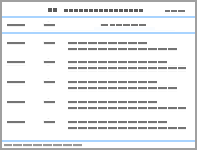
Tab.1
Detailed parameters of wind farm
| 设备名称 | 参数名称 | 参数值 |
|---|---|---|
| 发电机 | 额定功率/MW | 2.5 |
| 发电机 | 频率/Hz | 50 |
| 发电机 | 额定电压/kV | 0.69 |
| 发电机 | 定子电阻, | 0.0098 |
| 发电机 | 转子电阻, | 0.0093 |
| 发电机 | 定子电抗, | 0.0086 |
| 发电机 | 转子电抗, | 0.0094 |
| 发电机 | 励磁电抗, | 4.186 |
| 线路 | 线路电阻,Rp.u. | 0.01725 |
| 线路 | 线路电抗,Xp.u. | 0.05522 |
| 风力机 | 切入风速/(m·s-1) | 3 |
| 风力机 | 切出风速/(m·s-1) | 25 |
| 风力机 | 额定风速/(m·s-1) | 11.8 |
| 风力机 | 叶轮半径/m | 35.2 |
| 变压器 | 箱变容量/(MV·A) | 2.75 |
| 变压器 | 升压变容量/(MV·A) | 100 |

Fig.4
Evolution of fitness function metrics


Fig.5
Equivalence results of models before and after GA optimization (active power)


Fig.6
Equivalence results of models before and after GA optimization(reactive power)


Fig.7
Comparison of modeling performance among different models (active power)


Fig.8
Comparison of modeling performance among different models (reactive power)

Tab.2
Comparison of modeling performance among six models on active power data
| 模型 | e2 | 训练耗时/s |
|---|---|---|
| 单层LSTM | 1.66×10⁻⁴ | 38.90 |
| 单层GRU | 1.54×10⁻⁴ | 37.57 |
| 双层LSTM | 2.05×10⁻⁴ | 45.15 |
| 双层GRU | 1.62×10⁻⁴ | 44.98 |
| GRU-LSTM-FC | 1.84×10⁻⁴ | 42.76 |
| 所提模型 | 4.28×10⁻⁵ | 62.56 |
Tab.3
Comparison of modeling performance of six models on reactive power data
| 模型 | e2 | 训练耗时/s |
|---|---|---|
| 单层LSTM | 1.20×10⁻⁴ | 39.43 |
| 单层GRU | 8.80×10⁻⁵ | 37.78 |
| 双层LSTM | 8.84×10⁻⁵ | 45.96 |
| 双层GRU | 9.28×10⁻⁵ | 46.45 |
| GRU-LSTM-FC | 6.52×10⁻⁵ | 45.21 |
| 所提模型 | 1.69×10⁻⁵ | 63.16 |

Fig.9
Changes in loss function during training

Tab.4
Clustering results of mechanism-based unit grouping
| 聚类结果 | 风电机组编号 |
|---|---|
| 1 | 4,7,8,24,27,30,33,34,35,36,39,40 |
| 2 | 10,11,15 |
| 3 | 1,2,3,13,14,16,17,18,38 |
| 4 | 5,6,9,12,19,20,21,22,23,25,26,28,29,31,32,37 |

Fig.10
Comparison of proposed model and four-machine equivalent model (active power)


Fig.11
Comparison of proposed model and four-machine equivalent model (reactive power)

| [1] |
魏娟, 黎灿兵, 黄晟, 等. 大规模风电场高电压穿越控制方法研究综述[J]. 上海交通大学学报, 2024, 58(6): 783-797.
doi: 10.16183/j.cnki.jsjtu.2022.416 |
| WEI Juan, LI Canbing, HUANG Sheng, et al. Review of high voltage ride-through control method of large-scale wind farm[J]. Journal of Shanghai Jiao Tong University, 2024, 58(6): 783-797. | |
| [2] | 中华人民共和国国家能源局. 国家能源局发布2023年全国电力工业统计数据[J]. 电力科技与环保, 2024, 40(1): 95. |
| National Energy Administration of People’s Republic of China. National Energy Administration released statistical data of national electric power industry in 2023[J]. Electric Power Environmental Protection, 2024, 40(1): 95. | |
| [3] | Global Wind Energy Council. Global wind report 2024[EB/OL]. (2024-04-16)[2024-07-16]. https://gwec.net/global-wind-report-2024/. |
| [4] | 孙华东, 李佳豪, 李文锋, 等. 大规模电力系统仿真用新能源场站模型结构及建模方法研究(一): 模型结构[J]. 中国电机工程学报, 2023, 43(4): 1378-1389. |
| SUN Huadong, LI Jiahao, LI Wenfeng, et al. Research on model structures and modeling methods of renewable energy station for large-scale power system simulation (Part Ⅰ): Model structure[J]. Proceedings of the CSEE, 2023, 43(4): 1378-1389. | |
| [5] |
HANSEN A D, SØRENSEN P, BLAABJERG F, et al. Dynamic modelling of wind farm grid interaction[J]. Wind Engineering, 2002, 26(4): 191-210.
doi: 10.1260/030952402321039403 URL |
| [6] |
LI W X, CHAO P P, LIANG X D, et al. An improved single-machine equivalent method of wind power plants by calibrating power recovery behaviors[J]. IEEE Transactions on Power Systems, 2018, 33(4): 4371-4381.
doi: 10.1109/TPWRS.2017.2771323 URL |
| [7] | 吴磊, 晁璞璞, 李甘, 等. 数据-模型混合驱动的风电场聚合等值建模方法[J]. 电力系统自动化, 2022, 46(15): 66-74. |
| WU Lei, CHAO Pupu, LI Gan, et al. Hybrid data-model-driven aggregation equivalent modeling method for wind farm[J]. Automation of Electric Power Systems, 2022, 46(15): 66-74. | |
| [8] | 米增强, 苏勋文, 杨奇逊, 等. 风电场动态等值模型的多机表征方法[J]. 电工技术学报, 2010, 25(5): 162-169. |
| MI Zengqiang, SU Xunwen, YANG Qixun, et al. Multi-machine representation method for dynamic equivalent model of wind farms[J]. Transactions of China Electrotechnical Society, 2010, 25(5): 162-169. | |
| [9] |
余浩, 黎灿兵, 叶志亮, 等. 计及尾流效应的风电场短路故障动态等值建模[J]. 上海交通大学学报, 2024, 58(6): 798-805.
doi: 10.16183/j.cnki.jsjtu.2022.476 |
| YU Hao, LI Canbing, YE Zhiliang, et al. Dynamic equivalence modeling of short-circuit faults in wind farms considering wake effects[J]. Journal of Shanghai Jiao Tong University, 2024, 58(6): 798-805. | |
| [10] | 贾科, 孔繁哲, 张旸, 等. 基于改进K-均值算法的双馈风场故障等值建模方法[J]. 电网技术, 2023, 47(10): 4161-4173. |
| JIA Ke, KONG Fanzhe, ZHANG Yang, et al. Fault equivalent modeling of doubly fed wind farm based on improved K-means algorithm[J]. Power System Technology, 2023, 47(10): 4161-4173. | |
| [11] |
GENG X Y, MU Y K, MAO S L, et al. An improved K-means algorithm based on fuzzy metrics[J]. IEEE Access, 2020, 8: 217416-217424.
doi: 10.1109/Access.6287639 URL |
| [12] | 杨茂, 张罗宾. 基于数据驱动的超短期风电功率预测综述[J]. 电力系统保护与控制, 2019, 47(13): 171-186. |
| YANG Mao, ZHANG Luobin. Review on ultra-short term wind power forecasting based on data-driven approach[J]. Power System Protection & Control, 2019, 47(13): 171-186. | |
| [13] | 范高锋, 王伟胜, 刘纯, 等. 基于人工神经网络的风电功率预测[J]. 中国电机工程学报, 2008, 28(34): 118-123. |
| FAN Gaofeng, WANG Weisheng, LIU Chun, et al. Wind power prediction based on artificial neural network[J]. Proceedings of the CSEE, 2008, 28(34): 118-123. | |
| [14] | ZHENG C, WANG S R, LIU Y L, et al. A novel equivalent model of active distribution networks based on LSTM[J]. IEEE Transactions on Neural Networks & Learning Systems, 2019, 30(9): 2611-2624. |
| [15] | 牛哲文, 余泽远, 李波, 等. 基于深度门控循环单元神经网络的短期风功率预测模型[J]. 电力自动化设备, 2018, 38(5): 36-42. |
| NIU Zhewen, YU Zeyuan, LI Bo, et al. Short-term wind power forecasting model based on deep gated recurrent unit neural network[J]. Electric Power Automation Equipment, 2018, 38(5): 36-42. | |
| [16] |
邵宜祥, 刘剑, 胡丽萍, 等. 一种改进组合神经网络的超短期风速预测方法研究[J]. 发电技术, 2024, 45(2): 323-330.
doi: 10.12096/j.2096-4528.pgt.22038 |
|
SHAO Yixiang, LIU Jian, HU Liping, et al. Research on an ultra-short-term wind speed prediction method based on improved combined neural networks[J]. Power Generation Technology, 2024, 45(2): 323-330.
doi: 10.12096/j.2096-4528.pgt.22038 |
|
| [17] |
胡德凤, 张晨曦, 汪世涛, 等. 基于深度信号处理和堆叠残差GRU的刀具磨损智能预测模型[J]. 计算机科学, 2021, 48(6): 175-183.
doi: 10.11896/jsjkx.210100101 |
|
HU Defeng, ZHANG Chenxi, WANG Shitao, et al. Intelligent prediction model of tool wear based on deep signal processing and stacked-ResGRU[J]. Computer Science, 2021, 48(6): 175-183.
doi: 10.11896/jsjkx.210100101 |
|
| [18] | 余欣梅, 陈豪君, 王星华. 基于深度神经网络的DFIG低电压穿越技术研究[J]. 南方能源建设, 2021, 8(3): 122-130. |
| YU Xinmei, CHEN Haojun, WANG Xinghua. Research on low voltage ride through technology of DFIG based on deep neural networks[J]. Southern Energy Construction, 2021, 8(3): 122-130. | |
| [19] | KATOCH S, CHAUHAN S S, KUMAR V. A review on genetic algorithm: Past, present, and future[J]. Multimedia Tools & Applications, 2021, 80(5): 8091-8126. |
| [20] | 丁新虎, 潘学萍, 和大壮, 等. 基于GA优化GRU-LSTM-FC组合网络的风电场动态等值建模[J]. 电力自动化设备, 2023, 43(8): 119-125. |
| DING Xinhu, PAN Xueping, HE Dazhuang, et al. Wind farm dynamic equivalent modeling by GA-optimized GRU-LSTM-FC combined network[J]. Electric Power Automation Equipment, 2023, 43(8): 119-125. | |
| [21] | 中国电力科学研究院. PSASP 7.0版动态元件库用户手册[EB/OL]. (2023-03-01)[2024-07-16]. https://www.docin.com/p-826860807.html. |
| China Electric Power Research Institute. Mannual of power system analysis software package V7.0[EB/OL]. (2023-03-01)[2024-07-16]. https://www.docin.com/p-826860807.html. | |
| [22] | 卫慧, 陈鹏, 张芮菡, 等. 基于长短期记忆网络的大型漂浮式风力发电机平台运动极短期预报方法[J]. 上海交通大学学报, 2023, 57(Sup.1): 37-45. |
| WEI Hui, CHEN Peng, ZHANG Ruihan, et al. Ultra-short-term platform motion prediction method of large floating wind turbines based on LSTM network[J]. Journal of Shanghai Jiao Tong University, 2023, 57(Sup.1): 37-45. | |
| [23] | 王凇瑶, 张智晟. 基于量子加权多层级GRU神经网络的综合能源系统多元负荷短期预测[J]. 电力系统保护与控制, 2022, 50(23): 85-93. |
| WANG Songyao, ZHANG Zhisheng. Short-term multivariate load forecasting of an integrated energy system based on a quantum weighted multi-hierarchy gated recurrent unit neural network[J]. Power System Protection & Control, 2022, 50(23): 85-93. | |
| [24] | HE K M, ZHANG X Y, REN S Q, et al. Deep residual learning for image recognition[C]// 2016 IEEE Conference on Computer Vision and Pattern Recognition. Las Vegas, USA: IEEE, 2016: 770-778. |
| [25] | 吴红斌, 何叶, 赵波, 等. 基于改进K-means聚类算法的风电场动态等值[J]. 太阳能学报, 2018, 39(11): 3232-3238. |
| WU Hongbin, HE Ye, ZHAO Bo, et al. Research on dynamic equivalent of wind farm based on improved K-means clustering algorithm[J]. Acta Energiae Solaris Sinica, 2018, 39(11): 3232-3238. |
| [1] | CHEN Xinhao, JIANG Jijiang, XU Yuwang, FU Shixiao, LIU Chenglong, SONG Bin. Parameter Optimization Method for FPSO Docking Mooring Lines Under Typhoon Conditions Based on Improved Genetic Algorithms [J]. Journal of Shanghai Jiao Tong University, 2026, 60(6): 985-995. |
| [2] | WU Zelin, LUO Feng, CUI Xiwen, CHENG Xin, XIA Tangbin. A Fusion Method Based on Deep Learning for Fault Diagnosis of Oilfield Injection Pumps with Unbalanced Data [J]. Journal of Shanghai Jiao Tong University, 2026, 60(6): 1017-1025. |
| [3] | QIAO Lijie, DONG Han, FENG Keyun, LI Zizhou, HAO Chen, WANG Weizhe, ZHAO Xinbao. Data-Driven Reduced-Order Model for Efficient Temperature Prediction of Gas Turbine Blades [J]. Journal of Shanghai Jiao Tong University, 2026, 60(6): 1026-1033. |
| [4] | WU Yajun, KANG Yingwei. Fault Warning for Gas Turbine Combustion Chamber Based on Deep Transfer Learning [J]. Journal of Shanghai Jiao Tong University, 2026, 60(5): 848-859. |
| [5] | LIANG Jiaming, YU Yin, HU Yile. Prediction of Fatigue Crack Growth in Metal Materials via Spatiotemporal Neural Network [J]. Journal of Shanghai Jiao Tong University, 2026, 60(3): 511-521. |
| [6] | LI Shijie, LIU Taixu, LIU Jialun, DONG Zhilin, XU Chengqi. Trajectory Tracking Control of Azimuth Stern Drive Tugs Based on GRU-MPC [J]. Journal of Shanghai Jiao Tong University, 2026, 60(3): 418-426. |
| [7] | Chen Chengxin, Zhang Pengyuan. DSNet: Disentangled Siamese Network with Neutral Calibration for Speech Emotion Recognition [J]. J Shanghai Jiaotong Univ Sci, 2026, 31(2): 248-257. |
| [8] | Liu Peijin, Ding Haojian, Yan Dongyang, Sun Haofeng, Huang Tao, Li Jie. Multi-Objective Approach for Optimizing Production Parameters of Low-Permeability Oil Well to Enhance Energy Efficiency [J]. J Shanghai Jiaotong Univ Sci, 2026, 31(2): 486-498. |
| [9] | XIA Xiaoyan, ZHANG Yu, HU Xikun, ZHONG Ping. Research on Physical Adversarial Attack Methods for UAV Remote Sensing Target Detection Based on Diffusion Models [J]. Air & Space Defense, 2026, 9(1): 52-62. |
| [10] | LI Xiang, CHEN Siyuan, ZHANG Jun, KE Deping, GAO Jiemai, YANG Huanhuan. Physics-Informed Fast Transient Stability Assessment of Non-Fixed Length in Power Systems [J]. Journal of Shanghai Jiao Tong University, 2025, 59(7): 962-970. |
| [11] | WANG Xiaoqian, ZHOU Yusheng, MAO Yuanjun, LI Bin, ZHOU Wenqing, SU Sheng. Distributed Photovoltaic Power Outlier Detection Based on Quantile Regression Neural Network [J]. Journal of Shanghai Jiao Tong University, 2025, 59(6): 836-844. |
| [12] | ZENG Jincan, HE Gengsheng, LI Yaowang, DU Ershun, ZHANG Ning, ZHU Haojun. A Short-Term Carbon Emission Accounting Method for Power Industry Using Electricity Data Based on a Combined Model of CNN and LightGBM [J]. Journal of Shanghai Jiao Tong University, 2025, 59(6): 746-757. |
| [13] | TAHIR Rizwana, CAI Yunze. Multi-Human Pose Estimation by Deep Learning-Based Sequential Approach for Human Keypoint Position and Human Body Detection [J]. J Shanghai Jiaotong Univ Sci, 2025, 30(6): 1103-1113. |
| [14] | HUANG Yixiang, DOU Xun, LI Linxi, YANG Hanyu, YU Jiancheng, HUO Xianxu. Quantitative Method of Response Value of Integrated Energy Equipment Based on Global Sensitivity Analysis [J]. Journal of Shanghai Jiao Tong University, 2025, 59(5): 569-579. |
| [15] | PAN Meiqi, HE Xing. A Fault Diagnosis Method for Wind Turbines Based on Zero-Shot Learning [J]. Journal of Shanghai Jiao Tong University, 2025, 59(5): 561-568. |
| Viewed | ||||||
|
Full text |
|
|||||
|
Abstract |
|
|||||
