

Journal of Shanghai Jiao Tong University ›› 2026, Vol. 60 ›› Issue (1): 142-153.doi: 10.16183/j.cnki.jsjtu.2024.071
• Naval Architecture, Ocean and Civil Engineering • Previous Articles Next Articles
WAN Zhipeng, CUI Lin( ), JENG Dongsheng
Received:2024-03-07
Revised:2024-04-28
Accepted:2024-07-11
Online:2026-01-28
Published:2026-01-27
Contact:
CUI Lin
E-mail:cuilin@qut.edu.cn.
CLC Number:
WAN Zhipeng, CUI Lin, JENG Dongsheng. A Semi-Dynamic Coupled Model of Seabed Oscillatory and Residual Response Under Wave-Current Interaction[J]. Journal of Shanghai Jiao Tong University, 2026, 60(1): 142-153.
Add to citation manager EndNote|Ris|BibTeX
URL: https://xuebao.sjtu.edu.cn/EN/10.16183/j.cnki.jsjtu.2024.071

Fig.1
Sketch for wave-current-seabed interaction


Fig.2
Diagram of flume tests


Fig.3
Verification of free surface elevation and dynamic wave pressure on the seabed surface under wave-current interaction


Fig.4
Coupling mechanism of oscillatory and cumulative soil response


Fig.5
Validation of oscillatory seabed pore pressure under wave-current interaction


Fig.6
Comparison between experimental and simulation results of cumulative pore pressure in the seabed along horizontal and vertical directions

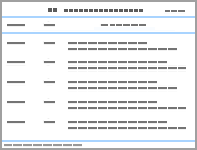
Tab.1
Parameters used in numerical examples
| 案例编号 | 流体参数 | Gs/(MN·m-2) | 土体参数 | 是否液化 | |||
|---|---|---|---|---|---|---|---|
| H/m | d/m | U/(m·s-1) | ks/(μm·s-1) | Dr | |||
| 1 | 3.0 | 10.0 | 1.0 | 5.0 | 50 | 0.45 | 是 |
| 2 | 2.7 | 10.0 | 1.0 | 5.0 | 50 | 0.45 | 是 |
| 3 | 2.4 | 10.0 | 1.0 | 5.0 | 50 | 0.45 | 否 |
| 4 | 2.1 | 10.0 | 1.0 | 5.0 | 50 | 0.45 | 否 |
| 5 | 1.8 | 10.0 | 1.0 | 5.0 | 50 | 0.45 | 否 |
| 6 | 3.0 | 9.0 | 1.0 | 5.0 | 50 | 0.45 | 是 |
| 7 | 3.0 | 8.0 | 1.0 | 5.0 | 50 | 0.45 | 是 |
| 8 | 3.0 | 7.0 | 1.0 | 5.0 | 50 | 0.45 | 是 |
| 9 | 3.0 | 6.0 | 1.0 | 5.0 | 50 | 0.45 | 是 |
| 10 | 3.0 | 10.0 | 0.9 | 5.0 | 50 | 0.45 | 是 |
| 11 | 3.0 | 10.0 | 0.8 | 5.0 | 50 | 0.45 | 是 |
| 12 | 3.0 | 10.0 | 0.7 | 5.0 | 50 | 0.45 | 是 |
| 13 | 3.0 | 10.0 | 0.6 | 5.0 | 50 | 0.45 | 是 |
| 14 | 3.0 | 10.0 | 1.0 | 4.5 | 50 | 0.45 | 是 |
| 15 | 3.0 | 10.0 | 1.0 | 4.0 | 50 | 0.45 | 是 |
| 16 | 3.0 | 10.0 | 1.0 | 3.5 | 50 | 0.45 | 是 |
| 17 | 3.0 | 10.0 | 1.0 | 3.0 | 50 | 0.45 | 是 |
| 18 | 3.0 | 10.0 | 1.0 | 5.0 | 45 | 0.45 | 是 |
| 19 | 3.0 | 10.0 | 1.0 | 5.0 | 40 | 0.45 | 是 |
| 20 | 3.0 | 10.0 | 1.0 | 5.0 | 35 | 0.45 | 是 |
| 21 | 3.0 | 10.0 | 1.0 | 5.0 | 30 | 0.45 | 是 |
| 22 | 3.0 | 10.0 | 1.0 | 5.0 | 50 | 0.405 | 是 |
| 23 | 3.0 | 10.0 | 1.0 | 5.0 | 50 | 0.360 | 是 |
| 24 | 3.0 | 10.0 | 1.0 | 5.0 | 50 | 0.315 | 是 |
| 25 | 3.0 | 10.0 | 1.0 | 5.0 | 50 | 0.270 | 是 |

Fig.7
Pore pressure in the seabed with wave cycles at (x, z)=(35.5, -1) m


Fig.8
Liquefaction analysis along horizontal and vertical directions in the seabed


Fig.9
Distributions of pore pressure at wave trough at different fluid or soil parameters along the seabed depth direction


Fig.10
Comparative analysis of maximum liquefaction depth at different fluid or soil parameters in the u-p coupled model


Fig.11
Comparisons of maximum liquefaction depth between u-p coupled model and QS coupled model

| [1] | 刘晓磊, 张淑玉, 郑杰文, 等. 黄河三角洲极端风暴诱发地质灾害研究进展及对策[J]. 海洋地质前沿, 2022, 38(11): 28-39. |
| LIU Xiaolei, ZHANG Shuyu, ZHENG Jiewen, et al. Research progress and countermeasures on geological hazards induced by extreme storms in the Yellow River Delta[J]. Marine Geology Frontiers, 2022, 38(11): 28-39. | |
| [2] | 常方强, 贾永刚. 黄河口粉质土海床液化过程的现场试验研究[J]. 土木工程学报, 2012, 45(1): 121-126. |
| CHANG Fangqiang, JIA Yonggang. In-situ test to study silt liquefaction at the subaqueous delta of Yellow River[J]. China Civil Engineering Journal, 2012, 45(1): 121-126. | |
| [3] | SUMER B M. Liquefaction around marine structures[M]. New Jersey, USA: World Scientific, 2014. |
| [4] |
BIOT M A. General theory of three-dimensional consolidation[J]. Journal of Applied Physics, 1941, 12(2): 155-164.
doi: 10.1063/1.1712886 URL |
| [5] |
YAMAMOTO T, KONING H L, SELLMEIJER H, et al. On the response of a poro-elastic bed to water waves[J]. Journal of Fluid Mechanics, 1978, 87: 193-206.
doi: 10.1017/S0022112078003006 URL |
| [6] |
JENG D S, RAHMAN M. Effective stresses in a porous seabed of finite thickness: Inertia effects[J]. Canadian Geotechnical Journal, 2000, 37(6): 1383-1392.
doi: 10.1139/t00-063 URL |
| [7] |
JENG D S, CHA D H. Effects of dynamic soil behavior and wave non-linearity on the wave-induced pore pressure and effective stresses in porous seabed[J]. Ocean Engineering, 2003, 30(16): 2065-2089.
doi: 10.1016/S0029-8018(03)00070-2 URL |
| [8] |
YANG G, YE J H. Wave & current-induced progressive liquefaction in loosely deposited seabed[J]. Ocean Engineering, 2017, 142: 303-314.
doi: 10.1016/j.oceaneng.2017.07.027 URL |
| [9] |
SEED H B, RAHMAN M S. Wave-induced pore pressure in relation to ocean floor stability of cohesionless soils[J]. Marine Geotechnology, 1978, 3(2): 123-150.
doi: 10.1080/10641197809379798 URL |
| [10] | MCDOUGAL W G, TSAI Y T, LIU L F, et al. Wave-induced pore water pressure accumulation in marine soils[J]. Journal of Offshore Mechanics & Arctic Engineering, 1989, 111(1): 52-56. |
| [11] |
JENG D S, SEYMOUR B R, LI J. A new approximation for pore pressure accumulation in marine sediment due to water waves[J]. International Journal for Numerical and Analytical Methods in Geomechanics, 2007, 31(1): 53-69.
doi: 10.1002/nag.v31:1 URL |
| [12] | SUMER B M, FREDSØE J. The mechanics of scour in the marine environment[M]. New Jersey, USA: World Scientific, 2002. |
| [13] | SUMER B M, KIRCA V S O, FREDSOE J. Experimental validation of a mathematical model for seabed liquefaction under waves[J]. International Journal of Offshore and Polar Engineering, 2012, 22: 133-141. |
| [14] |
JENG D S, ZHAO H Y. Two-dimensional model for accumulation of pore pressure in marine sediments[J]. Journal of Waterway, Port, Coastal, and Ocean Engineering, 2015, 141(3): 04014042.
doi: 10.1061/(ASCE)WW.1943-5460.0000282 URL |
| [15] |
TSOTSOS S, GEORGIADIS M, DAMASKINIDOU A. Numerical analysis of liquefaction potential of partially drained seafloors[J]. Coastal Engineering, 1989, 13(2): 117-128.
doi: 10.1016/0378-3839(89)90019-7 URL |
| [16] |
LIU X L, CUI H N, JENG D S, et al. A coupled mathematical model for accumulation of wave-induced pore water pressure and its application[J]. Coastal Engineering, 2019, 154: 103577.
doi: 10.1016/j.coastaleng.2019.103577 URL |
| [17] | HIGUERA P. Application of computational fluid dynamics to wave action on structures[D]. Spain: University of Cantabria, 2015. |
| [18] | ANDERSON J D. Computational fluid dynamics: the basics with applications[M]. New York, USA: McGraw-Hill, 1995. |
| [19] | SCHÄFFER H A, GERT K. Review of multidirectional active wave absorption methods[J]. Journal of Waterway Port Coastal & Ocean Engineering, 2000, 126(2): 88-97. |
| [20] |
QI W G, LI C F, JENG D S, et al. Combined wave-current induced excess pore-pressure in a sandy seabed: Flume observations and comparisons with theoretical models[J]. Coastal Engineering, 2019, 147: 89-98.
doi: 10.1016/j.coastaleng.2019.02.006 URL |
| [21] |
YE J H, JENG D S. Effects of bottom shear stresses on the wave-induced dynamic response in a porous seabed: PORO-WSSI (shear) model[J]. Acta Mechanica Sinica, 2011, 27: 898-911.
doi: 10.1007/s10409-011-0469-1 URL |
| [22] |
ZEN K, YAMAZAKI H. Mechanism of wave-induced liquefaction and densification in seabed[J]. Soils and Foundations, 2008, 30(4): 90-104.
doi: 10.3208/sandf1972.30.4_90 URL |
| [23] |
ISHIHARA H. Liquefaction and flow failure during earthquakes[J]. Géotechnique, 1993, 43: 351-451.
doi: 10.1680/geot.1993.43.3.351 URL |
| [24] |
YE J H. 3D liquefaction criteria for seabed considering the cohesion and friction of soil[J]. Applied Ocean Research, 2012, 37: 111-119.
doi: 10.1016/j.apor.2012.04.004 URL |
| [1] | YAO Shun, MA Ning, DING Junjie, GU Xiechong. Numerical Simulation and Uncertainty Analysis of Wave-Co-Current Interaction with Irregular Waves [J]. Journal of Shanghai Jiao Tong University, 2021, 55(3): 337-346. |
| [2] | DING Junjie,MA Ning,GU Xiechong. Development of a Wave-Absorbing Device with Multiple Porous Plates for Circulating Water Channel and Simulation on Its Performance [J]. Journal of Shanghai Jiaotong University, 2020, 54(1): 52-59. |
| [3] | SHAN Tiebing,YANG Jianmin,LI Xin,XIAO Longfei. Current Effects on Wave Run-Up Characteristics Around Column [J]. Journal of Shanghai Jiaotong University, 2014, 48(1): 116-124. |
| Viewed | ||||||
|
Full text |
|
|||||
|
Abstract |
|
|||||
