

Journal of Shanghai Jiao Tong University ›› 2026, Vol. 60 ›› Issue (4): 628-641.doi: 10.16183/j.cnki.jsjtu.2024.123
• New Type Power System and the Integrated Energy • Previous Articles Next Articles
YUAN Kai1, WANG Feifei2, ZHANG Shenxi2,3( ), SUN Chongbo1, SONG Yi1, HOU Ruosong4, CHENG Haozhong2
Received:2024-04-11
Revised:2024-06-11
Accepted:2024-06-28
Online:2026-04-28
Published:2026-04-29
Contact:
ZHANG Shenxi
E-mail:willzsx@sjtu.edu.cn
CLC Number:
YUAN Kai, WANG Feifei, ZHANG Shenxi, SUN Chongbo, SONG Yi, HOU Ruosong, CHENG Haozhong. Distributed Optimization of Distribution Network Considering Regulation of 5G Base Station Communication Load and Backup Energy Storage[J]. Journal of Shanghai Jiao Tong University, 2026, 60(4): 628-641.
Add to citation manager EndNote|Ris|BibTeX
URL: https://xuebao.sjtu.edu.cn/EN/10.16183/j.cnki.jsjtu.2024.123

Fig.1
Dispatchable capacity of 5G base station energy storage


Fig.2
Flow chart of model solving


Fig.3
Topology of distribution network


Fig.4
Wind and solar power output and load data

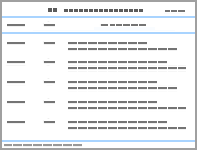
Tab.1
Equipment parameter settings of 5G base station
| 参数 | 数值 |
|---|---|
| AAU休眠状态功耗/kW | 0.1 |
| BBU激活、休眠状态功耗/kW | 0.3,0.2 |
| 储能额定能量/(kW·h) | 20 |
| 储能最大充放电功率/kW | 5 |
| 储能荷电状态上、下限 | 0.9,0.1 |
| 储能充、放电效率 | 0.9 |

Fig.5
Communication load rate of 5G base stations in different types of areas

Tab.2
Time-of-use electricity tariff
| 时段 | 售电电价/ [元·(kW·h)-1] |
|---|---|
| 23:00—7:00 | 0.58 |
| 7:00—10:00, 13:00—17:00, 22:00—23:00 | 0.86 |
| 10:00—13:00, 17:00—22:00 | 1.18 |

Fig.6
Trading power of each stakeholder


Fig.7
Electricity prices and power traded between 5G base stations and other stakeholders


Fig.8
Electricity prices and power traded between distribution networks and other stakeholders

Tab.3
Comparison of benefits before and after participating in electricity cooperation 元
| 利益主体 | 参与合作 | 不参与合作 |
|---|---|---|
| 配电网 | 26259.87 | 25479.45 |
| 分布式风电 | 609.40 | 427.68 |
| 分布式光伏 | 211.58 | 161.73 |
| 5G基站 | -739.99 | -1552.39 |

Fig.9
Power and communication load transfer results of 5G base stations in different regions


Fig.10
Energy storage capacity and charging and discharging results in different regions of Scenario 1


Fig.11
Total dispatchable capacity of energy storage before and after communication load transfer and total power of 5G base stations

Tab.4
Comparison of benefits for stakeholders in different scenarios 元
| 利益主体 | 场景1 | 场景2 |
|---|---|---|
| 配电网 | 26259.87 | 26493.98 |
| 分布式风电 | 609.40 | 612.94 |
| 分布式光伏 | 211.58 | 211.25 |
| 5G基站 | -739.99 | -972.78 |

Fig.12
Iterative convergence results


Fig.13
Total dispatchable capacity and total power of 5G base stations before and after energy storage aggregation

| [1] |
BUZZI S, CHIH-LIN I, KLEIN T E, et al. A survey of energy-efficient techniques for 5G networks and challenges ahead[J]. IEEE Journal on Selected Areas in Communications, 2016, 34(4): 697-709.
doi: 10.1109/JSAC.2016.2550338 URL |
| [2] | POMPILI D, HAJISAMI A, TRAN T X. Elastic resource utilization framework for high capacity and energy efficiency in cloud RAN[J]. IEEE Communications Magazine, 2016, 54(1): 26-32. |
| [3] | WU Q Q, LI G Y, CHEN W, et al. An overview of sustainable green 5G networks[J]. IEEE Wireless Communications, 2017, 24(4): 72-80. |
| [4] |
SHENG M, ZHAI D S, WANG X J, et al. Intelligent energy and traffic coordination for green cellular networks with hybrid energy supply[J]. IEEE Transactions on Vehicular Technology, 2017, 66(2): 1631-1646.
doi: 10.1109/TVT.2016.2554618 URL |
| [5] | ÇELEBI H, YAPıCı Y, GÜVENÇ İ, et al. Load-based on/off scheduling for energy-efficient delay-tolerant 5G networks[J]. IEEE Transactions on Green Communications & Networking, 2019, 3(4): 955-970. |
| [6] |
曾博, 穆宏伟, 董厚琦, 等. 考虑5G基站低碳赋能的主动配电网优化运行[J]. 上海交通大学学报, 2022, 56(3): 279-292.
doi: 10.16183/j.cnki.jsjtu.2021.367 |
| ZENG Bo, MU Hongwei, DONG Houqi, et al. Optimization of active distribution network operation considering decarbonization endowment from 5G base stations[J]. Journal of Shanghai Jiao Tong University, 2022, 56(3): 279-292. | |
| [7] | 李昆, 方家琨, 艾小猛, 等. 考虑通信与配套设备协调优化的大规模5G宏基站网络能量管理模型[J]. 中国电机工程学报, 2023, 43(14): 5391-5404. |
| LI Kun, FANG Jiakun, AI Xiaomeng, et al. Energy management model of large-scale 5G macro base station network considering the coordinated optimization of communication equipment and standard equipment[J]. Proceedings of the CSEE, 2023, 43(14): 5391-5404. | |
| [8] |
YONG P, ZHANG N, LI Y W, et al. Analytical adequacy evaluation for power consumers with UPS in distribution networks[J]. IEEE Transactions on Smart Grid, 2022, 13(6): 4424-4435.
doi: 10.1109/TSG.2022.3176292 URL |
| [9] |
李俊双, 胡炎, 邰能灵. 计及通信负载与供电可靠性的5G基站储能与配电网协同优化调度[J]. 上海交通大学学报, 2023, 57(7): 791-802.
doi: 10.16183/j.cnki.jsjtu.2021.542 |
| LI Junshuang, HU Yan, TAI Nengling. Collaborative optimization scheduling of 5G base station energy storage and distribution network considering communication load and power supply reliability[J]. Journal of Shanghai Jiao Tong University, 2023, 57(7): 791-802. | |
| [10] | 麻秀范, 刘子豪, 王颖, 等. 考虑通信负载迁移及储能动态备电的5G基站光伏消纳能力研究[J]. 电工技术学报, 2023, 38(21): 5832-5845. |
| MA Xiufan, LIU Zihao, WANG Ying, et al. Research on photovoltaic absorption capacity of 5G base station considering communication load migration and energy storage dynamic backup[J]. Transactions of China Electrotechnical Society, 2023, 38(21): 5832-5845. | |
| [11] | 乔锐勋, 王军华, 韦道明, 等. 计及后备储能及空调调度潜力的5G基站多时间尺度优化方法[J]. 电力系统自动化, 2023, 47(4): 111-120. |
| QIAO Ruixun, WANG Junhua, WEI Daoming, et al. Multi-time-scale optimization method for 5G base station considering backup energy storage and air-conditioning scheduling potential[J]. Automation of Electric Power Systems, 2023, 47(4): 111-120. | |
| [12] | 毛安家, 张丽婧, 盛倩倩. 考虑通信可靠性的5G基站储能聚合商优化调度研究[J]. 电工技术学报, 2023, 38(9): 2364-2374. |
| MAO Anjia, ZHANG Lijing, SHENG Qianqian. Research on optimal scheduling of 5G base station energy storage aggregators considering communication reliability[J]. Transactions of China Electrotechnical Society, 2023, 38(9): 2364-2374. | |
| [13] | 高洪超, 李楚一, 王冠雄, 等. 聚合规模化5G基站的虚拟电厂动态构建与响应实证[J]. 电力系统自动化, 2024, 48(18): 47-55. |
| GAO Hongchao, LI Chuyi, WANG Guanxiong, et al. Dynamic construction and response demonstration of virtual power plant with aggregated large-scale 5G base stations[J]. Automation of Electric Power Systems, 2024, 48(18): 47-55. | |
| [14] |
叶鹏, 刘思奇, 关多娇, 等. 基于自适应均衡技术的分布式储能聚合模型及评估方法[J]. 上海交通大学学报, 2021, 55(12): 1689-1699.
doi: 10.16183/j.cnki.jsjtu.2021.322 |
| YE Peng, LIU Siqi, GUAN Duojiao, et al. An aggregation model and evaluation method of distributed energy storage based on adaptive equalization technology[J]. Journal of Shanghai Jiao Tong University, 2021, 55(12): 1689-1699. | |
| [15] | 王艳茹, 尹喜阳, 欧清海, 等. 基于能量共享与交易协同的5G融合配电网基站储能调控方法[J]. 中国电力, 2023, 56(6): 61-70. |
| WANG Yanru, YIN Xiyang, OU Qinghai, et al. Energy storage regulation method of base stations in 5G integrated distribution network based on energy sharing and trading coordination[J]. Electric Power, 2023, 56(6): 61-70. | |
| [16] | 胡龙, 方八零, 樊飞龙, 等. 用户-基站-充电站能量共享、互动优化方法及在园区中的应用[J/OL]. 上海交通大学学报. https://link.cnki.net/doi/10.16183/j.cnki.jsjtu.2023.407. |
| HU Long, FANG Baling, FAN Feilong, et al. Energy sharing and interaction optimization method for users, base stations, and charging stations: An application in parks[J/OL]. Journal of Shanghai Jiao Tong University. https://link.cnki.net/doi/10.16183/j.cnki.jsjtu.2023.407. | |
| [17] | 陈实, 郭正伟, 周步祥, 等. 考虑5G基站储能可调度容量的有源配电网协同优化调度方法[J]. 电网技术, 2023, 47(12): 5225-5241. |
| CHEN Shi, GUO Zhengwei, ZHOU Buxiang, et al. Coordinated optimization scheduling for active distribution networks considering schedulable capacity of energy storage for 5G base stations[J]. Power System Technology, 2023, 47(12): 5225-5241. | |
| [18] |
HAN J P, LIU N, HUANG Y J, et al. Collaborative optimization of distribution network and 5G mobile network with renewable energy sources in smart grid[J]. International Journal of Electrical Power & Energy Systems, 2021, 130: 107027.
doi: 10.1016/j.ijepes.2021.107027 URL |
| [19] | 田松. 5G基站规模部署后节能降耗策略研究[J]. 通信与信息技术, 2021(4): 23-24. |
| TIAN Song. Research on energy saving and consumption reduction strategy after scale deployment of 5G base station[J]. Communication & Information Technology, 2021(4): 23-24. | |
| [20] | 周宸宇, 冯成, 王毅. 基于移动用户接入控制的5G通信基站需求响应[J]. 中国电机工程学报, 2021, 41(16): 5452-5462. |
| ZHOU Chenyu, FENG Cheng, WANG Yi. Demand response of 5G communication base stations based on admission control of mobile users[J]. Proceedings of the CSEE, 2021, 41(16): 5452-5462. | |
| [21] | 帅农村, 邵泽才. 基于多元线性回归算法的5G基站能耗模型[J]. 移动通信, 2020, 44(5): 32-36. |
| SHUAI Nongcun, SHAO Zecai. 5G base station energy consumption model based on multiple linear regression algorithm[J]. Mobile Communications, 2020, 44(5): 32-36. | |
| [22] | 刘友波, 王晴, 曾琦, 等. 能源互联网背景下5G网络能耗管控关键技术及展望[J]. 电力系统自动化, 2021, 45(12): 174-183. |
| LIU Youbo, WANG Qing, ZENG Qi, et al. Key technologies and prospects of energy consumption management for 5G network in background of energy Internet[J]. Automation of Electric Power Systems, 2021, 45(12): 174-183. | |
| [23] |
WEN Y L, HU Z C, YOU S, et al. Aggregate feasible region of DERs: Exact formulation and approximate models[J]. IEEE Transactions on Smart Grid, 2022, 13(6): 4405-4423.
doi: 10.1109/TSG.2022.3179998 URL |
| [24] | 顾欣, 王琦, 胡云龙, 等. 基于纳什议价的多微网综合能源系统分布式低碳优化运行策略[J]. 电网技术, 2022, 46(4): 1464-1482. |
| GU Xin, WANG Qi, HU Yunlong, et al. Distributed low-carbon optimal operation strategy of multi-microgrids integrated energy system based on Nash bargaining[J]. Power System Technology, 2022, 46(4): 1464-1482. | |
| [25] | 吴锦领, 楼平, 管敏渊, 等. 基于非对称纳什谈判的多微网电能共享运行优化策略[J]. 电网技术, 2022, 46(7): 2711-2723. |
| WU Jinling, LOU Ping, GUAN Minyuan, et al. Operation optimization strategy of multi-microgrids energy sharing based on asymmetric Nash bargaining[J]. Power System Technology, 2022, 46(7): 2711-2723. |
| [1] | LU Bin, WANG Yixiao, PU Chuanqing, CHEN Yunhui, CHEN Bobo, FAN Feilong. Asynchronous Coordinated Control Method for Regional Multi-Agent Integrated Energy Systems Considering Voltage Deviation [J]. Journal of Shanghai Jiao Tong University, 2025, 59(6): 758-767. |
| [2] | Duan Jizhong, Su Yan. Improved Sensitivity Encoding Parallel Magnetic Resonance Imaging Reconstruction Algorithm Based on Efficient Sum of Outer Products Dictionary Learning [J]. J Shanghai Jiaotong Univ Sci, 2025, 30(3): 555-565. |
| [3] | Duan Jizhong, Xu Yuhán, Huang Huan. Fast Parallel Magnetic Resonance Imaging Reconstruction Based on Sparsifying Transform Learning and Structured Low-Rank Model [J]. J Shanghai Jiaotong Univ Sci, 2025, 30(3): 499-509. |
| [4] | GAO Chong, DUAN Yao, CHENG Ran, CHEN Peidong, ZHOU Shucan, ZHANG Shenxi, CHEN Weilin, LIU Zhiwen. Collaborative Optimization Scheduling Method for Active Distribution Networks Considering Dispatchable Backup Batteries of 5G Base Station and Soft Open Point [J]. Journal of Shanghai Jiao Tong University, 2025, 59(11): 1603-1617. |
| [5] | FU Wenxi, DOU Zhenlan, ZHANG Chunyan, WANG Lingling, JIANG Chuanwen, XIONG Zhan. Bi-Level Optimization Operation Method of Multi-H2-IES Considering Dynamic Carbon Emission Factors [J]. Journal of Shanghai Jiao Tong University, 2024, 58(5): 610-623. |
| [6] | WANG Guanyang, LI Chen, YU Yingjie, DENG Xiaobo, LU Da, LIANG Junli, WANG Tao. Helicopter Target Recognition Based on Micro-Doppler Feature [J]. Air & Space Defense, 2024, 7(2): 63-73. |
| [7] | LI Junshuang, HU Yan, TAI Nengling. Collaborative Optimization Scheduling of 5G Base Station Energy Storage and Distribution Network Considering Communication Load and Power Supply Reliability [J]. Journal of Shanghai Jiao Tong University, 2023, 57(7): 791-802. |
| [8] | ZENG Bo, MU Hongwei, DONG Houqi, ZENG Ming. Optimization of Active Distribution Network Operation Considering Decarbonization Endowment from 5G Base Stations [J]. Journal of Shanghai Jiao Tong University, 2022, 56(3): 279-292. |
| [9] | TAN Jia, LI Zhiyi, YANG Huan, ZHAO Rongxiang, JU Ping. A Multi-Level Collaborative Load Forecasting Method for Distribution Networks Based on Distributed Optimization [J]. Journal of Shanghai Jiao Tong University, 2021, 55(12): 1544-1553. |
| [10] | LI Yuanchao,CHEN Feng. High-Rank Matrix Completion Method for Autism Spectrum Disorders [J]. Journal of Shanghai Jiaotong University, 2019, 53(6): 734-740. |
| Viewed | ||||||
|
Full text |
|
|||||
|
Abstract |
|
|||||
