

Journal of Shanghai Jiao Tong University ›› 2026, Vol. 60 ›› Issue (1): 163-174.doi: 10.16183/j.cnki.jsjtu.2023.650
• Naval Architecture, Ocean and Civil Engineering • Previous Articles
LUO Lijuan1, REN Xiang1,2( ), LI Sheng1, TANG Yong1, HE Pengyuan1
Received:2023-12-28
Revised:2024-03-11
Accepted:2024-03-22
Online:2026-01-28
Published:2026-01-27
Contact:
REN Xiang
E-mail:renxiang_bzu@126.com.
CLC Number:
LUO Lijuan, REN Xiang, LI Sheng, TANG Yong, HE Pengyuan. Calculation of Horizontal Bearing Capacity of Anti-Slide Piles Based on Soil Arching Effect and Improved Strain Wedge Model in Loess Sites[J]. Journal of Shanghai Jiao Tong University, 2026, 60(1): 163-174.
Add to citation manager EndNote|Ris|BibTeX
URL: https://xuebao.sjtu.edu.cn/EN/10.16183/j.cnki.jsjtu.2023.650

Fig.1
Principal stress distribution of soil in front of piles


Fig.2
Evolution process of passive soil arching in front of piles


Fig.3
Arch axis shape of passive soil arching


Fig.4
Relationship between soil strain of wedge-shaped body in front of pile and nonlinear deformation of pile shaft


Fig.5
Schematic diagram of strain wedge plane calculation


Fig.6
Horizontal force calculation of pile shaft using finite difference method

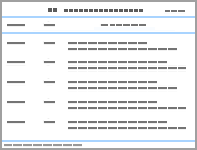
Tab.1
Finite difference unified equation for horizontally loaded piles
| 方程 | 说明 |
|---|---|
| y1-2y0+y-1=0 | 桩底弯矩M=0 |
| y2-2y1+2y-1-y-2=0 | 桩底剪力Q=0 |
| y2-4y1+6y0-4y-1+y-2=ζp0 | 桩底土抗力p0乘以系数ζ |
| y3-4y2+6y1-4y0+y-1=ζp1 | 点1处土抗力p1乘以系数ζ |
| yi+2-4yi+1+6yi-4yi-1+yi-2=ζpi | 嵌固段点i土抗力pi乘以系数ζ |
| yn1+5-4yn1+4+6yn1+3-4yn1+2+yn1+1=ζpn1+3 | 地面点n1+3土抗力pn1+3乘以系数ζ |
| yn1+5-2yn1+4+2yn1+2-yn1+1=ψQn1+3 | 地面点n1+3剪力Qn1+3乘以系数ψ |
| yi+2-2yi+1+2yi-1-yi-2=ψQi | 悬臂段点i剪力Qi乘以系数ψ |
| yn+2-2yn+1+2yn-1-yn-2=ψQn | 桩顶剪力Qn乘以系数ψ |
| yn+1-2yn+yn-1=0 | 桩顶弯矩M=0 |

Fig.7
Iterative calculation process of improved strain wedge model


Fig.8
Improved strain wedge model of row piles


Fig.9
Shape and force analysis diagram of passive soil arching


Fig.10
Force diagram of passive soil arching


Fig.11
Schematic diagram of horizontal force of improved strain wedge of row piles


Fig.12
Iterative calculation process of improved strain wedge model of row piles


Fig.13
Comparison of horizontal displacement of row piles under different loads (L=3a)


Fig.14
Comparison of bending moments of pile body under different loads (L=3a)


Fig.15
Change of soil resistance (pi) in front of pile with horizontal displacement (yi)


Fig.16
Distribution of Δpi with pile depth under different pile top loads

| [1] | 吴子树, 张利民, 胡定. 土拱的形成机理及存在条件的探讨[J]. 成都科技大学学报, 1995(2): 15-19. |
| WU Zishu, ZHANG Limin, HU Ding. Studies on the mechanism of arching action in loess[J]. Journal of Chengdu University of Science and Technology, 1995(2): 15-19. | |
| [2] | 陈鑫, 向先超, 刘凯, 等. 小桩距下的抗滑桩后滑坡推力分布规律分析[J]. 地质科技情报, 2019, 38(6): 157-164. |
| CHEN Xin, XIANG Xianchao, LIU Kai, et al. Thrust distribution law of anti-slide pile under small pile spacing[J]. Bulletin of Geological Science and Technology, 2019, 38(6): 157-164. | |
| [3] | 田洪义, 王朦, 贺建清, 等. 基于土拱效应确定桩板墙挡土板土压力[J]. 自然灾害学报, 2023, 32(1): 105-113. |
| TIAN Hongyi, WANG Meng, HE Jianqing, et al. Determination of earth pressure on retraining plate of sheet-pile retaining wall based on soil arching effects[J]. Journal of Natural Disasters, 2023, 32(1): 105-113. | |
| [4] | 赵明华, 廖彬彬, 刘思思. 基于拱效应的边坡抗滑桩桩间距计算[J]. 岩土力学, 2010, 31(4): 1211-1216. |
| ZHAO Minghua, LIAO Binbin, LIU Sisi. Calculation of anti-slide piles spacing based on soil arching effect[J]. Rock and Soil Mechanics, 2010, 31(4): 1211-1216. | |
| [5] | 李邵军, 陈静, 练操. 边坡桩-土相互作用的土拱力学模型与桩间距问题[J]. 岩土力学, 2010, 31(5): 1352-1358. |
| LI Shaojun, CHEN Jing, LIAN Cao. Mechanical model of soil arch for interaction of piles and slope and problem of pile spacing[J]. Rock and Soil Mechanics, 2010, 31(5): 1352-1358. | |
| [6] | 张玲, 陈金海, 赵明华. 考虑土拱效应的悬臂式抗滑桩最大桩间距确定[J]. 岩土力学, 2019, 40(11): 4497-4505. |
| ZHANG Ling, CHEN Jinhai, ZHAO Minghua. Determination of maximum spacing of cantilever anti-slide piles with consideration of soil arching effect[J]. Rock and Soil Mechanics, 2019, 40(11): 4497-4505. | |
| [7] |
任翔, 罗丽娟, 李芳涛, 等. 黄土地区抗滑桩嵌固段桩前被动土拱形成演化过程试验[J]. 中国公路学报, 2022, 35(11): 86-96.
doi: 10.19721/j.cnki.1001-7372.2022.11.009 |
|
REN Xiang, LUO Lijuan, LI Fangtao, et al. Experimental study on the evolution of passive soil arch in front of antislide piles in loess area[J]. China Journal of Highway and Transport, 2022, 35(11): 86-96.
doi: 10.19721/j.cnki.1001-7372.2022.11.009 |
|
| [8] | 毛坚强, 徐骏, 杨磊. 滑体段采用m法模型的抗滑桩计算方法[J]. 岩土力学, 2018, 39(4): 1197-1202. |
| MAO Jianqiang, XU Jun, YANG Lei. An improved method for stabilising pile by using m-method model to the whole pile[J]. Rock and Soil Mechanics, 2018, 39(4): 1197-1202. | |
| [9] |
POULOS H G, CHEN L T. Pile response due to excavation-induced lateral soil movement[J]. Journal of Geotechnical and Geoenvironmental Engineering, 1997, 123(2): 94-99.
doi: 10.1061/(ASCE)1090-0241(1997)123:2(94) URL |
| [10] |
CHEN L T, POULOS H G, LOGANATHAN N. Pile responses caused by tunneling[J]. Journal of Geotechnical and Geoenvironmental Engineering, 1999, 125(3): 207-215.
doi: 10.1061/(ASCE)1090-0241(1999)125:3(207) URL |
| [11] |
LOGANATHAN N, POULOS H G. Analytical prediction for tunneling-induced ground movements in clays[J]. Journal of Geotechnical and Geoenvironmental Engineering, 1998, 124(9): 846-856.
doi: 10.1061/(ASCE)1090-0241(1998)124:9(846) URL |
| [12] | 梁发云, 于峰, 李镜培, 等. 土体水平位移对邻近既有桩基承载性状影响分析[J]. 岩土力学, 2010, 31(2): 449-454. |
| LIANG Fayun, YU Feng, LI Jingpei, et al. Analysis of the bearing capacity of a single pile under adjacent building subjected to lateral soil movements[J]. Rock and Soil Mechanics, 2010, 31(2): 449-454. | |
| [13] | 黄茂松, 张陈蓉, 李早. 开挖条件下非均质地基中被动群桩水平反应分析[J]. 岩土工程学报, 2008, 30(7): 1017-1023. |
| HUANG Maosong, ZHANG Chenrong, LI Zao. Lateral response of passive pile groups due to excavation induced soil movement in stratified soils[J]. Chinese Journal of Geotechnical Engineering, 2008, 30(7): 1017-1023. | |
| [14] | 郑俊杰, 章荣军, 潘玉涛, 等. 考虑开挖卸荷及变形耦合效应的被动桩分析方法[J]. 岩土工程学报, 2012, 34(4): 606-614. |
| ZHENG Junjie, ZHANG Rongjun, PAN Yutao, et al. Analytic method for passive piles considering excavation-induced unloading effects and deformation coupling effect[J]. Chinese Journal of Geotechnical Engineering, 2012, 34(4): 606-614. | |
| [15] | 竺明星, 龚维明, 何小元, 等. 堆载作用下考虑土拱效应的被动桩变形内力半解析解[J]. 岩土工程学报, 2013, 35(11): 1997-2008. |
| ZHU Mingxing, GONG Weiming, HE Xiaoyuan, et al. Semi-analytical solution to deformation and internal force of passive piles under surcharge loads considering soil arching effect[J]. Chinese Journal of Geotechnical Engineering, 2013, 35(11): 1997-2008. | |
| [16] | 李忠诚, 梁志荣. 侧移土体成拱效应及被动桩计算模式分析[J]. 岩土工程学报, 2011, 33 (Sup.1): 106-111. |
| LI Zhongcheng, LIANG Zhirong. Soil arching effect and calculation model for soil pressures of passive piles[J]. Chinese Journal of Geotechnical Engineering, 2011, 33 (Sup.1): 106-111. | |
| [17] | ASHOUR M, PILLING P, NORRIS G. Lateral behavior of pile groups in layered soils[J]. Journal of Geotechnical and Geo-environmental Engineering, 2004, 130(6): 580-592. |
| [18] |
XU L Y, CAI F, WANG G X, et al. Nonlinear analysis of single laterally loaded piles in clays using modified strain wedge model[J]. International Journal of Civil Engineering, 2017, 15(6): 895-906.
doi: 10.1007/s40999-016-0072-8 URL |
| [19] | 杨晓峰, 张陈蓉, 黄茂松, 等. 砂土中桩土侧向相互作用的应变楔模型修正[J]. 岩土力学, 2016, 37(10): 2877-2884. |
| YANG Xiaofeng, ZHANG Chenrong, HUANG Maosong, et al. Modification of strain wedge method for lateral soil-pile interaction in sand[J]. Rock and Soil Mechanics, 2016, 37(10): 2877-2884. | |
| [20] | 杨明辉, 冯超博, 赵明华, 等. 考虑坡度效应的水平受荷桩应变楔计算方法[J]. 岩土力学, 2018, 39(4): 1271-1280. |
| YANG Minghui, FENG Chaobo, ZHAO Minghua, et al. A method for calculating laterally loaded pile using strain wedge model considering slope effect[J]. Rock and Soil Mechanics, 2018, 39(4): 1271-1280. | |
| [21] |
PENG W Z, ZHAO M H, XIAO Y, et al. Analysis of laterally loaded piles in sloping ground using a modified strain wedge model[J]. Computers and Geotechnics, 2019, 107: 163-175.
doi: 10.1016/j.compgeo.2018.12.007 URL |
| [22] |
CHEN L, PANG L, JIANG C, et al. Analysis method for bearing capacity of laterally loaded rigid piles on slopes using improved failure wedge model[J]. Computers and Geotechnics, 2022, 145: 104700.
doi: 10.1016/j.compgeo.2022.104700 URL |
| [23] |
LIU P, JIANG C, ZENG F. Analysis of laterally loaded piles in sand considering the relationship between the strain wedge model and failure wedge model[J]. Computers and Geotechnics, 2023, 154: 105149.
doi: 10.1016/j.compgeo.2022.105149 URL |
| [24] | 任翔. 抗滑桩嵌固段桩前被动土拱效应及其对桩身受力的影响[D]. 西安: 长安大学, 2022. |
| REN Xiang. Passive soil-arch effect in front of embedded section of anti-slide piles and its influence on the force of the piles[D]. Xi’an: Chang’an University, 2022. | |
| [25] | 方瑾瑾, 冯以鑫, 赵伟龙, 等. 真三轴条件下原状黄土的非线性本构模型[J]. 岩土力学, 2019, 40(2): 517-528. |
| FANG Jinjin, FENG Yixin, ZHAO Weilong, et al. Nonlinear constitutive model for intact loess in true tri-axial tests[J]. Rock and Soil Mechanics, 2019, 40(2): 517-528. | |
| [26] | 李广信. 高等土力学[M]. 北京: 清华大学出版社, 2016. |
| LI Guangxin. Advanced soil mechanics[M]. Beijing: Tsinghua University Press, 2016. | |
| [27] | 金鑫, 王铁行, 郝延周, 等. 桩间黄土卸荷湿陷过程中卸荷量计算方法初探[J]. 岩土力学, 2022, 43(9): 2399-2409. |
| JIN Xin, WANG Tiehang, HAO Yanzhou, et al. Preliminary study of unloading calculation method in the unloading collapse process of loess between piles[J]. Rock and Soil Mechanics, 2022, 43(9): 2399-2409. | |
| [28] | 杨雪强, 吉小明, 张新涛. 抗滑桩桩间土拱效应及其土拱模式分析[J]. 中国公路学报, 2014, 27(1): 30-37. |
| YANG Xueqiang, JI Xiaoming, ZHANG Xintao. Analysis of soil arching effect between anti-slide piles and different arch body modes[J]. China Journal of Highway and Transport, 2014, 27(1): 30-37. |
| [1] | WU Zhijian1,2,3,LEI Tian1,2,CHEN Yujin1,2,WANG Ping1,2,3,CHAI Shaofeng1,2,3. Deformation and Instability Characteristics of Loess Slope Based on Shaking Table Model Test [J]. Journal of Shanghai Jiaotong University, 2015, 49(07): 940-945. |
| [2] | ZHANG Ze-zhong1,2 (张泽忠), WU Zhi-jian1,2,3* (吴志坚), CHEN Tuo4 (陈 拓), LEI Tian1,2 (雷 天). Analysis on Intensity Zonation in Thick Loess Region [J]. Journal of shanghai Jiaotong University (Science), 2013, 18(6): 724-728. |
| [3] | He B.-G.; Zhu Y.-Q.; Ye C.-L.; Zhang Z.-Q.. Model test for dynamic construction mechanical effect of large-span loess tunnel [J]. J Shanghai Jiaotong Univ Sci, 2011, 16(1): 112-117. |
| [4] | WU Zhi-Jian-1, 2 , ZENG Li-Feng-1, WANG Lan-Min-1, 2 , YU Kai-3, CHEN Tuo-1. Application of Microtremor Method in Shear Wave Velocity Structure Survey at Loess Regions [J]. Journal of Shanghai Jiaotong University, 2011, 45(05): 696-700. |
| Viewed | ||||||
|
Full text |
|
|||||
|
Abstract |
|
|||||
