

Journal of Shanghai Jiao Tong University ›› 2025, Vol. 59 ›› Issue (10): 1442-1450.doi: 10.16183/j.cnki.jsjtu.2023.581
• New Type Power System and the Integrated Energy • Previous Articles Next Articles
LI Yibo1, ZHOU Qian2, ZHU Dandan2( ), JIANG Yafeng1, WU Qiuwei3, CHEN Jian1
Received:2023-11-17
Revised:2024-02-03
Accepted:2024-02-19
Online:2025-10-28
Published:2025-10-24
CLC Number:
LI Yibo, ZHOU Qian, ZHU Dandan, JIANG Yafeng, WU Qiuwei, CHEN Jian. Control Strategy for Improving Active Frequency Support Capability of Offshore Wind Farm[J]. Journal of Shanghai Jiao Tong University, 2025, 59(10): 1442-1450.
Add to citation manager EndNote|Ris|BibTeX
URL: https://xuebao.sjtu.edu.cn/EN/10.16183/j.cnki.jsjtu.2023.581
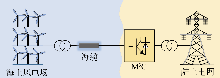
Fig.1
Topology structure of wind farm grid connected by low frequency AC transmission systems
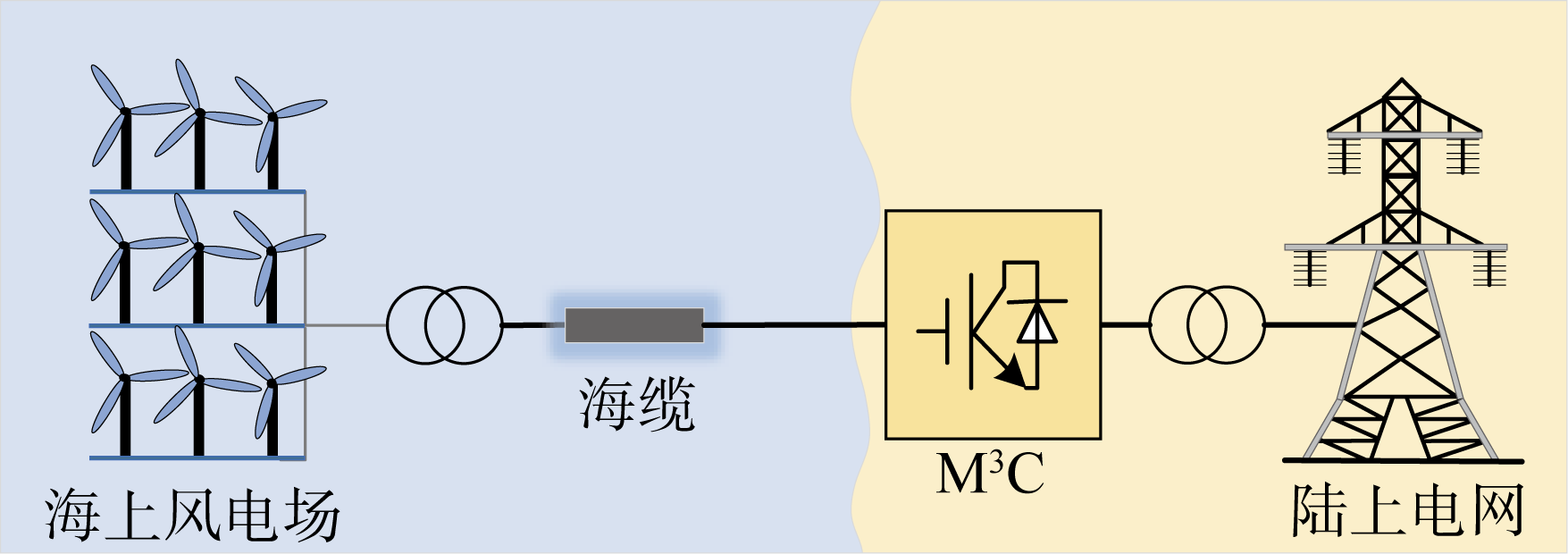
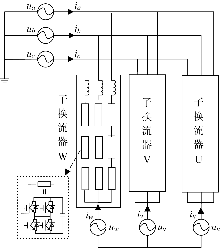
Fig.2
M3C main circuit structure
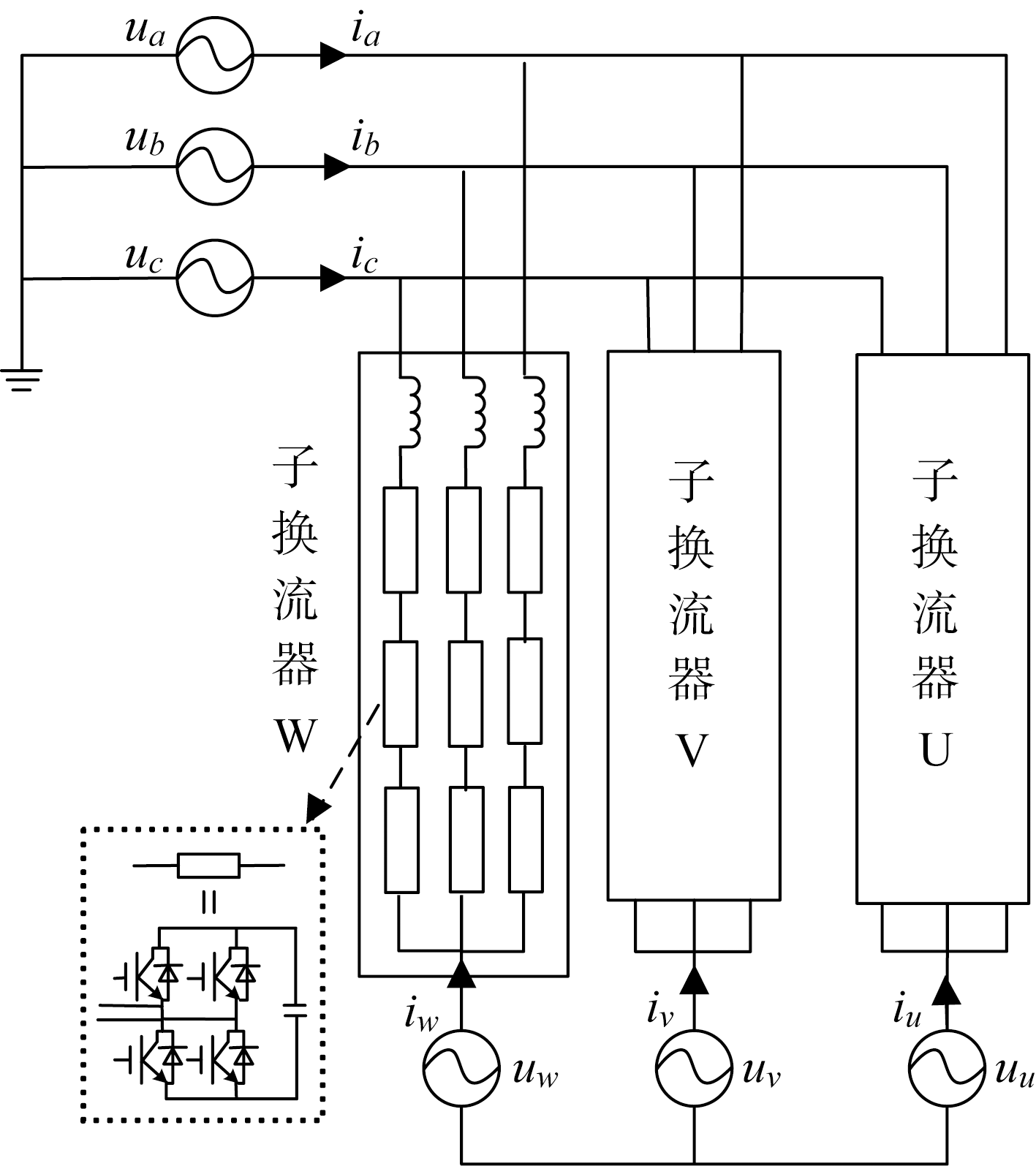
Fig.3
Control strategy block of M3C power frequency side
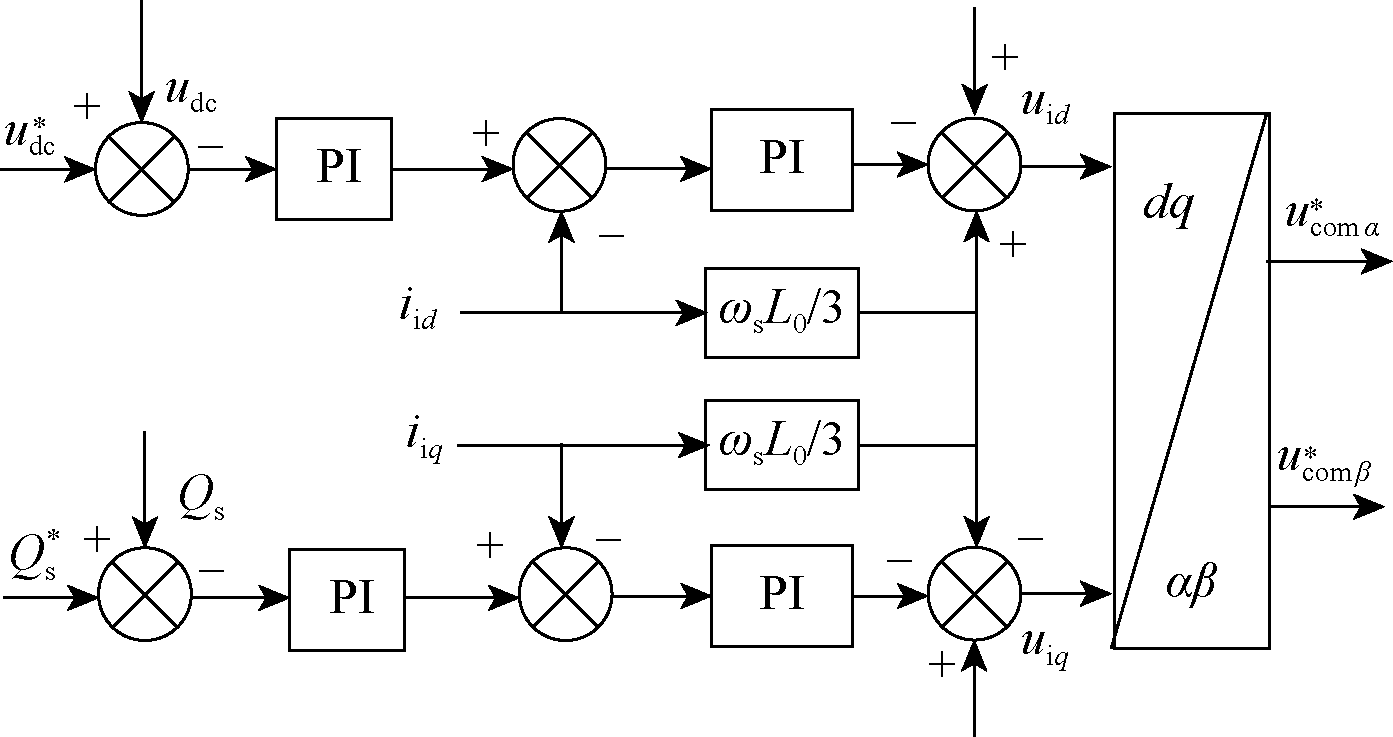
Fig.4
Control strategy block of M3C low frequency side
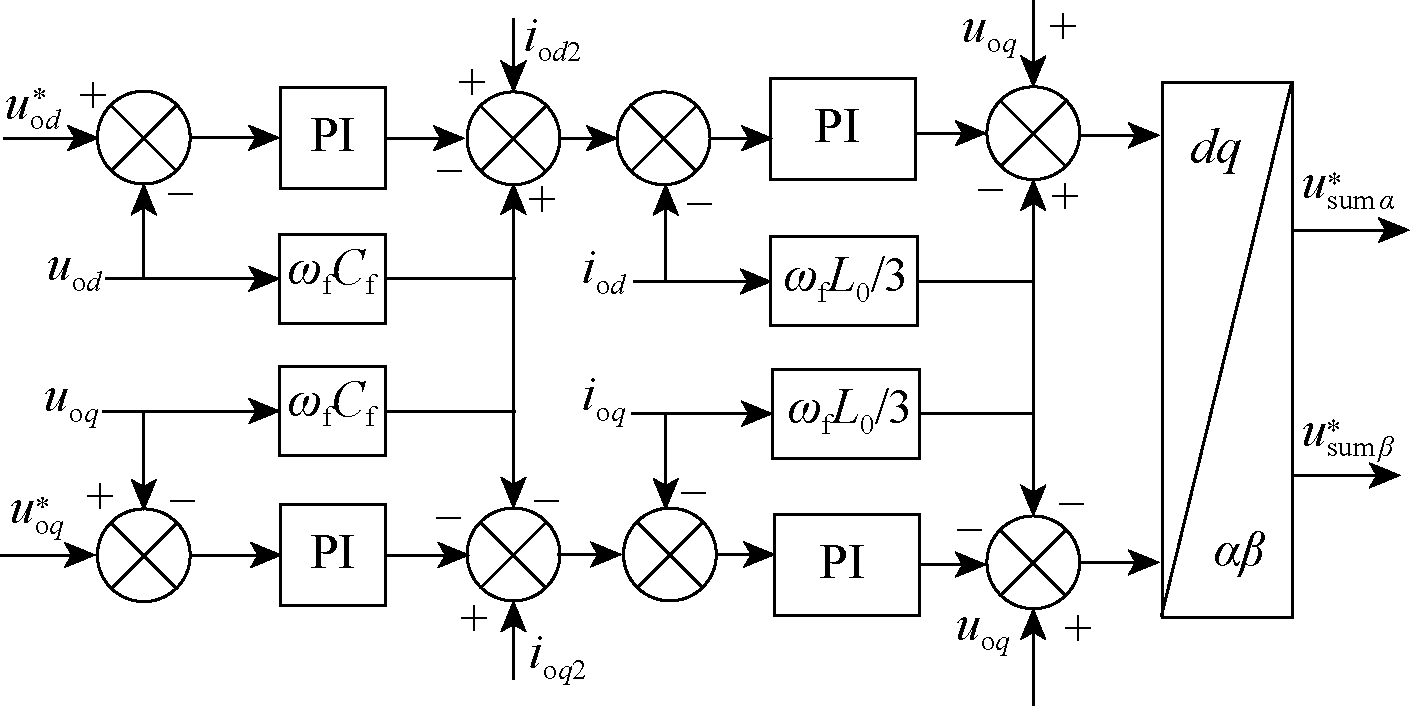
Fig.5
Control block of permanent magnet synchronous generator
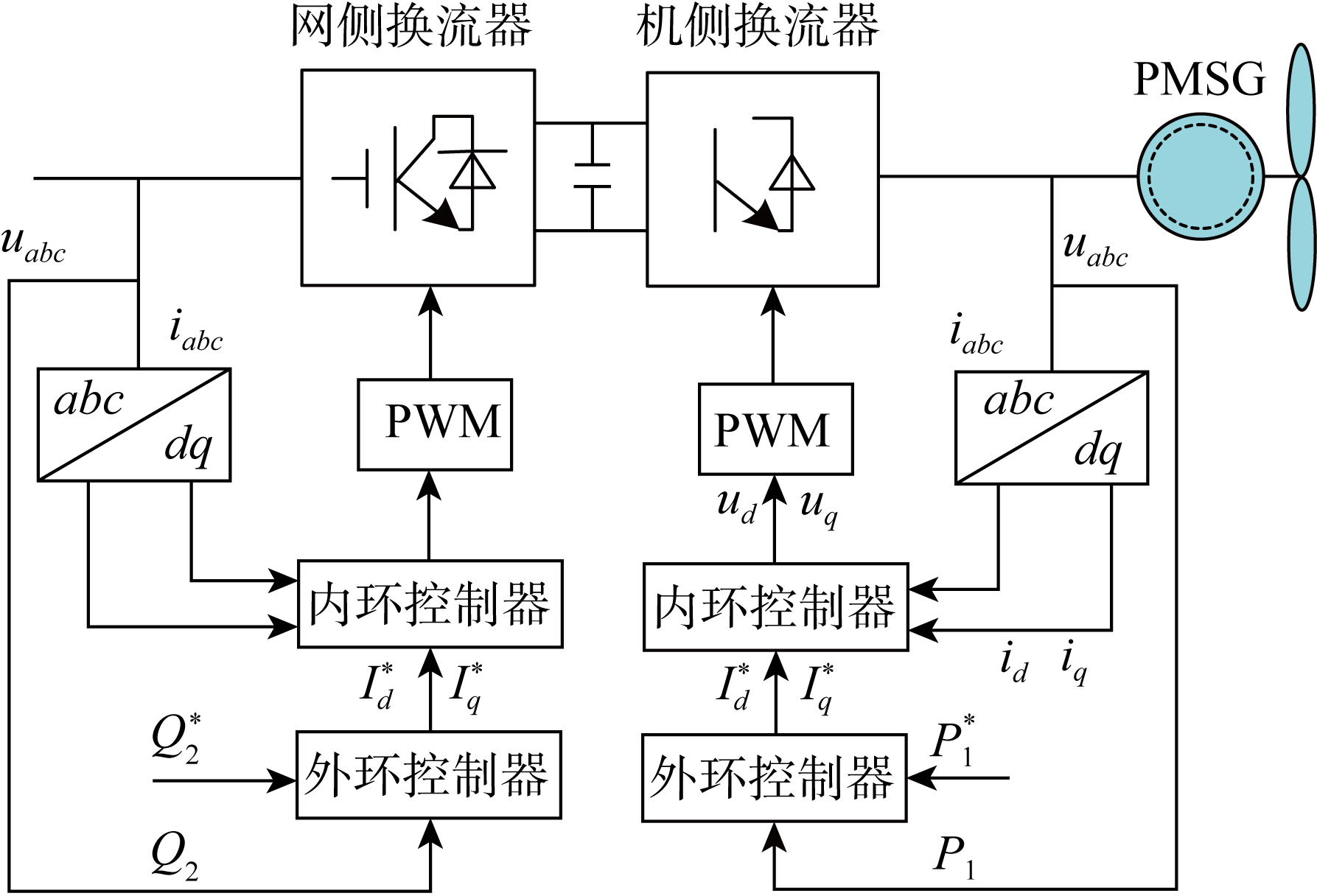
Fig.6
Synchronous generator inertia response and primary frequency modulation
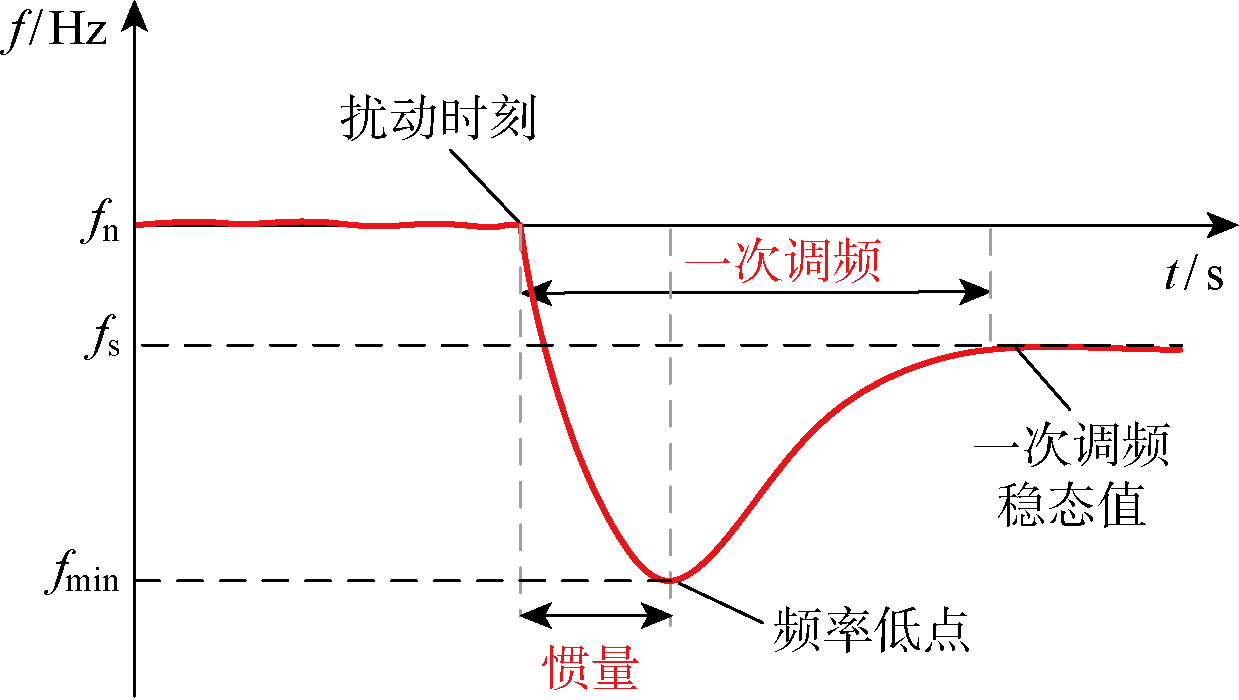
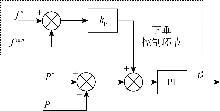
Fig.7
Additional droop control
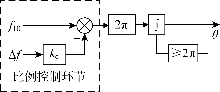
Fig.8
Frequency droop control
Fig.9
Cooperative control block of system
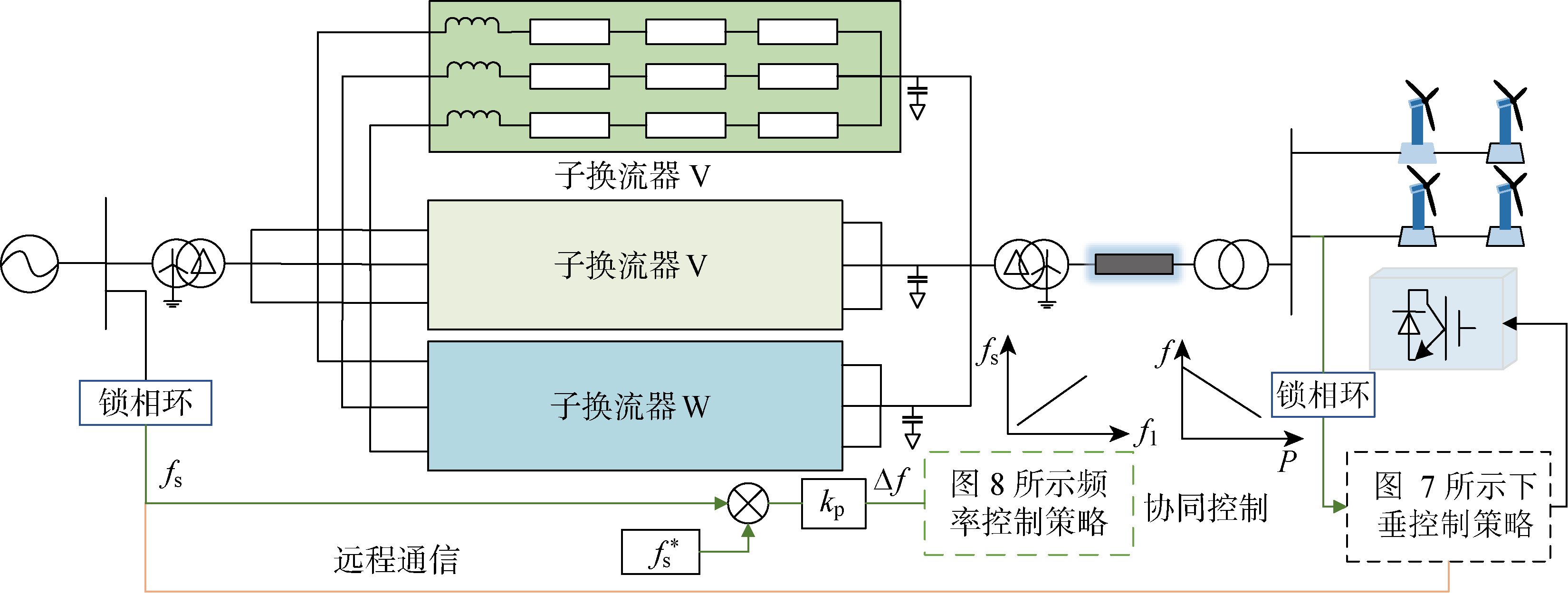
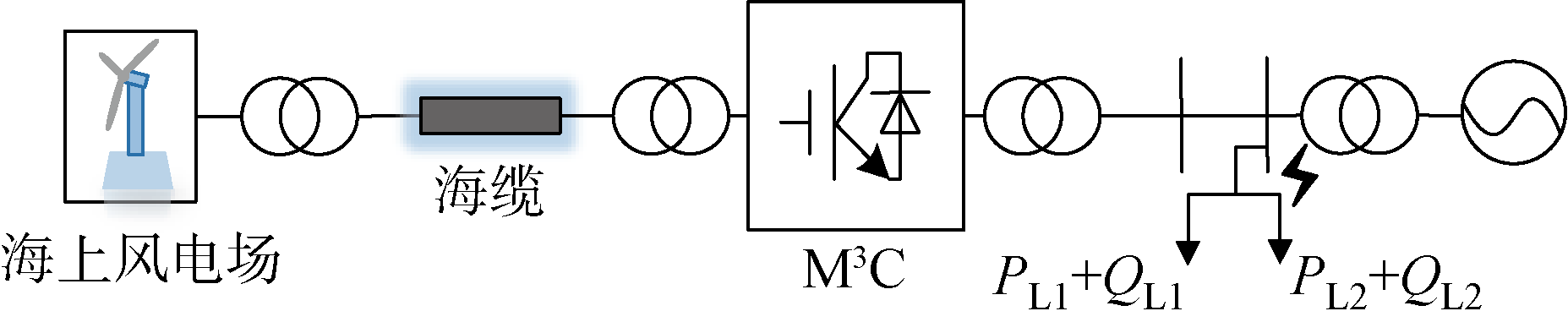
Fig.10
Structure of simulation model
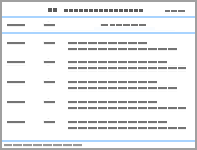
Tab.1
System parameters
| 装置 | 参数 | 数值 |
|---|---|---|
| 风电场 | 额定容量/MW | 300 |
| 低频系统 | 额定线电压/kV | 35 |
| 额定频率/HZ | 20 | |
| 海缆 | 长度/km | 28 |
| M3C换流站 | 额定容量/MW | 400 |
| 子模块电容/mF | 4 | |
| 额定电容电压/kV | 3 | |
| 桥臂模块数/个 | 100 | |
| 桥臂电感/mH | 40 | |
| 阀额定电压/kV | 12 | |
| 工频系统 | 额定线电压/kV | 35 |
| 额定频率/HZ | 50 |
Tab.2
Synchronous machine parameters
| 参数 | 数值 |
|---|---|
| 额定容量/MW | 300 |
| 机端电压/kV | 13.8 |
| 惯性时间常数/s | 3.2 |
| 交轴电抗xd,x'd,x″d | 1.305, 0.296, 0.252 |
| 直轴电抗xq,x'q,x″q | 0.474, 0.243, 0.18 |
| 时间常数 | 1.01, 0.053, 0.1 |
| 励磁调节器增益 | 300 |
| 励磁时间常数/ms | 1 |
| 原动机调差参数 | 0.35 |
| 伺服时间常数/s | 0.5 |
Fig.11
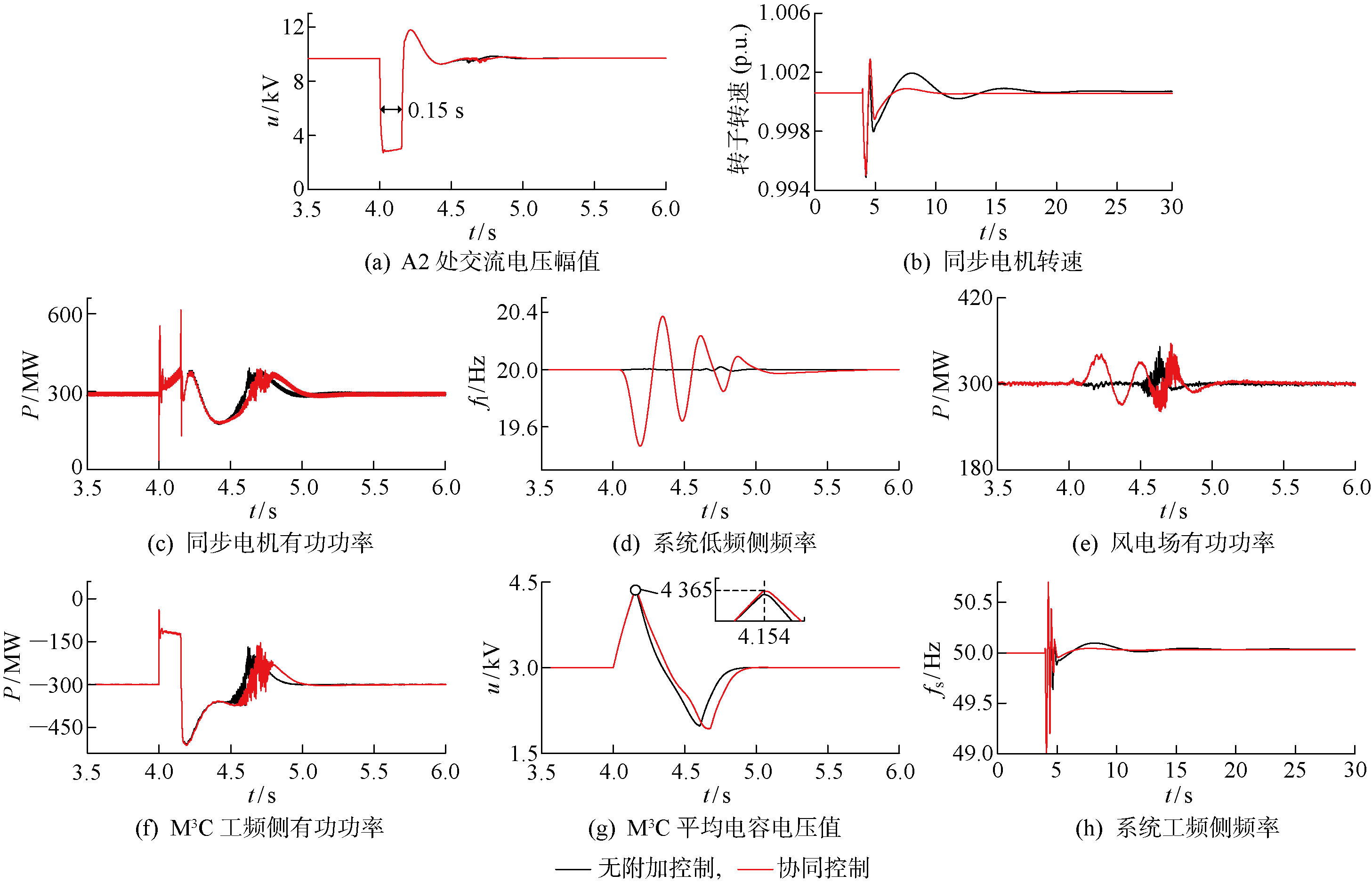
System response at sudden load increase of load
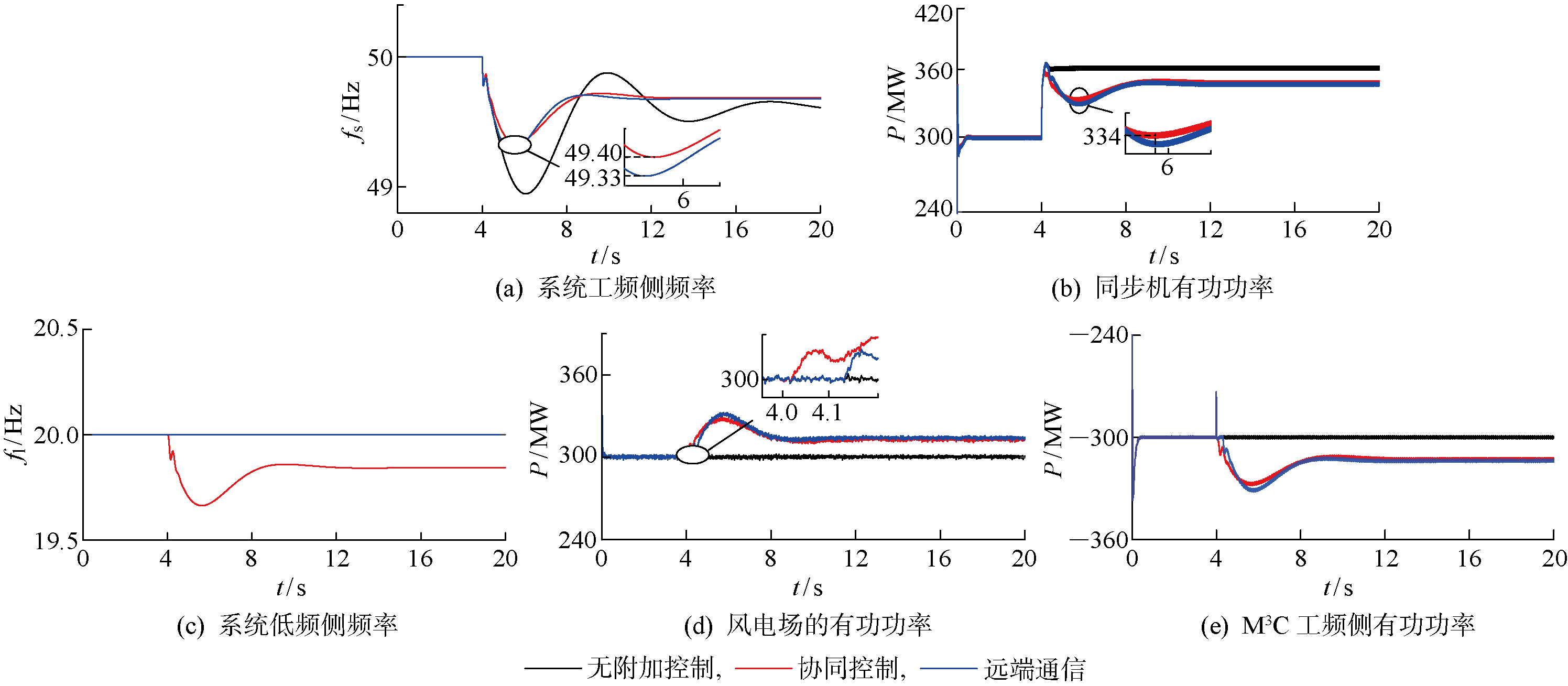
Fig.12
Response of three-phase AC short circuit fault system
| [1] | 汤广福, 贺之渊, 庞辉. 柔性直流输电工程技术研究、应用及发展[J]. 电力系统自动化, 2013, 37(15): 3-14. |
| TANG Guangfu, HE Zhiyuan, PANG Hui. Research, application and development of VSC-HVDC engineering technology[J]. Automation of Electric Power Systems, 2013, 37(15): 3-14. | |
| [2] | 王锡凡, 卫晓辉, 宁联辉, 等. 海上风电并网与输送方案比较[J]. 中国电机工程学报, 2014, 34(31): 5459-5466. |
| WANG Xifan, WEI Xiaohui, NING Lianhui, et al. Integration techniques and transmission schemes for off-shore wind farms[J]. Proceedings of the CSEE, 2014, 34(31): 5459-5466. | |
| [3] | 李峰, 王广柱. 模块化多电平矩阵变换器电容电压纹波稳态分析[J]. 中国电机工程学报, 2013, 33(24): 52-58. |
| LI Feng, WANG Guangzhu. Steady-state analysis of sub-modular capacitor voltage ripple in modular multilevel matrix converters[J]. Proceedings of the CSEE, 2013, 33(24): 52-58. | |
| [4] | LIU S Q, ZHAO B Y, WANG G, et al. An improved phasor method for modelling and analysis of modular multilevel matrix converter[J]. IEEE Transactions on Power Delivery, 2021, 36(3): 1744-1755. |
| [5] | OATES C. A methodology for developing ‘Chainlink’ converters[C]// 2009 13th European Conference on Power Electronics and Applications. Barcelona, Spain: IEEE, 2009: 1-10. |
| [6] | KAMMERER F, KOLB J, BRAUN M. A novel cascaded vector control scheme for the modular multilevel matrix converter[C]// IECON 2011-37th Annual Conference of the IEEE Industrial Electronics Society. Melbourne, Australia: IEEE, 2011: 1097-1102. |
| [7] | KAMMERER F, KOLB J, BRAUN M. Fully decoupled current control and energy balancing of the modular multilevel matrix converter[C]// 2012 15th International Power Electronics and Motion Control Conference. Novi Sad, Serbia: IEEE, 2012: LS2a.3-1-LS2a. 3-8. |
| [8] | 吴小丹. 面向低频海上风电送出的模块化多电平矩阵变换器输入输出侧解耦控制[J]. 电网技术, 2022, 46(8): 2909-2923. |
| WU Xiaodan. Input/output side decoupling control of modular multilevel matrix converter for low-frequency offshore wind power transmission[J]. Power System Technology, 2022, 46(8): 2909-2923. | |
| [9] | LIU S Q, WANG X F, MENG Y Q, et al. A decoupled control strategy of modular multilevel matrix converter for fractional frequency transmission system[J]. IEEE Transactions on Power Delivery, 2017, 32(4): 2111-2121. |
| [10] | 孙玉巍, 常静恬, 付超, 等. 分频输电系统模块化多电平矩阵变换器谐波特性分析[J]. 电力工程技术, 2022, 41(5): 21-30. |
| SUN Yuwei, CHANG Jingtian, FU Chao, et al. Harmonic characteristics analysis of modular multilevel matrix converter for fractional frequency transmission system[J]. Electric Power Engineering Technology, 2022, 41(5): 21-30. | |
| [11] | 马睿聪, 刘福锁, 曹永吉, 等. 电力系统频率动态与功角振荡的耦合特性分析[J]. 电力工程技术, 2023, 42(4): 102-112. |
| MA Ruicong, LIU Fusuo, CAO Yongji, et al. Coupling characteristic analysis of power system frequency dynamic and power angle oscillation[J]. Electric Power Engineering Technology, 2023, 42(4): 102-112. | |
| [12] | LIU H Z, CHEN Z. Contribution of VSC-HVDC to frequency regulation of power systems with offshore wind generation[J]. IEEE Transactions on Energy Conversion, 2015, 30(3): 918-926. |
| [13] | 李宇骏, 杨勇, 李颖毅, 等. 提高电力系统惯性水平的风电场和VSC-HVDC协同控制策略[J]. 中国电机工程学报, 2014, 34(34): 6021-6031. |
| LI Yujun, YANG Yong, LI Yingyi, et al. Coordinated control of wind farms and VSC-HVDC to improve inertia level of power system[J]. Proceedings of the CSEE, 2014, 34(34): 6021-6031. | |
| [14] | 江守其, 徐亚男, 李国庆, 等. 提升海上风电经柔直联网系统频率稳定性的协调控制策略[J]. 电力自动化设备, 2023, 43(9): 194-201. |
| JIANG Shouqi, XU Yanan, LI Guoqing, et al. Coordinated control strategy for improving frequency stability of MMC-HVDC connecting offshore wind power[J]. Electric Power Automation Equipment, 2023, 43(9): 194-201. | |
| [15] | 徐政, 张哲任. 低频输电技术原理之一: M-3C的数学模型与等效电路[J]. 浙江电力, 2021, 40(10): 13-21. |
| XU Zheng, ZHANG Zheren. Principles of low frequency power transmission technology: Part 1-mathematical model and equivalent circuit of M3C[J]. Zhejiang Electric Power, 2021, 40(10): 13-21. | |
| [16] | 年珩, 金萧, 李光辉. 特高压直流换相失败对送端电网风机暂态无功特性的影响分析[J]. 中国电机工程学报, 2020, 40(13): 4111-4122. |
| NIAN Heng, JIN Xiao, LI Guanghui. Influence of UHV DC commutation failure on the transient reactive power characteristics of wind turbines in sending terminal grid[J]. Proceedings of the CSEE, 2020, 40(13): 4111-4122. | |
| [17] | 秦世耀. 风电机组惯量及一次调频优化控制研究[D]. 南京: 东南大学, 2021. |
| QIN Shiyao. Research on optimal control strategy of inertia and primary frequency regulation for wind turbines[D]. Nanjing: Southeast University, 2021. | |
| [18] |
周涛, 黄菊, 韩汝帅, 等. 综合惯性控制下风机惯性支撑能力分析及等效惯量评估[J]. 上海交通大学学报, 2024, 58(12): 1915-1924.
doi: 10.16183/j.cnki.jsjtu.2023.161 |
| ZHOU Tao, HUANG Ju, HAN Rushuai, et al. Analysis of inertial support capacity and equivalent inertia evaluation of wind turbine under comprehensive inertial control[J]. Journal of Shanghai Jiao Tong University, 2024, 58(12): 1915-1924. | |
| [19] | AIK D L H. A general-order system frequency response model incorporating load shedding: Analytic modeling and applications[J]. IEEE Transactions on Power Systems, 2006, 21(2): 709-717. |
| [1] | BAI Yunjie, XIE Kaigui, SHAO Changzheng, HU Bo. Game Optimization Scheduling of Wind-Solar-Hydro-Thermal Power Alliance in Upstream and Downstream Regions of Cascade Hydropower [J]. Journal of Shanghai Jiao Tong University, 2026, 60(2): 224-234. |
| [2] | FAN Hong, WEI Xinwu, JIA Qingshan, LUO Jiayi. Collaborative Optimization Scheduling Method for Electric-Gas-Thermal Multi-Energy System Under Energy-Transportation Integration [J]. Journal of Shanghai Jiao Tong University, 2026, 60(2): 211-223. |
| [3] | WANG Rui, BAI Xiaoqing, HUANG Shengquan. Local Control Strategy for Optimal Power Flow in Low-Voltage Distribution Network Based on Robust Stochastic Optimization [J]. Journal of Shanghai Jiao Tong University, 2026, 60(2): 235-245. |
| [4] | LIU Donglin, ZHOU Xia, DAI Jianfeng, XIE Xiangpeng, TANG Yi, LI Juanshi. Bi-Level Optimization Scheduling Strategy for Building Integrated Energy System Considering Virtual Energy Storage [J]. Journal of Shanghai Jiao Tong University, 2026, 60(1): 61-73. |
| [5] | LIU Lin, YANG Siyu, HUANG Xianan, CHEN Yantao, XU Huashuai, WANG Lingling, JIANG Chuanwen. Data-Model Hybrid-Driven Simulation Method for Electric Vehicle Fleet Behavior [J]. Journal of Shanghai Jiao Tong University, 2026, 60(1): 51-60. |
| [6] | FENG Mengyuan, WEN Shuli, SHI Shanshan, WANG Haojing, ZHU Miao, YANG Wen. A Review of Optimal Allocation and Operation of Energy Storage System for Peak Shaving and Frequency Regulation in New Type Power Systems [J]. Journal of Shanghai Jiao Tong University, 2026, 60(1): 1-18. |
| [7] | WU Dongge, CHANG Xinyue, XUE Yixun, HUANG Yuxi, SU Jia, LI Zening, SUN Hongbin. Low-Carbon Energy Management in Active Distribution Networks Based on Dynamic Carbon Entropy [J]. Journal of Shanghai Jiao Tong University, 2025, 59(12): 1795-1804. |
| [8] | YANG Kaitao, LUO Xi, XUE Bike, GUO Yanmin, FU Xueqian. Transaction Mechanism of Medium- and Long-Term Continuous Centralized Auction Considering Available Transmission Capacity [J]. Journal of Shanghai Jiao Tong University, 2025, 59(11): 1647-1659. |
| [9] | PAN Yi, WANG Mingshen, MIAO Huiyu, YUAN Xiaodong, HAN Huachun. An Evolutionary Game Approach to Incentive Mechanism of Vehicle-to-Grid [J]. Journal of Shanghai Jiao Tong University, 2025, 59(11): 1637-1646. |
| [10] | ZHANG Jiamin, CAI Ye, TANG Xiafei, TAN Yudong, CAO Yijia, LI Junxiong. Information Gap Decision Theory-Spectrum Clustering Typical Scenario Generation Considering Source Load Uncertainty [J]. Journal of Shanghai Jiao Tong University, 2025, 59(11): 1625-1636. |
| [11] | LI Haoran, SUN Hongbin, XUE Yixun, CHANG Xinyue, SU Jia. Low-Carbon Economic Dispatch of Energy Distribution Network in Synthetic Ammonia Park Considering Hydrogen Production by Water Electrolysis [J]. Journal of Shanghai Jiao Tong University, 2025, 59(11): 1618-1624. |
| [12] | GAO Chong, DUAN Yao, CHENG Ran, CHEN Peidong, ZHOU Shucan, ZHANG Shenxi, CHEN Weilin, LIU Zhiwen. Collaborative Optimization Scheduling Method for Active Distribution Networks Considering Dispatchable Backup Batteries of 5G Base Station and Soft Open Point [J]. Journal of Shanghai Jiao Tong University, 2025, 59(11): 1603-1617. |
| [13] | ZHANG Lei, LI Ran, TANG Lun, CHEN Sijie, ZHAO Shizhen, SU Fu. Neural Branching Power-Computation Network Fast Optimization Method Considering Computing Demand Response [J]. Journal of Shanghai Jiao Tong University, 2025, 59(11): 1592-1602. |
| [14] | SUN Yi, LIU Zhuang, HUANG Ting, PENG Jie, WANG Xiaotian, LIU Chuang. Decision-Making Model of Electricity Procurement and Sale for Electricity Retailers Considering the Uncertainty of Prosumers [J]. Journal of Shanghai Jiao Tong University, 2025, 59(10): 1476-1486. |
| [15] | LIU Yanhang, QIAO Ruyu, LIANG Nan, CHEN Yu, YU Kai, WU Hanxiao. Renewable Energy Consumption Strategies of Power System Integrated with Electric Vehicle Clusters Based on Load Alignment and Deep Reinforcement Learning [J]. Journal of Shanghai Jiao Tong University, 2025, 59(10): 1464-1475. |
| Viewed | ||||||
|
Full text |
|
|||||
|
Abstract |
|
|||||
