

Journal of Shanghai Jiao Tong University ›› 2024, Vol. 58 ›› Issue (12): 1846-1856.doi: 10.16183/j.cnki.jsjtu.2023.139
• New Type Power System and the Integrated Energy • Previous Articles Next Articles
ZHAN Bochun1, FENG Changsen2, WANG Xiaohui3, ZHANG Heng3, MA Junwei4, WEN Fushuan1( )
)
Received:2023-04-17
Revised:2023-07-13
Accepted:2023-07-14
Online:2024-12-28
Published:2025-01-06
CLC Number:
ZHAN Bochun, FENG Changsen, WANG Xiaohui, ZHANG Heng, MA Junwei, WEN Fushuan. A P2P Electricity-Carbon Trading Mechanism for Distributed Prosumers Based on Carbon Emission Flow Model[J]. Journal of Shanghai Jiao Tong University, 2024, 58(12): 1846-1856.
Add to citation manager EndNote|Ris|BibTeX
URL: https://xuebao.sjtu.edu.cn/EN/10.16183/j.cnki.jsjtu.2023.139

Fig.1
Time scale of electricity spot market, carbon emission trading market, and P2P trading


Fig.2
Iterative process of improved Benders decomposition

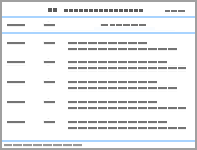
Tab.1
Comparison of computational performance
| 产消者 数量/个 | Benders分解 | ADMM | 集中式算法 | |||||||
|---|---|---|---|---|---|---|---|---|---|---|
| 迭代 次数/次 | 总计算 时间/s | 最优解/元 | 迭代 次数/次 | 总计算 时间/s | 最优解/元 | 总计算 时间/s | 最优解/元 | |||
| 12 | 17 | 209.78 | 51.04 | 19 | 218.07 | 51.04 | 6.28 | 51.04 | ||
| 20 | 23 | 577.30 | 76.97 | 28 | 601.58 | 76.97 | 13.42 | 76.97 | ||
| 30 | 36 | 1634.76 | 108.65 | 47 | 1695.74 | 108.65 | 25.76 | 108.65 | ||
Tab.2
Average algorithm running time by iteration
| 产消者个数 | 每轮迭代平均计算时间/s | |
|---|---|---|
| 主问题 | 子问题 | |
| 5 | 2.48 | 0.75 |
| 12 | 11.46 | 0.88 |
| 20 | 24.13 | 0.97 |
| 30 | 44.25 | 1.16 |
| 50 | 77.29 | 1.28 |
| 100 | 167.34 | 1.42 |

Fig.3
Energy consumption structure of prosumers in 24 periods


Fig.4
Scheduling plans of energy storage system for Prosumer e


Fig.5
Energy trading plans and carbon intensity for Prosumer e


Fig.6
Total P2P trading amount of each prosumer in 24 periods


Fig.7
Settlement fee of P2P trading

Tab.3
Comparisons of results obtained in three modes
| 序号 | 产消者总成本/元 | P2P交易率/% | 碳排 放量/kg | |||
|---|---|---|---|---|---|---|
| 电能成本 | 碳排放 权成本 | 电能 交易率 | 碳配额 交易率 | |||
| 模式1 | 49.21 | 1.83 | 55.44 | 61.78 | 59.42 | |
| 模式2 | 93.46 | 6.37 | 0 | 0 | 82.75 | |
| 模式3 | 48.17 | 0 | 38.68 | 0 | 70.44 | |
| [1] | 中华人民共和国国家能源局. 能源碳达峰碳中和标准化提升行动计划[EB/OL]. (2022-10-09)[2023-04-05]. http://www.nea.gov.cn/2022-10/09/c_1310668927.htm. |
| National Energy Administration of the People’s Republic of China. Action plan for energy carbon peaking and carbon neutrality standardization improvement[EB/OL]. (2022-10-09)[2023-04-05]. http://www.nea.gov.cn/2022-10/09/c_1310668927.htm. | |
| [2] | 秦博宇, 周星月, 丁涛, 等. 全球碳市场发展现状综述及中国碳市场建设展望[J]. 电力系统自动化, 2022, 46(21): 186-199. |
| QIN Boyu, ZHOU Xingyue, DING Tao, et al. Review on development of global carbon market and prospect of China’s carbon market construction[J]. Automation of Electric Power Systems, 2022, 46(21): 186-199. | |
| [3] | CAO Z W, ZHOU X, HU H, et al. Toward a systematic survey for carbon neutral data centers[J]. IEEE Communications Surveys & Tutorials, 2022, 24(2): 895-936. |
| [4] | 王健, 周念成, 王强钢, 等. 基于区块链和连续双向拍卖机制的微电网直接交易模式及策略[J]. 中国电机工程学报, 2018, 38(17): 5072-5084. |
| WANG Jian, ZHOU Niancheng, WANG Qianggang, et al. Electricity direct transaction mode and strategy in microgrid based on blockchain and continuous double auction mechanism[J]. Proceedings of the CSEE, 2018, 38(17): 5072-5084. | |
| [5] | 高红均, 张凡, 刘俊勇, 等. 考虑多产消者差异化特征的社区微网系统P2P交易机制设计[J]. 中国电机工程学报, 2022, 42(4): 1455-1470. |
| GAO Hongjun, ZHANG Fan, LIU Junyong, et al. Design of P2P transaction mechanism considering differentiation characteristics of multiple prosumers in community microgrid system[J]. Proceedings of the CSEE, 2022, 42(4): 1455-1470. | |
| [6] | 刘连光, 潘明明, 田世明, 等. 考虑源网荷多元主体的售电竞争非合作博弈方法[J]. 中国电机工程学报, 2017, 37(6): 1618-1626. |
| LIU Lianguang, PAN Mingming, TIAN Shiming, et al. A non-cooperative game analysis of an competitive electricity retail considering multiple subjects of source-grid-load[J]. Proceedings of the CSEE, 2017, 37(6): 1618-1626. | |
| [7] | CUI S C, WANG Y W, SHI Y, et al. A new and fair peer-to-peer energy sharing framework for energy buildings[J]. IEEE Transactions on Smart Grid, 2020, 11(5): 3817-3826. |
| [8] | MORSTYN T, TEYTELBOYM A, MCCULLOCH M D. Bilateral contract networks for peer-to-peer energy trading[J]. IEEE Transactions on Smart Grid, 2019, 10(2): 2026-2035. |
| [9] | KIM J, DVORKIN Y. A P2P-dominant distribution system architecture[J]. IEEE Transactions on Power Systems, 2020, 35(4): 2716-2725. |
| [10] | WANG B X, DUAN M S. Consignment auctions of emissions trading systems: An agent-based approach based on China’s practice[J]. Energy Economics, 2022, 112: 106187. |
| [11] | YANG Y X, XU X. Production and carbon emission abatement decisions under different carbon policies: Supply chain network equilibrium models with consumers’ low-carbon awareness[J]. International Transactions in Operational Research, 2024, 31(4): 2734-2764. |
| [12] | FENG F, DU X, SI Q, et al. Hybrid game optimization of microgrid cluster (MC) based on service provider (SP) and tiered carbon price[J]. Energies, 2022, 15(14): 5291. |
| [13] | KANG C Q, ZHOU T R, CHEN Q X, et al. Carbon emission flow from generation to demand: A network-based model[J]. IEEE Transactions on Smart Grid, 2015, 6(5): 2386-2394. |
| [14] | YAN Z Y, ZHOU T, ZHANG H, et al. Real-time carbon flow algorithm of electrical power systems based on network power decomposition[C]// 2021 IEEE Conference on Telecommunications, Optics and Computer Science. Shenyang, China: IEEE, 2021: 467-470. |
| [15] | CHENG Y H, ZHANG N, WANG Y, et al. Modeling carbon emission flow in multiple energy systems[J]. IEEE Transactions on Smart Grid, 2019, 10(4): 3562-3574. |
| [16] | WANG Y Q, QIU J, TAO Y C, et al. Carbon-oriented operational planning in coupled electricity and emission trading markets[J]. IEEE Transactions on Power Systems, 2020, 35(4): 3145-3157. |
| [17] | POURAKBARI-KASMAEI M, LEHTONEN M, CONTRERAS J, et al. Carbon footprint management: A pathway toward smart emission abatement[J]. IEEE Transactions on Industrial Informatics, 2020, 16(2): 935-948. |
| [18] | NAN J P, FENG J R, DENG X, et al. Hierarchical low-carbon economic dispatch with source-load bilateral carbon-trading based on aumann-shapley method[J]. Energies, 2022, 15(15): 5359. |
| [19] | 赵伟, 熊正勇, 潘艳, 等. 计及碳排放流的电力系统低碳规划[J]. 电力系统自动化, 2023, 47(9): 23-33. |
| ZHAO Wei, XIONG Zhengyong, PAN Yan, et al. Low-carbon planning of power system considering carbon emission flow[J]. Automation of Electric Power Systems, 2023, 47(9): 23-33. | |
| [20] | 张笑演, 王橹裕, 黄蕾, 等. 考虑扩展碳排放流和碳交易议价模型的园区综合能源优化调度[J]. 电力系统自动化, 2023, 47(9): 34-46. |
| ZHANG Xiaoyan, WANG Luyu, HUANG Lei, et al. Optimal dispatching of park-level integrated energy system considering augmented carbon emission flow and carbon trading bargain model[J]. Automation of Electric Power Systems, 2023, 47(9): 34-46. | |
| [21] | RAHMANIANI R, AHMED S, CRAINIC T G, et al. The benders dual decomposition method[J]. Operations Research, 2020, 68(3): 878-895. |
| [22] | ZOU J K, AHMED S, SUN X A. Stochastic dual dynamic integer programming[J]. Mathematical Programming, 2019, 175(1): 461-502. |
| [23] | IRIA J, COELHO A, SOARES F. Network-secure bidding strategy for aggregators under uncertainty[J]. Sustainable Energy, Grids & Networks, 2022, 30: 100666. |
| [24] | LU S, GU W, ZHANG C, et al. Hydraulic-thermal cooperative optimization of integrated energy systems: A convex optimization approach[J]. IEEE Transactions on Smart Grid, 2020, 11(6): 4818-4832. |
| [25] | LI G G, LI Q Q, YANG X, et al. General Nash bargaining based direct P2P energy trading among prosumers under multiple uncertainties[J]. International Journal of Electrical Power & Energy Systems, 2022, 143: 108403. |
| [26] | SI F Y, HAN Y H, XU Q Q, et al. Cloud-edge-based we-market: Autonomous bidding and peer-to-peer energy sharing among prosumers[J]. Journal of Modern Power Systems & Clean Energy, 2023, 11(4): 1282-1293. |
| [1] | LIU Changxi, QI Guomin, WANG Jicheng, LI Tianye, YANG Jian, LEI Xia. Design of Two-Stage Electricity Spot Market Model Considering Carbon Emission Trading [J]. Journal of Shanghai Jiao Tong University, 2025, 59(3): 342-353. |
| [2] | SHI Yadong, LIU Ran, WANG Chengkai, WU Zerui. Stochastic Due-Date Lot-Streaming Flowshop Scheduling with Benders Decomposition and Branch-and-Bound [J]. Journal of Shanghai Jiao Tong University, 2024, 58(8): 1271-1281. |
| [3] | CHEN Hui, HE Gengsheng, LIU Yuliang, ZENG Hongmei, ZHANG Shixu, LI Yaowang. Capacity Allocation Strategy of Energy Storage in Low-Carbon Park Considering Equivalent Energy Storage Characteristics of Thermal System [J]. Journal of Shanghai Jiao Tong University, 2024, 58(6): 863-871. |
| [4] | LI Wei, LI Ran, HU Yan, WANG Xiwei, XIONG Kang. Assessment Model for Interregional Electricity Price Difference and Cross-Regional Electricity Trading Volume Considering Carbon Cost [J]. Journal of Shanghai Jiao Tong University, 2024, 58(12): 1835-1845. |
| [5] | LIU Bingwen, WU Xiong, CAO Binrui, MA Song, HE Wenwen. Joint Planning of Regional Integrated Energy System Based on Enhanced Benders Decomposition [J]. Journal of Shanghai Jiao Tong University, 2024, 58(10): 1513-1523. |
| [6] | YANG Qiu-ping1* (杨秋平), ZHANG Hao2 (张 皞), SANG Hui-yun2 (桑惠云), XIE Xin-lian2 (谢新连). Mathematical Approach for Fleet Planning Under Complicated Circumstances [J]. Journal of shanghai Jiaotong University (Science), 2014, 19(2): 241-250. |
| [7] | . Robust Tolerance Design Method Based on Cooperative Game [J]. Journal of Shanghai Jiaotong University, 2011, 45(11): 1587-1591. |
| Viewed | ||||||
|
Full text |
|
|||||
|
Abstract |
|
|||||
